Banking for Expats: Accounts, Documents and Tax Rules
Table of contents
- Which Account Type Fits Your Residence and Income
- Traditional Bank or Fintech Account
- Documents Banks Require and Accepted Substitutes
- Why the Same Profile Gets Two Different Answers
- Build One Evidence Folder
- How to Open an Account From Abroad Step by Step
- The Seven Steps
- What a Healthy New Account Looks Like
- Fees and Transfer Routes That Cost the Least
- The Three Cost Layers
- An Illustrative Monthly Invoice
- Tax Residency and Reporting Rules That Shape Your Bank Choice
- What Gets Reported
- A Workflow for When Countries Don't Line Up
- Account Rejections, Freezes and Fraud Precautions
- Start With the Most Common Causes
- Fraud Precautions That Actually Matter
- Choose Your Banking Setup Before You Move
- The Decision Rule
- Your Next Actions in Order
You've landed, your client is waiting to pay you, and your home bank has just flagged a card payment in a new country. Your landlord wants a local direct debit, your employer wants local account details, and the bank you applied to online wants proof of an address you don't have yet. This is the starting point for Banking for Expats. It isn't mainly about finding a famous bank logo. It's about proving who you are, where you're tax resident, and where your money comes from, in a form a compliance team accepts. Get that evidence straight and most account choices become manageable. Get it wrong and even a simple application stalls.
Which Account Type Fits Your Residence and Income
Start with residence and income, not with an app store ranking. A resident account assumes legal residence and a local address. A non-resident account is for people without either, whether they're keeping a home-country link or opening abroad, and it usually carries stricter checks and fewer products.
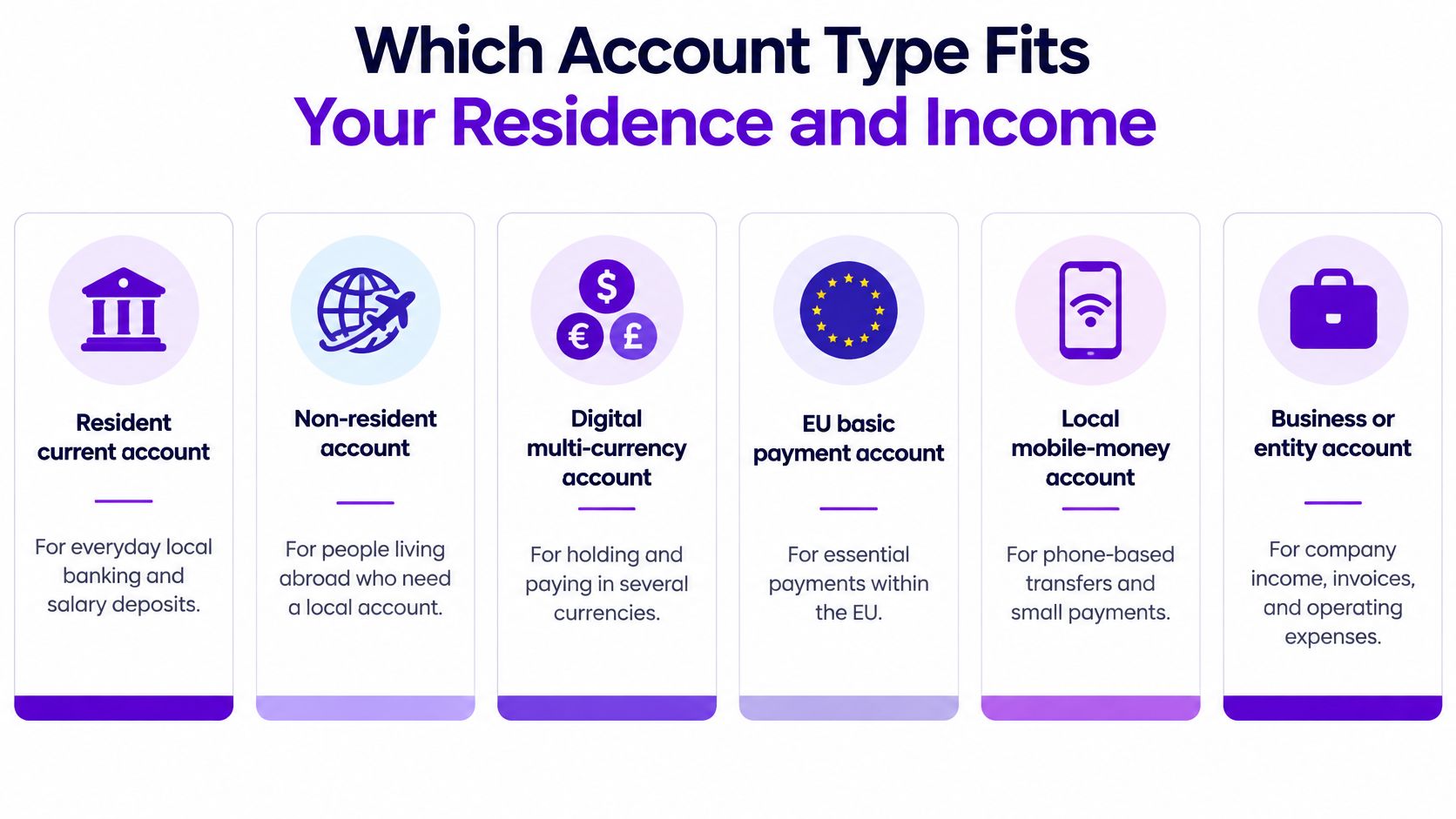
Expat account types at a glance
| Account type | Who usually qualifies | Strength | Limit |
|---|---|---|---|
| Resident current account | People with legal residence and a local address | Full local services, cards and direct debits | Needs residence proof and may require a branch visit |
| Non-resident account | Foreign residents without a local address | Keeps banking flexible across borders | Stricter verification, fewer products, possible higher fees |
| Digital multi-currency account | Freelancers and nomads paid in several currencies | Holds many currencies and converts them at low cost | Narrower credit; deposit protection depends on the provider's licence |
| EU basic payment account | Legally resident consumers in the EU | Right to essential payment services | No overdraft or premium features |
| Local mobile-money account | People where bank branches are scarce | Mobile access and low entry requirements | Limited cross-border and credit functions |
| Business or entity account | Founders with companies or holding structures | Separates business revenue from personal money | Detailed due diligence on owners |
Access itself isn't rare anymore. The World Bank's Global Findex 2021 found that 76% of adults worldwide held an account with a bank or another regulated provider, and 33% of adults in Sub-Saharan Africa had a mobile-money account in 2021. That doesn't mean every account gives you credit, cheap foreign exchange, deposit protection, or reliable cross-border payments.
Traditional Bank or Fintech Account
A traditional bank gives you branches, lending, mortgages, and fuller regulated protection. It's slower when you lack a local address, local credit history, or documents in the format staff expect. For a long stay, that friction is often worth paying once.
A fintech multi-currency account usually opens faster, holds several currencies, and converts at a lower spread. The trade-off is narrower credit, lower limits, and a provider that may hold a payment or e-money licence rather than a full banking licence. Check which licence applies, whether client funds are safeguarded, and which services are excluded before you route salary through it.
I would prioritise a traditional resident account if you are:
Staying long term: You need direct debits, a local salary account, and a track record for renting.
Borrowing locally: You want a mortgage, loan, or credit card assessed on local income.
Dealing with local institutions: Your employer, landlord, or tax office expects domestic account details.
I would prioritise a digital multi-currency account if you are:
Paid in several currencies: You invoice clients abroad and don't want forced conversion on receipt. If you're building that client base, remote openings beyond tech can help you find work that fits this income pattern.
Changing countries often: You need account details that survive a move.
Testing a market: You're a founder who needs payments working before committing to local incorporation and premises.
Practical rule: Choose the account that covers salary and daily card use first, then add a second account for currencies or savings.
Don't start with the cleverest setup. Start with the account that gets you paid and lets you pay rent without a workaround.
Documents Banks Require and Accepted Substitutes
Banks don't ask for documents to be difficult. They must verify identity, address, purpose of the account, and expected transaction activity before approval, and your profile is judged twice, once against local eligibility and again against the bank's own risk assessment.
Documents banks check and common substitutes
| Document | What the bank verifies | Substitute to ask about |
|---|---|---|
| Valid passport | Identity and nationality | National ID card, if the bank lists it as accepted |
| Residence permit or visa | Legal right to stay and open the account | Approval letter for a digital nomad visa or a residence certificate |
| Proof of address | Current residential address | Lease, utility bill or bank-issued address letter |
| Tax residence certificate or tax ID | Tax residence for reporting | Tax ID plus a signed self-certification |
| Source-of-funds evidence | Origin of income | Client contracts, invoices or payment platform statements |
| Expected activity explanation | Countries, currencies and transfer volumes | Written summary that matches your statements |
Why the Same Profile Gets Two Different Answers
In the EU, the European Commission guidance on access to bank accounts explains that the Payment Accounts Directive gives legally resident consumers a right to a basic payment account. Banks generally can't reject you solely because you live in another EU country. That right doesn't cover premium accounts, credit, overdrafts, investments, or unrestricted business banking.
A bank may still ask for evidence of a genuine connection to the country, such as employment, study, property ownership, or cross-border work. So separate essential payments from optional products. Secure salary, invoices, direct debits, and card payments first, then apply for extras after you've built a documented local profile.
Non-resident onboarding is more demanding because the bank must also verify beneficial ownership and expected activity without meeting you. If you're applying from the US system without the usual identifier, our guide to opening a bank account without an SSN covers that specific document problem.
Build One Evidence Folder
Keep certified copies and clean digital scans in one folder, named by document and date. Every substitute must match what you've declared. A lease in one name, a tax ID from a country you claim to have left, and invoices showing different expected volumes will trigger questions.
Send the pack complete on first submission. Piecemeal uploads create piecemeal reviews, and each new file can restart the clock.
How to Open an Account From Abroad Step by Step
Opening from abroad works when you treat it as a compliance submission, not a signup form. The sequence below keeps your declared facts consistent from first click to first transfer.
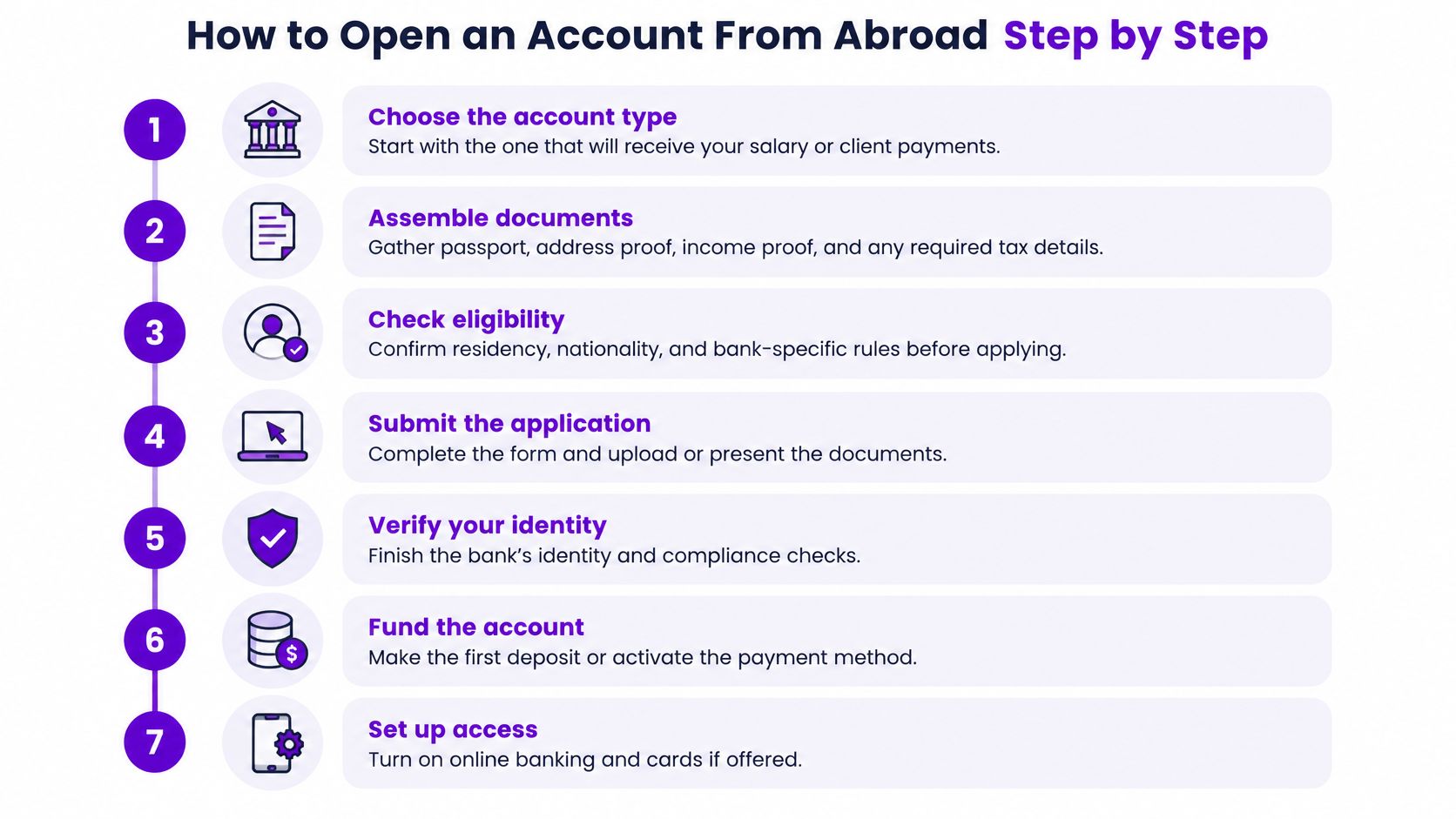
The Seven Steps
Choose the account type that will receive income first. Pick the account for salary or client payments before you optimise savings or currency features. If that account fails, everything else waits.
Assemble the evidence pack. Use the document list and check that every file shows the same name spelling, address, and residence dates. Rename scans clearly so a reviewer doesn't have to guess.
Check eligibility before applying. Ask the bank directly whether it accepts your nationality, residence status, temporary address, or digital residence document. The common slip is applying from a country the bank doesn't list for your profile, then treating the rejection as a mystery.
Apply with a consistent declaration. Your declared residence, device location, and expected countries should match. Mismatches between what you state and where you log in or spend trigger enhanced review, so don't declare one country while your daily activity clearly shows another.
Complete identity verification. This is usually a video call, document upload, or branch visit. Keep the reference number, date, and name of the process you completed, because support teams ask for them when an application stalls.
Make a small test transfer. Send a low amount from your home account and confirm it arrives with the expected sender details and fees deducted. Don't move rent money until you've seen one clean inbound payment.
Record limits and switch on alerts. Note the approval date, daily limits, card restrictions, and any conditions on incoming currencies. Then set balance and transaction alerts so you spot a hold or failed payment early.
What a Healthy New Account Looks Like
You're done when three things are true. Your card works for a normal local purchase, an incoming transfer has landed as expected, and the bank holds a documented residence date that matches your own records.
If you can't explain a payment in one sentence with a document to back it, don't send it through a brand new account.
That's especially true for a large first receipt from a new client in a new country. Send the test payment, keep the contract ready, and let the account build a normal pattern.
Fees and Transfer Routes That Cost the Least
You're not moving money in a niche system. The Bank for International Settlements commentary on international banking statistics reported banks' global cross-border claims at approximately $39 trillion at the end of the fourth quarter of 2023. You feel that system through correspondent banks, conversion, compliance checks, and timing differences on ordinary salary and invoice payments.
Transfer routes and their cost drivers
| Route | Main cost driver | Typical speed | Best use |
|---|---|---|---|
| Bank wire (SWIFT) | Sender and receiver fees, intermediary deductions and a marked-up rate | Often 1-5 business days | Larger one-off payments |
| Mid-market rate transfer service | Visible fee plus conversion close to the mid-market rate | Often same day to 2 days | Regular recurring transfers |
| Multi-currency account conversion | Conversion spread or fixed fee | Usually immediate | Holding and converting when the rate is favourable |
| Card spending abroad | Foreign transaction fee and card-network exchange rate | Immediate | Small everyday spending |
| ATM cash withdrawal | Withdrawal fee plus exchange markup | Immediate | Emergency cash only |
| Platform payout | Platform fee plus withdrawal exchange rate | Set by the platform's payout cycle | Freelancers paid through marketplaces |
The Three Cost Layers
Every route has up to three costs. There's the explicit fee you see, the exchange-rate markup you often don't, and, on international wires, intermediary deductions taken before money arrives. A free transfer with a poor rate can cost more than a paid transfer at a clean rate. Our guidance on how to avoid foreign transaction fees helps you separate those layers on card spending.
An Illustrative Monthly Invoice
Say you receive a 3,000 EUR monthly invoice payment to a home account, and this example is illustrative so you can repeat it with your own figures.
Bank wire markup: 3,000 EUR x 1.5% = 45 EUR per month, or 540 EUR a year.
Lower conversion spread: 3,000 EUR x 0.4% = 12 EUR per month, or 144 EUR a year.
Difference: 540 EUR minus 144 EUR = 396 EUR a year, before any fixed fees on either route.
Cross-border freelancers should factor transfer fees, currency conversion, withholding taxes and platform fees into the calculation before accepting a client's rate. Price the route into the quote, not after the invoice is overdue.
Convert in batches when the rate is favourable, route large receipts through the cheapest rail you trust, and keep card use for small everyday spending. Don't use ATMs abroad as your default currency conversion method.
Tax Residency and Reporting Rules That Shape Your Bank Choice
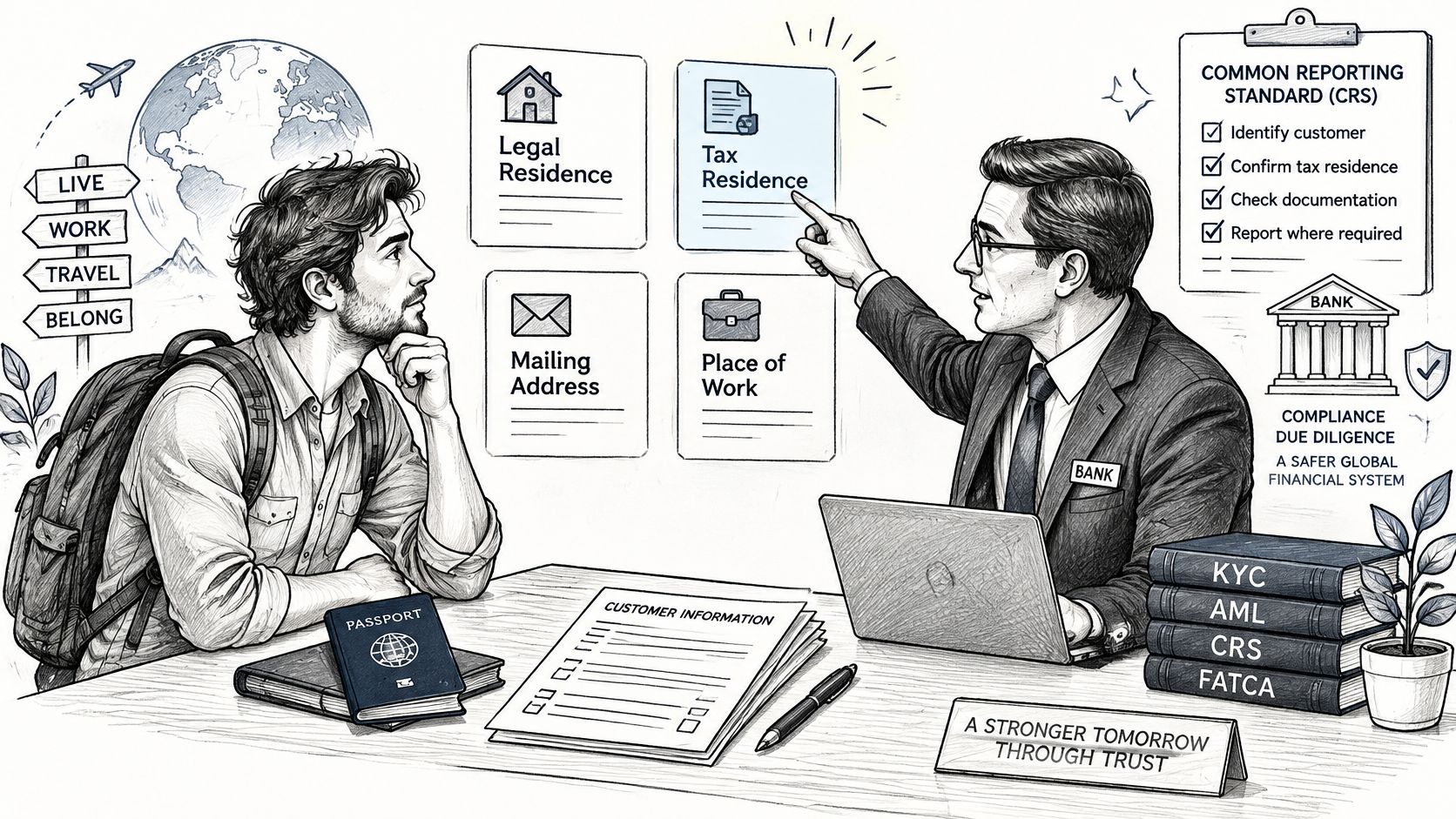
You land with a new lease, clients in another country, and a company registered somewhere else. The bank still has to pin down one fact before it decides what to report: your tax residence. Legal residence, tax residence, mailing address, and place of work can all differ. Reporting follows tax residence, not the city on your visa sticker.
The image below shows the conversation worth having before a move, not after a bank review letter arrives.
What Gets Reported
Under the OECD guidance notes on the Common Reporting Standard, participating financial institutions identify a customer's tax residence and report account information to their local tax authority, which can exchange it with the jurisdiction where you're tax resident. Reportable data can include your name, address, tax-residence jurisdiction, tax-identification number where applicable, date of birth, account number, year-end balance or value, and certain income amounts.
Entity accounts still sit inside those rules when an individual is a controlling person. That matters if you route revenue through a company or holding structure. Founders setting up in Europe should also watch tax mistakes when registering EU companies, because a badly recorded structure creates banking questions later. The same residence questions apply if you're investing while living abroad: investment accounts are identified and reported on tax residence too.
The video below is a useful primer to watch before you complete a self-certification in a new country.
A Workflow for When Countries Don't Line Up
When you change countries, update your self-certification promptly and keep the date you told each bank. A late update leaves the old jurisdiction on file while your activity already points somewhere else.
When you keep a home address but work abroad, decide which country you're tax resident in and write down the reason. The mailing address on the application is not that decision.
When you're a US citizen: Note that US citizenship can trigger FATCA reporting by your bank even when you're not tax resident in the United States.
Keep an evidence file with leases, visas, tax certificates, travel records, and a jurisdiction-by-jurisdiction register of residence dates, tax IDs, and entity control. Reconcile bank statements with your bookkeeping so reported income and declared income tell the same story. Banks check whether the documents, the self-certification, and the money movement agree. A gap is what triggers the review, not the brand on the account.
A borderless lifestyle doesn't remove geographic banking obligations. Mobility increases documentation rather than reducing it.
Get professional tax advice before you change residence or route business income through a new country. Incorrect or stale self-certification can produce reporting errors, account reviews, withholding issues, or penalties.
Account Rejections, Freezes and Fraud Precautions
A bank rejects or freezes an expat account when it cannot recognise a document, or when the name, address, tax residency and payment pattern on file do not describe the same person. A move adds evidence the bank will ask for. It does not relax the check.
You receive a client payment in a new city. The app flags the transfer. Compliance is comparing the counterparty, the country and your declared residence, not offering a different account type.
Rejections and restrictions: cause and response
| Symptom | Likely cause | Response |
|---|---|---|
| Automated verification fails | Unreadable scan or name spelled differently across documents | Resubmit clear scans and match the name exactly |
| Application stalls on address | Temporary address not accepted | Provide a lease or bank-issued address letter |
| Account restricted after a move | Declared residence no longer matches account activity | Update residence and self-certification with evidence |
| Transfers held for review | Unexpected counterparty or country | Send the contract and invoice that explain the payment |
| Access declined for visa-based applicant | Residence document expired or temporary | Provide the current permit or a renewal letter |
| Unauthorised transaction alert | Compromised login or card details | Freeze the card, change the password and call the bank on its verified number |
Start With the Most Common Causes
Check name spellings first. A middle name on a passport, missing on a lease and shortened on an invoice fails automated matching before anyone reads your income story.
Then check whether the address the bank holds is still one it will accept, and whether declared tax residency still matches where you log in, spend and receive money. A short stay that looks like a new residence, with no updated self-certification, is a common reason a previously open account goes into review. The fix is dated proof of where you are tax resident, not a second application at another bank.
Digital onboarding still applies stricter checks to non-standard profiles. A temporary permit usually means the bank wants the current permit or a renewal letter before it proceeds. A fast signup screen cannot override a document the institution does not recognise.
Fraud Precautions That Actually Matter
Never share one-time codes: A real bank does not need you to read a login code to a caller.
Check the domain before logging in: Type it yourself instead of following a link in a message.
Enable alerts: Turn on transaction and balance alerts for every account and card.
Keep a second contact method: Register a backup email or phone number you control while travelling.
Report fast: Freeze the card and call the verified number as soon as a transfer looks wrong.
If an account is frozen, use this order. First, request the written reason. Second, submit the full evidence pack in one batch: identity, address, current residence status and the contract or invoice behind any held payment. Third, ask for the review timeline and a named contact. Fourth, keep dated copies of every submission. Partial replies restart the same mismatch.
Choose Your Banking Setup Before You Move
You don't need five accounts. You need a setup that matches how long you'll stay, how you're paid, and whether money flows through a company. Pick a legal anchor account where you live or are tax resident, a multi-currency account for income and conversion, or both.
The Decision Rule
Staying 12 months or more in one country: Prioritise a resident account and document your address properly. You'll need it for rent, utilities, local salary, and a credible local footprint.
Moving every few months: Prioritise a digital multi-currency account and keep a home-country account open. Don't close the home account until the replacement has survived real income and real bills.
Running a company or holding structure: Add a business account and confirm controlling-person reporting before you open it. Mixing company revenue into a personal account creates tax and compliance problems that are tedious to unwind.
Mazurly's Travel section covers digital nomad visas, banking across borders, and international health insurance, so you can plan the visa and address evidence alongside the account rather than discovering a mismatch during onboarding.
Your Next Actions in Order
Map your residence dates. Write down where you've lived, where you're tax resident, and when each status changed.
Assemble the evidence pack. Build it once, with matching names, addresses, and source-of-funds documents.
Shortlist two providers. Compare their fee schedules on your real transfer amounts and frequency, not on a headline rate.
Apply in one batch. Submit a complete, consistent application and keep reference numbers.
Calendar a yearly review. Recheck tax residence, address, permit expiry, and account limits every year and after every move.
Confirmation test: The account should receive your income, pay your recurring bills, and produce statements that match your tax records.
If it fails any part of that test, it isn't your main account yet, whatever the app promises. Fix the failing part before you move, while you still have a working backup and time to answer a compliance team calmly. That's the difference between banking that supports a mobile life and banking that interrupts it.
Plan your move with practical guides on cross-border banking, visas, payments, and running a business from anywhere at Mazurly. Build your evidence pack, compare accounts on your real income pattern, and set up the account that will get you paid before you land.