
Invoicing for Consultants: A Practical Workflow

Table of contents
- What Belongs on a Consultant Invoice
- Build a complete invoice record
- Describe what the client accepted
- Rates and Payment Terms That Protect Cash Flow
- Match the fee to the work
- Calculate the floor before negotiating
- Price the wait for payment
- How to Invoice from Milestone to Cash
- Before delivery starts
- At acceptance and after submission
- Cross-Border Tax, Currency and E-Invoice Rules
- Resolve the jurisdiction before the document
- Agree on what you will actually receive
- When to Automate Consultant Invoicing
- Choose the channel before the software
- Keep a minimum viable billing system
- Mistakes That Keep Consultant Invoices Unpaid
- Remove approval friction
- Stop commercial gaps becoming collection arguments
- Lock Terms, Then Send the Invoice
- Run the final send check
Solo consultants typically bill only 40 to 60% of their working time; prospecting, invoicing, admin and unpaid revisions absorb the rest. When a client pays late, that thin margin disappears fast, and an overdue invoice can mean financing the project out of personal savings.
Good invoicing for consultants starts before the invoice exists. Pick the pricing model that protects the work against its biggest uncertainty: hourly billing where scope is unstable, a fixed price when both sides can define the result, a monthly retainer for repeating needs, value-based fees where the client buys an outcome. Where the client's actions drive much of the result, separate the delivery fee from any performance bonus and never present an uncertain gain as guaranteed. Agree what triggers payment, then treat cross-border billing as a compliance decision rather than a nicer PDF.
What Belongs on a Consultant Invoice
A few client invoices may fund your entire operating month. A missing purchase-order number or incorrect legal entity isn't a formatting nit: it can leave an otherwise valid bill waiting for someone to identify its owner.
Build your invoice around what the client's accounts-payable team needs to approve, record, and pay it. Your contact may understand the project perfectly, but the person releasing payment may never have heard of you.
Build a complete invoice record
Use the following as a drafting checklist, not a substitute for jurisdiction-specific invoice requirements. Add registration numbers, tax identifiers, or other mandatory disclosures where the applicable rules require them.
Consultant invoice fields and what to write
| Field | Example | Why it matters |
|---|---|---|
| Legal entity | Registered consultant name, not a nickname | Must match the contract and tax identity |
| Client name and address | Legal entity on the proposal | A wrong entity sits in the wrong AP queue |
| Invoice number | Unique identifier from your invoice register | Needed for receipts, disputes, and credit notes |
| Issue date and service period | Acceptance date; work from project start through acceptance | Supports the tax point and the milestone |
| Due date | Calendar date calculated from the agreed payment term | Starts the reminder clock |
| Currency | USD, EUR, or GBP, as agreed | Stops a silent conversion dispute |
| Purchase order | Client PO when they require one | Portals may reject invoices without it |
| Description | Milestone or hours in plain language | Vague lines become disputes |
| Quantity and rate | Approved hours times agreed rate, or an accepted milestone | Ties the bill to the pricing model |
| Tax | Amount, reverse-charge wording, or applicable not-charged explanation | Missing tax data stalls approval |
| Total and payment details | Amount due plus bank details or payment link | Client can pay without another email |
| Late-payment note | Remedy already in the contract | Don't invent a new penalty on the invoice |
Show the subtotal, applicable tax, and total separately. Don't use a zero-tax entry as a catch-all for situations you haven't checked. An exemption, reverse charge, and a service outside the scope of a tax aren't interchangeable explanations.
Describe what the client accepted
Use a description that connects directly to the proposal, approved timesheet, or acceptance email. These adaptable lines make the billing basis visible:
Hourly: Analytics troubleshooting, approved hours during the stated service period, billed at the contracted hourly rate.
Fixed price: Tracking-plan implementation, accepted milestone, completion evidence attached.
Retainer: Reserved monitoring capacity for the billing month, including the agreed report and advisory allocation.
Avoid descriptions such as consulting services rendered when a more specific description is available. They force the approver to reconstruct the work from email.
Before sending, compare the draft against the signed proposal and vendor-registration record. Check the client entity, billing unit, tax treatment, payment destination, and acceptance evidence together. A polished invoice with the wrong commercial details is still the wrong invoice.
Rates and Payment Terms That Protect Cash Flow
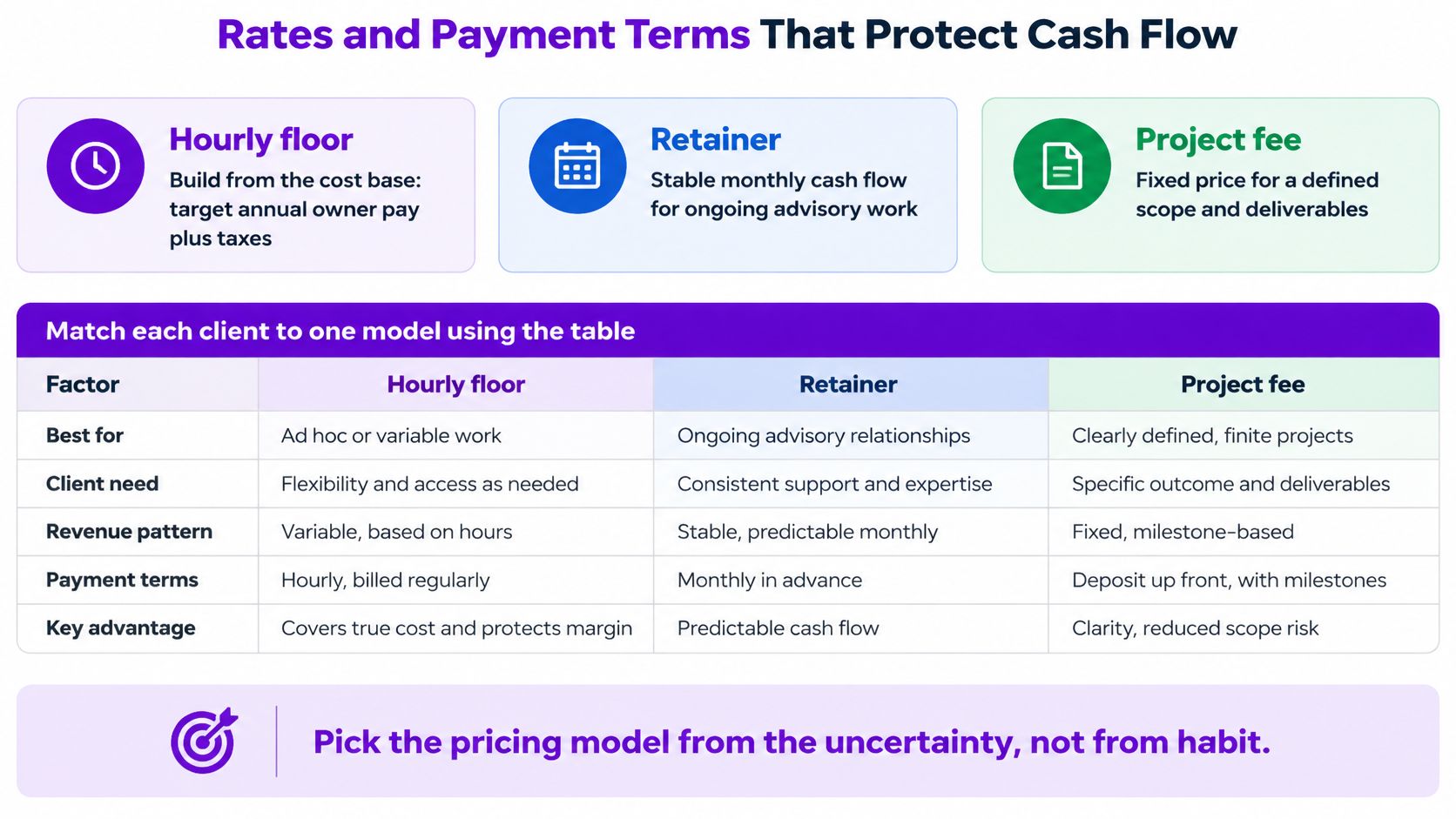
Pick the pricing model from the uncertainty, not from habit. If you can't define the finished result, don't commit to an implementation fee that assumes you can.
Hourly work transfers scope risk to the buyer, but creates budget uncertainty for them. Fixed fees give buyers certainty while leaving you responsible for estimation errors. Retainers support predictable capacity only when the client isn't buying unlimited access.
Match the fee to the work
Which consultant pricing model fits the work
Match each client to one model using the table.
| Model | Use when | Protect it with |
|---|---|---|
| Hourly | Scope is unstable, diagnostic, advisory, or client-controlled | Minimum booking, availability window, written OK past the estimate |
| Fixed price | Both sides can define the finished result | Internal hour estimate, risk margin, scope limits, revision cap, milestones |
| Monthly retainer | Needs repeat and capacity is predictable | Named deliverables, unused-capacity rule, request deadline, out-of-scope rate |
| Value-based | Client is buying a measurable result | Fee kept separate from results the client controls; no guaranteed upside |
Hourly floor means building from the cost base: target annual owner pay plus taxes and operating costs. A retainer supports stable monthly cash flow for ongoing advisory work. A project fee provides a fixed price for a defined scope and deliverables.
One client can move between models as the work changes. Diagnose an unclear analytics problem hourly, quote the agreed implementation at a fixed price, then reserve monitoring capacity through a retainer. Separate a performance bonus from delivery fees when the client's decisions drive much of the outcome.
Calculate the floor before negotiating
Our minimum viable rate calculation is:
Annual owner pay + taxes, insurance, software, equipment, training, unpaid leave, and overheads ÷ realistic billable hours.
We plan with 40 to 60% utilisation, meaning the share of available working time spent on paid delivery. Prospecting, proposals, invoicing, training, and leave still need funding, even though you can't put them on a client's timesheet. Use our guide to pricing freelance services to turn that floor into a consistent pricing grid.
For fixed work, estimate delivery hours internally and add a documented risk margin. The floor tells you what you need to survive; it doesn't establish the value of the engagement.
Price the wait for payment
Atradius's U.S. payment-practices report reported overdue invoices affecting 43% of credit-based B2B sales and average payment terms of 45 days from invoicing. Those are business-credit figures, not a forecast for your consultancy, but they show why payment timing belongs in commercial decisions.
Multiply each invoice by your estimated probability of on-time payment to estimate expected on-time receipts. Then move anticipated receipts later in your cash forecast and check whether you can still cover obligations. That calculation isn't a replacement for a full collection forecast.
Commercial rule: If you can't finance the client's payment cycle, negotiate a deposit or staged billing instead of quietly accepting the exposure.
Use contract wording that specifies the payment deadline, notice procedure, and right to pause undisputed overdue work. Have local counsel review interest, penalties, and suspension rights before relying on them.
How to Invoice from Milestone to Cash
A payment term doesn't manage itself. The UK government's late-payment executive summary found that 30-day terms were standard for 54% of businesses with business customers. Your workflow still needs an owner, a trigger, and a next action when payment doesn't arrive.
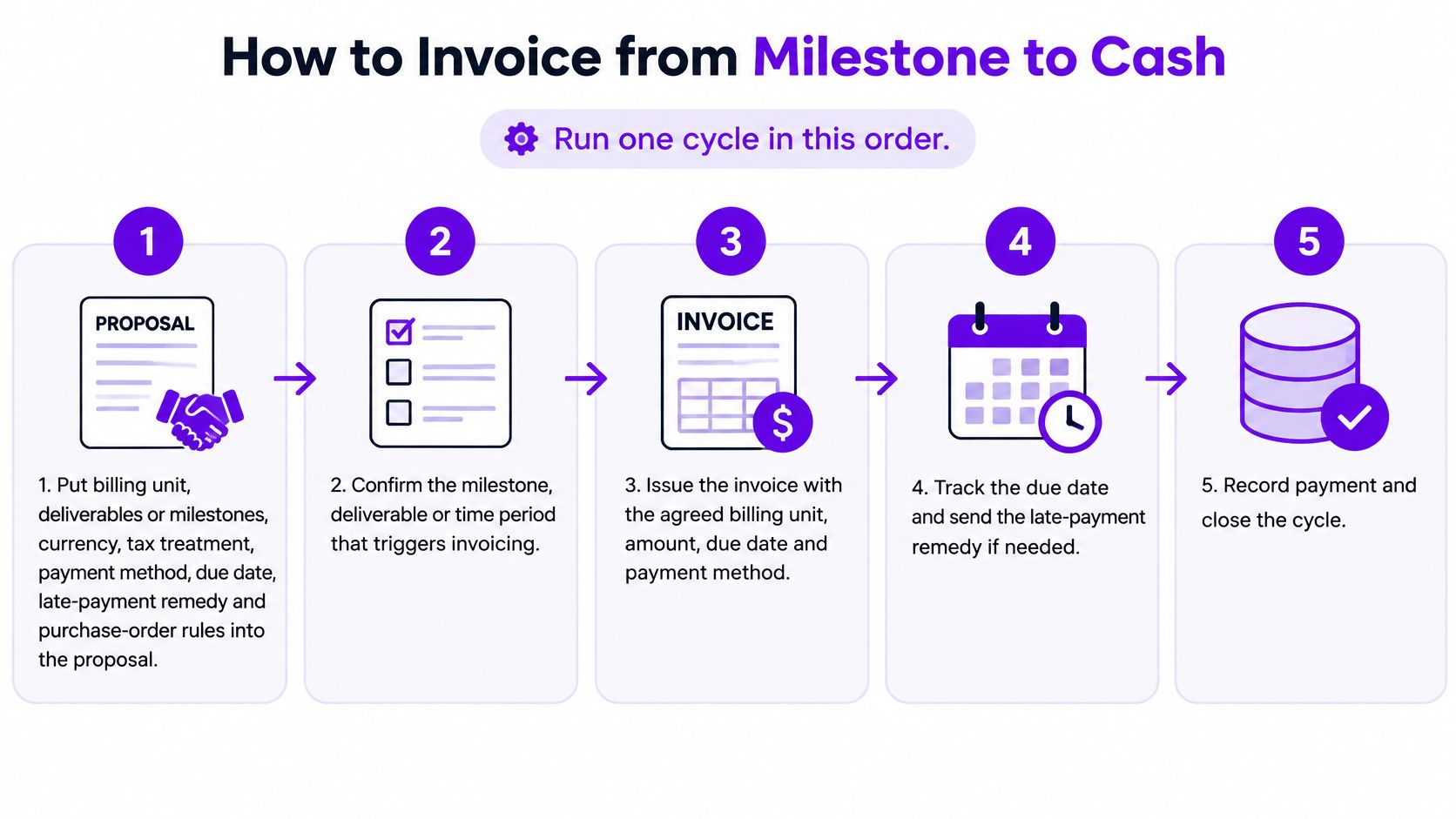
Run one cycle in this order, from commercial agreement through reconciliation.
Before delivery starts
Put the payment agreement in writing. Include the billing unit, deliverables, currency, tax treatment, payment method, due date, late-payment remedy, and purchase-order rules in the proposal or contract. Resolve contradictions between your proposal and the client's procurement terms before beginning.
Verify the buyer and payment contact. Confirm the client's legal entity and accounts-payable address, not just your project sponsor's details. Our client onboarding checklist helps make this part of setup rather than an urgent task after delivery.
Control exposure on unfamiliar clients. Request a deposit or use accepted, billable milestones for new or financially uncertain buyers. A deposit reduces exposure but may create procurement friction, so discuss it before the client approves the engagement.
Keep fixed-price controls beside the billing record. Store precise scope limits, revision limits, dependencies, and payment milestones together. If client feedback arrives late or a dependency fails, you need the agreed consequences available without reconstructing the negotiation.
At acceptance and after submission
Invoice when the billing trigger occurs. Issue the invoice when the milestone is accepted or the agreed billing period closes. Attach the acceptance email or approved time record so accounts payable can match the charge to evidence.
Make payment executable. Include a usable electronic payment method and confirm any vendor-setup requirements. A bank account on the invoice won't help if the buyer still needs to approve you as a supplier.
Schedule reminders around the due date. Send a reminder before it, on it, and at fixed escalation points afterward. Include the invoice identifier, amount, due date, and a direct request to flag processing problems.
Maintain a receivables ledger. Record invoice age, promised payment date, dispute status, and next action. A promise to pay isn't a receipt, so keep the invoice open until funds are reconciled.
Separate disputed and undisputed amounts. Ask the client to identify the specific disputed line and reason. Request payment of the undisputed balance while you resolve the remainder, using a credit note or correction where appropriate.
Apply the agreed work-pause procedure. Don't automatically begin the next milestone while an earlier invoice is materially overdue. Follow the contract's notice and suspension conditions rather than announcing a new rule during collection.
Reconcile receipts daily. Match payments to invoice identifiers and investigate short payments, deductions, or bank fees. Don't mark an invoice paid merely because a client sent a transfer screenshot.
Close the evidence file. Keep the contract, customer-location evidence, conversion basis, tax support, accepted invoice, and payment confirmation under the invoice identifier.
Before closing an accepted milestone, check that the invoice was delivered successfully, its due date is in the ledger, and someone owns the next action.
Cross-Border Tax, Currency and E-Invoice Rules
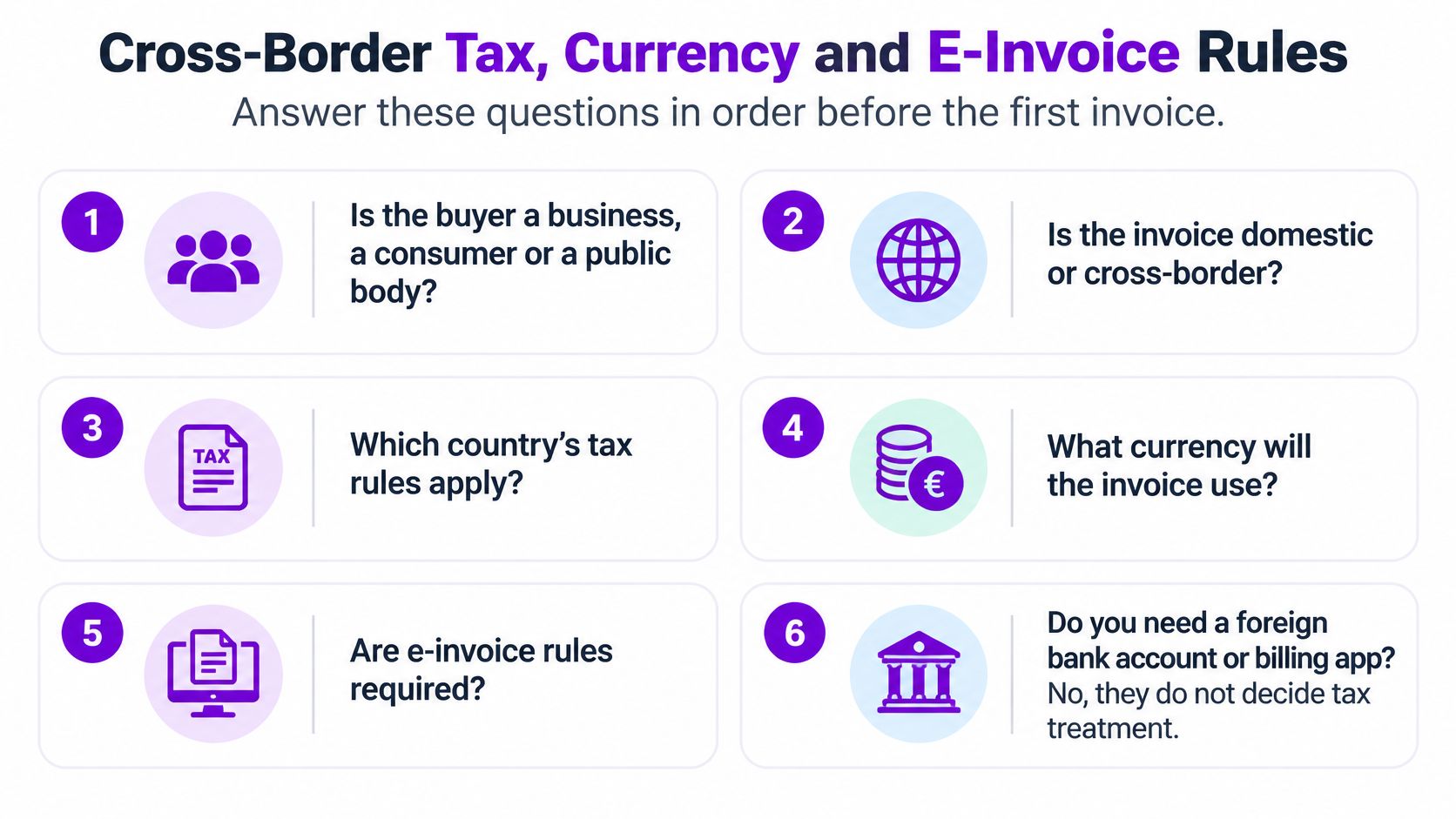
A foreign bank account doesn't decide tax treatment. Neither does the billing app you use. A cross-border invoice requires decisions about the supplier, buyer, service, applicable rules, and submission method.
For example, Qvalia's e-invoicing compliance update describes Germany's requirement for businesses to be able to receive compliant structured e-invoices from January 1, 2025. A receiving requirement isn't the same as a universal requirement for every overseas consultant to issue that format, so establish the scope before changing your process.
Resolve the jurisdiction before the document
Identify the buyer and supply. Is the customer a business, consumer, or public body? Establish the customer's location and the service classification rather than assuming that remote delivery automatically makes the service an export. Keep the contract and customer-status evidence.
Distinguish clearance from delivery. Does an applicable system require authority validation before the invoice is valid, or does it require a structured file delivered through an accepted channel? Ask the client's procurement team for its submission specification, then verify legal obligations separately.
Determine the invoice disclosures. Confirm which legal entity, tax number, tax explanation, currency, and exchange-rate basis belong on the document. If you're uncertain about place-of-supply or withholding treatment, resolve the actual transaction with a qualified tax adviser before issuing it.
Preserve evidence of supply. Keep the statement of work, client-location records, relevant time records, and milestone acceptance. These documents should explain what you supplied, to whom, and where the applicable rules treat it as supplied.
Confirm the accepted file. Establish whether the client needs a PDF, portal submission, or structured e-invoice. Save the submitted file and its acceptance or rejection response, not just the human-readable preview.
Agree on what you will actually receive
Choose one invoice currency and distinguish it from your bookkeeping currency. Store the exchange-rate source and relevant date with the transaction when conversion is required.
Before accepting a cross-border rate, account for transfer fees, currency conversion, withholding taxes, and platform fees. Clarify who bears bank charges and whether the client expects to deduct withholding. A fee can look profitable until the amount reaching your account is lower than the agreed commercial expectation.
Compare receiving methods using our international banking guide, but keep payment routing separate from the tax decision. A convenient receiving account doesn't establish where your business owes tax.
Finish with an invoice-specific evidence folder. It should contain the contract, tax decision support, accepted file, conversion record, and eventual payment confirmation. That makes a later client query or tax review a document check rather than an email search.
When to Automate Consultant Invoicing
Don't automate a format the client will reject. Earlier European Commission analysis of electronic invoicing reported that 42% of large enterprises sent or received e-invoices, compared with 22% of small and medium-sized enterprises. Treat those as historical adoption figures, not current coverage or proof that a particular buyer accepts your file.
Choose the submission channel by client, then automate the repeatable work around it. Buying a broader system won't remove a buyer's portal requirements.
Choose the channel before the software
PDF, portal, or structured e-invoice
| Path | Use when | Main risk |
|---|---|---|
| PDF by email | Low volume and the client accepts a PDF | Procurement or a mandate rejects it |
| Client portal | A large buyer dictates how invoices are submitted | Duplicate entry and portal downtime |
| Structured e-invoice | The country or client requires a structured file | Mapping errors, rejected invoices, credit-note delays |
| Accounting export | Books already live in one ledger | Tax fields mapped wrong on the way out |
A PDF is straightforward to inspect and archive. A portal may provide submission status, but you'll need to reconcile that status with your own ledger. Structured delivery requires testing identifiers, tax codes, corrections, and acknowledgements, not just generating a file.
A Vertex global e-invoicing survey release reported that 80% of surveyed global business leaders planned to improve system integration over the following two years. Integration is ongoing work, so include maintenance and recovery effort in the business case.
Keep a minimum viable billing system
Maintain a single numbering sequence and a receivables list with invoice age, promised payment date, dispute flag, and next action. Keep offline copies of contracts, issued invoices, and payment evidence, plus an approved alternative submission route where the client permits one.
Track days sales outstanding, overdue share, disputed value, and bad-debt exposure by client. Use automated reminders for routine follow-up, but handle the first broken payment promise personally.
For a PDF-accepting client, our Free Invoice Generator offers a draft without a new subscription:
Enter the parties and dates. Add registered business details, the client's legal name and address, invoice identifier, currency, service period, and due date.
Add the billing lines. Use accepted milestones or approved hours at the contracted rate.
Complete the commercial details. Include the applicable tax explanation, payment information, and contractual late-payment note.
Save and reconcile. File the invoice and map its total, tax, and currency into your bookkeeping ledger.
Information entered into our tools, including invoice details and client names, stays on your local device and isn't sent to a server, third party, or external service.
If you use AI to help draft descriptions or review administrative checklists, BromeAI's guide to combining models in an AI workspace provides context for organising that workflow. Keep tax decisions, bank-detail verification, and final invoice approval under human control.
Mistakes That Keep Consultant Invoices Unpaid
An invoice can be mathematically correct and still be difficult to approve. The useful test isn't whether it looks professional. It's whether the buyer can match it to an authorised purchase without asking you to explain it.
Check for these failure points before blaming the client's payment process.
Remove approval friction
Vague acceptance criteria: Define an observable finished result in the proposal. Approval shouldn't depend on whether someone feels the work is complete.
Month-end batching: Bill at the agreed trigger instead of allowing administrative habit to postpone submission.
Missing vendor information: Block sending until tax details and purchase-order data match the client's supplier record.
Untraceable submission: Save the portal receipt or delivery acknowledgement so you can distinguish an unpaid invoice from an undelivered one.
Unexplained short payments: Request a remittance breakdown before treating a deduction as a discount you agreed to give.
Stop commercial gaps becoming collection arguments
Unlimited retainers: Specify reserved capacity, request deadlines, and the rate or approval process for overflow.
Guaranteed upside in value-based work: Separate your delivery commitment from commercial outcomes the client controls.
Assumed payment timing: Forecast from each client's actual behaviour rather than treating the written term as a guaranteed receipt date.
Platform dependence: Retain usable records and an agreed recovery route so an outage doesn't erase your billing position.
Unapproved bank-detail changes: Verify changes through a known contact channel before relying on new payment instructions.
Review priority: Fix the mistake that delayed the most cash, not the cosmetic issue that's easiest to notice.
For disputed balances and work pauses, check that the agreed procedure was followed rather than starting another collection thread. For international work, check that the tax decision and currency treatment were documented before submission.
Review a small batch of recently issued invoices. Mark where each one stalled, identify who needed what information, and change the relevant proposal field, vendor record, or sending check. Adding another reminder won't solve an invoice the buyer can't approve.
Lock Terms, Then Send the Invoice
Take the next accepted piece of work and reopen its proposal. Confirm the billing unit, currency, tax explanation, payment deadline, and late-payment remedy. If any term is missing, resolve it before sending another bill.
Keep your pricing grid on a single page. Review it each quarter and whenever costs, workload, tax obligations, or clientele change.
Run the final send check
Match the agreement: Use the contracted entity, billing basis, and accepted milestone description.
Confirm delivery: Send through the client's approved channel and retain its acknowledgement.
Assign follow-up: Enter the due date and next action in the receivables list.
File the evidence: Store the contract and invoice together, then add payment proof when received.
For sensitive documents shared outside a procurement system, PDFWix explains how to secure PDFs with AES-256 encryption. Confirm that the recipient can process an encrypted attachment, and share the password separately.
Send the invoice when acceptance triggers billing. Keep everything under its invoice identifier so the next query has a clear answer.
Mazurly offers a Free Invoice Generator and practical guidance for pricing, payments, and cross-border business administration. Visit Mazurly to draft your next consultant invoice, then use the agreed submission channel and record its due date before returning to delivery.