
Travel Insurance for Expats: What Covers You in 2026

Table of contents
- Must-Have Coverages Every Expat Policy Needs
- Where cheap policies usually break
- Is a Trip Policy Still Enough for You?
- Trip Policies and Expat Health Plans Side by Side
- Three rows that surprise people
- Exclusions and Evacuation Rules That Void Claims
- Evacuation is a logistics benefit
- How to File a Claim Without Losing Money
- Country Rules That Change Your Cover
- What a European card actually buys
- Expat Scenarios and Which Policy Fits
- A three-week conference in Spain
- Six months in Lisbon with asthma
- A year in Bali and a stolen work laptop
- Choose Your Cover Before Your Next Move
You booked the apartment, told your clients you will be online from another time zone, and last summer's travel policy is still in your inbox. It felt solid when the trip was ten days. It feels thinner now that the return date keeps moving.
That gap is where people lose money. Travel insurance for expats is built for a sudden illness, a leg you cannot finish, a lost bag, and an emergency flight home. It is not a stand-in for the doctor you see every month, the inhaler you refill, or a year of living in one city. Mix those up and the claim you need most is the one the wording never promised.
Say you twist an ankle in week two. A holiday policy may pay the emergency room. Say that ankle needs physio every week for three months, or your blood pressure medicine runs out. That is a different product. The pages below separate the two, using days abroad, residence, home-country eligibility, and the kind of care you use day to day.
Must-Have Coverages Every Expat Policy Needs
Travel insurance for expats is emergency-focused cover for people who live or work abroad. You buy it per trip or per year, and it is built around the risks that hit hardest away from home.
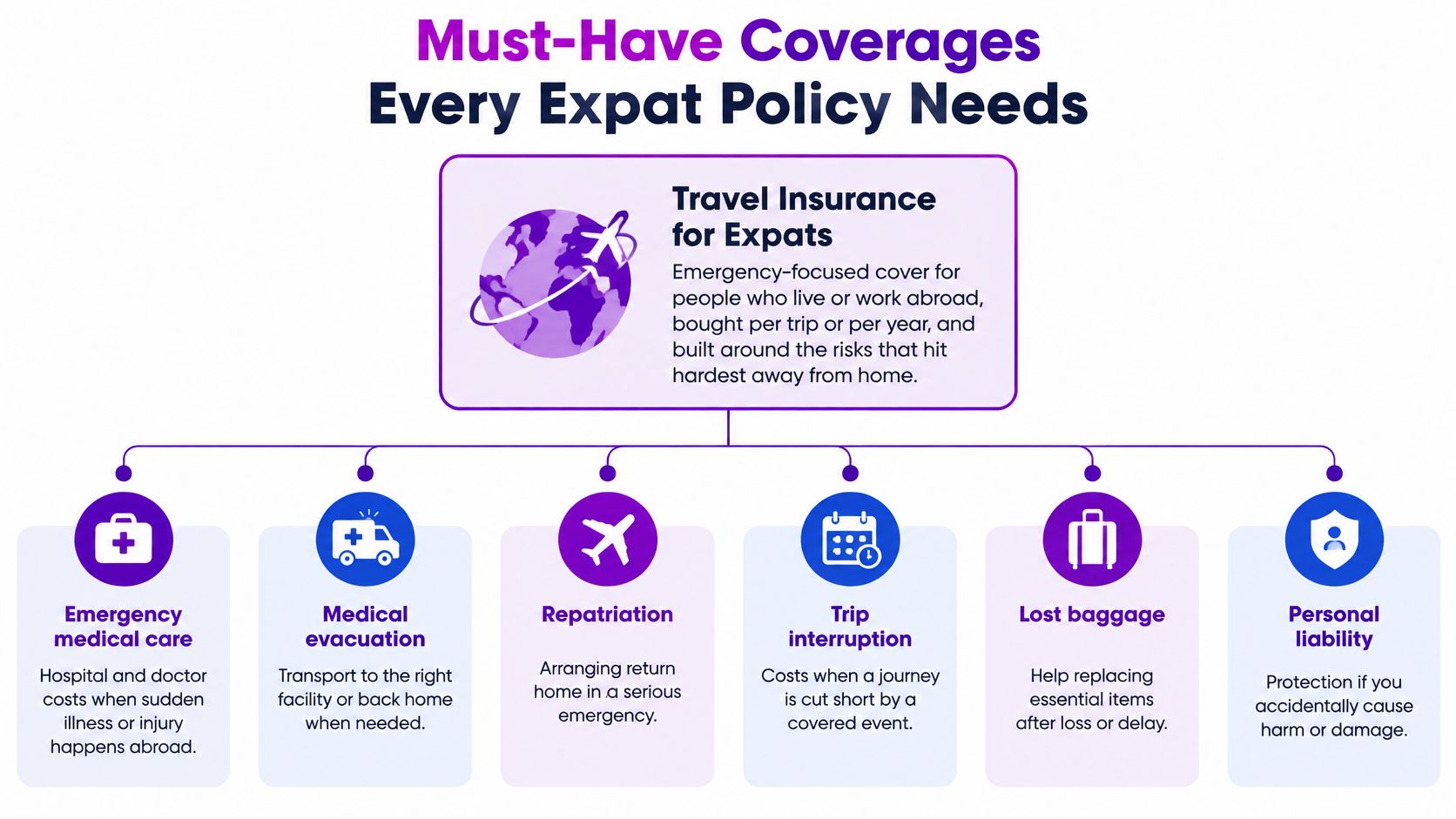
Read the schedule against this list before you compare prices. A missing row is not a small gap. It is the bill you will pay yourself.
| Coverage | What it pays for | Minimum to check | Why it matters |
|---|---|---|---|
| Emergency medical treatment | Hospital care, surgery and emergency doctor visits abroad | At least $100,000 for the policy term | Private hospitals abroad can bill well above home rates |
| Emergency evacuation and repatriation | Air ambulance to an adequate facility or back to your home country | Unlimited, or at least $250,000 | Evacuation alone can cost $20,000 to $200,000 or more |
| Trip interruption | Non-refundable costs if a covered illness forces an early return | Covers flights, rent and prepaid bookings | Cuts losses when a medical event ends a stay early |
| Baggage and personal property | Lost, stolen or damaged belongings | A per-item cap that fits your laptop and phone | Electronics are often capped below replacement value |
| Personal liability | Injury or damage you cause to other people | At least $100,000 | Covers legal costs if a claim is brought in another country |
| Travel delay | Meals and lodging after a long delay | Trigger point of 6 to 12 hours | Reimburses extra costs when transport fails |
| 24/7 emergency assistance | Referrals, translation, hospital coordination and direct billing | Available in your language, with direct billing | Speeds up care and avoids paying upfront |
Where cheap policies usually break
Three rows cause most of the regret on a long stay.
Emergency medical treatment pays the hospital, the surgeon, and the emergency doctor. Look for at least $100,000 for the policy term, not a small per-visit cap. An annual maximum matters as much as any single-claim limit, because several bills can stack under one ceiling before you fly home.
Emergency evacuation and repatriation is the row that changes the math. The U.S. Department of State states that an air-ambulance evacuation to the United States can cost between $20,000 and $200,000, depending on location and medical condition, and warns that evacuation costs may exceed $250,000 in some circumstances. The U.S. government does not pay those hospital bills or private evacuation expenses. Ask whether the evacuation limit is separate from the medical maximum, or shared with it.
Baggage and personal property looks fine until you hit the per-item cap. A laptop or phone often sits under a cap well below what it costs to replace. If the schedule pays $500 per item and the machine cost more, the difference is yours.
Liability, delay, and the assistance line still deserve a pass. Liability is what answers a claim brought against you in another country's courts. Delay only starts after the hours printed on the schedule, often 6 to 12 hours. Assistance is the team that finds a hospital, translates, and, when the plan allows it, arranges direct billing so you are not funding care on a credit card.
Practical rule: Find each row named in the policy wording, not only in the marketing summary. If the wording is silent, you don't have that benefit.
Is a Trip Policy Still Enough for You?
A trip policy is a rental car sized for a holiday. Living abroad is closer to owning the car. The wear is different, the paperwork is different, and the roadside plan from the rental desk will not cover a year of driving.

Run these four tests in order. The first one you fail is the one that should change the product you buy.
Days abroad. Add up every night you expect to be outside your home country over the next year, including the hops between cities. A trip contract is written for a planned journey with an end date. If your calendar is already longer than the maximum trip length on the schedule, the policy can expire while you are still paying rent. Remote workers who move every few weeks often fail this test without noticing, because no single booking looks long.
Residence status. A visitor, a visa holder, and a tax resident are not the same person to an insurer. Once a country treats you as living there, a "trip" may no longer exist in the wording. Check the eligibility lines for nationality, country of residence, and whether remote work is allowed. Verdict: if you hold a residence permit, or you are about to, don't assume a holiday contract still fits.
Home-country eligibility. Some home health plans keep paying abroad only if you stay enrolled at home. Others stop the moment care happens overseas. Call the home insurer and ask two questions. Will you still be eligible after this move, and will they pay anything for treatment outside the home country? Verdict: if the home plan goes quiet abroad, a travel add-on cannot rebuild it.
Type of care. List what you will use. Emergency rooms are one list. Monthly prescriptions, check-ups, maternity care, and mental-health visits are another. Trip contracts are built for the first list. Verdict: if any item on your list is routine, the trip policy fails this test even when the dates still fit.
If the stay is open-ended, or you need any routine care, an expat health plan is the right starting point. A holiday premium is not a discount on the wrong product.
One extra check sits inside test three. Some overseas medical benefits are secondary, which means the insurer wants the home plan to pay, or to decline, before it looks at the bill. That delay is painful when the home plan excludes foreign treatment.
Trip Policies and Expat Health Plans Side by Side
A cheap holiday policy can cover a catastrophic night in hospital and still leave the predictable care of a long stay uninsured. That is the cost trap. You save on the premium, then pay the prescriptions, the follow-up visits, and the check-ups yourself. International private medical costs are also climbing. A 2025 global medical trend report placed expatriate medical-cost increases at roughly 9.25% to 12% globally, with some locations reaching 14%, as noted in MarketWatch's guide to travel insurance for digital nomads.
| Criteria | Trip policy | Expat health plan |
|---|---|---|
| Maximum duration | Usually one trip, often capped around six months | Renewable, typically on a 12-month term |
| Routine care and check-ups | Usually excluded | Usually included, often with a co-payment |
| Prescriptions | Excluded or limited to emergencies | Usually included for ongoing conditions |
| Pre-existing conditions | Often excluded or limited | Covered after a waiting period, depending on the plan |
| Primary or secondary | Often secondary, paying after your home insurer | Usually primary, paying directly |
| Direct billing | Limited, often reimbursement only | Common through a provider network |
| Emergency evacuation | Included, with set limits | Included, often at higher limits |
| Typical cost | Low, priced per trip | Higher, priced by age, region and cover level |
Three rows that surprise people
Maximum duration is a product boundary, not a suggestion. The U.S. National Association of Insurance Commissioners defines travel insurance as protection for risks associated with planned travel and explicitly excludes major-medical policies for people working or residing overseas, including trips longer than six months. A digital nomad who stays past that cap, changes countries on repeat, or needs routine outpatient care is outside what a trip contract is for.
Routine care and prescriptions are where a long stay spends money. A trip policy may pay the night you are admitted and refuse the inhaler refill the next month. An expat health plan is priced to include that ongoing care, usually with a co-payment, and it renews on a term you can match to a visa.
Primary or secondary status decides who pays first. NAIC reporting separates emergency medical and dental policies into primary and excess, or secondary, categories. A secondary policy may require you to submit the claim first to domestic health insurance, Medicare, or another payer. If the home plan excludes overseas treatment, you wait for a denial and you may still have a gap.
Direct billing, evacuation limits, and price follow from those three. A low trip premium is real, and so is the higher price of a plan built by age, region, and cover level. Before you compare those premiums, get three answers in writing. The duration must cover the whole residence. The pre-existing wording must match your history. The policy must say whether it is primary or excess. A premium comparison only means something once those three match. While you wait on that letter, also note deductibles, coinsurance, the annual maximum, and whether remote work is an eligible reason to be abroad.
Exclusions and Evacuation Rules That Void Claims
The denial that stings most is usually a pre-existing condition, not a missing receipt. Insurers look back over a set period, often months, and treat a condition as pre-existing if you had symptoms, medication, or advice in that window. People assume "I felt fine on the plane" is the test. The look-back is the test.
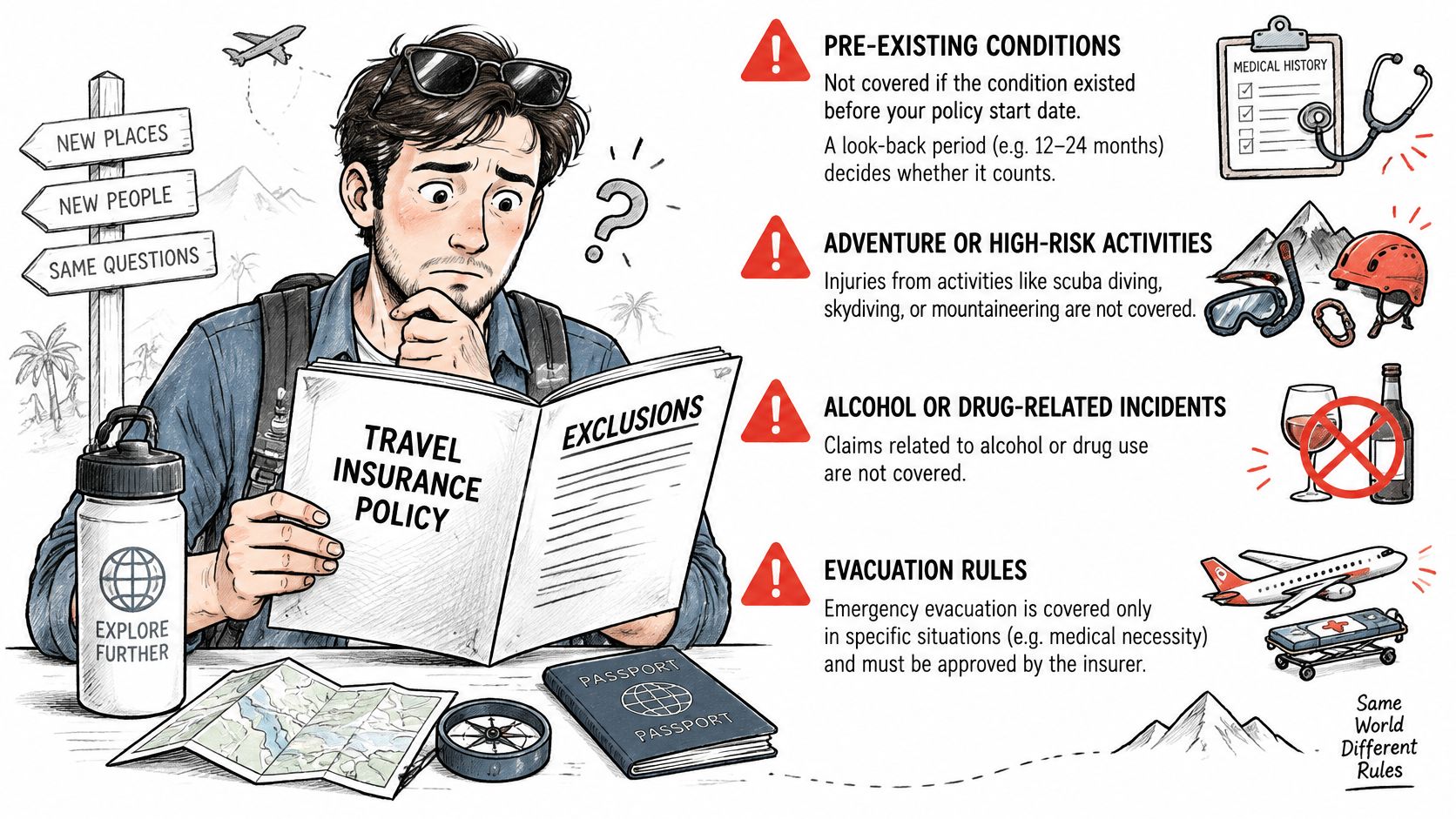
Read these before you rely on the certificate.
Pre-existing conditions. A look-back period decides whether a condition counts, even if you have not had a formal diagnosis.
Routine, planned, or elective care. Check-ups, scheduled surgery, and dental cleanings sit outside emergency wording.
Adventure sports. Diving, climbing, and skiing need a rider on many contracts. Without it, the injury is excluded.
Alcohol-related incidents. A fall after drinking can wipe out an otherwise valid medical claim.
Pandemics. Some wordings stop paying when the insurer, or a government, has already issued an advisory.
War and political unrest. Injury tied to unrest, even as a bystander, is a common exclusion.
Work-linked losses. Equipment and liability tied to your job are often outside a personal travel contract.
The call that prevents the pre-existing denial is a boring one. Before you buy, list diagnoses, medicines, and the last time you saw a doctor for each, then ask the insurer to confirm in writing what the look-back will do with that list. A waiver you don't have in writing is not a waiver.
Evacuation is a logistics benefit
Cover doesn't start at the hospital door. NAIC guidance on travel insurance describes evacuation as transportation to the nearest appropriate or adequately equipped medical facility, with onward transport home only when medically warranted. Standard U.S. health insurance commonly doesn't cover overseas repatriation or transport to an appropriate facility. The same guidance notes that many countries, including most EU countries, may require proof of medical insurance for a visa.
A serious injury on an island, or in a town with a small hospital, can need a staffed aircraft. A policy that only reimburses the local hospital leaves that flight uninsured. Check four things in the wording. Does the assistance center arrange the flight, or do you pay and claim later? Who picks the receiving hospital? Is a companion's seat included? Does repatriation need approval before anyone moves you?
This short walk-through shows how evacuation benefits are triggered, and why skipping the assistance line is a common reason a transport bill comes back unpaid.
Many refusals come from self-transport. You took a taxi to a bigger city, or a relative booked a commercial flight, and nobody called the assistance number first. If the wording requires that call, the insurer can decline the whole transport cost even when the injury was covered.
For a visa file, the certificate should state valid dates, geographic scope, emergency medical limits, and evacuation or repatriation. A line that only says "travel insurance" is weaker than a certificate that names those four items. Match the dates to the visa, not to the week you happen to fly.
How to File a Claim Without Losing Money
A claim is a file you build while you are tired, in a language you may not speak well. Insurers pay on paper, not on how bad the week felt. The order below is the one that keeps money from leaking out of an otherwise valid loss.
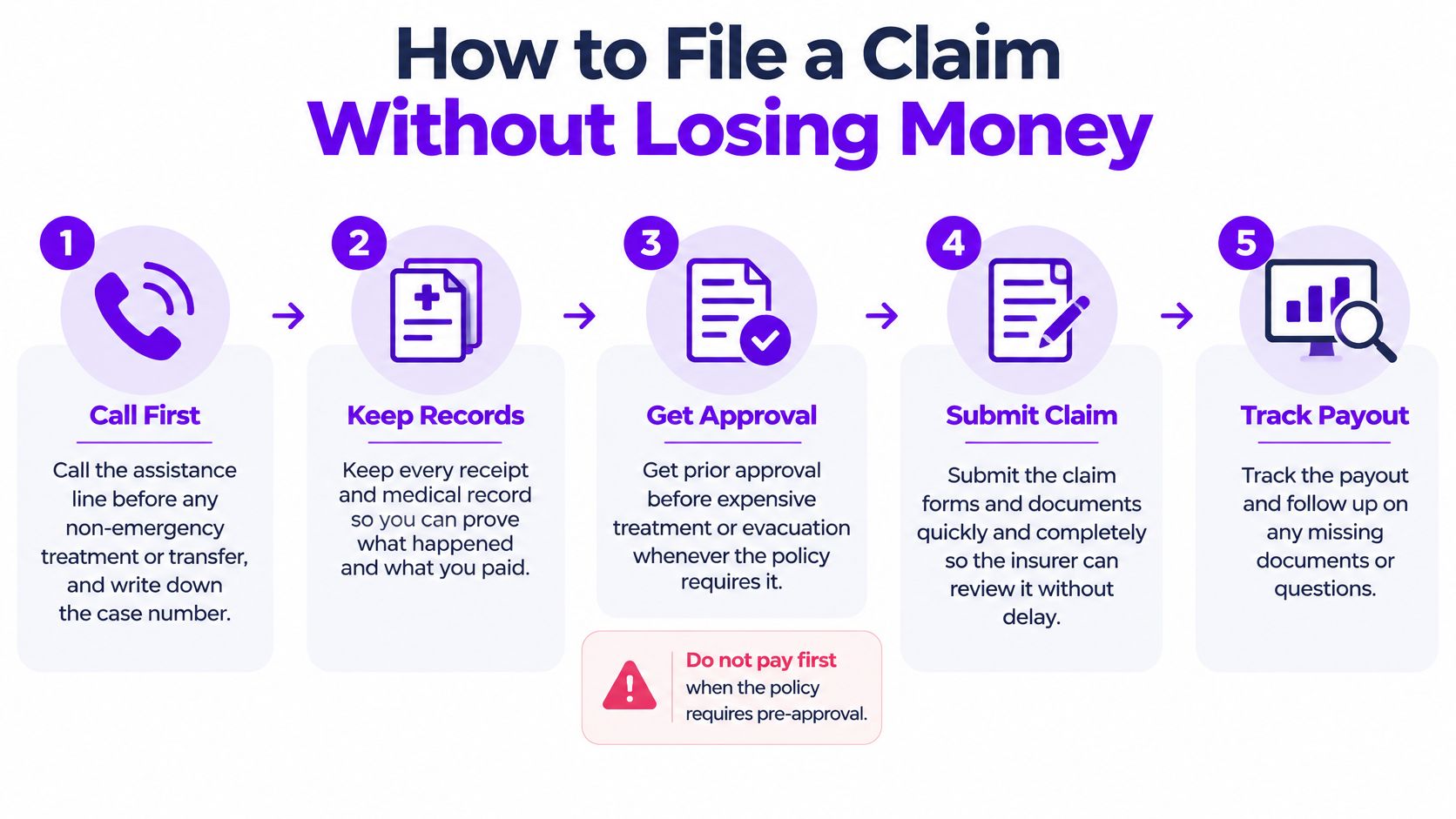
Call the assistance line first. Do this before any non-emergency treatment or any transfer, and write down the case number. That call is how the insurer approves the hospital and the route. Skip it and a later reimbursement can be refused even when the illness itself was covered.
Keep every medical paper. That means receipts, itemized bills, and the discharge summary, plus a translation if the insurer asks for one. A card slip with no itemized bill is hard to match to a covered service, so ask the hospital to break out each charge before you leave the desk.
Record business equipment at purchase. Photograph serial numbers, keep invoices, and store proof of ownership apart from your personal bag list. A leased laptop, a company-owned machine, or a device bought abroad is the item adjusters question first.
Check professional-use wording before you fly. The Post Office notes that business-owned laptops and phones may fall outside ordinary travel cover. A stolen suitcase and a stolen company laptop can be treated differently even when they sat in the same cafe. If the policy excludes professional use, add a business-equipment or cyber rider before departure, not after the theft.
File a police report promptly for theft. Go as soon as you can and ask for a stamped copy with the items listed, not a verbal note that you stopped by the station. A report dated days after the loss is one of the easiest things for an adjuster to question.
Submit the claim before the deadline. Every policy states its own claim deadline in the wording, so find it now and count back from the date of the event. Send the form, the bills, and proof of loss together. A complete pack moves faster than a form with a promise to send papers later.
Ask how gadgets are valued. Replacement cost and depreciated value are different checks. If the wording pays depreciated value, a three-year-old laptop will not be settled at today's price.
One more split matters. A trip policy's emergency claim and an expat health plan's routine-care claim go to different desks with different rules. If you carry both, send each bill to the right file the first time, because a rejected form does not restart your deadline.
If the taxi from the airport is the reason you are in hospital, the medical file and the crash file have to move together. This guide on how to reach responders after an airport-road crash is a practical companion to that first assistance call.
If your policy is secondary, claim from the home insurer first and keep both sets of letters. A denial from home is often what the overseas insurer wants to see before it pays.
"Remote work included" does not mean "business continuity protected."
A stolen laptop may be covered. The client penalty, the lost working days, and the cost of rebuilding access to client files usually are not, and travel cancellation does not replace those either. Separate personal gear from business gear in your folder, and decide before you leave whether cyber and liability sit on this policy or on a business policy of their own.
Country Rules That Change Your Cover
Public healthcare arrangements are not insurance. They change how much private cover you still need, and they stop at borders that a lease does not respect. Confirm the rules for each country before you move, because both public arrangements and entry rules change.
| Region or situation | Public care arrangement | Still needed privately |
|---|---|---|
| EU, Iceland, Liechtenstein, Norway, Switzerland and UK | European Health Insurance Card for temporary stays, at local cost | Private care, repatriation, evacuation and lost property |
| Countries without a reciprocal agreement | No public cover for visitors | Full private policy with emergency care and evacuation |
| Destinations that require proof of insurance to enter | Public care does not replace an entry certificate | A certificate naming dates, territory, medical limits and evacuation |
| Places with limited specialist care | Local public hospitals may lack the specialty you need | Evacuation to an adequate facility, with a clear assistance process |
What a European card actually buys
The European Commission reported about 253 million European Health Insurance Cards in circulation in 2023, and the system processed approximately 2.2 million reimbursement claims a year. The card gives access to medically necessary, state-provided care during a temporary stay in the 27 EU member states, Iceland, Liechtenstein, Norway, Switzerland, and the United Kingdom, generally on the same terms and at the same cost as a local resident.
It is not travel insurance, and it is not international private medical insurance. It doesn't cover private hospitals, planned treatment, lost property, or the cost of getting you home. It is built for temporary stays. Many expat and nomad stays are longer than that design. Inside the participating countries, the card can shrink the public-hospital bill. You still need private cover for private clinics, evacuation, repatriation, trip interruption, and any care outside that map.
Outside reciprocal arrangements, a visitor often has no public cover at all. The private policy then has to carry emergency treatment and evacuation on its own. In a town with thin specialist care, the useful benefit is the assistance process that moves you, not a promise that the local ward can do the surgery.
Stays that turn into residence also change the visa you hold. Our notes on digital nomad visas help you see which countries treat a long remote stay as a visit and which treat it as residence, because that label changes what "temporary" means to both the insurer and the clinic.
Expat Scenarios and Which Policy Fits
A three-week conference in Spain
A consultant flies to Spain for three weeks, with prepaid flights, a hotel, and a schedule of meetings. The most likely medical concerns are a fracture or a stomach bug, not a year of prescriptions. A trip policy with strong emergency medical limits, trip interruption for the unused hotel and the flight change, and evacuation back to an adequate hospital is enough. The first thing to read is whether evacuation is unlimited or capped high enough for a medical flight, and whether interruption includes the prepaid rooms. The verdict flips if the consultant plans to stay for the rest of the year, or needs a regular prescription while there. At that point the dates no longer describe a conference.
Six months in Lisbon with asthma
A freelancer takes a six-month remote stint in Lisbon and uses a monthly asthma inhaler plus the odd check-up. Emergency wording does not pay for that refill. The care-type test fails on day one, even if the trip dates fit on paper. An expat health plan is the right contract, and the pre-existing wording needs a close read before purchase, because asthma is exactly the kind of history a look-back will catch. Check first whether prescriptions for an ongoing condition are listed as covered, and whether a waiting period applies. The verdict would change only if the inhaler were a one-off emergency supply and the stay were a short visit with a firm flight home. It isn't.
A year in Bali and a stolen work laptop
A founder lives in Bali for a year, moves between islands, and loses a company laptop the week a client deliverable is due. The medical need is evacuation from a smaller island if something serious happens, plus ordinary care during a full year of residence. The equipment need is separate. The founder wants an expat plan, a business-equipment rider that accepts company-owned gear, and a claim folder with serial numbers, invoices, and a police report ready before anything goes missing. Check the residence dates first, then the professional-use exclusion. A cost of living comparison is worth running before a long lease, because rent and daily costs sit outside every travel claim. The verdict changes if the stay shrinks to a short holiday and the laptop is personal, insured at replacement value, with a per-item cap that matches the price.
Choose Your Cover Before Your Next Move
Do this before the next departure, while you can still change the contract.
Count the days. Add every night you expect to spend abroad over the next 12 months, and mark any stretch that runs past half a year. The policy has to match that calendar, not the shorter trip you first imagined.
Run the four tests. Days, residence, home-country eligibility, and type of care. Write down which one fails first. That failure picks the product.
Check each country on the route. Use the public-care table for what stays private, then confirm whether entry needs a certificate that names dates, territory, medical limits, and evacuation.
Build the claims folder now. Serial numbers, invoices, and the assistance number for each device and each trip. You will not want to hunt for them from a hospital bed.
Buy before you leave. Waiting periods and pre-existing rules often start on the purchase date, not on the day you get sick.
If you want a plain shopping checklist beside these tests, HearSmart's travel insurance buying guide walks through comparing policies in everyday language. Our Travel section covers digital nomad visas, banking across borders, and international health insurance, so the cover decision can sit next to the visa and the money questions. Buy for the stay you have.
Mazurly helps globally mobile founders, freelancers, and remote teams turn visas, insurance, and cross-border money admin into clear workflows. If you are matching a health plan to a long stay, start with the guides and tools on Mazurly and line the policy up with the move before you fly.