Investing While Living Abroad: A Practical Guide for Expats
Table of content
- Why Investing Abroad Is More Than Picking Assets
- Residency, Domicile, and Citizenship Explained
- What each label actually changes
- How FATCA, CRS, and FBAR Reporting Work
- Choosing and Keeping Brokerage and Banking Access
- Home account or local account
- What to check before you commit
- Currency Risk and FX Strategy for Nomads
- The three FX problems to separate
- Retirement Accounts and Pension Implications
- Crypto, Robo Portfolios, and Foreign Funds Compared
- Compare them on the right three axes
- Checklist and Next Steps for Cross-Border Investors
You've moved countries, opened a local broker, and told yourself the paperwork is someone else's problem now. Then a notice shows up asking why your accounts, address, and tax status don't line up, and suddenly the issue isn't your portfolio performance, it's your admin trail.
Investing while living abroad gets messy fast because the hard part isn't choosing assets, it's keeping your legal, tax, banking, and currency lives from drifting apart. If you want the practical version, start with the basics of cross-border finance in Mazurly's finance resources, then build from there with your actual residency records, not assumptions.
Why Investing Abroad Is More Than Picking Assets
A freelance designer leaves Lisbon for Mexico City, opens a local brokerage app, buys a few funds, and figures the move solved the problem. Two years later, the first compliance letter lands, and the surprise isn't the wording, it's the fact that the account was never the only issue in play.
The mistake is treating investment choice as the main decision. It's not. Residency, citizenship, account location, and currency each create their own obligations, and they don't politely merge just because you changed apartments or countries.
Practical rule: if you can't explain where you're tax-resident, you're not ready to open another investing account.
A moving nomad needs four things in order. First, a clean answer to where tax residence sits right now. Second, a way to avoid accidental dual-residence exposure. Third, stable access to banking and brokerage infrastructure. Fourth, a currency plan that doesn't let exchange rates eat the return you thought you earned.
The United States is the clearest warning sign here. Since 1970, the Bank Secrecy Act has required a U.S. person to file an FBAR when foreign financial accounts cross the reporting threshold, even if the accounts sit entirely outside the U.S. The point is simple, moving abroad doesn't erase the compliance link between the investor and the home country. For a broader local planning lens, see the Malta digital nomad visa guide if you're using residency changes as part of your location strategy.
If you take one thing from this section, take this, the portfolio comes after the paperwork. Get the legal position straight first, then invest.
Residency, Domicile, and Citizenship Explained
Most cross-border mistakes start with lazy language. People say “I moved abroad” as if that settles tax status, inheritance exposure, reporting, and account access. It doesn't. Nationality, tax residence, domicile, and account location are separate variables, and each one can trigger a different rule.
What each label actually changes
| Label | What it determines | Common obligation triggered |
|---|---|---|
| Nationality | Your citizenship or passport status | Citizenship-based reporting, including U.S. filing obligations |
| Tax residence | Where you're currently taxed on worldwide income | Income tax returns, treaty analysis, local reporting |
| Domicile | Your long-term home for certain legal systems | Inheritance or succession exposure in some countries |
| Account location | Where the bank or broker is chartered | KYC checks, account restrictions, reporting by the institution |
A person can hold a U.S. passport, become tax-resident in Portugal, keep a domicile issue alive in the UK, and hold accounts in Singapore. That's not contradictory. It's normal in cross-border finance, and it's exactly why generic expat advice fails so often.
The residence question comes first. Where are you tax-resident right now, and what changed on the date you moved? If that date is fuzzy, your filings become fuzzy too. I've seen people rely on travel screenshots, lease emails, and half-finished spreadsheets when what they really needed was a simple residence log tied to move dates and treaty tie-breaker analysis.
Don't confuse the broker's address with your tax address. They're related, but they're not the same thing.
A second mistake is treating an overseas account as proof that you've “gone local.” A local bank account doesn't erase your former obligations, and a foreign broker doesn't make you invisible to your home-country rules. If you've recently changed country, your first job is to document the move, then map what each jurisdiction still claims from you.
That's the lens that matters. Once you separate the labels, you can see where the overlap is real and where it's just habit talking.
How FATCA, CRS, and FBAR Reporting Work
The cleanest way to think about cross-border reporting is this, secrecy is fading and documentation is winning. Overseas accounts are not private just because they sit abroad, and the major reporting systems were built to make sure of that.
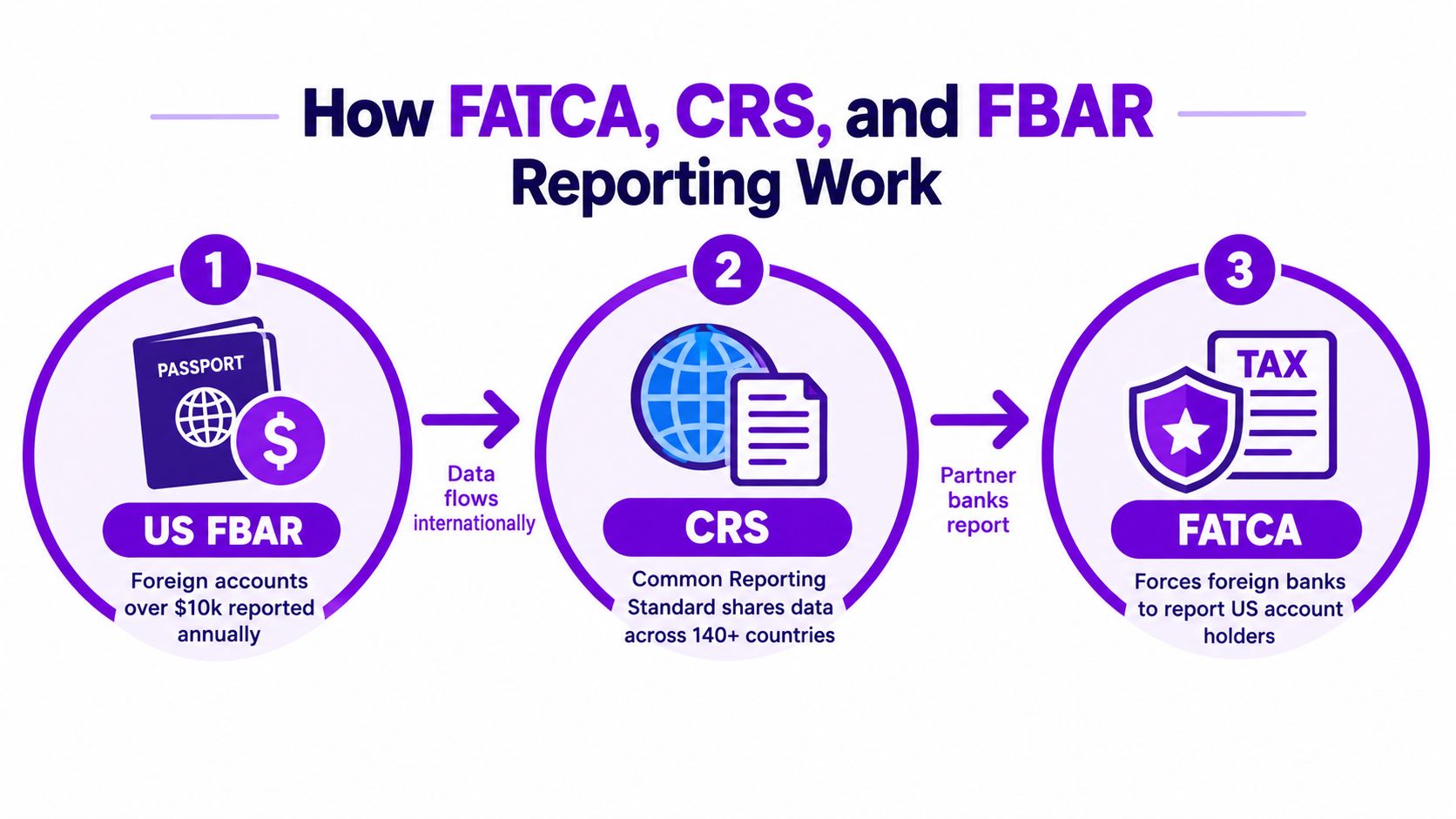
The U.S. FBAR rule is the one most Americans abroad trip over first. Under the Bank Secrecy Act, a U.S. person must report foreign financial accounts when the combined maximum value across reportable accounts exceeds $10,000 at any time during the calendar year. That threshold applies across all reportable foreign accounts, not one-by-one, and the values must be converted into U.S. dollars before reporting. The accounts can include bank accounts, brokerage accounts, and mutual funds, and the rule is a reporting trigger, not a tax rate. IRS IRM guidance on FBAR reporting lays out the framework.
FBAR is not the same thing as FATCA. FATCA is about foreign financial institutions reporting U.S. account holders to the U.S., while FBAR is a direct filing obligation on the individual. CRS is the broader international version of account exchange, used by participating jurisdictions for automatic information sharing. The OECD says more than 170 jurisdictions are involved in this transparency cooperation, so an “offshore” account often means “reported elsewhere,” not “hidden.”
The pattern is getting even wider with digital assets. The OECD has also released updated technical material for crypto reporting, and its revised CRS text expands coverage to certain electronic-money products, central-bank digital currencies, and indirect crypto investments through derivatives and vehicles. That matters because a small account, a wallet app, or a foreign fund can still sit inside a reporting pipeline.
Bottom line: if the institution asks for your tax ID, residence, or self-certification, answer carefully and keep the records.
The practical habit is simple. Keep your residence documents, account opening forms, tax IDs, and annual statements in one place. When a broker, bank, or tax authority asks for evidence, you want files, not memories.
Choosing and Keeping Brokerage and Banking Access
Opening an account is the easy part. Keeping it open after you move again is where most nomads get burned. A broker that liked you in one country may hate your file the moment your address changes, and a bank that accepted you remotely may decide your KYC profile is too messy to maintain.
Home account or local account
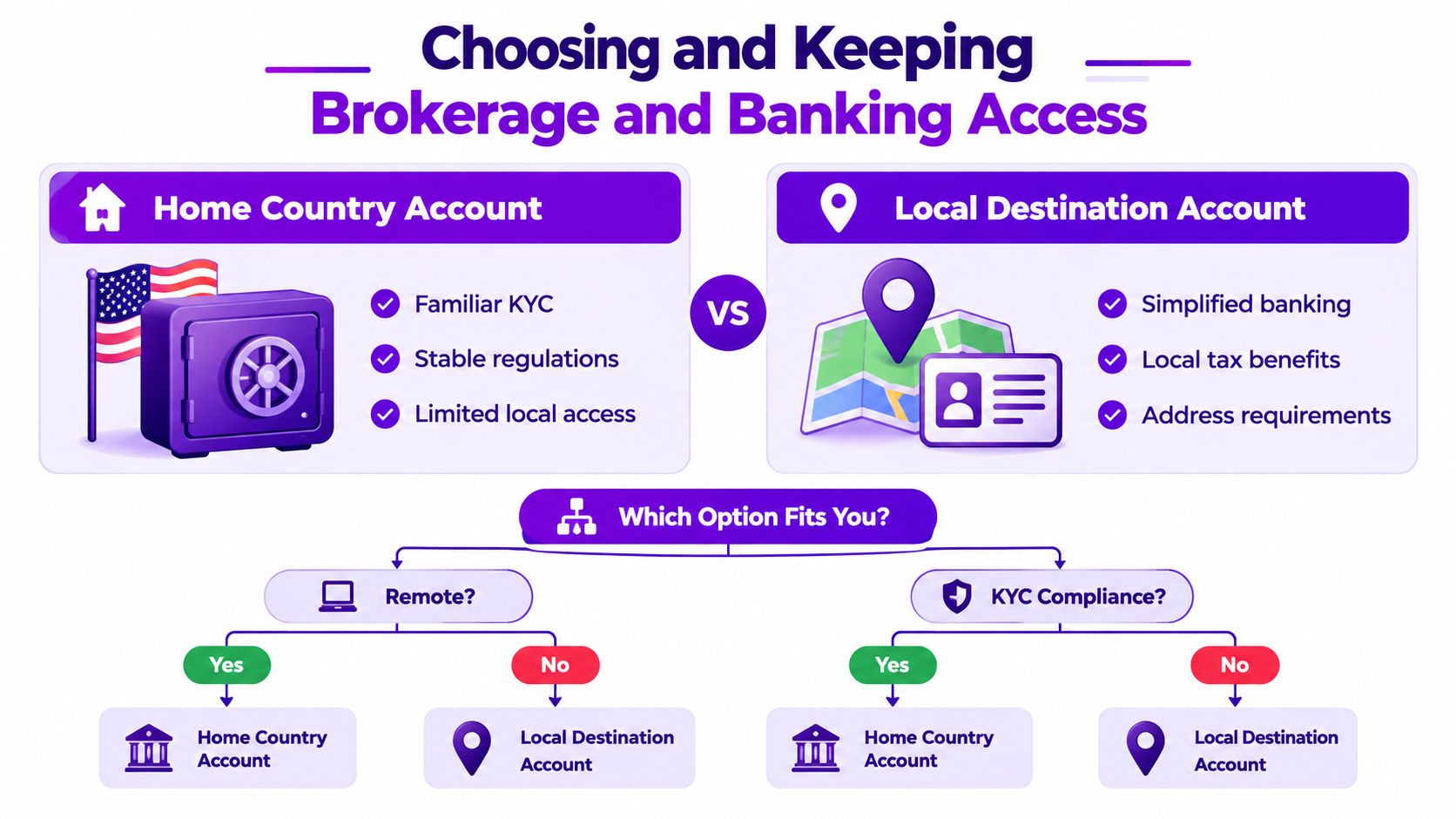
A home-country account usually gives you familiarity, a known platform, and fewer surprises at the start. The downside is that once you live abroad, stale addresses, outdated tax IDs, and country restrictions can make the account brittle. Some institutions can and do close or freeze accounts when residency changes, not because you did anything dramatic, but because their compliance team decided you no longer fit the profile.
A local destination account can help with day-to-day spending, local salary flows, and bills. It can also create fresh reporting duties and a new layer of admin if you keep moving. If you've been asking whether a local bank account is enough to “start over,” it isn't. It may help operationally, but it doesn't solve tax residence or cross-border reporting.
A third option is the multi-currency or international account. That's often the least glamorous and the most useful. It stages conversions, preserves flexibility, and reduces the number of times you're forced to swap currencies just to move money. If you want a practical example of how a well-structured international account is used in everyday practice, this bank account in Dubai resource shows the sort of access and setup questions that matter in cross-border banking.
What to check before you commit
- Will it survive another move? Ask whether non-resident customers are supported, and whether the platform has a history of keeping files open after residency changes.
- Will it accept your new tax ID? If the answer is vague, assume the admin pain will show up later.
- Can you move money cleanly? Watch conversion spreads, transfer limits, and whether you can hold multiple currencies without getting punished.
- Will it stay compliant with your new address? A stale self-certification is not a harmless detail. It's the kind of thing that creates friction exactly when you're busy traveling.
Keep the shortlist small. Two or three accounts that work across countries are usually better than a pile of local relationships you can't maintain. If a platform only makes sense while you stay put, it's the wrong platform for a nomad.
Currency Risk and FX Strategy for Nomads
A move across borders changes more than your address. If you earn in one currency, spend in another, and report in a third, foreign exchange is part of your investment result from day one.
A simple example shows why. If a portfolio returns 8 percent in local currency and your base currency moves 4 percent against it, your base-currency result can fall to 4 percent after translation. The asset did not weaken, but your outcome still did. That is why FX decisions belong in the portfolio conversation from the start, alongside asset selection.
For a closer look at how investors deal with this problem, the currency risk guide for investors is a useful reference. It is especially relevant if you already hold property, deposits, or portfolio assets across currency zones.
The three FX problems to separate
Base-currency drift shows up on your net worth sheet. Your portfolio may be unchanged, yet the reporting currency moves and the statement value shifts.
Spending mismatch hits when income and expenses live in different currencies. A remote worker paid in euros but spending in pesos needs a conversion plan, not guesswork.
Translation exposure matters when you report to a tax authority in one currency but hold assets in another. Reporting currency and spending currency are different variables, and people get into trouble when they blur them.
The fix is straightforward, but it has to be deliberate. Keep some cash in the currency you spend. Use a multi-currency account to stage conversions instead of forcing every transfer through one base currency first. Decide in advance whether your investments should be hedged or unhedged, then stay consistent long enough to judge the result.
Your real budget is shaped by what you pay for housing, transport, insurance, transfers, and card conversion costs. If you want to ground your FX plan in actual expenses, use the cost of living comparison by country before you decide how much currency risk you can tolerate. FX planning should match the country where you live, not just the currency on your brokerage statement.
That is where a nomad-friendly checklist helps: where you earn, where you spend, where you report, and where your account is held. Keep those three variables separate, then set your currency mix around them. If the plan only works while you stay put, it is the wrong plan.
Retirement Accounts and Pension Implications
Retirement accounts are where a lot of mobile people get careless. They assume leaving a country means the account should be abandoned or that contribution rules automatically disappear. Both assumptions are too crude. Residency, citizenship, and the scheme's own rules often decide what you can keep, contribute to, or transfer.
Some schemes are portable. Some are not. Some let the balance sit while you live elsewhere. Some only work cleanly if you keep a qualifying address or status. That's why “just keep contributing” is the wrong reflex. Sometimes it's fine, sometimes it's a compliance mistake, and sometimes it creates a mess you won't notice until a later filing cycle.
The same caution applies to account types like 401(k), IRA, ISA, Super, or SIPP. Their treatment doesn't depend only on where the investments are listed. It depends on whether the plan rules allow non-residents, whether contributions are still permitted after departure, and how the receiving country sees the wrapper. You need to ask three direct questions before the next move.
- Can the account stay where it is?
- Can I still contribute legally?
- What happens to tax treatment if I move again?
If the answer to any of those is unclear, stop and get advice before you change address. That's especially true if the account has long-term pension implications or if your citizenship creates a separate reporting layer.
Pension mistakes are expensive because they're slow. The damage often shows up years later, after the move is long forgotten.
Do not assume a local pension substitute is automatically better. In cross-border planning, wrappers matter as much as returns, and bad wrapper decisions can create tax friction that overwhelms a decent investment choice. Before your next relocation, review every retirement account you own and decide which ones need preservation, which ones need contribution changes, and which ones need a transfer plan.
Crypto, Robo Portfolios, and Foreign Funds Compared
App-based investing sells convenience, but convenience doesn't cancel reporting. A wallet, robo app, exchange-traded crypto product, or foreign fund can still create the same cross-border headaches as a traditional broker if the custody, classification, or disclosure rules get messy.

Compare them on the right three axes
Custody tells you who holds the asset or the keys. Self-custody changes where control sits, but it doesn't magically erase tax obligations or reporting duties.
Classification tells you what the asset is in the eyes of the rules. A token, a fund, a stablecoin, and a derivative wrapper can look similar on an app and still be treated very differently by tax and reporting systems.
Disclosure tells you what gets reported and to whom. That's where the OECD's crypto reporting work matters, along with the broader CRS expansion to electronic-money and digital-currency products.
A robo portfolio can feel simpler because the interface is cleaner. That feeling is often misleading. If the platform uses foreign funds, wraps exposure in a vehicle that your home country treats oddly, or changes jurisdiction when you move, the reporting headache just shifts shape.
A foreign fund is the clearest example of why “local” doesn't always mean easy. It may be easier to buy, but harder to classify. A token held in self-custody may be easier to control, but harder to document. A regulated product may simplify administration while increasing the odds that it gets reported through a formal channel.
For practical security habits around digital assets, the guide to securing digital assets during trips is a useful reminder that custody discipline matters even before tax reporting enters the picture. I'd still keep the same recordkeeping standard for basis, dates, wallet history, and platform statements no matter which product you choose.
My view is blunt. If you can't explain the asset in one sentence and track its paperwork in one folder, you're not ready to hold it across borders. Fancy UX doesn't change that.
Checklist and Next Steps for Cross-Border Investors
Build this around two lists, one for before you move, one for every year you stay mobile. Before you relocate, confirm tax residence in writing, update all account addresses, check whether each broker accepts your new country, review retirement accounts, save proof of move dates, and reconcile every tax ID you've ever used. After the move, audit statements, review self-certifications, check currency balances, and fix stale records before they become a filing problem.
Three steps matter most. First, confirm tax residence in writing. Second, audit existing accounts against current residency. Third, use a cross-border tax professional before opening new structures. If you want a residency certificate, foreign pension disclosure, or local bank question answered cleanly, get it on paper.
Mazurly helps location-independent people plan around the genuine friction points, not the fantasy version of expat life. If you're sorting out residency, banking, and the day-to-day logistics that sit around investing while living abroad, visit Mazurly for tools and guides built for moving work and money across borders.