Costa Rica Digital Nomad Visa: Step-by-Step Guide for 2026
Table of content
- Arriving With a Laptop – Why the Category Matters
- The category is the decision
- Why the fit matters before you buy the ticket
- What the Costa Rica Digital Nomad Visa Is
- What it allows, and what it doesn't
- The structure behind the label
- Eligibility Requirements and Income Proof Structure
- Build the evidence month by month
- What weakens a file
- Application Path and Renewal Reality Check
- Initial filing versus renewal
- Common friction points
- Tax Rules, Banking, Driving, and Remote Work Logistics
- Tax relief is narrow, not universal
- Make the visa work with daily operations
- Who Should Pursue This Visa and How to Decide
- A good fit looks like this
- When another plan may be smarter
You can land in Costa Rica with a laptop, a phone hotspot, and a rough plan for a few months of beach-adjacent work, then discover the hard part isn't finding Wi-Fi. The hard part is proving you fit the right immigration category, proving your income cleanly, and keeping your documents alive long enough to survive the approval and renewal cycle. That's where the Digital Nomad Visa Costa Rica either becomes a smooth long-stay base or turns into a pile of avoidable delays.
Arriving With a Laptop – Why the Category Matters
A remote designer lands in San José on a Tuesday, checks into a short-term rental, and starts looking for a longer stay by Friday. The instinct is to treat immigration like a later problem, after the flight is booked and the desk setup is handled. That approach is expensive, because Costa Rica's remote-worker pathway is built around proof, not intention.

The category is the decision
Costa Rica created this route for people who earn abroad and work remotely, not for travelers who want to improvise later. The visa sits in a special immigration category, Stay for Remote Workers and Service Providers, and its logic is straightforward, stay lawfully while keeping your work outside the local labor market. That choice affects housing, insurance, and the document set you will need to file.
A weak category match causes problems fast. If your income story is messy, your travel pattern is unstable, or you expect to work for Costa Rican clients, the application can turn into a paperwork headache before it ever reaches review.
Costa Rica gave this status a legal home through Law No. 10008 in 2021, and the origin matters because it fixed the category in statute rather than leaving it as an informal workaround. NPR covered the creation of the category when the law was introduced, while the legal text itself sets out the framework more directly (NPR on the legal creation of the category, Law No. 10008).
Why the fit matters before you buy the ticket
If you rely on foreign clients and get paid on a predictable schedule, this pathway can make sense. If your work mix includes local contracts, shifting freelance deposits, or income that changes month to month, you need stronger documentation discipline than many applicants expect. That means collecting bank statements, contract records, and income proof before you travel, not after an officer asks for them.
The practical trade-off is simple. Good paperwork gives you a clean filing path and fewer surprises at renewal. Loose paperwork forces you to explain gaps, and those gaps are where delays usually start.
Costa Rica's attraction is obvious. The paperwork is not. A good application starts with the right category, because the wrong assumption at arrival becomes the wrong document set at filing.
What the Costa Rica Digital Nomad Visa Is
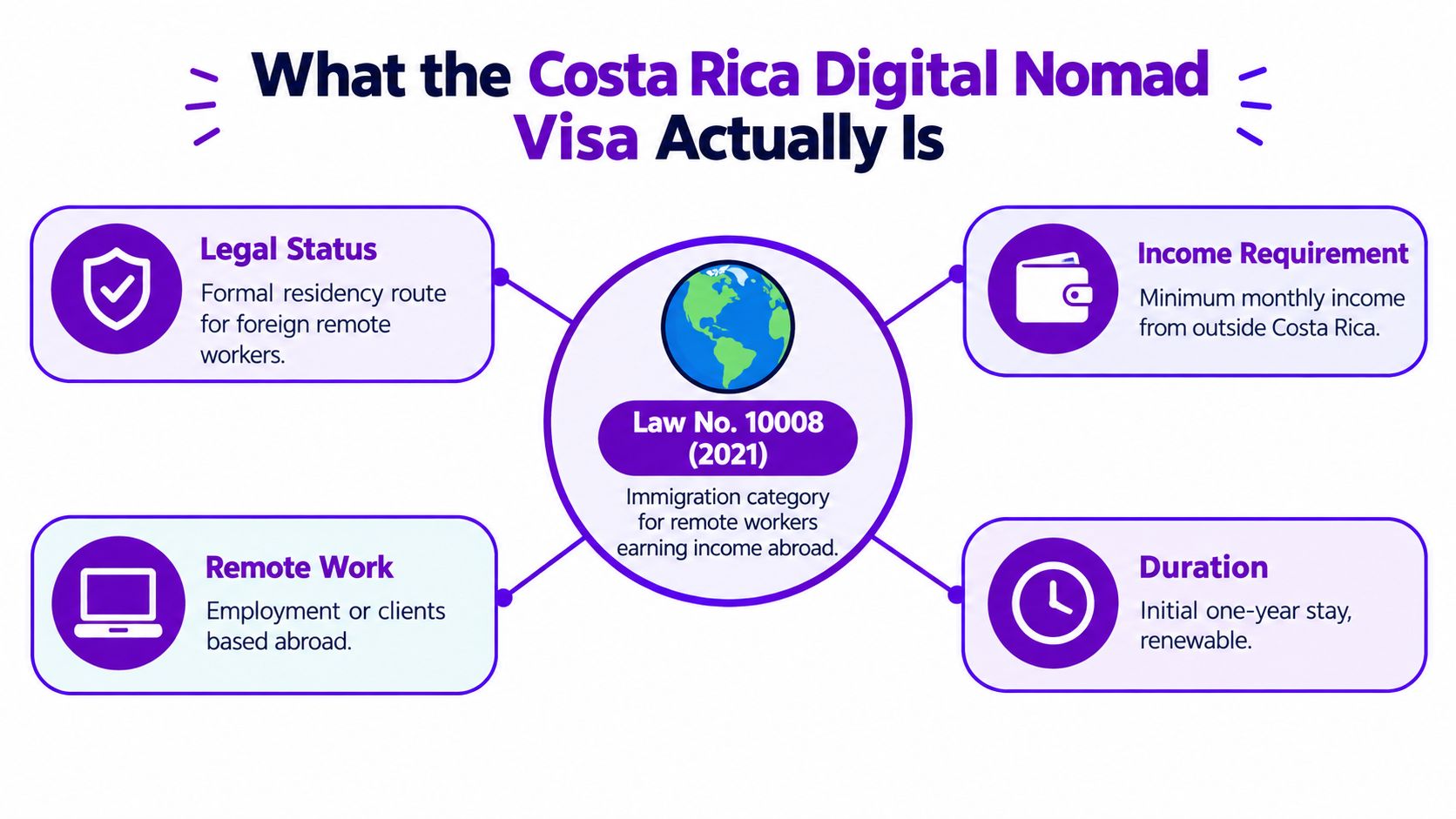
Costa Rica's digital nomad route is a specific immigration category for foreign remote workers and service providers whose income comes from outside the country. It was created under Law No. 10008, enacted in 2021, which matters because the status exists in statute, with defined scope and limits.
What it allows, and what it doesn't
The program covers paid work delivered remotely through digital or telecommunications channels to people or entities abroad. That keeps the emphasis on foreign-source income, not local employment. In practical terms, the visa fits someone whose clients, employer, or revenue base stays outside Costa Rica, even while they live there.
That boundary matters in filing. You are not applying for access to the local labor market. You are applying for a lawful way to live in Costa Rica while keeping your economic activity anchored abroad. In real files, that distinction affects how you organize invoices, contracts, and payment trails, because officers want to see where the work is performed and where the money comes from.
The structure behind the label
The phrase “digital nomad visa” can make the status sound casual, but Costa Rica's version is more defined than that. It gives an initial one-year stay, with the possibility of renewal for one additional year, so the maximum stay can reach two years.
That structure tells you what the government expects. It expects temporary residence, verified foreign income, and continued compliance. It does not function like permanent residence, and it does not resolve cross-border tax questions on its own. If your work model depends on local clients, a local entity, or a long-term settlement plan, this category may not fit your situation.
The cleanest way to read the visa is simple. It is a lawful residence tool for globally paid professionals. The document set matters because the category is built around proof, not assumptions.
Eligibility Requirements and Income Proof Structure
The income rule looks simple on paper, but the work is in proving continuity. Costa Rica uses a 12-month income-continuity test, not a one-month snapshot or a balance check on the day you apply. For an individual, the requirement is USD 3,000 per month in foreign-source income during the 12 months before filing. If you include qualifying dependents, the figure rises to USD 4,000 per month (official tourism requirements).
Build the evidence month by month
A clean file usually has three layers. First, bank statements that show the recurring foreign deposits. Second, contracts or client or employer records that explain where the money comes from. Third, an affidavit that ties the documents together and confirms the income source and continuity.
Costa Rica's official guidance also says the income must be valued at the Central Bank's official selling exchange rate, so careless currency conversion can create avoidable friction. That matters if your income arrives in more than one currency or lands in accounts with mixed activity.
| Applicant type | Minimum monthly income | Required evidence window | Key supporting document |
|---|---|---|---|
| Individual applicant | USD 3,000 | Previous 12 months | Bank statements with affidavit |
| Applicant with dependents | USD 4,000 | Previous 12 months | Bank statements with affidavit |
What weakens a file
Irregular deposits are not automatically disqualifying, but unexplained transfers make the file harder to trust. If a client pays late, a platform batches payouts, or money moves through multiple accounts, document the trail before you file. The cleaner the narrative, the less room immigration has to question whether the income is stable and foreign-source.
If you want a practical reference for signature and compliance workflows, the BoloSign Costa Rica compliance resource helps frame how signed evidence and formal records fit together when you are dealing with cross-border paperwork.
Working rule: Assemble the last 12 months as a month-by-month packet, not as a pile of unrelated PDFs.
The application also asks for a USD 100 government payment, a completed form, and passport documentation. A month-by-month package is stronger than a “good cash balance” story, because the visa measures recurring foreign remuneration, not just liquidity.
For comparison with another Latin American nomad route, this breakdown pairs well with Mazurly's digital nomad visa Colombia guide, especially if you are choosing between countries with different proof styles.
Application Path and Renewal Reality Check
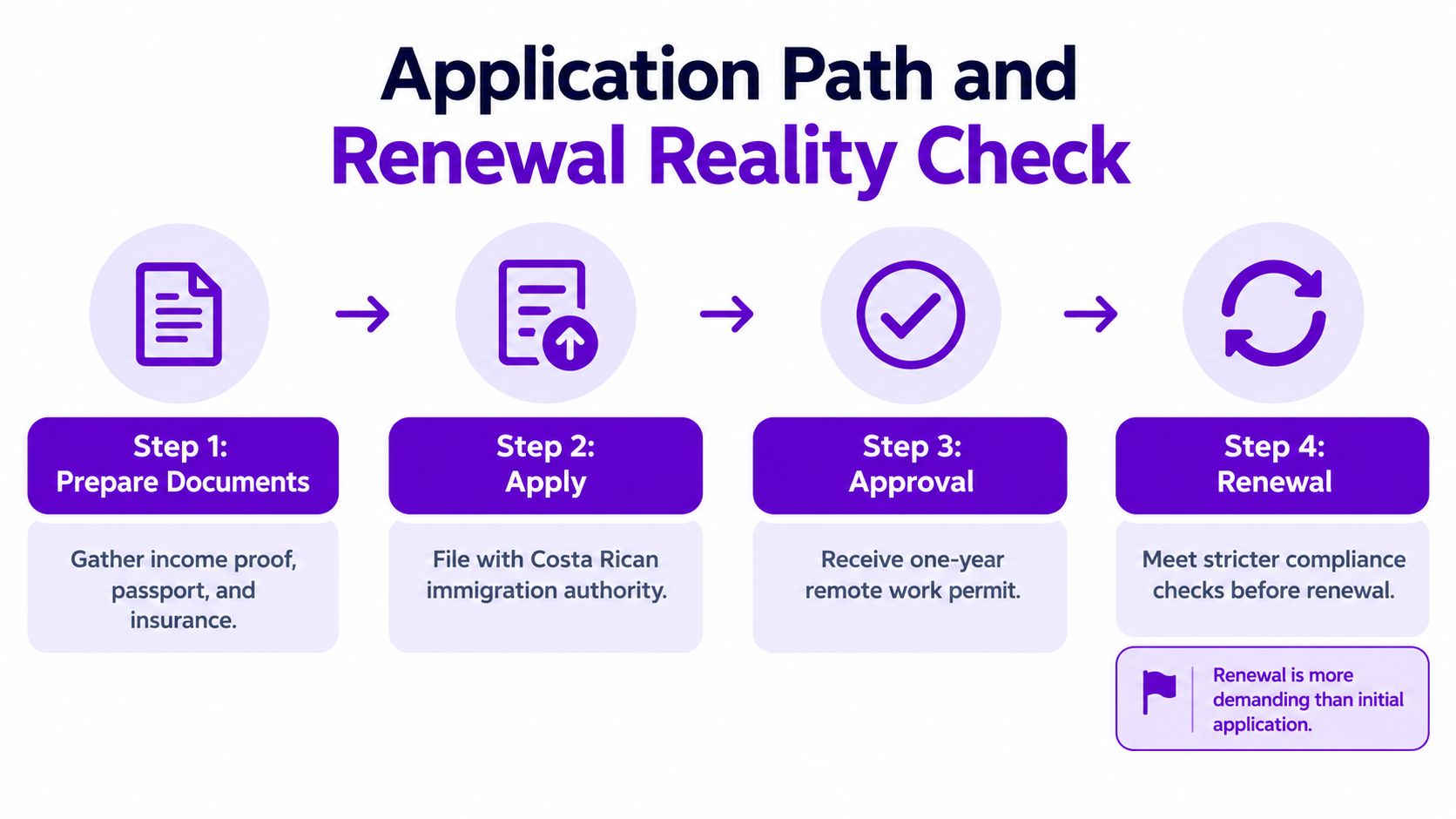
A strong first filing can still turn into a messy renewal if the paperwork trail is thin. The initial application is about proving eligibility and assembling the file cleanly. Renewal asks a different question, whether you have stayed inside the rules long enough to justify another year of residence. Costa Rica's official renewal guidance adds details that many summaries skip.
Initial filing versus renewal
The first filing centers on proof of qualification. Renewal centers on proof of compliance. Costa Rica's official tourism guidance says renewal applicants must have been physically present for at least 80 days, submit the renewal through the government's digital platform, provide bank statements and an affidavit showing continued foreign income, pay government and immigration-document fees, and keep medical coverage active for the full authorized period (official renewal guidance).
That 80-day threshold catches people off guard. Some secondary guides still mention 180 days, but the official page uses 80 days, so that is the figure to work with if you are planning a renewal. Travelers who bounce in and out frequently can still qualify on paper, but the file gets harder to defend when the presence record looks scattered.
Common friction points
Expired passports cause more headaches than people expect. Incomplete bank statements do too, along with insurance that lapses before the renewal window and gaps in legalization or certification. The system does not reward partial readiness. It rewards clean timing and records that line up.
A practical renewal-readiness check should include:
- Presence tracking, so you can confirm you met the physical presence threshold.
- Income continuity, using the same month-by-month packet built for the initial filing.
- Insurance dates, so coverage does not expire mid-process.
- Document validity, so passport pages and supporting records remain usable.
- Submission timing, so you are not rushing a renewal with missing pieces.
The strongest renewal files are unremarkable in the best way. They show routine presence, steady foreign income, and no gaps in the supporting documents. If your travel pattern relies on short stays and frequent border crossings, the second year usually demands more discipline than the first.
Tax Rules, Banking, Driving, and Remote Work Logistics
A Costa Rica nomad usually feels the practical benefits before the tax questions. The visa can support use of a foreign driver's license, access to a Costa Rican bank account, and import of work gear without ordinary import taxes, which reduces the first-wave friction that slows many relocations (official benefits page). The tax side is narrower. The visa can exempt qualifying foreign earnings from Costa Rican income tax, but it does not settle every cross-border issue a remote worker carries with them (EY tax alert on treatment of foreign earnings).

Tax relief is narrow, not universal
The cleanest way to read the rule is simple. Costa Rica's exemption is aimed at qualifying foreign-source income, not every tax obligation a nomad may face. Home-country residency can still remain in play, along with social-security exposure, permanent-establishment risk, and reporting duties elsewhere.
That is why the paper trail matters. Keep invoices, contracts, and payment records that show which work was done for foreign clients. If you begin serving Costa Rican clients, hiring locally, or setting up a local entity, the analysis changes and local advice becomes the safer move.
Make the visa work with daily operations
The immigration file does not live on its own. Banking, invoicing, time-zone coordination, and insurance renewals need the same routine behind them, or the paperwork starts to fray. For client communication and handoff habits, remote collaboration best practices is a useful reference when you are setting response windows and record-keeping that still works across time zones.
A practical setup is plain. Use one system for invoices, one calendar for renewals, and one folder for tax and immigration proofs. If your records already live in a structured workflow, the visa's benefits are easier to use. If they sit across email threads and messaging apps, the administrative load rises fast.
For broader budgeting and asset-planning context, Mazurly's investing while living abroad guide fits this stage, especially if you are keeping finance, travel, and residency decisions aligned.
Who Should Pursue This Visa and How to Decide
A Digital Nomad Visa Costa Rica fits best when your income comes mainly from abroad, you want a longer stay in one country, and your records for the last 12 months are clean enough to survive review. If that matches your situation, the visa can support a real base in Costa Rica instead of a short stay that turns into paperwork trouble later.
A good fit looks like this
The strongest applicants usually have steady foreign clients, predictable deposits, and travel habits that do not fight the renewal presence rules. They also arrive with paperwork that already tells a coherent story, which matters more than many first-time applicants expect.
The program has stayed selective. Immigration data analyzed by the tourism school at Universidad Hispanoamericana recorded 683 applications from 2022 through 2024, with 589 approved, an approval rate of about 86.2%. Approvals peaked at 317 in 2023 and fell to about 158 in 2024, roughly a 50.2% decline from the prior year (application data summary). That pattern suggests interest is real, but approval still depends on a file that holds together.
The approved applicant pool that was publicly documented during that period was still measured in the hundreds, not in the thousands. For a visa marketed to remote workers, that is a useful reminder that the system is active but not casual.
When another plan may be smarter
If your income arrives in uneven bursts, if you move too often, or if local clients are likely to become part of your work, this visa can create more friction than freedom. Someone who crosses borders frequently may struggle with the presence requirement. A freelancer with irregular deposits may need a cleaner accounting trail before filing. A person planning local business activity should treat this visa as the wrong tool for that job.
Budget also matters. If you are still comparing destinations, Mazurly's cost of living comparison countries guide helps test whether Costa Rica fits your spending pattern and work routine better than another place. That comparison is practical, because the right visa only works when daily life, not just intent, supports it.
Choose this route if your foreign income is stable, your documents are orderly, and your travel pattern can support a second year without scrambling. Skip it if you would have to reshape your work, deposits, or travel just to keep the application alive.
The decision is usually clear once you test the full compliance picture. If the money, the paper trail, and the renewal habits all line up, the visa is worth pursuing. If any one of those pieces is shaky, another residency path may be less stressful.