
How to Avoid Foreign Transaction Fees in 2026
Table of contents
- What Foreign Transaction Fees Really Cost
- The Scale in Monthly Spend
- Foreign Fee Layers and What They Cost
- Cards and Multi-Currency Accounts Compared
- Payment Rails for Nomad Spend
- Three Scenes, Three Choices
- Client Payouts Without Double Conversion
- A Five Step Inbound Routine
- Set Up Fee-Free Payments and Terminal Choices
- Audit What You Already Carry
- Assign Each Job to One Rail
- Choose Correctly at the Terminal
- Cut Cash Stops Down
- What Repeated Foreign ATM Use Costs
- Monthly Checks Waivers and the Lock-In
- The Monthly Routine
- The Lock-In Decision
Get a no foreign transaction fee card and you're done. That's the popular advice, and it's incomplete enough to cost you money every month.
A card with a 0% foreign transaction fee solves one layer. It doesn't stop a hotel terminal from converting your bill at its own rate, an ATM owner from adding a surcharge, or a foreign software company from triggering a fee on a different card you left on file. It also doesn't tell you what happens when a client pays you in euros and your bank converts those euros to dollars before you can spend them in Europe.
Learning how to avoid foreign transaction fees means treating the charge as a stack, not a logo on a card. You check each layer, assign each kind of spend to the cheapest rail, and make one correct choice at the terminal. Do that once, check it monthly, and the fees mostly disappear.
What Foreign Transaction Fees Really Cost
Paying in your home currency feels safer because you can read the total. It's often the expensive choice. When you accept that home currency total, the merchant or ATM sets the conversion rate instead of your card network, and your issuer can still add its own fee on top.
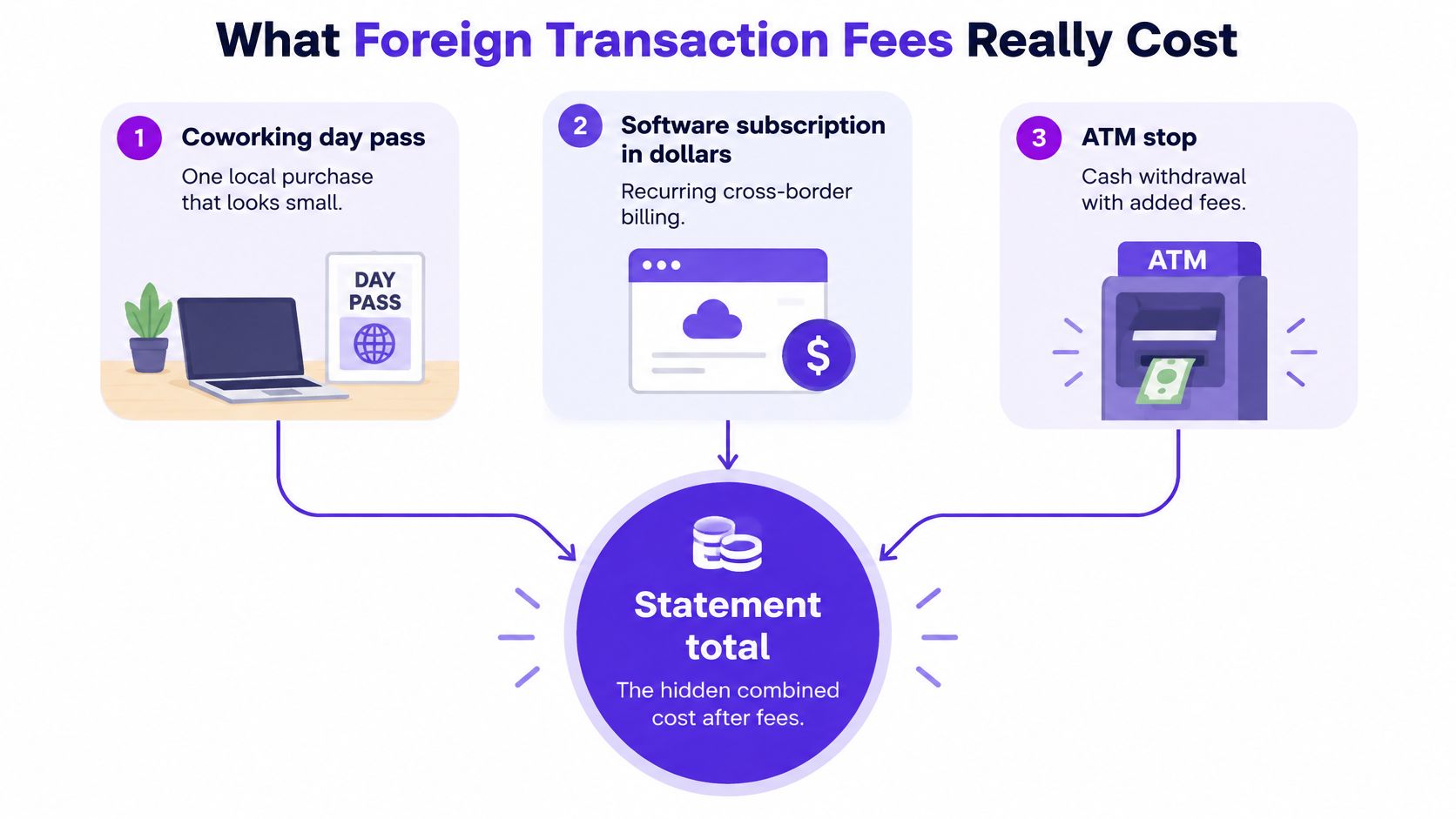
Say your week includes a coworking day pass paid in local currency, a software subscription billed in dollars by a company based abroad, and one ATM stop for cash. Those three small items can hit three different layers. The coworking pass may carry an issuer fee. The subscription may count as a foreign merchant transaction even though the price shows dollars. The ATM stop can add an operator surcharge, a fee from your own bank, and a conversion markup if you accept the machine's rate.
The Scale in Monthly Spend
These aren't rounding errors for people who live and bill across borders. In 2024, credit card fees in travel transactions averaged 2% to 3.9% across geographies, and 40% of North American respondents reported paying 3% to 3.9% per transaction, according to Phocuswright research on the cost of payments in travel.
Put that high band on spend you recognize. At 3%, you pay $30 on $1,000. A $3,000 month of rent deposits, hotels, transit, subscriptions, and contractor tools routed through foreign merchants costs about $90. Repeat that month all year and you're near $1,080, before any ATM charges or a poor conversion rate at a terminal.
Practical rule: Add the issuer fee and the conversion markup together before you trust any product marketed as fee free. A $0 fee line with a weak exchange rate isn't free.
Foreign Fee Layers and What They Cost
| Fee layer | Typical amount | Who charges it | When it hits |
|---|---|---|---|
| Issuer foreign transaction fee | Often inside a 2% to 3.9% travel card total | Card issuer | Foreign currency, foreign country, or foreign merchant |
| Card network assessment | Passed through by issuer, with a 1% example in consumer guidance | Card network, passed on by issuer | Any qualifying foreign transaction |
| Issuer total at a 3% rate | $30 per $1,000, about $90 on $3,000 in a month | Card issuer | Any qualifying foreign transaction |
| Dynamic currency conversion | Markup set at the terminal above the card network rate | Merchant or ATM | Charge offered in home currency |
| ATM operator surcharge | $2.40 average at a foreign ATM in a 2013 notice | ATM owner | Each cash withdrawal abroad |
| Customer's own out of network fee | $1.40 average in that 2013 notice | Home bank | Each cash withdrawal abroad |
| Exchange spread on a no fee product | Gap between the rate you receive and the mid market rate | Bank or fintech | Conversion even when the fee line shows $0 |
A dollar price on a receipt doesn't prove the merchant is domestic. What matters is where the merchant processes the payment and what your issuer's terms count as foreign. That's why a subscription you bought from your kitchen table can produce the same fee as a purchase made in another country.
Cards and Multi-Currency Accounts Compared
Don't look for one winner. Each rail does one job well and another job badly, so you need to match the rail to the payment in front of you.
A no foreign transaction fee credit card is your default for hotels, transit, flights, and online merchants, provided the terms really say 0% and you pay the balance in full. Credit also gives you a hold friendly way to handle hotel deposits without tying up cash in a checking account. Its weakness is cash. Taking money from an ATM on a credit card usually counts as a cash advance, with separate pricing and interest that starts right away.
ATM fee rebate checking is your cash tool. It's built for places where small restaurants, markets, and landlords still prefer notes. The catch sits in the fine print. Some accounts cap monthly reimbursements, some refund weeks later, and a rebate on the operator fee doesn't remove an exchange spread your bank builds into the rate.
Payment Rails for Nomad Spend
| Payment rail | Foreign purchases | ATM cash | Best nomad job | Main catch |
|---|---|---|---|---|
| No foreign fee credit card | 0% when the issuer terms say so | Poor | Hotels, transit, online foreign merchants | Annual fee must beat rewards, still decline conversion |
| ATM fee rebate checking | Often 0% on debit purchases | Operator fees reimbursed, sometimes capped | Cash heavy countries | A spread can remain, rebates can be delayed |
| Multi-currency account | Near mid market if that currency is already held | Included up to a plan limit, then a fee | Invoices, contractors, local rent | Weekend or plan markups, not a credit line |
| Home bank card with a foreign fee | About 3% in a typical worked example | Plus the ATM stack | Backup only | Can still hit some home currency foreign merchants |
| Airport or hotel cash exchange | No card fee | Not an ATM | Emergency pocket money | Retail cash rates are usually the worst |
A multi-currency account wins when money already arrives in the currency you spend. If clients pay you in euros, pounds, or Australian dollars, holding that balance lets you pay local costs without converting twice. It isn't a credit line, and some plans add markups on weekends or above a monthly exchange allowance, so convert larger amounts on a weekday inside your plan limit when you can.
Your regular home bank card that still charges a foreign fee belongs in a drawer as a backup. Keep it for the day your main card gets frozen, not for daily spend. Airport and hotel cash exchange sits below even that. Use it for a taxi when nothing else works, then switch to a proper rail the same day.
Three Scenes, Three Choices
Paid in euros, living in Spain: Spend from the euro balance for rent, groceries, and a local SIM. Converting that income to dollars and back to euros pays for two spreads you never needed.
Three week city hop with card friendly shops: Put almost everything on the no fee credit card and carry only a small cash buffer.
Cash heavy month in a smaller town: Use the rebate checking account, withdraw less often, and keep the credit card for larger merchants that accept it.
Before you open anything new, compare how each provider handles fraud alerts, card freezes, and account recovery while you're abroad, since security features for international payments matter as much as a low headline fee when a blocked card can strand you at check in. If you're rebuilding your whole setup, our guide to the best international banking options for mobile workers walks through account types side by side.
Keep three tools, not seven. One card for spend, one account for cash, and one bucket for the currencies you actually earn and pay rent in.
Client Payouts Without Double Conversion
Most advice stops at spending. For freelancers and consultants, the bigger leak often sits on the way in, when a client payment gets converted once by a platform and again by your bank.
Double conversion works like this. A client in Spain pays you in euros. Your payment platform converts those euros to dollars at its rate and deposits dollars. You then live in Spain, so your card converts dollars back to euros for rent. You paid two spreads on money that started and ended in the same currency.
A Five Step Inbound Routine
List each client and its paying currency. Write down who pays you, in what currency, and through which platform or bank rail. Invoice in that currency when you hold a balance in it, so the payment lands without a forced conversion.
Ask where an unfamiliar currency can land. If a client pays in a currency you don't hold, ask whether the payout can go to a balance in your main working currency, and who sets the rate on arrival. Get that answer before the first invoice, not after the first short payment.
Record any forced conversion rate. When a payroll tool, marketplace, or processor converts for you, note the rate it used and compare it with the mid market reference that day. You can't fix a cost you never wrote down, and a pattern of weak rates is grounds to renegotiate the rail.
Route each receipt to its matching bucket. Euros from a Spanish client pay Spanish rent from the euro balance. Pounds from a London client pay a UK contractor. Money should move toward expenses in the same currency first.
Price the remaining layers into your quote. If a client insists on a rail that costs you about 3% in a worked example, add that expected hit to your project rate or state in the contract which party absorbs conversion fees. Silence on this point usually means you absorb them.
Say you quote a project at a flat rate and the client pays through a platform that converts at a poor rate, then your bank converts again. Your effective day rate just dropped, and no line on any statement calls it a fee. Stating the invoice currency, the payment rail, and who pays conversion costs in your agreement prevents that argument later.
If you're setting up accounts in a country where you don't yet have local tax credentials, our walkthrough on how to open a bank account without an SSN covers the documents banks typically ask for instead.
Run one quick test before your next engagement. Pick one client, one currency, and one payout account, then do one written rate check before the first invoice goes out. If that single path is clean, copy it for every other client.
Set Up Fee-Free Payments and Terminal Choices
Set this up in one sitting, before your next trip or billing cycle. You'll need your card agreements or pricing pages open, plus a plain note you can update later.
The fee you're fighting is a stack wearing one logo. A card can advertise no foreign transaction fee and still cost you money through a foreign merchant trigger, a network assessment, or dynamic currency conversion at the terminal. The steps below build your fee free rails first, then cover the two decisions you make in person at terminals and ATMs.
Audit What You Already Carry
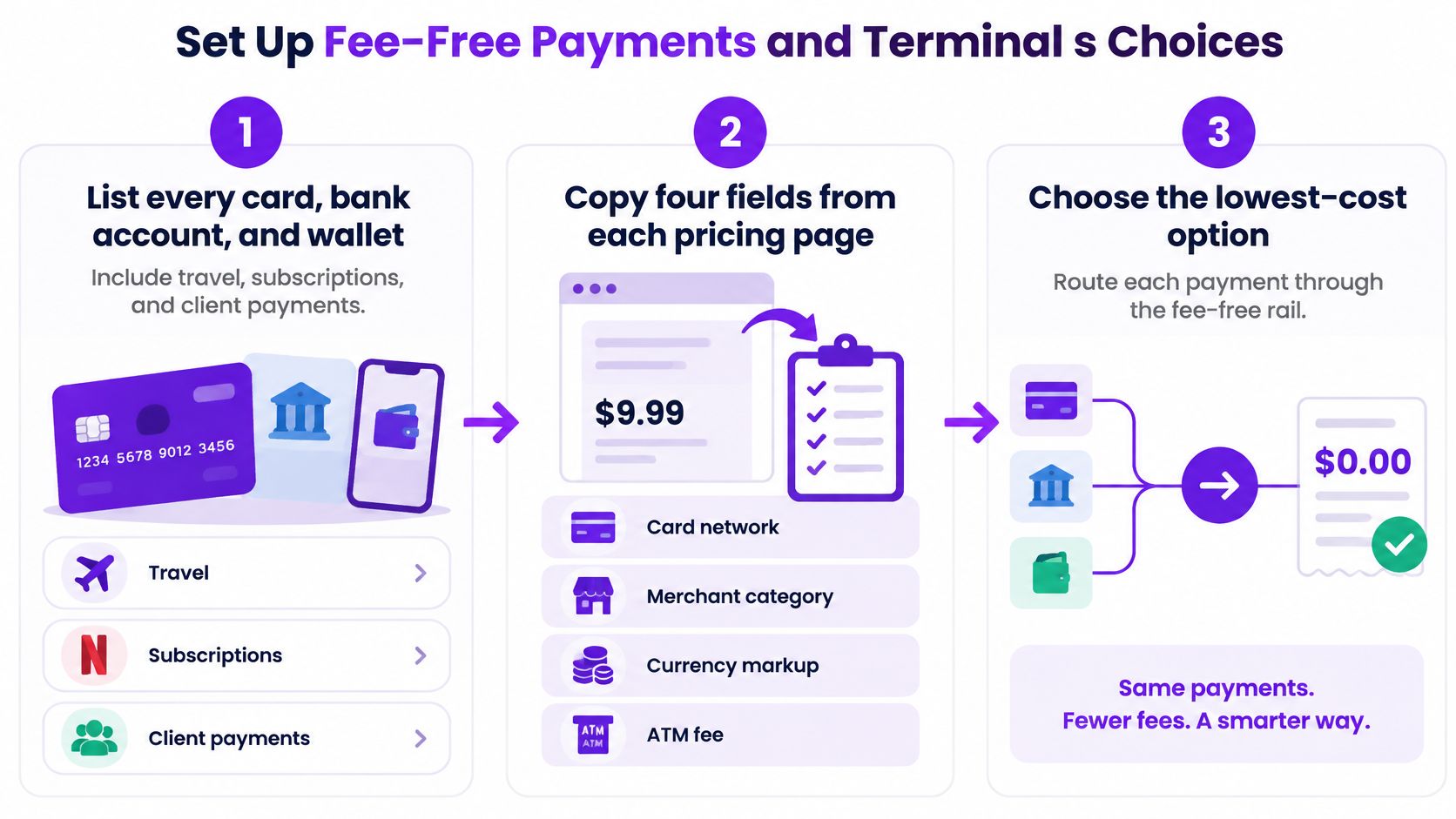
List every card, account, and wallet you use. Include the card on file for software, ads, hosting, and app stores, not just the cards in your physical wallet. Subscriptions are where old, fee charging cards hide.
Copy four fields from each pricing disclosure. Record the foreign transaction percentage, any fixed fee, the cash advance fee, and the exchange rate method. The CFPB consumer credit rules on foreign transaction disclosures govern how issuers disclose these charges, and the percentage on your agreement often combines a network assessment and the issuer's own charge in a single number. Two cards quoting the same headline figure can split it differently, which is worth knowing when you compare statements later.
Mark the three triggers for each card. A purchase can qualify because it's in a foreign currency, because it happens outside your home country, or because the merchant is foreign, even when the price displays in U.S. dollars. That third trigger catches people who never leave home but buy from overseas vendors.
Run the break even math on any annual fee. Removing a 3% fee saves $30 per $1,000 of foreign spend. A card with a $90 annual fee therefore needs $3,000 of qualifying spend to break even before rewards or other benefits count. Below that spend level, a no annual fee option usually wins.
Assign Each Job to One Rail
Make one no foreign fee card your default. Use it for hotels, transit, flights, and foreign websites, and update it as the card on file for every recurring foreign merchant you found in step 1. Keep a backup card stored separately from your wallet, so one lost card doesn't force you onto an expensive rail.
Designate balances for your rent currencies. Pick the one or two currencies you pay housing and regular local bills in, and hold those in your multi-currency account. Spending from a matching balance removes conversion from the transaction entirely, which is the cleanest way to avoid foreign transaction fees on large, repeated payments.
This short video walks through the same audit and terminal decisions in order, which helps if you want to follow along with your own statements open.
Choose Correctly at the Terminal
Always select the local currency. When a terminal or ATM offers your home currency, that's dynamic currency conversion. The merchant or ATM operator sets that rate and keeps the markup, and no line on your receipt shows what you paid for the privilege. Choosing local currency lets your card network convert instead, so your no fee card does the work you picked it for.
Use disclosure rules as a comparison tool in Europe. EU Regulation 2019/518, adopted on March 19, 2019 with most provisions applying from December 15, 2019, requires conversion charges to be shown as a percentage markup over the latest available European Central Bank reference rate. If the screen shows a markup you'd never accept as a stated fee, decline the conversion.
The terminal is asking who gets to set your exchange rate. Local currency means your card network sets it. Home currency means the merchant sets it.
Cut Cash Stops Down
- Withdraw less often, in larger amounts, from the right machines. A 2013 U.S. Federal Register notice on ATM disclosures reported that a foreign ATM charged an average of $2.40, while the customer's own financial institution charged an additional average of $1.40, for a combined $3.80 per withdrawal. Each stop is a flat toll regardless of how much cash you take out, so small frequent withdrawals pay the toll many times over. Two withdrawals a month at $3.80 comes to about $91.20 a year before any exchange markup, so use in network or fee reimbursing ATMs and consolidate your stops.
What Repeated Foreign ATM Use Costs
| Charge | Amount | When measured |
|---|---|---|
| Foreign ATM operator average | $2.40 | 2013 Federal Register notice |
| Customer's own institution, average add on | $1.40 | 2013 Federal Register notice |
| Combined average per withdrawal | $3.80 | 2013 Federal Register notice |
| Foreign ATM charge in 2004 | Under $1.50 | Cited in the 2013 notice |
| Two withdrawals a month | About $91.20 a year at $3.80, before FX markup | Illustration from those averages |
You're done when one note names your tool for card spend, subscriptions, contractor payments, and cash. If any category still points to whatever card is closest, that category will produce your next fee.
Monthly Checks Waivers and the Lock-In
Setups drift. A subscription renews on an old card, a hotel bills through a foreign entity, a new client pays through a converting platform. A ten minute monthly check catches all three before they repeat.
The Monthly Routine
Scan each statement for fee lines and odd totals. Look for foreign transaction charges, conversion notes, and merchants you assumed were domestic. Software, advertising platforms, hotels, and coworking spaces billed by a foreign entity are the usual surprises.
Move every recurring foreign merchant to your no fee card. Update the card on file the same day you spot the fee, then note the next renewal date. Fixing the card after the second renewal means you paid the fee twice for one lesson.
Ask for a waiver when a fee posts. In 2024, 64% of U.S. consumers who asked their credit card issuer to waive or reduce a foreign transaction fee succeeded, according to LendingTree's survey of 2,042 consumers. Call, name the charge and date, ask politely for a waiver or reduction, and write down the agent's name. You can also ask before a long stay abroad, while you still have time to switch cards if the answer is no.
Tell your issuer before a new country. A fraud freeze at a hotel desk pushes people toward the nearest expensive ATM or a backup card with a 3% worked example fee. A two minute travel notice in the app prevents that scramble.
Skip add on prompts that lock in a merchant rate. Screens offering rate protection or guaranteed home currency totals are selling you the merchant's conversion. Decline and pay in local currency.
If you're comparing account structures while living outside your home country, our guide to opening a bank account for non residents explains what banks typically require. Readers who are also sorting out the rest of a mobile work setup, from where to find a suitable finance plan for tracking income across currencies to keeping invoices consistent, can use our Dive Deeper guides, which cover visas, banking, insurance, coding, deep work tactics, tools, marketing, emails, and partnerships. Our Free Invoice Generator tool helps you state the billing currency clearly on every invoice, and since Mazurly pricing is coming soon, everything on Mazurly is free in the meantime.
The Lock-In Decision
Before this week ends, name your three tools out loud. Your default no fee card for spend and subscriptions. Your cash account for withdrawals. Your currency balance for rent and client income in the place you live.
If you're keeping a fee charging card for its rewards, write its break even spend next to it. Rewards that return less than the fee you pay abroad aren't rewards, they're a discount on an overcharge. Drop the card from foreign use if the math fails, and keep it only for domestic categories where it wins.
Tonight's version is smaller. Put one card in your wallet, set one cash rule you'll follow at every ATM, and make sure one currency balance is ready before your next charge or client payment lands. That's the whole system, and it fits on an index card.
Stop paying conversion costs twice on money you earn and spend abroad. Mazurly gives globally mobile founders, freelancers, and remote operators practical guides and free tools for invoicing, banking, visas, and cross border payments, so you can set up your three tool money system and keep it running from anywhere. Visit us today, pick your default card, cash account, and currency balance, and route your next payment the cheaper way.