
Digital Nomad Visa Brazil Requirements for 2026

Table of contents
- Brazil Digital Nomad Visa Rules in One Table
- VITEM XIV requirements at a glance
- Separate eligibility from missing paperwork
- Which Remote Setups Fit the Visa
- Business model and the evidence it needs
- Freelancers need a traceable payment chain
- Founders should resolve the employer-letter gap early
- Income Insurance and Tax Residency
- Make your financial evidence readable
- Buy coverage for the intended stay
- Don't treat foreign income as a tax exemption
- How to Apply for VITEM XIV
- Prepare and submit in sequence
- Review the file as a connected explanation
- Visa Costs and Renewal After Year One
- Visa cost and compliance checklist
- Plan the next decision before expiry
- Your First Month After You Land
- Set up contact and work essentials
- Handle identification and housing deliberately
- Keep your professional arrangement aligned
- Decide Whether Brazil Fits Your Setup
- Apply, wait, or choose another route
- Compare the whole move
Brazil's digital nomad route is VITEM XIV, and the first-pass test is foreign-source income of at least US$1,500 a month or US$18,000 in funds, for remote work paid from outside Brazil. Meeting the money test doesn't automatically make every laptop-based business eligible.
The harder question is how you'll prove who pays you. An employee with a foreign employment contract has a different evidence problem from a founder who takes distributions from an overseas company.
Think of the application as a paper trail connecting your work, your payer, and your bank account. Before committing to housing or flights, make sure those documents tell the same story.
Brazil Digital Nomad Visa Rules in One Table
The financial alternatives are at least US$1,500 in foreign-source monthly income or at least US$18,000 in bank funds, according to the Brazilian Embassy in Tallinn's digital nomad guidance. That guidance also allows bank funds to complement income evidence and calls for health insurance covering Brazil throughout the stay, evidence of the foreign professional relationship, and a remote-work declaration.
The savings alternative isn't a visa fee or a payment to the government. It's evidence that you can support yourself while living in Brazil.
VITEM XIV requirements at a glance
| Requirement | Official benchmark | What it means |
|---|---|---|
| Visa category | VITEM XIV temporary visa | Residence for remote work, not a tourist extension |
| Legal basis | Normative Resolution No. 45/2021 | Dedicated digital nomad immigration category |
| Who pays you | Employer or client outside Brazil | A Brazilian employer is incompatible with this visa |
| Monthly income | At least US$1,500 | Foreign-source income, not Brazilian wages |
| Savings alternative | At least US$18,000 | Equal to 12 months of the monthly floor; funds may complement income |
| Initial stay | 1 year | Initial residence period; check later rules before it ends |
| Health cover | Insurance valid for the full stay in Brazil | Proof belongs in the application file |
| After entry | Federal Police registration within 30 days | Residence administration continues after arrival |
The Brazilian Embassy in Helsinki's VITEM XIV guidance identifies an initial residence period of one year. Treat that as a planning horizon, not permission to remain indefinitely, and follow the validity recorded on your issued documents.
Separate eligibility from missing paperwork
A missing employer letter and an incompatible employer aren't the same problem. You can ask an overseas employer to document an existing remote arrangement. You can't turn Brazilian employment into foreign employment by describing it differently.
Likewise, savings can help establish financial self-sufficiency, but they don't replace evidence of qualifying professional activity. Someone with money in the bank still needs to explain the remote work they'll perform.
Mark each table row as ready, document missing, or eligibility question. Then resolve eligibility questions before paying to prepare the rest of the file.
Practical rule: Don't ask only whether you meet the income requirement. Ask whether a consular officer can follow the money from a qualifying foreign relationship to you.
Which Remote Setups Fit the Visa
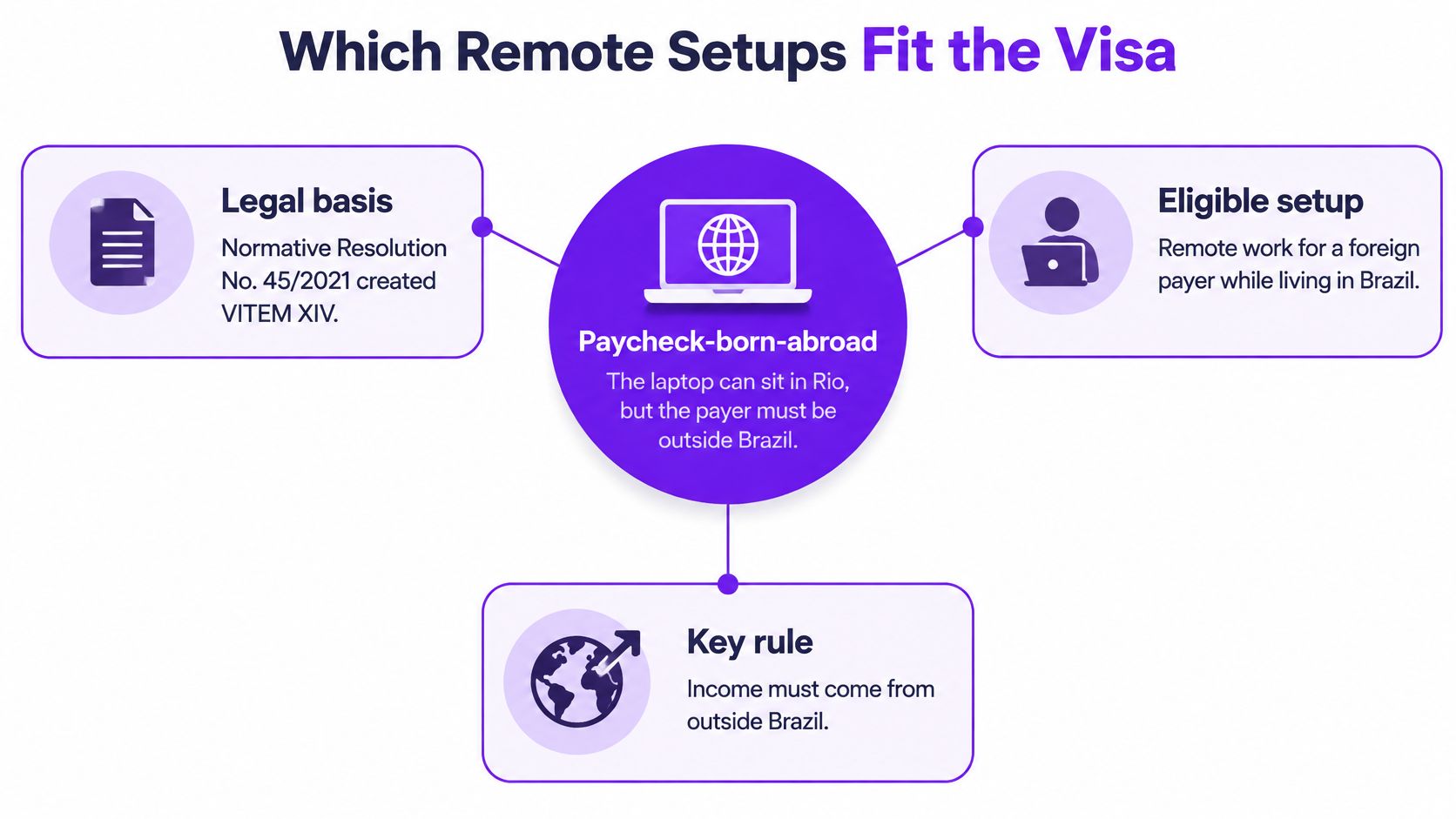
Your laptop can sit in Rio, but your paycheck needs to come from abroad. That's the simplest starting analogy, though founders and freelancers need to look beyond the location of the bank account receiving the transfer.
The Brazilian Consulate in Istanbul's digital nomad guidance identifies Normative Resolution No. 45/2021 as the framework for remote professional activities using information and communication technologies for an employer or client outside Brazil. It also specifies Federal Police registration within 30 days of entering Brazil, making this a residence pathway with post-arrival obligations.
The distinction is between working from Brazil and entering the Brazilian labor market. An online job doesn't qualify merely because you can perform it from anywhere.
Business model and the evidence it needs
The Brazilian Consulate in Atlanta's nomad instructions emphasize the foreign professional relationship, supporting contracts, and proof that the work can be performed remotely. The comparison below is an evidence-strength assessment, not an official ranking or a promise of approval.
| Setup | Core evidence | Visa fit |
|---|---|---|
| Salaried employee of a foreign employer | Employment contract plus employer or manager letter authorizing remote work from Brazil | Strongest documentary fit |
| Single foreign-client contractor | Service contract and client confirmation that the work is remote and paid from abroad | Strong if the payer is outside Brazil |
| Multi-client freelancer | Contracts, invoices, and payment records showing foreign clients | Possible if foreign remuneration is traceable |
| Founder paid by distributions | Foreign company ownership documents; often no conventional employer letter | Weakest and fact-specific |
| Any work for a Brazilian company | Brazilian employment relationship | Not this visa |
| Foreign company with some Brazilian customers | Evidence of foreign remuneration and a non-Brazilian labor relationship | Unresolved; confirm with the consulate |
Employees have the clearest document chain. The contract identifies the employer and compensation. A signed employer or manager letter should then explicitly authorize working remotely from Brazil, rather than merely say the company allows remote work.
A contractor with a foreign client can build a similarly clear file. The service agreement should identify the contracting entity, describe the services, and state the payment arrangement. Ask the client to confirm that you can deliver the work remotely from Brazil.
Don't substitute a friendly email saying they're happy for you to travel when what you need is a clear statement about the professional arrangement. The officer should be able to understand the relationship without reconstructing it from scattered messages.
Freelancers need a traceable payment chain
A multi-client freelancer's challenge is organization. Prepare a client summary connecting each relevant agreement to invoices and matching receipts, with the client's location clearly identified.
Say you're a designer serving overseas software companies. Label the contract, invoice, and bank receipt with the same client name so the reviewer can follow the chain. Where a payment processor appears on the bank statement instead of the client, include the processor record connecting the payment to the invoice.
These are useful supporting documents, not a guarantee that invoices alone satisfy your consulate. A portfolio explains what you do, but it doesn't establish who owes you money or where that payer is located.
For broader planning around location-independent work, the digital nomad insights from Mega Income Stream can help you think through operating arrangements. Use official consular instructions, rather than lifestyle guidance, to decide what belongs in the visa file.
Founders should resolve the employer-letter gap early
A founder taking distributions may have substantial income without a conventional salary or manager. Ownership documents can establish that you own a company, but they don't necessarily establish a qualifying service relationship or explain the work you'll perform.
Prepare a factual description of your role, the company's location, how it pays you, and where its customers are. Ask the consulate covering your residence whether it will accept ownership records, distribution statements, customer contracts, payment processor records, or a founder declaration.
A foreign company with Brazilian customers is an unresolved edge case, not an automatic approval or rejection. Incorporation abroad doesn't settle every question about the relationship between your work and Brazilian operations.
A foreign bank account isn't a substitute for a foreign professional relationship.
Choose the setup that matches how you receive money. Don't collect an employee-style file if your real arrangement is owner distributions, and don't hide a mixed customer base behind a broad description such as online consulting.
Income Insurance and Tax Residency
Keep financial eligibility, insurance, and tax planning in separate folders. They answer different questions, and passing the immigration money test doesn't settle the others.
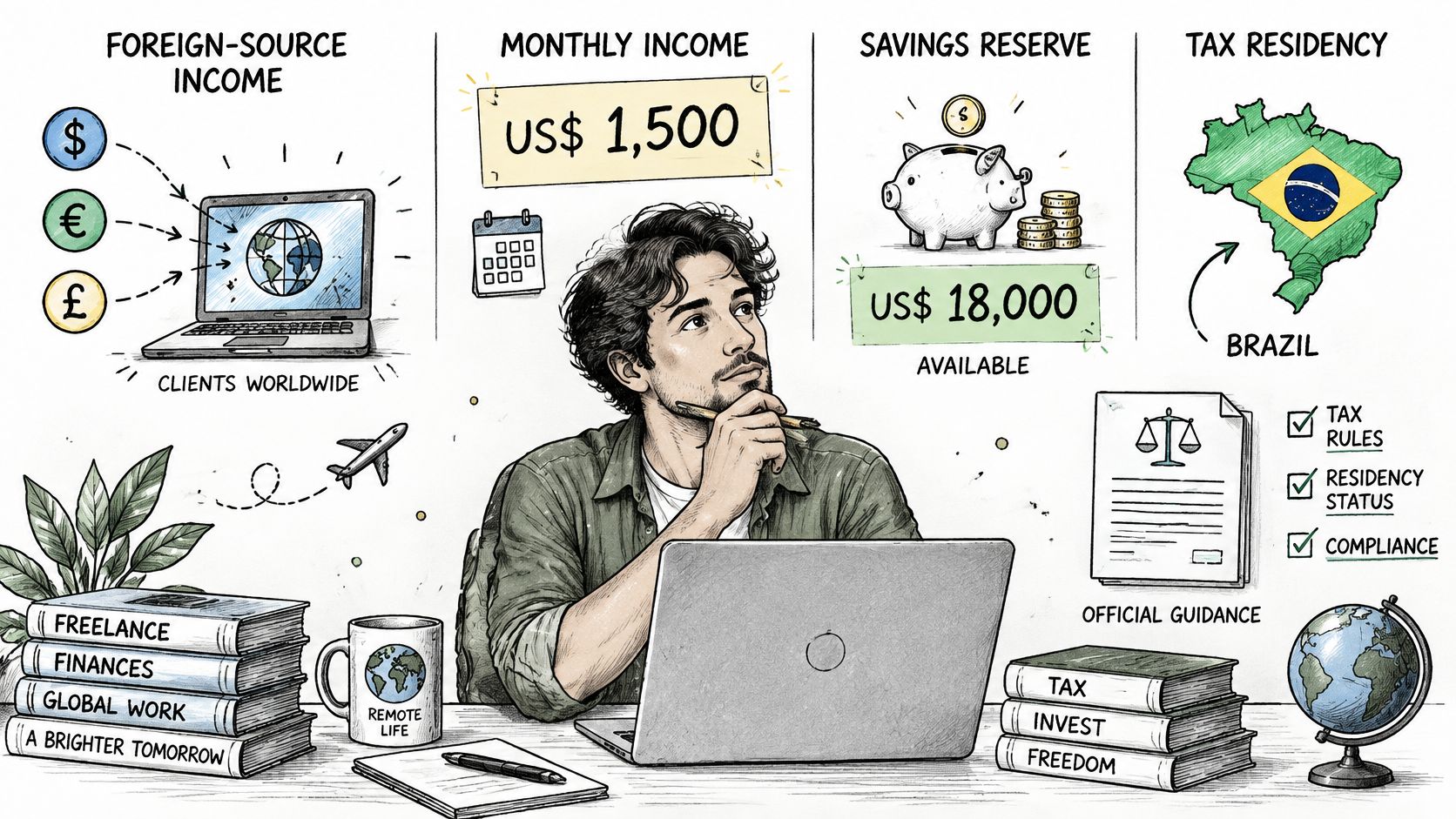
The Brazilian Embassy in Sofia's VITEM XIV guidance confirms the financial alternatives of at least US$1,500 per month in foreign-source income or US$18,000 in available funds. Choose the evidence route that accurately reflects your finances rather than presenting an unusually large transfer as recurring earnings.
Make your financial evidence readable
Bank statements should clearly identify you, the financial institution, the currency, and the relevant transactions or available balance. Keep original downloadable statements, not just cropped screenshots from a banking app.
For recurring earnings, connect deposits to payslips or client invoices. For irregular freelance payments, prepare a short reconciliation explaining which invoices produced which receipts.
Account ownership: Make it clear that the money belongs to you.
Payment identity: Explain processor names that don't match client names.
Currency clarity: Label the original currency and explain any conversion used.
Consistency: Match your name and business details across contracts and statements.
Buy coverage for the intended stay
Check the insurance certificate for territorial coverage and policy dates before paying. A policy that expires while you still intend to reside in Brazil leaves a gap that an attractive premium doesn't solve.
When comparing health insurance options for remote workers, distinguish visa documentation from the care you would receive. Review exclusions, deductibles, claims procedures, and whether you must pay providers upfront.
Ask the insurer for a certificate clearly naming you and confirming coverage in Brazil. Save the certificate and assistance contact details offline.
Don't treat foreign income as a tax exemption
The visa's foreign-payer condition is an immigration test, not a promise that Brazil will disregard your income for tax purposes. Ask a Brazil-capable tax adviser when residence could begin under your travel pattern and how salary, freelance receipts, distributions, and investments would be treated.
Keep entry and exit records alongside contracts and foreign tax documents. Our guide to investing while living abroad provides context for organizing cross-border investment questions, but your adviser should assess your circumstances.
Proceed when the financial trail and coverage are clear. Pause when your qualifying income depends on arrangements you haven't yet explained, especially revenue connected to Brazilian customers.
How to Apply for VITEM XIV
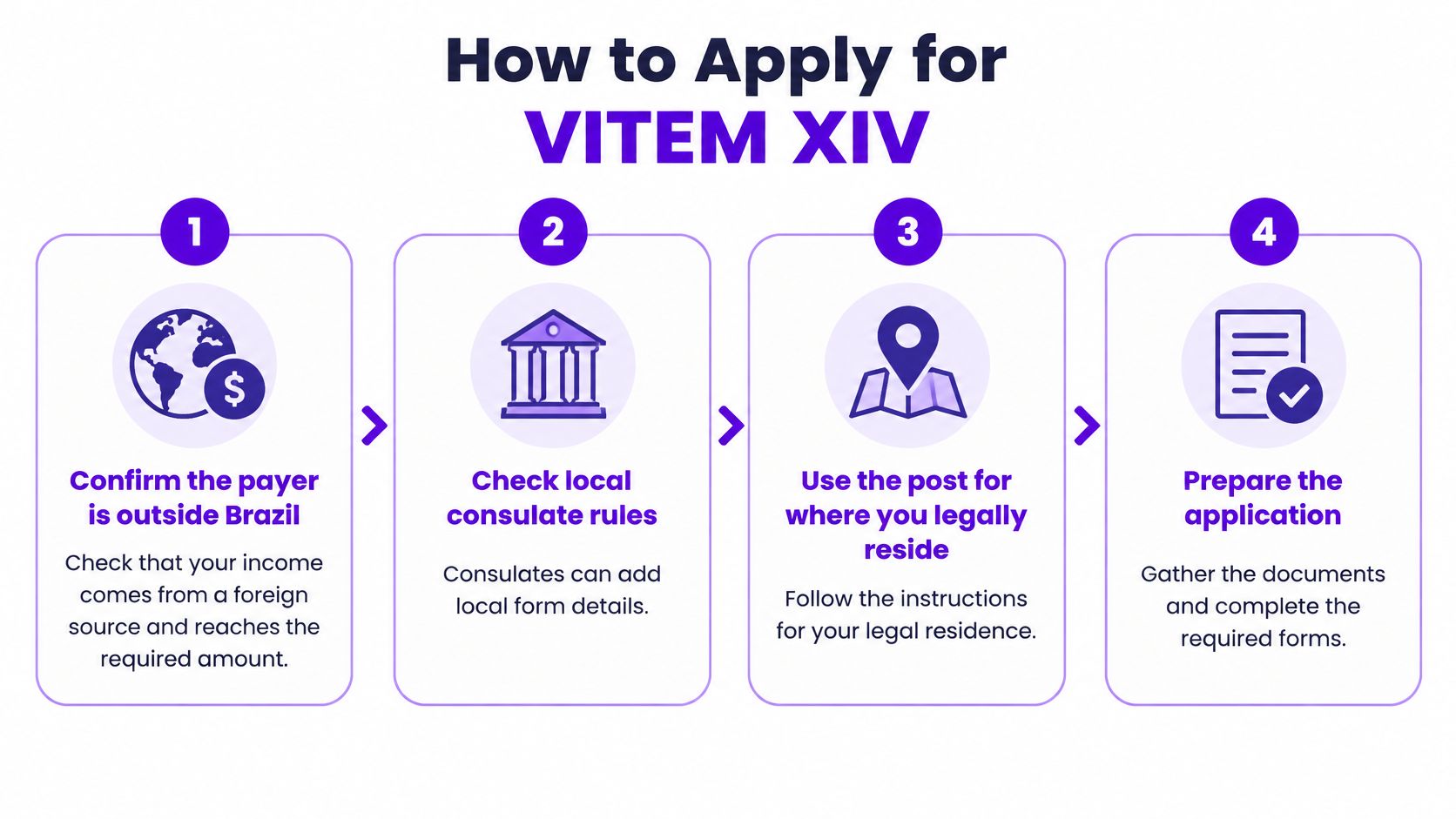
Use the Brazilian consulate responsible for where you legally reside. Its current checklist should control submission format, appointment arrangements, document preparation, and any additional local requirements.
The Brazilian Consulate in Hong Kong's VITEM XIV instructions distinguish foreign remote work from incompatible Brazilian employment and support keeping an employment or services contract plus a signed employer or manager statement confirming that the role can be performed remotely from Brazil.
Prepare and submit in sequence
Confirm the payer and financial route. Identify the legal entity employing or contracting with you, its location, and how you'll establish financial eligibility. The common slip is focusing on where the bank account sits while leaving the underlying payer unclear.
Collect your identity and professional documents. Prepare your valid passport, employment or services contract, and signed remote-work authorization. Check that the letter mentions permission to work from Brazil, rather than relying on a generic remote-work policy.
Add the supporting evidence. Include the remote-work declaration, financial records in your name, and insurance for the intended stay. A bank statement belonging to someone else or coverage ending mid-stay creates an avoidable question.
Complete the consular application. Follow your responsible post's VITEM XIV instructions and check whether it requests further identity, background, translation, or legalization documents. Don't copy another country's checklist and assume the submission method will match.
Wait for the decision before committing to travel. Respond promptly to requests for clarification and keep copies of the submitted file. Don't treat an application receipt as approval, or assume an airport officer will convert a tourist arrival into this residence visa.
Complete post-entry registration. Follow the applicable Federal Police instructions and bring the documents requested for your appointment. Don't assume the visa sticker completes every residence formality.
Review the file as a connected explanation
Before submission, compare names, payer details, dates, and compensation across the application. Explain genuine differences, such as a client's trading name differing from its registered company name.
An employer letter should identify the signatory and their role so the authorization is understandable. Keep the original signed version and a contact route for follow-up.
Before you submit: Someone unfamiliar with your business should be able to identify who pays you, what you do, and why you can do it from Brazil.
After approval, calendar the registration task and the residence end date shown on your documents. Keep those dates separate from passport expiry and insurance renewal so you don't confuse unrelated deadlines.
Visa Costs and Renewal After Year One
Money you demonstrate isn't the same as money you spend. Available savings remain your financial evidence, while application charges, insurance, and document preparation belong in your moving budget.
Don't rely on a fee quoted for someone applying through a different consulate. Obtain the current amount, accepted payment method, and payment instructions from the post handling your file.
Visa cost and compliance checklist
| Cost item | What to check |
|---|---|
| Consular visa fee | Confirm the schedule and payment rules with the consulate covering your residence |
| Health insurance for full stay | Confirm explicit coverage in Brazil throughout the intended period |
| Document translation or legalization | Ask whether the consulate requires it for each document type |
| Federal Police registration | Confirm the current fee through the official appointment process |
| Proof of funds benchmark | Financial evidence alternative to monthly income, not a fee |
Price document preparation only after checking what your post wants. Translating every document before receiving instructions can create unnecessary expense, while postponing a required legalization can delay submission.
Keep a separate reserve for appointment travel, document delivery, and temporary accommodation. Those costs don't establish visa eligibility, but they affect whether the move is affordable.
Plan the next decision before expiry
Don't budget on the assumption that an extension is automatic. Confirm the current renewal route, eligibility conditions, supporting documents, and submission timing with the appropriate authority before your permission expires.
Set an advance reminder tied to your actual residence end date. At that review, decide whether you'll pursue an available extension, qualify through another route, or leave on schedule.
Maintain current contracts, financial records, and insurance documents while you're in Brazil. Rebuilding the entire evidence trail just before expiry is harder than keeping it organized as you go.
Your First Month After You Land
Put Federal Police registration ahead of discretionary travel. Confirm the deadline and procedure applicable to your issued permission, then arrange the appointment before committing to a long trip away from your arrival city.
Keep your passport, visa, entry evidence, appointment confirmation, and requested supporting documents together. Check the current document list rather than assuming the consular application bundle is sufficient.
Set up contact and work essentials
A local phone connection or suitable eSIM helps you receive appointment updates and coordinate housing. Test calls and mobile data before relying on the connection for work.
Arrange a dependable mailing address and a backup workspace. Café Wi-Fi can be useful, but it shouldn't be your only option for confidential calls or time-sensitive client delivery.
Phone access: Keep your existing number accessible if it receives banking verification messages.
Insurance access: Save the certificate, assistance number, and claims instructions offline.
Work continuity: Test video calls and identify an alternative connection.
Document backup: Store encrypted copies separately from the originals.
Handle identification and housing deliberately
A CPF, Brazil's individual taxpayer number, is commonly requested during banking, phone-plan, and longer-rental arrangements. Confirm the current issuing procedure rather than relying on an old account of a tourist workaround.
For financial setup, our guide to bank accounts for non-residents can help you prepare questions about identification, address evidence, and account access. Don't assume immigration permission means every institution will accept the same documents.
Start with flexible furnished accommodation while you test the neighborhood, connection quality, and commute to administrative appointments. Before signing a longer lease, check deposit terms, included utilities, and cancellation obligations.
To build a realistic moving budget, Fintrack's planning guidance offers a useful structure for separating initial moving expenses from recurring bills. Add overlapping accommodation and document-related travel rather than budgeting only for rent.
Keep your professional arrangement aligned
Don't take Brazilian employment or shift work onto Brazilian companies because you're now living locally. Review material changes to your role or client base before assuming your existing permission covers them.
During your arrival week, confirm the police booking, save your insurance documents, back up foreign-payment evidence, and record your residence expiry. Once those tasks are secure, you'll have more room to explore without neglecting the administration that supports your stay.
Decide Whether Brazil Fits Your Setup
The right verdict comes from your documents, not your job title. A consultant, developer, or agency owner can have a clear foreign professional relationship, an unresolved arrangement, or an incompatible local one.
Apply, wait, or choose another route
Apply when the story is complete. Your payer is outside Brazil, your financial evidence meets the applicable benchmark, your insurance covers the intended stay, and your contract and authorization explain the remote arrangement. Check the responsible consulate's full checklist before submitting.
Wait when the money is clear but the relationship isn't. Founder distributions, missing client agreements, and a customer base that includes Brazil deserve a direct consular question before you commit. Describe the arrangement accurately and ask which supporting documents the post will accept.
Choose another route when a Brazilian company would employ you. A remote schedule doesn't remove that boundary. Seek advice on an immigration category that matches the work you plan to do.
Compare the whole move
Brazil needs to fit your operating model as well as your destination preferences. Consider client time zones, insurance, administrative workload, housing commitments, and tax advice alongside immigration eligibility.
Our comparison of digital nomad visas can help you evaluate alternatives. We also offer a Travel Visa Requirements Finder, and our Travel section covers smart visas, eSIMs, and cost of living; the Free Invoice Generator can help keep foreign-client invoices tidy, though it doesn't replace contracts or payment evidence.
If your foreign-payer story is clear, request the current document checklist this week. If it isn't, resolve the evidence before paying for long-term plans.
At Mazurly, we combine mobility guidance with practical tools for running a business across borders. Use our Travel Visa Requirements Finder to compare your options, then organize the contracts, invoices, insurance, and arrival tasks that will support your Brazil application.