
Bank Account for Non Residents: Options and Documents
Table of contents
- Which Account Type Fits Your Situation
- Sort by tax home, payment flow, and purpose
- Tax Residence, Not Address, Decides What Banks Ask
- Separate the different kinds of residence
- Work through your status before applying
- How Country Rules Change Your Options
- Compare the route, not just the country
- Get a usable written answer
- Documents Banks Ask Non-Residents For
- Make the file internally consistent
- Add company authority and ownership evidence
- How to Open a Non-Resident Account Remotely
- Complete the application in a controlled sequence
- Check company classification and access continuity
- Fees and Costs to Compare Before You Open
- Compare what arrives, not the headline fee
- Build your own cost comparison
- Keep Your Account Open After Approval
- Understand what activation actually permits
- Maintain evidence alongside your bookkeeping
You're ready to invoice a client abroad, but the payment form asks for bank details you don't have. Your existing bank wants a local address, an app asks for tax identification numbers, and you're unsure whether your passport or your current location determines eligibility.
Finding a bank account for non residents starts with understanding how the provider sees you. Your passport proves identity, but your tax residence, business structure, and expected payments often determine whether the bank can accept you and keep serving you.
Which Account Type Fits Your Situation
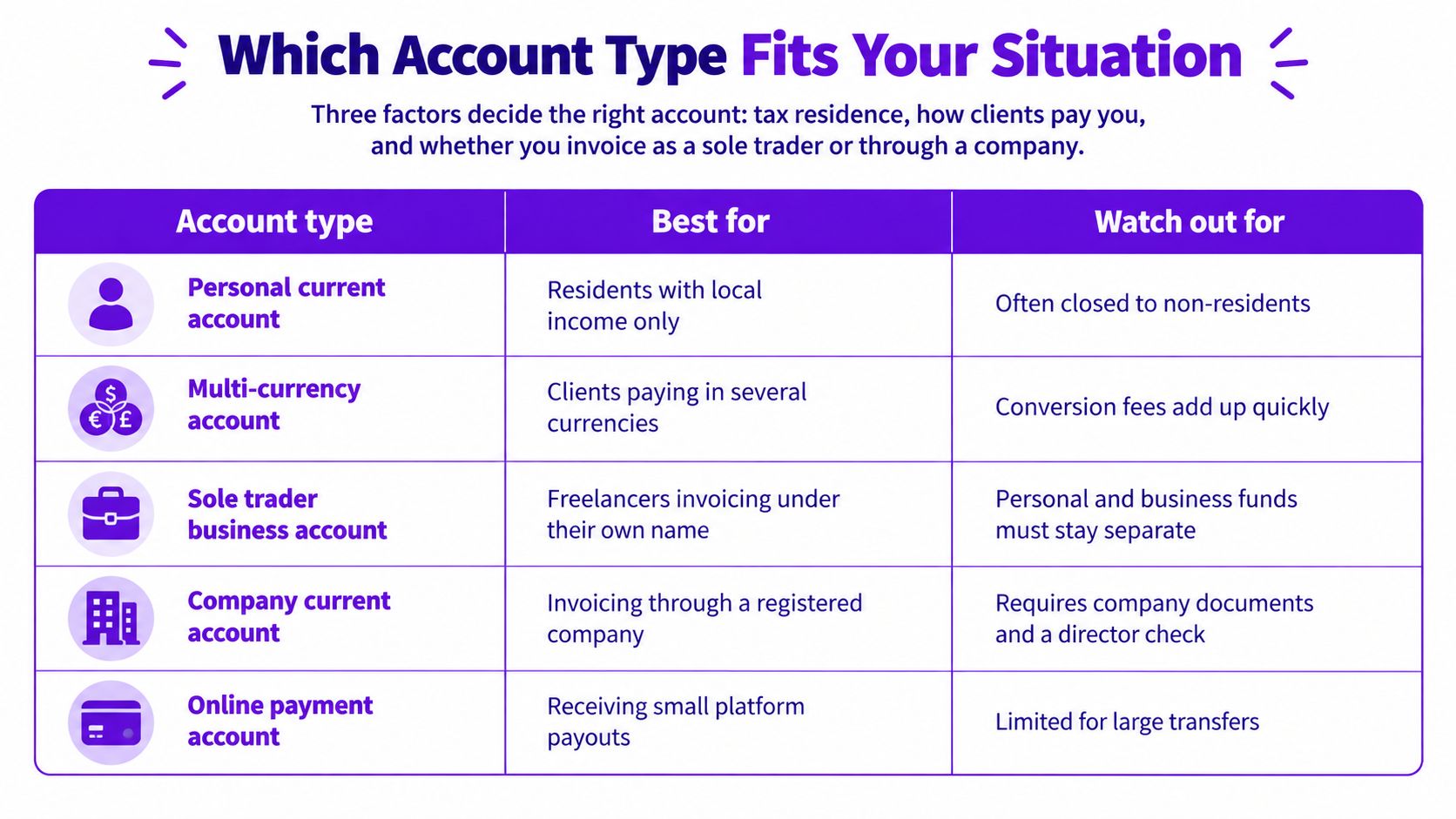
No single account type wins. The right choice depends on your tax residence, how clients pay you, and whether you invoice personally or through a company.
Non-resident account types compared
| Account type | Best for | Typical onboarding | Main limitation |
|---|---|---|---|
| Multi-currency fintech account | Freelancers receiving foreign-currency client payments | Remote application with app-based identity checks where eligible | Limited lending; protections differ by country and provider |
| Traditional bank non-resident account | Customers with a stable tax home who need a broader banking relationship | Branch or video verification with more supporting paperwork | Slower review and possible minimum balances |
| Local account at a remote-friendly bank | Remote workers needing local bills, rent, or payroll | Remote application with accepted address evidence | Often requires local residence or an eligible local address |
| Business account for a company | Founders invoicing clients across borders | Entity documents and director and ownership checks | Beneficial-owner review can delay approval |
| EU basic payment account | Legally resident EU consumers needing essential payment functions | Application in another member state | No guaranteed credit or savings products |
The visual below offers another way to compare everyday payment needs. Treat product labels as starting points, not promises of eligibility.
Sort by tax home, payment flow, and purpose
Start with these questions:
Where do you file as a tax resident? Identify the tax IDs you hold, rather than choosing an account based only on your passport.
How will clients pay? List currencies, payment methods, and frequency. Receiving USD through local payment details is a different requirement from accepting international wires.
What relationship do you need? Separate receiving and spending money from savings, borrowing, and other banking services. Also check whether the account permits sole-trader activity or requires a company.
App-based providers can make remote onboarding convenient, but a fintech account isn't automatically a bank deposit. Check the legal provider, how customer money is held, and what protection applies if the provider fails.
Traditional banks may offer more products, but opening a current account doesn't guarantee credit approval. For broader comparison criteria, use our international banking guide.
Say you're a freelancer with an established tax home and US clients paying in USD. An eligible multi-currency business account could receive client payments, while a local personal account handles rent and household bills after you transfer your earnings.
Shortlist rule: Pick a pair of suitable account types before collecting documents. Build a file for specific providers, not every bank you might eventually consider.
Tax Residence, Not Address, Decides What Banks Ask
A foreign passport doesn't automatically make you a non-resident for tax purposes. Equally, a home address doesn't tell the bank everything it needs to know.
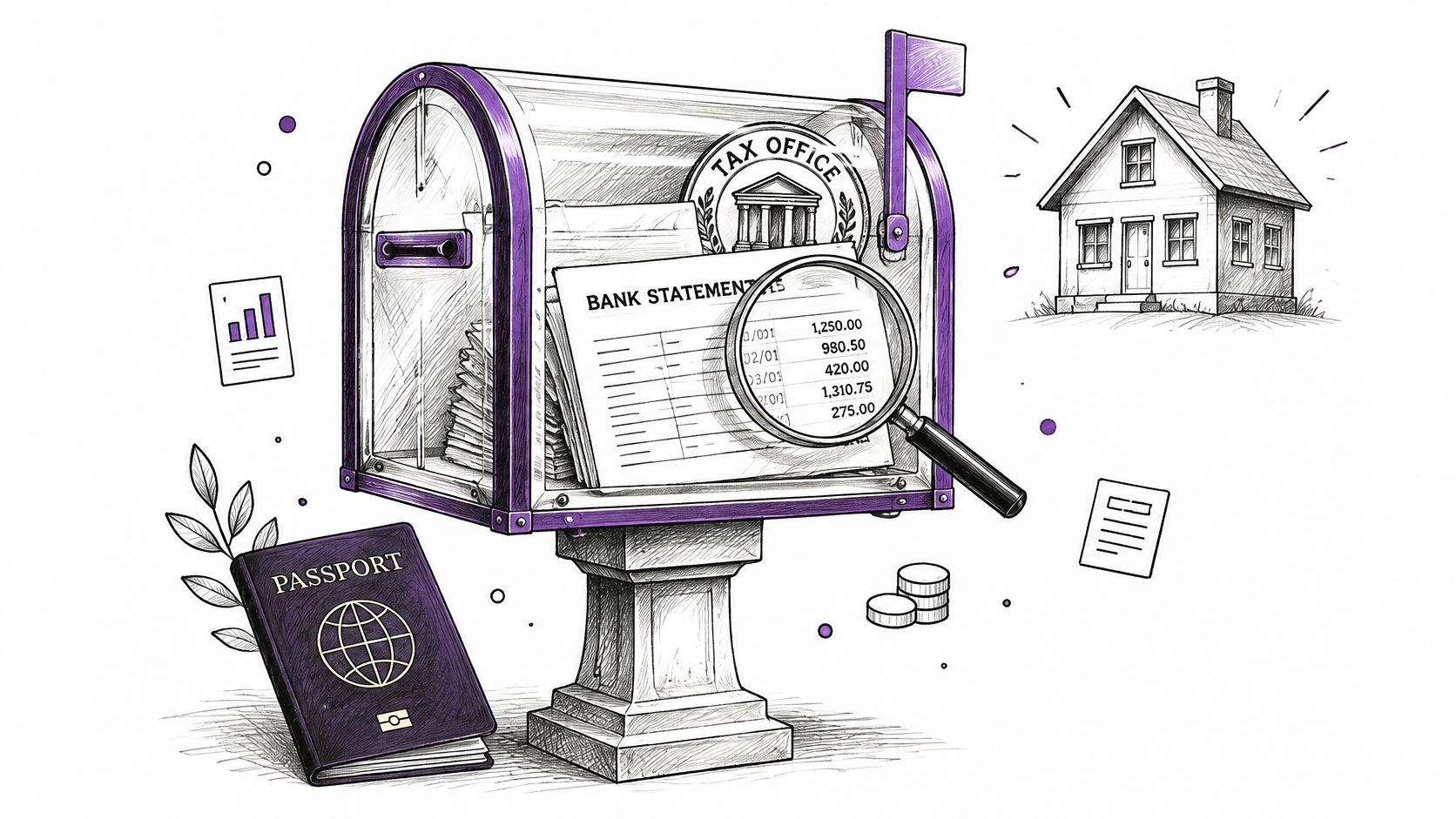
Think of the account as a mailbox the tax office may receive information from. The bank needs to establish which tax authority should receive that information, not merely where to deliver your debit card.
Separate the different kinds of residence
Citizenship means your nationality, usually evidenced by a passport.
Physical location means where you're staying now.
Legal residence means your permission to live somewhere under immigration rules.
Tax residence means where domestic tax rules treat you as a resident, potentially subject to treaty considerations.
Under the Common Reporting Standard, banks identify reportable overseas tax residents and pass account information through their domestic tax authority for annual exchange, including balances, interest, dividends, and financial-asset sale proceeds, as described in the Tax Observatory's assessment of CRS. That reporting framework doesn't itself prohibit non-resident accounts.
FATCA addresses US status separately: CIMB's FATCA and CRS FAQ distinguishes tax-residence reporting from obligations concerning US persons, including Americans living abroad. For example, a US citizen living in Lisbon doesn't stop being a US person just because they now have a Portuguese address.
Use the video as a supplementary explanation while keeping your own circumstances in mind.
Work through your status before applying
Start by identifying every country that could treat you as tax resident under its domestic rules. For each candidate, check your TIN, relevant filings, and the residence you intend to declare; don't omit a jurisdiction just because the form looks easier with fewer entries.
Then establish whether you're a US person for FATCA purposes and define the account's intended use. If Australia is part of your situation, Everglow Prosperity's explanation of Australian income tax for foreign residents provides useful country-specific context.
Support a residence change with dated evidence, such as tax filings, departure records, or local registration. Temporary travel doesn't by itself establish a new tax residence, and multiple tax residences may require multiple TINs.
Opening an account doesn't determine where income is taxable, and reporting doesn't automatically mean additional tax is owed. Keep that distinction in mind when planning investing while living abroad, too.
How Country Rules Change Your Options
The clearest cross-border access right in these examples concerns EU consumers. The Payment Accounts Directive, adopted in 2014 and implemented by member states from 2016, gives legally resident EU consumers access to a basic payment-account application in another member state without rejection solely because they live elsewhere, according to the EU's bank-account guidance.
That right concerns essential functions: receiving income or benefits, paying bills and taxes, and buying goods and services. Banks can still verify identity, conduct anti-money-laundering checks, and reject applications for legally justified reasons.
Compare the route, not just the country
Non-resident account routes by country
| Country or region | Typical route for non-residents | Usual requirements | Watch-out |
|---|---|---|---|
| EU, cross-border consumer | Basic payment account in another member state | Legal residence in the EU, identity evidence, and anti-money-laundering checks | Basic functions only; savings and credit aren't guaranteed |
| United States | A bank that explicitly accepts the applicant's overseas residence; a branch visit may be necessary | Passport, foreign address, and tax identifiers requested for the product | Confirm personal versus business eligibility and US-status questions |
| United Kingdom | An expat or non-resident product offered to customers in the applicant's residence country | Passport, proof of address, and any product-specific UK connection | A UK-address requirement can exclude an otherwise suitable applicant |
The EU row describes a legal baseline. The US and UK rows are screening routes, not equivalent statutory access rights or assurances that a particular bank will accept you.
Find the route matching your status, then check whether it supports your actual use. An account available to an overseas employee may not accept freelance business receipts; a company account may accept a foreign director without offering that director a personal account.
Get a usable written answer
Don't ask only whether the bank accepts foreigners. Give the eligibility team your citizenship, tax-residence country, current residential country, and personal or company-account requirement.
Ask them to confirm:
Residence eligibility: Does the product accept someone living and tax-resident where you are?
Opening method: Can the entire process finish remotely, including identity checks and activation?
Permitted activity: Are client receipts, contractor payments, or your business sector supported?
Address evidence: Must the address be local, and which documents will they accept?
A bank's written eligibility policy is more useful than another customer's successful application. Their residence, product, or business structure may be different from yours.
For other countries, use the same questions without assuming that a familiar bank brand follows identical rules everywhere. Keep the reply with your application records, including the product name and any stated conditions.
Documents Banks Ask Non-Residents For
Banks request documents to establish who you are, what the account will do, and who ultimately controls any company involved. The FATF Recommendations require customer identification and verification, beneficial-owner checks, an understanding of the relationship's purpose, and ongoing scrutiny of transactions.
Documents non-residents usually need
| Document | Why the bank asks | Common snag |
|---|---|---|
| Passport or national ID | Confirms identity and nationality | Expired document or unreadable mobile upload |
| Proof of residential address | Supports the residential address on file | Document outside the bank's accepted age window or in a landlord's name |
| Tax identification number (TIN) | Supports tax classification and reporting | Missing identifier for a declared tax residence |
| Tax-residence self-certification | Declares reportable tax residences | Answers contradict tax filings |
| Business registration and ownership chart | Establishes the entity and its controllers | Unclear beneficial owners or unexplained nominee arrangements |
| Source-of-funds evidence | Explains where incoming money originates | Payments without matching contracts or invoices |
| Expected transaction profile | Provides a baseline for monitoring | A description that doesn't identify customers or payment activity |
Make the file internally consistent
Use your legal name consistently, including middle names where requested. If documents use different transliterations, add an explanation and obtain certified translations when the bank requires them.
Don't force different address types into the same field. Your home, company's registered office, and coworking space can legitimately differ, but label each accurately and explain mail-forwarding arrangements.
Prepare a short transaction note covering expected monthly receipts, outgoing payments, currencies, customer locations, and major counterparties. Describe the work itself, such as software consulting for overseas businesses, rather than vaguely writing online services.
Say your passport record refers to a former city, invoices show your current location, and the company is registered elsewhere. Those differences don't necessarily prevent approval, but unexplained differences invite questions; dated relocation evidence and a clear address summary help the reviewer understand them.
Add company authority and ownership evidence
A company should also prepare its certificate of incorporation, shareholder register, ownership chart down to individuals, and director identity documents. Include evidence that the applicant is authorized to operate the account when requested.
For US applications, don't confuse a personal identifier with a company's tax identifier. Our guide to opening a bank account without an SSN helps distinguish that specific obstacle from the rest of the application.
How to Open a Non-Resident Account Remotely
Remote opening works best when you treat it as a document-review process with a digital interface. A polished app doesn't remove the bank's need to understand your circumstances.
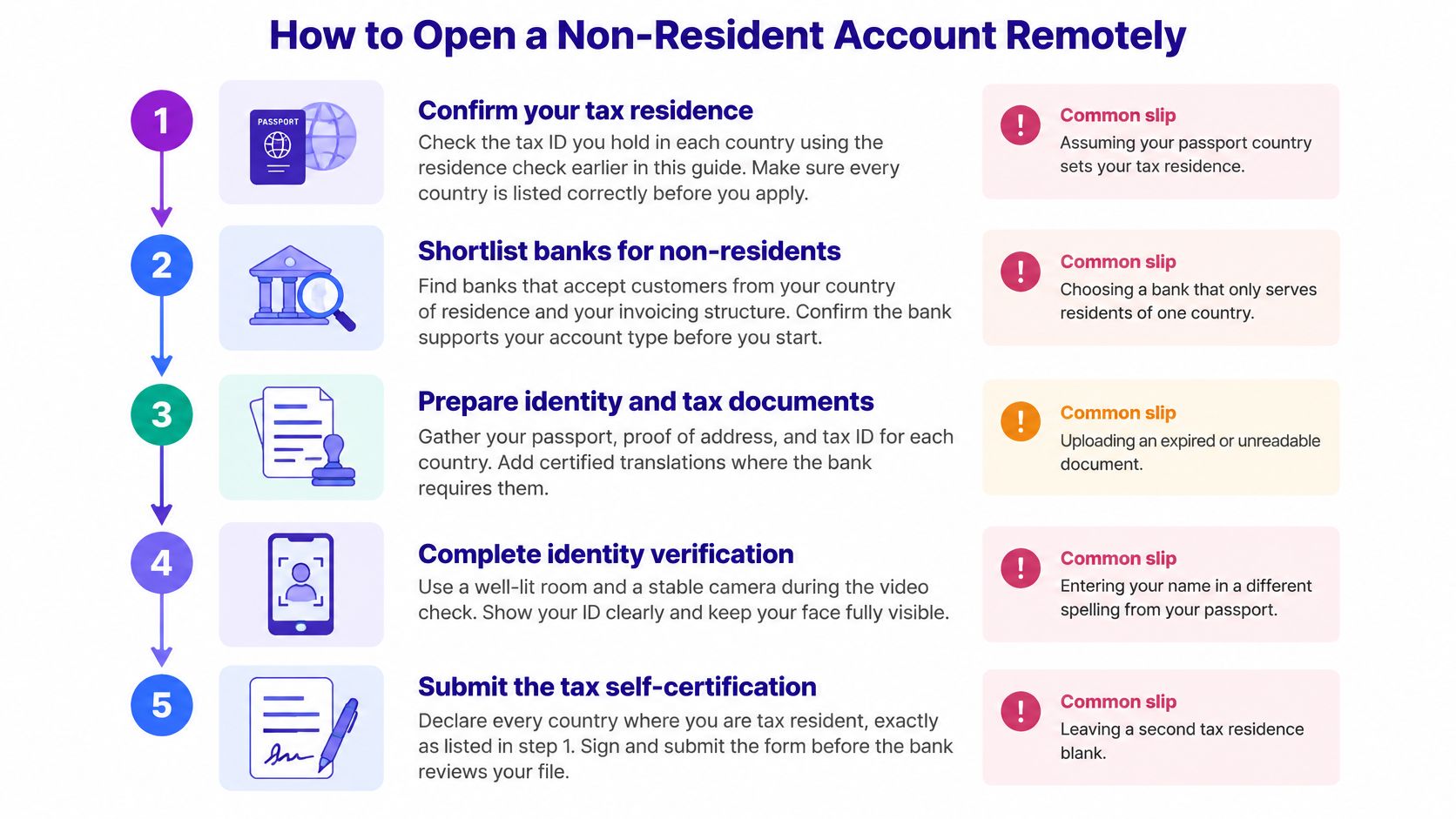
The illustration summarizes the main verification stages. The operational checklist below also covers restrictions, funding, and testing.
Complete the application in a controlled sequence
Confirm your tax position before entering the form. Resolve uncertain residence claims and gather the relevant identifiers. The common slip is selecting your passport country without checking whether it matches your tax position.
Shortlist providers that explicitly accept your situation. Check your residential country, business structure, and account purpose against published eligibility criteria. Don't mistake online account opening for worldwide availability.
Prepare the application folder. Save readable identity, address, tax, and business records alongside a concise business-and-payments note. The common slip is uploading disconnected documents without explaining what the business does.
Complete the form and tax self-certification carefully. Under the OECD's CRS framework, banks may test declared residence against documentary evidence and foreign indicators, including overseas telephone numbers or addresses. An unexplained foreign number can prompt questions, so describe it accurately rather than hiding it.
Finish the video or in-app identity check. Use good light, a clean camera lens, and the original identity document. Glare, cropped edges, and blurred photographs can make an otherwise valid document unusable.
Upload the supporting records in the requested categories. Check spelling, document completeness, and whether the bank requires certification or translation. A trading name entered where the form asks for the registered legal name can delay matching.
Describe expected transactions concretely. Give anticipated monthly volumes, currencies, customer types, and principal counterparties, identifying estimates as estimates. Avoid vague descriptions that leave the reviewer guessing whether you sell consulting, products, or payment services.
Clarify any activation conditions. Ask whether approval means full functionality or whether withdrawals, transfers, or other features remain restricted. The common slip is sending clients account details before understanding those restrictions.
Fund and test the account. Once the bank confirms it's operational, make a small transfer and check receipt, charges, and outgoing access. Don't reroute essential client revenue until the payment path works.
Check company classification and access continuity
Company applications can require additional classification of controlling persons and whether the entity is a passive non-financial entity. Answer those questions using the company's actual activities and ownership, not a label chosen merely because it sounds favorable.
Keep access to the telephone number used for authentication. If you're changing mobile arrangements while traveling, digital SIM basics with RedSim can help you distinguish connectivity choices; separately confirm whether your banking number can receive required messages, since a data connection alone doesn't guarantee SMS access.
Before redirecting payments: Save the approval notice, activation confirmation, and successful test-payment record together.
Fees and Costs to Compare Before You Open
If you regularly convert foreign-currency revenue, check conversion costs before focusing on the monthly account fee. A low maintenance charge won't help much if every client payment is converted at an unfavorable rate.
Typical non-resident banking costs
| Cost | What drives it |
|---|---|
| Monthly account maintenance | Account tier and minimum balance |
| Currency conversion markup | Provider, currency pair, and transfer size |
| Incoming international wire | Intermediary and receiving-bank deductions |
| Outgoing SWIFT wire | Destination country and urgency |
| Card foreign transaction fee | Card type and provider policy |
| ATM withdrawal abroad | Network, operator charges, and withdrawal allowances |
| Account application fee | Bank policy for non-residents |
Compare what arrives, not the headline fee
A transfer advertised without a separate fee can still include a currency margin. Compare the amount the recipient gets for the same starting amount, currency pair, and quote time.
For a clearly hypothetical calculation, suppose a client payment is $5,000: a 0.5% conversion markup would cost $25, while 2.5% would cost $125. These are illustrative inputs and arithmetic, not quoted provider prices.
International wires need a separate check. The sending bank, intermediary banks, and receiving bank can deduct charges, so the credited amount may be lower than the invoice amount even before conversion.
Build your own cost comparison
Model your real activity: Add account maintenance, expected payment fees, conversion costs, card charges, and cash withdrawals across a normal year. Include busy and quiet periods.
Check waiver conditions: Establish whether a minimum balance or card-spend requirement removes fees, and whether meeting that condition would leave too much operating cash unavailable.
Request a usable exchange quote: Ask for the effective rate and the recipient amount for your likely transfer size. A description such as competitive exchange rates isn't enough to compare.
Ask about application charges: Confirm whether a non-resident application fee exists, whether it's refundable, and whether payment affects approval.
Keep receiving and conversion decisions separate. An account may receive a currency efficiently but convert it poorly, so check whether you can hold that currency or transfer it elsewhere without triggering additional charges.
Keep Your Account Open After Approval
Approval doesn't guarantee uninterrupted access. A bank can ask for updated evidence, restrict functionality during a review, or close an account when the relationship no longer meets its requirements.
Conditional onboarding also exists in some markets: Gateley's discussion of banking access describes Indian guidance allowing eligible non-resident accounts to open in debit-freeze or inactive mode pending address verification. That is a jurisdiction-specific example, not a feature to assume your bank offers.
Understand what activation actually permits
If the account is restricted, ask whether incoming payments can arrive, whether they remain accessible, and what happens if verification fails. Get the answer in writing before sharing payment details with clients.
When a bank asks for a genuine business connection, provide evidence of actual operations. Depending on the question, that might mean customer contracts, a real workspace agreement, supplier relationships, or records showing where services are performed; a registered address alone may not answer it.
Travel also needs context rather than concealment. Explain why your login locations change, why customers pay in different currencies, and how those payments relate to your stated business.
Maintain evidence alongside your bookkeeping
Keep an ongoing file rather than rebuilding it when a review arrives:
Match receipts to work: File incoming payments with their invoices and contracts, noting legitimate differences such as bundled payments or deducted fees.
Refresh address and tax records: Save new evidence when you move, retain relevant tax documents, and notify the bank when your declared circumstances change.
Update the payment profile: Tell the bank when a new customer, currency, or business line materially changes expected activity.
Explain unusual funds: Preserve source-of-funds records for transfers that aren't ordinary client revenue, such as owner funding or asset-sale proceeds.
A sudden increase in volume, an unfamiliar payment geography, an ownership change, or activity outside your stated business can lead to questions. Respond through the bank's authenticated channels and keep copies of what you submit.
For practical access planning, Cloud Residents explains how to manage bank verification while living overseas. Reliable authentication and prompt responses matter as much after opening as they do during onboarding.
Once a qualified tax adviser has confirmed any uncertain residence position, apply to the stronger account on your shortlist. Choose the provider whose eligibility rules, payment capabilities, and ongoing requirements you can realistically satisfy.
This guide provides general information, not financial or tax advice. Rules, fees, and figures change, so consult a qualified adviser before acting.
Our Dive Deeper guides cover banking, visas, insurance, and the practical work of running an online business, while our Travel section covers smart visas, eSIMs, and cost of living. Visit Mazurly to connect your banking checklist with the wider decisions involved in working and living across borders.