Best International Banking for Nomads and Founders
Table of contents
- Why the Cheapest International Bank Rarely Wins
- Price the workflow, not the account
- Five Criteria to Evaluate Any International Banking Option
- Start with the fee stack
- Check currencies and receiving details
- Test access and controls
- Traditional Banks vs Digital Banks and Fintechs
- Choose by function, not category
- The Hidden Cost Stack of Cross-Border Money Movement
- Identify every place money can leak
- Matching the Setup to Your Founder Profile
- The solo freelancer
- The small agency
- The e-commerce operator
- Keeping Accounts Open When You Keep Moving
- Build continuity into your records
- Building Your Own International Banking Stack
- Make the choice actionable
“Best international banking” advice often starts with a list of banks and ends with a card recommendation. That's the wrong starting point for a location-independent business. The cheapest advertised option can cost more in practice once you account for exchange-rate markups, intermediary deductions, payment delays, and the friction of keeping accounts open while you move.
The better question is: what does it cost to run your actual monthly workflow across the currencies and countries you use? A freelancer receiving client income, an agency paying overseas contractors, and an online seller paying suppliers don't need the same setup. They need accounts and payment services matched to their corridors, with backup options when a provider can't handle a transaction.
| Banking setup | Often suits | Check closely |
|---|---|---|
| Traditional bank | Businesses needing a long-term operating relationship, lending, or in-person help | FX pricing, wire charges, eligibility, and payment limits |
| Digital bank or fintech | Operators who prioritize app-based access and multi-currency workflows | Deposit protections, corridor coverage, transfer limits, and account eligibility |
| Layered setup | Founders with international receipts, expenses, or changing residence | Total fees, records, and the reliability of backup payment routes |
Why the Cheapest International Bank Rarely Wins
Free banking is the most expensive marketing trick in cross-border finance. I have watched founders celebrate a zero-fee account while the provider's conversion spread cost them more in a single quarter than a premium bank's annual fee would have.
There is no single best international bank for a location-independent business. What works is a banking stack: a dependable primary account, a second route for resilience, and a multi-currency service for the corridors where its pricing wins.
Your real costs hide in the workflow. You receive client money in one currency, convert part of it, pay contractors in two others, spend on a card abroad, and move the remainder to wherever you keep reserves. Each leg carries its own pricing. A "free" account with a wide FX spread and intermediary deductions on incoming wires bleeds more than a premium account charging explicit, predictable fees.
So map the money before you compare providers. Write down the currencies you receive, the countries you pay into, where you spend day to day, and where profits finally land.
The pipes underneath all of this are enormous. Global over-the-counter foreign-exchange turnover averaged US$7.5 trillion per day in April 2022, up 14% from US$6.6 trillion per day in April 2019, according to the BIS Triennial Central Bank Survey (the cost-stack section below has the full breakdown). Every hop in that flow is priced. That is why the exchange rate applied to your invoice matters more than the monthly fee on the pricing page.
Price the workflow, not the account
Add up the cost of receiving, converting, sending, and spending: account and card charges, transfer fees, correspondent deductions, the conversion rate applied to each balance, and anything the recipient pays.
Then price the friction nobody puts on a fee schedule. A compliance review that delays a contractor payment by days costs more than any wire fee. An account that freezes when you change residence costs even more.
The cheapest bank is the one whose total cost on your specific routes is lowest. Everything else is sticker price.
Five Criteria to Evaluate Any International Banking Option
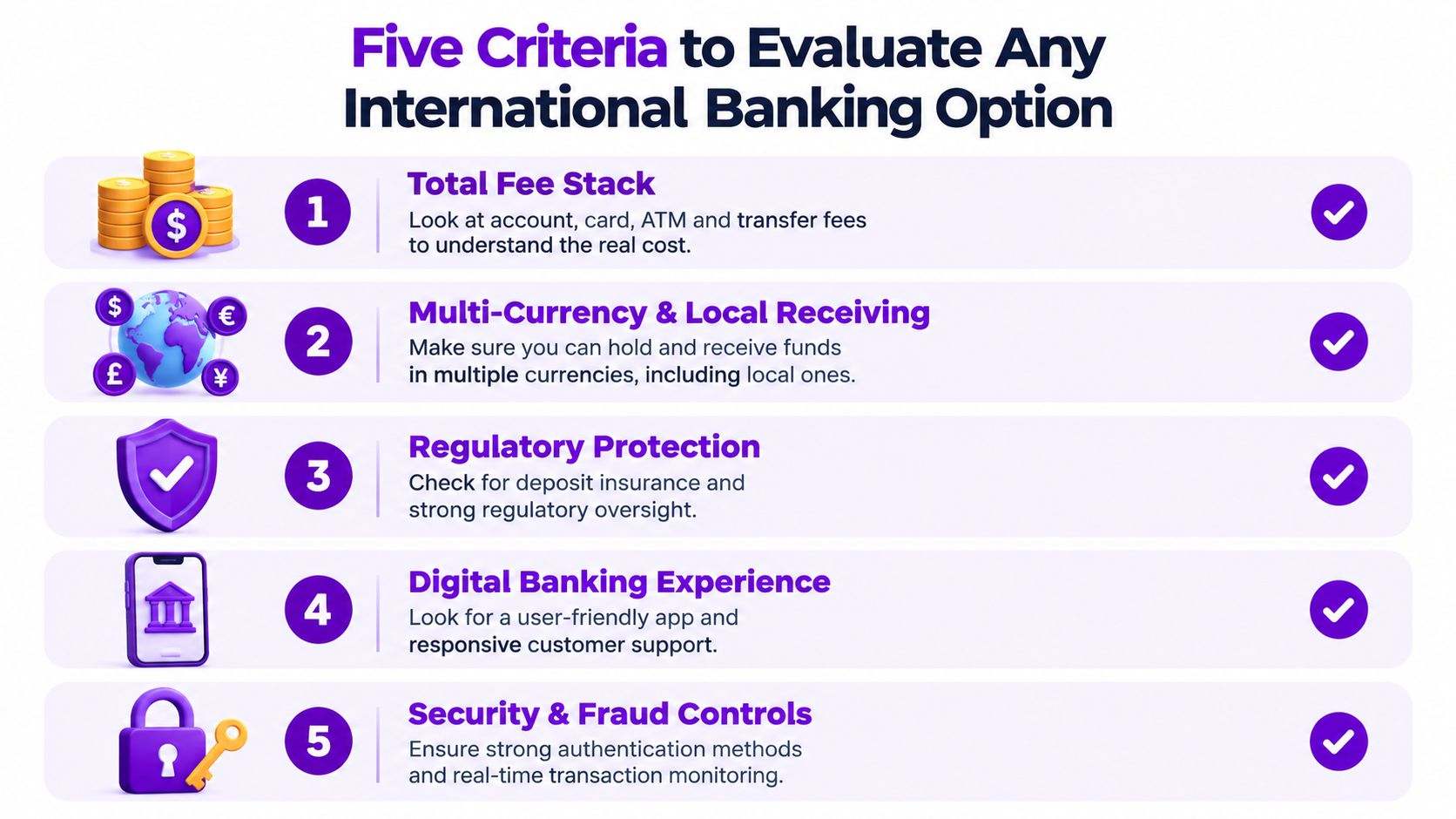
Use the same checklist for every provider. Marketing pages tend to spotlight features that are easy to compare, while your real costs and access depend on eligibility, transaction routes, and account terms. Ask for the details that apply to your business and expected activity before you move money.
Start with the fee stack
Look beyond account pricing. Check card purchases, ATM withdrawals, incoming and outgoing transfers, conversion rates, and any limits that trigger another fee. Ask whether the quoted transfer cost includes intermediary deductions and whether the recipient could face a separate charge. If the provider won't explain how a payment is routed, treat the uncertainty as a cost risk.
Check currencies and receiving details
A multi-currency balance is useful only if you can receive and pay in the currencies your business uses. Confirm whether the provider supplies local receiving details for the currencies you invoice in, and whether those details are appropriate for business receipts. Ask how a payment is handled when the sender uses a different currency or payment route than you expected.
Test access and controls
Review the card's overseas use, cash access, ATM limits, and support process for a blocked or disputed transaction. Separately, check eligibility, identity requirements, account protections, and how the provider handles changes in your address or business activity. For a broader personal-security checklist, see what to look for in a secure service.
Finally, evaluate corridor coverage directly. Ask whether your provider supports each country-to-country route you need, how funds are delivered, and what happens when a payment is held for review. A provider can be useful for one currency pair and unsuitable for another. Score each candidate against your actual receiving, spending, and payout routes rather than assuming that “international” means universal.
Traditional Banks vs Digital Banks and Fintechs
Traditional banks and fintechs solve different operational problems. A bank may be the better anchor for a long-term business relationship, while a digital service may simplify frequent conversions or card spending. Neither label guarantees low costs, suitable protections, or access for a non-resident founder.
| Criterion | Traditional Banks | Digital Banks and Fintechs |
|---|---|---|
| Account relationship | May offer broader in-person or business services, depending on the institution | Usually managed through an app or online portal |
| Currency handling | May support international payments, but check rates and available currencies | Often designed around multi-currency use, but confirm the exact corridors |
| Payment routing | Established bank relationships can help with some transfer needs | Digital workflows can be convenient, but routing and deductions still matter |
| Eligibility | Documentation and residency requirements can be demanding | Onboarding may be more accessible for some users, but eligibility varies |
| Support and continuity | Branch access may help where available | Remote support can be convenient, but escalation options vary |
A traditional bank is a strong candidate when you need a stable operating relationship, local services, or access to products beyond payments. It may also make sense if your customers or suppliers expect conventional bank transfers. But don't assume a bank's reach means its conversion pricing or transfer route is the best fit for your business. Ask for the costs and limits that apply to your currencies.
Digital banks and fintechs can be more convenient for app-based money management and holding multiple currencies. That can make them useful for collecting receipts, paying overseas expenses, or managing card spending. Still, a smooth app doesn't answer questions about deposit protection, account eligibility, or what happens when compliance teams request more information.
Choose by function, not category
Many founders need both types of provider. Use a regulated bank as the stable operating base where it meets your needs, then add a separate service only for the routes or functions it handles better. Keep enough operational flexibility to receive and make payments if either provider has an outage or review.
If you're comparing incorporation and banking options across jurisdictions, a practical guide to how to open an Irish company bank can help you understand the documentation questions to investigate. Treat any country-specific guidance as a starting point, then verify requirements with the institution you plan to use. Your company's jurisdiction, your personal residence, and the bank's own eligibility rules may all affect the result.
The Hidden Cost Stack of Cross-Border Money Movement
A "free" business account can be the most expensive line in your monthly pay run. Zero transfer fees mean little if the provider takes its margin inside the exchange rate, correspondent banks skim deductions along the route, and a routine compliance review holds a contractor payment for a week. A premium bank charging a visible fee and a tight spread often comes out cheaper on the same corridor. Price the workflow you run each month: money in, converted, paid out.
The machinery behind that pricing is visible in the BIS Triennial survey cited earlier, which recorded FX swaps at 51% of global OTC foreign-exchange turnover in April 2022, spot transactions at 28%, and outright forwards at 15%. Currency markets move through many instruments. Which one your provider uses, and how it prices your specific corridor, determines your real cost.
Identify every place money can leak
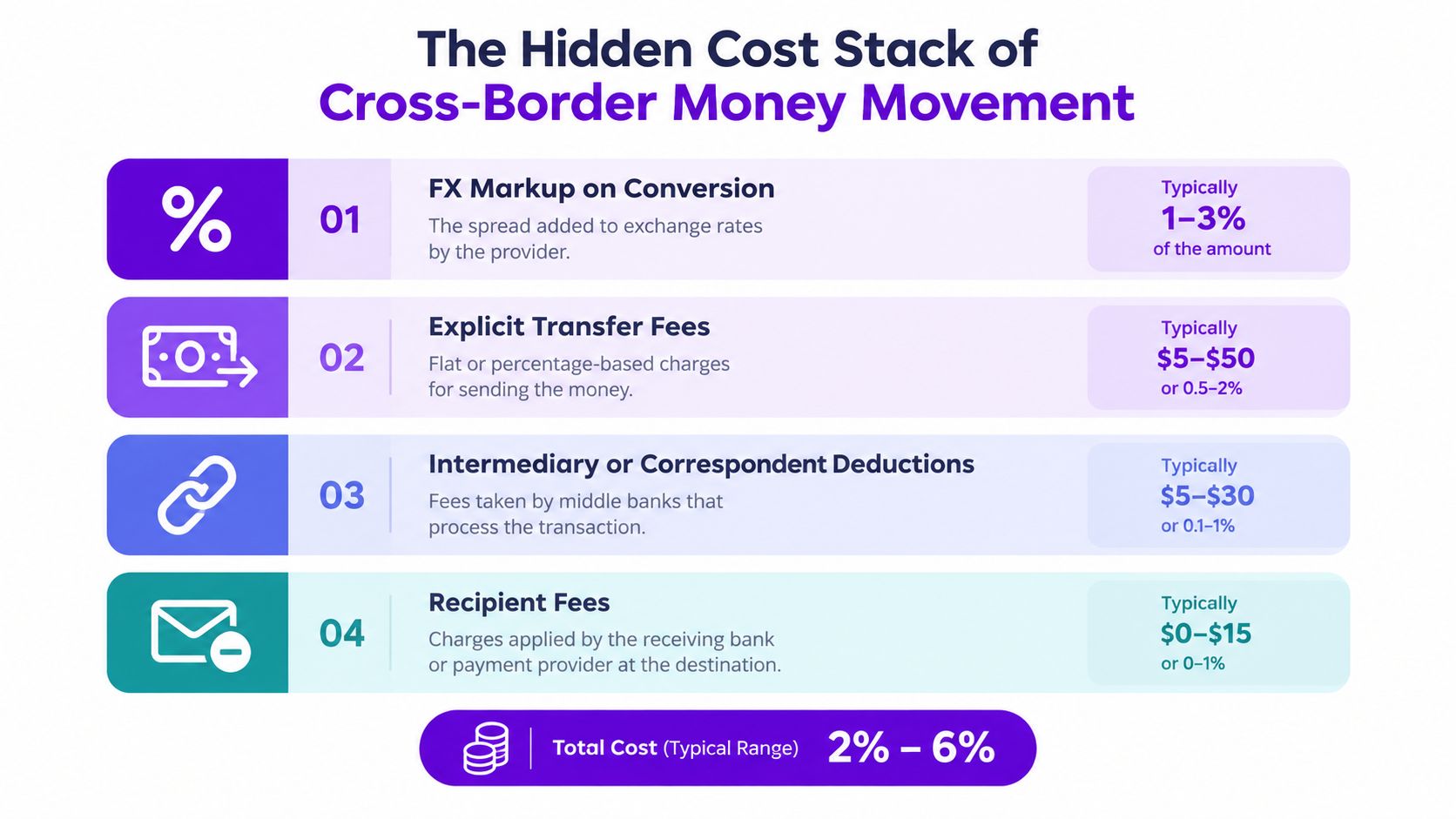
Seven charges can sit inside a single transfer. Check each one.
- FX markup: Compare the provider's conversion rate with a mid-market reference rate at the moment of the transaction. A small gap repeated across twelve monthly conversions adds up faster than any flat fee.
- Transfer fee: Ask whether you pay a flat charge, a percentage, or both, and whether the structure changes with payment size.
- Intermediary deduction: Ask whether correspondent banks can deduct fees along the route. On some corridors the answer is always yes.
- Recipient charge: Confirm whether the receiving institution takes a fee before crediting, so your invoice arrives short.
- Card and ATM costs: Review foreign-transaction surcharges, withdrawal fees, and monthly limits if you spend while traveling.
- Conversion timing: Automatic conversion at receipt removes your ability to choose the rate. Prefer setups that let you hold balances and convert when it suits you.
- Failed-payment cost: Tracing, correcting, or resending a returned payment costs admin hours, and a compliance hold can freeze funds mid-route.
The BIS remittance-cost data referenced in the final section puts the global average cost of sending a US$200 remittance at 6.5% in Q1 2025, with South Asia, the lowest-cost receiving region, at 4.8%. Those figures describe consumer remittances, which carry their own fee structure. Treat them as evidence that stacked charges are real, then measure your own route directly.
For a transaction-specific benchmark, evaluating Network International for UAE startups shows how a regional processor breaks down acceptance and settlement costs. If you are deciding where to live while running this stack, Mazurly's cost-of-living comparison by country models the spending side of the equation. Keep the two questions separate. A cheap destination does not repair an expensive payment route.
For a visual walkthrough of how correspondent banking routes a payment and where intermediary deductions enter the chain, this video traces a cross-border transfer step by step. Watch it before you compare provider fee schedules.
Matching the Setup to Your Founder Profile
The right stack depends on how money moves through your business. A freelancer receiving a small number of client payments has different priorities from an agency sending regular payouts or a seller managing marketplace receipts and supplier invoices.

The solo freelancer
Suppose you bill clients in one main currency, live in a different country, and spend in a mix of currencies as you travel. Prioritize reliable local receiving details for client invoices, a clear conversion process, and a card that works for routine spending. Keep a primary bank account for business continuity and avoid converting every receipt automatically if you can make the timing decision yourself.
Decision pivot: If you regularly convert client income into your spending currency, compare the rate and fees on that route before paying for features you won't use.
The small agency
An agency paying contractors across several countries needs predictable outgoing payments, clean records, and a process for checking recipient details. A multi-currency service may simplify recurring payouts, while a bank account can anchor operating funds and support the broader business relationship. Assign someone to reconcile payments against invoices and confirm what each contractor receives.
The e-commerce operator
A seller has to match marketplace payout currencies with supplier invoices, shipping costs, advertising expenses, and the currency used for operating cash. The important question isn't just whether a provider holds multiple currencies. Check whether it can receive marketplace funds and pay suppliers along the routes you use without forcing an expensive or inconvenient conversion.
If you're still planning the business model, use a structured view of startup costs for an online business to separate banking expenses from other operating costs. Then build a monthly flow map for receipts, payouts, card spending, and profit transfers. The most suitable setup is the one that makes those flows visible and manageable, not the one with the longest feature list.
Keeping Accounts Open When You Keep Moving
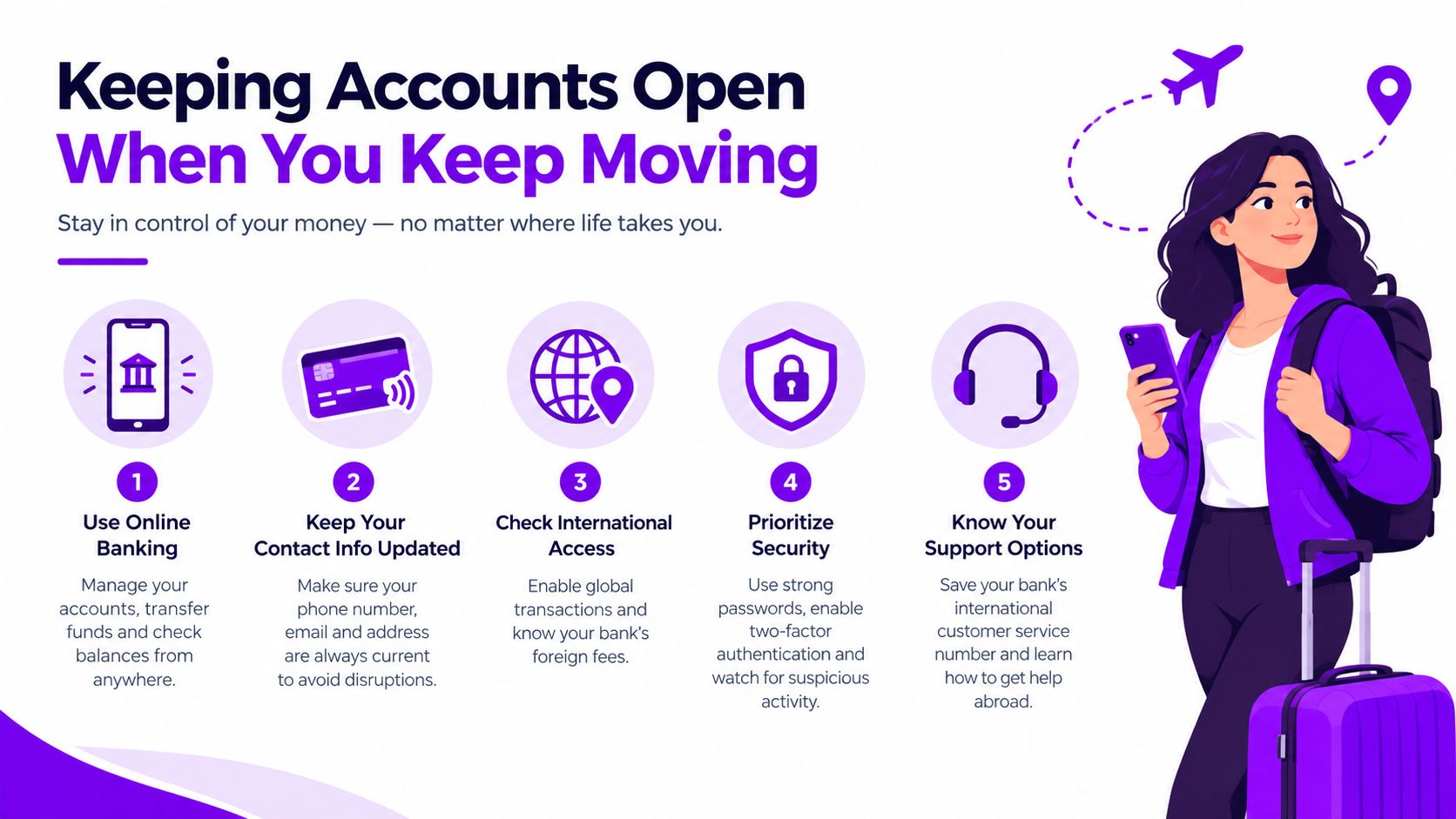
Account access is an operational requirement, not a paperwork task you can postpone. A change in address, tax residence, passport, business activity, or transaction pattern can prompt a provider to request updated information. If you don't have a clear record ready, a routine review can turn into a payment delay or account restriction.
Cross-border compliance is also not becoming simpler by default. EU authorities have highlighted the complexity of sanctions packages and weaknesses in screening, list updates, and record-keeping. The Roosevelt Institute report on access to bank accounts discusses documentation barriers in the United States, including the practical gap between forms of identification that may be permitted and the documents banks commonly request. Requirements differ by institution and jurisdiction, so confirm them directly.
Build continuity into your records
- Keep a primary account: Choose an institution that can support your core operating needs and keep its contact and escalation details available.
- Maintain a separate backup route: A second account or payment service can help if your main provider is unavailable. Use it for a clear business purpose and keep transactions explainable.
- Store current evidence: Keep identity documents, proof of address, tax-residency records, company information, invoices, and source-of-funds records organized and current.
- Set change triggers: Decide which changes require you to notify a provider, such as a new address, a shift in business activity, or a change in tax residence.
- Document the business purpose: Make invoices, contracts, and payment descriptions consistent enough that you can explain an unfamiliar transaction without reconstructing the story later.
Don't spread money across accounts just to collect features. Fragmentation without a clear reason can make bookkeeping and compliance questions harder to answer. If you invest while living internationally, review investing while living abroad as part of the broader task of keeping financial records consistent across borders.
Building Your Own International Banking Stack
Start with your monthly workflow, not a provider's feature page. List every recurring movement of money: which currencies you receive, which currencies you pay out, where conversions happen, and which corridors carry the most volume. That map defines the roles your stack needs to fill.
A lean setup usually has three. Your primary regulated account anchors the business relationship and runs routine operations. A second account in another jurisdiction gives you continuity if access or eligibility shifts. A multi-currency wallet or fintech account takes the FX-sensitive routes and card spending where its pricing beats the bank's spread. Assign each corridor to whichever route delivers the most money to the recipient. Convenience is a tiebreaker, nothing more.
This is also where the "free" account illusion breaks down. A premium bank charging a monthly fee can undercut a zero-fee fintech once you price the FX spread, intermediary deductions on wire routes, and the hours lost to repeated compliance reviews. Run the math per corridor before you commit.
The common mistake is choosing a provider first, then forcing every client receipt, contractor payout, and personal expense through it.
Make the choice actionable
Before opening or switching accounts:
- Map each recurring receipt, payment, conversion, and withdrawal by currency and corridor.
- Compare the full fee stack and the amount the recipient gets, rather than the sender's quoted fee.
- Confirm account eligibility, currency support, payment limits, and documentation requirements.
- Route each corridor through the cheapest option and record why each provider holds the role it does.
- Re-price the setup whenever your residence, business model, or payment mix changes.
Policy targets may shift these economics over time, but do not budget around a goal as if it were already met. The BIS has set a target for the global average retail cross-border-payment cost of no more than 1% by the end of 2027, with no corridor above 3%, per the cost presentation cited in the hidden-cost-stack section above. Price your stack on what providers charge today.
Mazurly publishes practical guidance for founders managing cross-border finances, business operations, and life across countries. Visit Mazurly to explore resources that can help you map your banking workflow, compare operating costs, and build a more resilient location-independent business.