App Monetization Strategies: 10 Models Compared for 2026
Table of contents
- 1. Freemium
- 2. Subscription
- 3. One-Time Purchase
- 4. In-App Digital Product Sales
- 5. In-App Advertising
- 6. Affiliate Marketing
- 7. Lead Generation
- 8. Transaction Fees
- 9. Usage-Based Pricing
- 10. B2B Team and Enterprise Licensing
- How the 10 App Monetization Models Compare on Fit, Revenue Pattern, Build Effort, and Payment Dependency
- Pick One Model to Test This Quarter, Not All Ten
A solo founder ships a useful travel tool, gets 20,000 downloads in a quarter, and still earns less than a part-time freelance contract. The problem may not be the product. It may be the revenue model, which determines who pays, how often they pay, and how much operational work your business takes on.
That work matters more when your team is remote and your customers cross borders. A subscription creates renewal and cancellation support. Affiliate links need careful placement and clear disclosure. A marketplace commission means payment disputes and payout questions land with you. Each model also brings its own demands for payment processing, tax handling, consent, and ongoing content.
This guide compares 10 app monetization strategies, from freemium and subscriptions to ads, affiliate marketing, and usage-based pricing. For each, you'll find a practical use case, what it takes to run, and the trade-offs a small or distributed team should weigh before building it. The wider market is shifting toward stronger monetization of existing users: TechCrunch's report on 2025 app spending says global consumer spending on mobile apps reached $155.8 billion as downloads declined. That makes it worth testing the revenue path that fits your product, not chasing installs for their own sake.
For a broader framework on selecting and combining models, see these app monetization strategies for 2026.
1. Freemium
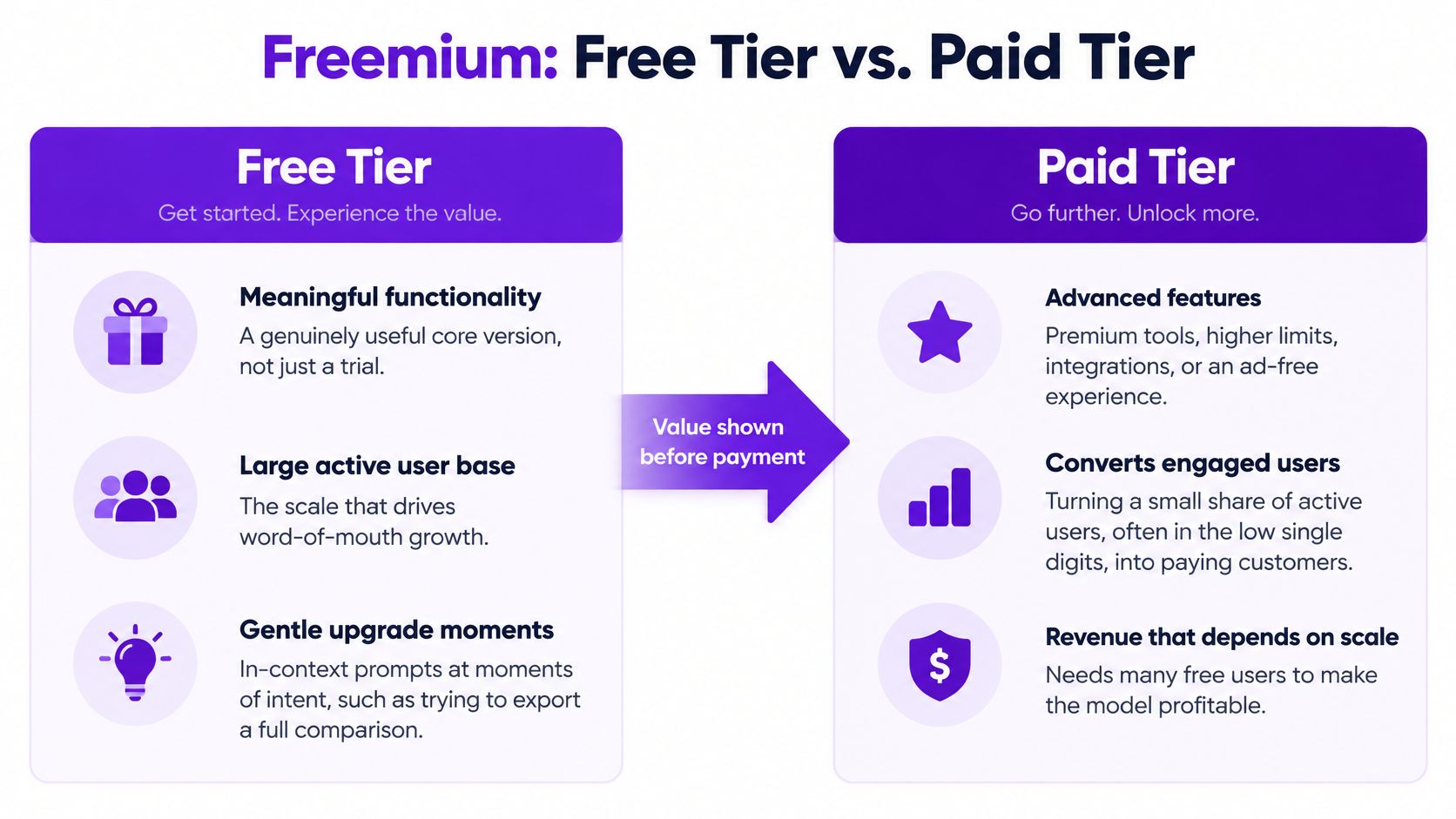
Freemium gives users a useful free version, then charges for features, capacity, or convenience they'll value once they've tried the product. Spotify pairs free, ad-supported listening with Premium; Dropbox offers free storage and charges for more space and team features. The model can work especially well for a tool whose value is easier to understand through use than through a sales page.
The operational burden starts with deciding what stays free. If the free version can't solve a real problem, users may leave before they understand the paid offer. If too much is free, engaged users may never reach a natural reason to upgrade. A remote team can manage the model without a sales department, but it still needs product analytics, billing support, and a way to explain feature differences clearly.
Practical rule: Gate a more valuable outcome, not the first useful action.
For a travel-planning app, free access might cover basic destination research, while paid users get saved comparisons, additional guides, or advanced cost analysis. Show an upgrade prompt when a user tries to export a full comparison, not when they first open the app. Track which feature prompts lead to upgrades, and use a trial only if users can experience the premium benefit before it ends.
Freemium also makes a useful starting point for testing paid demand without putting every new user behind a paywall. The trade-off is that you're supporting people who may never pay. Keep the free tier focused enough to deliver value without multiplying support questions and infrastructure costs.
2. Subscription
A subscription earns recurring revenue in exchange for ongoing access. It fits products that keep delivering value, such as meditation content, cloud features, or regularly updated destination intelligence. Duolingo Super, Headspace, and Calm show how a continuing service can support a recurring payment, while Suby's explanation of subscription business models provides a useful overview of the underlying mechanics.
Subscriptions can look simple on a pricing page and become demanding behind the scenes. Your team has to handle renewals, failed payments, cancellations, refunds, and questions about entitlements. For mobile apps, Google Play's service-fee policy sets a 15% fee for automatically renewing subscriptions, according to Google Play's developer service-fee policy. Model store fees before you treat customer payments as business revenue.
Annual plans can suit customers who expect to use the product throughout the year, but don't use them to disguise weak retention. Benchmark data in Arpu Brothers' 2025 subscription trends reports that 36% of users on low-priced annual plans remained subscribed after one year, compared with 6.7% of users on high-priced monthly plans. The figures describe different price groups and plan types, so they aren't a direct test of annual versus monthly pricing. They do underline the need to check how value, price, and renewal timing work together.
A travel app might sell ongoing access to updated guides and saved planning tools, while a short-lived, one-off trip planner may have little reason to bill users every month. For a related way to think about a focused recurring-revenue product, explore micro-SaaS ideas.
3. One-Time Purchase
A one-time purchase charges once for access to an app or a defined version. It suits tools with a clear scope and a customer who'd rather avoid a recurring bill. Procreate is a familiar example of a professional creative app sold without requiring a subscription. For a small team, that can mean a straightforward purchase decision and fewer renewal-related support requests.
The trade-off is what happens after the sale. Customers still expect the product to work, receive fixes, and stay compatible with their devices. If the original price is also expected to cover years of new features, your revenue can stop while maintenance continues. Define what the purchase includes, what future updates you'll provide, and whether new capabilities will be sold separately.
A practical example: a budgeting app could charge once for its core planner, then offer an optional paid add-on for a specialized report. The core offer stays easy to understand, while the add-on gives occasional users a way to pay for extra value without signing up for a subscription.
Before charging upfront, show the product's value through a demo, a sample workflow, or a clear explanation of what the buyer receives. Test different price points with actual purchase behavior rather than choosing a price based only on development effort. Also account for storefront commissions, refunds, and the support time needed when someone changes devices or can't restore a purchase.
This model works best when the product's usefulness is durable but doesn't require a steady stream of fresh content. It's a weaker fit for services that depend on ongoing research, frequent updates, or costly infrastructure.
4. In-App Digital Product Sales
In-app purchases let people buy digital goods or capabilities inside the app, from template packs and reports to virtual items and extra usage. Candy Crush sells boosters and extra moves; a productivity app could sell specialized templates. The purchase can be a one-off way to serve a user who wants a particular outcome but doesn't need a subscription.
This model needs a dependable checkout and entitlement system. A buyer should receive the item they paid for, and the app should be able to restore eligible purchases when someone reinstalls or changes devices. Consumable items, such as credits that get used up, need different handling from permanent features. A small team should implement transaction validation, prevent duplicate processing, and test refund and restore flows before promoting purchases.
Mobile spending suggests there's room for more than one type of in-app offer. Mordor Intelligence's mobile application market report identifies in-app purchases as the largest monetization category in 2025, at approximately 48.85% of market size, and forecasts subscriptions to grow fastest through 2031. That's a market-level finding, not a guarantee for any single app. It supports testing a hybrid offer where recurring access and occasional purchases solve distinct user needs.
For instance, a relocation app might include basic planning for free, sell a one-off destination report, and reserve continuously updated insights for subscribers. Keep prices and product details visible before checkout, and don't put essential functionality behind a surprise purchase. If users can finish the main job without buying an add-on, purchases feel more optional and the product is easier to trust.
5. In-App Advertising
Ads can monetize free usage without asking users to pay directly. Google AdMob supports mobile ad formats, while Unity Ads and AppLovin MAX are used for ad mediation and rewarded video. This model is strongest when users return often enough to create meaningful ad inventory and when ads don't interrupt the task that brought them in.
For a remote team, ads add work beyond placing a software development kit. Someone has to choose networks, monitor fill and revenue, manage consent, and troubleshoot ad quality. A globally distributed audience also means your team needs to consider privacy obligations across the markets where the app operates. Don't treat user consent as a minor setup step or assume an ad network handles every compliance responsibility for you.
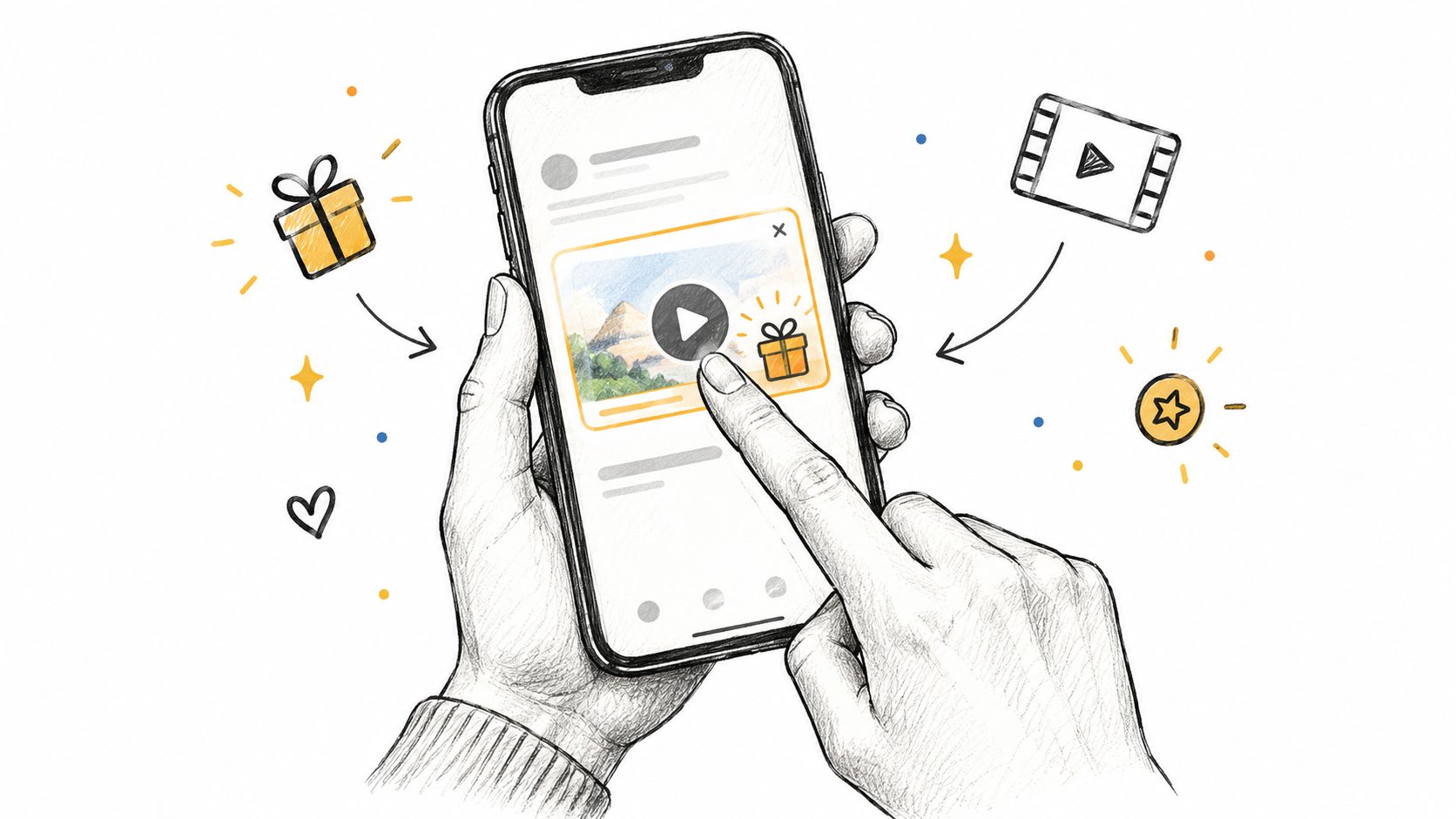
Rewarded video is often a better fit for a task-oriented app than a forced interruption. A user might choose to watch a video to gain one extra export or temporary access to a guide. By contrast, an interstitial shown halfway through filling out a form breaks the task and can make the app feel unreliable.
The market evidence is useful, but it doesn't remove the need to test whether ads suit your users. In 2025, non-gaming apps generated $20.9 billion in in-app-purchase revenue in the second quarter, exceeding mobile-game revenue by $300 million, according to Itransition's compilation of mobile app statistics. That finding concerns purchases, not ad revenue. It's a reminder that non-game apps can monetize through paid value instead of relying on ad volume.
If ads are part of your product, use a mediation layer to compare networks and keep placements away from high-friction workflows. Put a consent-management process in place, give users control where required, and offer an ad-free paid option only if you can support its billing and entitlement requirements. Ads may be easy to add technically, but the ongoing work can outweigh the revenue for a small app with limited usage.
A short explanation can help your team decide how to place ads without disrupting the core task:
6. Affiliate Marketing
Affiliate marketing earns a commission when a user follows a recommendation and completes an eligible action. It can fit naturally into apps that already help users choose a product or service. A travel-planning app, for example, might recommend an eSIM while someone is arranging a trip, or a comparison tool might direct users to a relevant booking partner.
The operational burden is generally lighter than running subscriptions or a marketplace. You don't manage the partner's checkout or deliver the purchase. You do need to apply to suitable affiliate programs, use tracked links, check that recommendations remain current, and understand the partner's attribution and payout terms. International customers also mean paying attention to the currencies and payout methods available to your business.
Trust is the asset you're monetizing. Disclose affiliate relationships near the recommendation, explain why the offer fits that user's situation, and avoid turning every screen into a product pitch. A location-independent founder might add a clearly labeled eSIM referral beside a destination guide, then compare clicks and completed referrals by placement. If users click but don't convert, the mismatch may be the offer, the context, or the landing page.
Affiliate income depends on partner conversion and commission rules, both of which can change. Don't build a core product promise around a single partner's program. Keep recommendations useful without the commission, and remove offers that distract users or no longer fit their needs.
This model is a practical first revenue experiment when an app already influences a buying decision. It's less useful if users come to complete a task unrelated to partner products or if you'd need to add thin, promotional content just to create link placements.
7. Lead Generation
Lead generation turns a user's expressed intent into an introduction to a service provider. A finance app might connect someone comparing accounts with a relevant provider; a relocation tool might offer to pass a user's inquiry to a consultant. The partner pays for an inquiry or qualified introduction, rather than waiting for the user to complete a purchase.
That sounds like affiliate marketing, but the operational burden is different. You're collecting information and deciding when it's appropriate to share it. Ask only for the details needed to route the inquiry, explain who will receive them, and use a distinct consent step for each partner. Don't bury the transfer in general terms that users won't notice.
For example, a visa-planning app could let a user request a consultation after completing a self-guided eligibility workflow. The form should identify the consultancy and explain what information will be shared. Your team then needs a process to pass the inquiry securely, confirm that the partner received it, and handle user questions about the introduction.
Lead quality matters more than form volume. Track whether partners accept the inquiries and whether users receive a useful response. If a partner rejects many leads, check your qualification questions and the way you describe the service before asking for a higher fee. A remote team may also need an agreement covering how partners handle personal information and what happens when a user withdraws consent.
This model fits high-consideration services better than quick, low-cost purchases. It can produce revenue without managing the final sale, but it places responsibility on your team to set clear expectations and protect users' information.
8. Transaction Fees
A marketplace commission takes a fee when a transaction passes through your app. Airbnb, Etsy, Upwork, Uber, and Lyft are recognizable examples of businesses built around transactions or marketplace activity. For a small app, the model makes sense only if you're bringing two sides together and providing enough value to justify handling the exchange.
Payments add significant operational work. You'll need to support checkout, refunds, disputed payments, payout timing, and transaction records. Cross-border activity can complicate what users pay and what providers receive, particularly when currencies and local payment options differ. Clarify which party pays the fee and show it before anyone commits to a booking or purchase.
Say your app connects remote consultants with clients who need short-term help. You might collect payment through a provider such as Stripe, retain your commission, and pay the consultant after the agreed milestone. That arrangement needs clear rules for cancellations, disputed work, and off-platform contact. Otherwise, users may move repeat business outside the app to avoid the fee.
A commission works when the platform supports a real part of the transaction, such as discovery, scheduling, trust, or payment protection. If your app only introduces two parties, a lead-generation model may require less infrastructure and create fewer disputes. If you do process transactions, build a transparent fee breakdown and a support workflow before trying to increase marketplace volume.
Monitor repeat buyers and sellers as well as transaction revenue. A fee that looks attractive on each booking can still damage retention if users believe it's arbitrary or if your app doesn't make the transaction safer or easier.
9. Usage-Based Pricing
Usage-based pricing charges for consumption, such as messages, storage, API calls, or documents processed. It fits products where users can connect usage to value and where each additional action has a cost for your business. Twilio and AWS use consumption-based pricing for services, while Stripe combines per-transaction charges with other products.
The main operational risk is an unpredictable bill. Users need a clear view of what counts as usage, what they've consumed, and what they'll pay. Your billing logic must also handle failed payments, disputed usage, and corrections when the app records activity incorrectly. If your own costs rise with usage, set thresholds and alerts before a customer can run up a bill they didn't expect.
A document-processing app could include a small allowance, then charge for additional files processed. Show the usage balance beside the upload workflow, alert users before the allowance runs out, and offer a spending cap. A base subscription with usage tiers can make revenue easier to forecast for both the business and its customers.
For a practical way to compare what your service costs to deliver against what you charge, see this guide to pricing freelance services. Keep the pricing unit simple enough for customers to predict. Charging for an invisible technical measure can create support issues even if it reflects your infrastructure cost accurately.
Usage pricing works when customers can see the meter, understand the unit, and control the spend.
If you need a deeper framework for choosing a unit and structuring tiers, read this overview of usage-based pricing for SaaS.
10. B2B Team and Enterprise Licensing
Team and enterprise licensing sells shared access to organizations, often through per-seat plans or a custom contract. It can suit collaboration software, productivity tools, or operational products that solve a problem for a group. Slack, Notion, Figma, and Zoom show how products can offer different capabilities to individual users and organizations.
A team plan isn't just an individual plan with more seats. Buyers may expect centralized billing, access controls, member management, and a clear way to add or remove users. Your team will also need to answer purchasing and security questions, manage invoices, and handle renewals. These requirements can turn a self-service product into a sales and support operation.
Suppose a distributed consultancy uses your app to coordinate client workflows across time zones. An admin could invite staff, manage access, and pay from one account instead of asking each employee to subscribe separately. Start with a simple upgrade path from an individual workspace to a team plan. Add administrative controls before promising enterprise readiness, and don't offer custom terms your small team can't support.
Annual billing and volume pricing may help a business plan its spend, but longer contracts also mean clearer expectations about availability, support, and account changes. Make sure your billing process can issue the documents business customers need. For ideas on lightweight collaboration workflows, explore these open-source project management tools.
This model is a strong fit when the product solves a shared business problem and one buyer can approve payment for a group. It's a poor fit if most users work independently or if you don't want to take on organizational support. Decide whether the business contract is worth the extra operational load before building a complex sales process.
How the 10 App Monetization Models Compare on Fit, Revenue Pattern, Build Effort, and Payment Dependency
| Model | Best For | Revenue Pattern | Build Effort | Payment Dependency |
|---|---|---|---|---|
| Freemium | Products that can attract a large active user base | A small share of free users convert to paid upgrades | Moderate: build free and paid tiers with upgrade gates | Paid upgrades; free access remains available |
| Subscription (Recurring Revenue) | Products delivering ongoing content, tools, or services | Recurring monthly or annual fees | Moderate: support billing, trials, and ongoing updates | High: recurring billing and payment processing |
| One-Time Purchase (Premium Upfront) | Clearly scoped tools, utilities, or digital products | Single upfront payment, with optional add-ons | Low: straightforward paid access and product delivery | High: users must pay before unlocking the product |
| In-App Digital Product Sales (Microtransactions and Virtual Goods) | Apps with purchasable content, templates, credits, or add-ons | Repeated, smaller purchases | Moderate: manage digital items, pricing, and purchase flows | High: depends on in-app purchase systems |
| In-App Advertising | Free apps with substantial user traffic | Revenue from impressions, clicks, or completed actions | Moderate: integrate ad networks and manage placements | Low: relies on advertisers and ad networks, not user payments |
| Affiliate Marketing | Content and tools that recommend relevant third-party services | Commissions from referred purchases or sign-ups | Low: add and track referral links | Low: partner programs pay commissions |
| Lead Generation | High-consideration services where users seek quotes or advice | Payments per qualified lead, call, or application | Moderate: build qualification, consent, and partner workflows | Low: partners pay for submitted leads |
| Transaction Fees (Marketplace Commission) | Marketplaces and platforms facilitating bookings or sales | Percentage or fixed fee per transaction | High: build payment, trust, and compliance systems | High: depends on processing transactions through the platform |
| Usage-Based Pricing | Products billed by consumption, such as APIs or data tools | Charges rise with units consumed | High: requires accurate metering, billing, and usage reporting | High: depends on usage tracking and payment billing |
| B2B Team and Enterprise Licensing | Organizations needing shared access, controls, and support | Per-seat, per-workspace, or custom contract revenue | High: requires team features, admin controls, and sales support | High: relies on organization billing and contract payments |
Pick One Model to Test This Quarter, Not All Ten
Small teams often make monetization harder by layering several models onto a product before they know why customers would pay. A subscription, affiliate link, ad network, and marketplace fee each bring separate billing, support, consent, and reporting work. More revenue options don't automatically make the business more resilient if no one on the team can maintain them.
Start with the model that follows naturally from the job your app already does. A tool with clear upgrade moments can test freemium. An app that continually delivers new content or capabilities can test a subscription. An app that influences a purchase decision can try a relevant affiliate recommendation. A product that processes costly tasks may need usage-based pricing, with clear limits and customer controls.
Make the first test small enough that you can explain what changed. Choose one part of the product, one offer, and one primary measure, such as trial-to-paid conversion or revenue per active user. Include operational signals too: billing questions, refunds, failed payments, consent drop-off, and the support hours your team spends on the new model. A revenue increase that creates a disproportionate support burden may not be a good trade for a small, distributed business.
Review the test after a defined period and decide whether to keep, revise, or remove it. Don't add a second model just because competitors use one. Add it when user behavior shows a segment with a different need, or when the first model leaves clear value uncaptured. For example, users who don't need ongoing access may prefer a one-off report, while regular users might value a subscription.
The market-wide picture can encourage testing without dictating the answer. RevenueCat's review of 2025 app monetization trends reports that more than 35% of apps combine subscriptions with one-time purchases or lifetime deals, and that more than 60% of top-grossing apps use combinations of ads, in-app purchases, and subscriptions. Those figures describe different groups and don't mean a small app should copy a larger product's stack. Use them as a reason to consider combinations only after you've found a working primary model.
The practical goal isn't to build the most elaborate pricing page. It's to find a payment path your users understand and your team can operate. Test one model, measure what it earns and what it costs to support, then let real behavior guide the next decision.
Mazurly offers practical resources on marketing, growth, monetization, and the operations of location-independent work. If you're choosing a revenue model for a remote business, explore the tools and guides at Mazurly and use them to turn your next monetization test into a clear operating plan.