
Business Plan for Freelancers: A Step-by-Step Template

Table of contents
- What a Freelancer Business Plan Must Contain
- Planning pays more once you have real clients
- Define Your Services, Niche and Ideal Client
- What a broad niche actually costs
- Price Your Work and Set Revenue Targets
- Where the hourly math usually goes wrong
- Model Cash Flow in Three Scenarios
- Reserves and the Monday forecast
- Build a Pipeline and a Revenue Mix That Holds
- Rank sources before you add another offer
- Set Up Contracts, Invoicing and Risk Cover
- Invoices, hours that overlap, and cover
- Review the Plan Every Quarter, Starting Today
You opened the banking app before the coffee finished brewing. Rent is due in nine days, a client two time zones away still hasn't released the milestone, and the conversion into the currency you spend already thinned the invoice. That's the month a business plan for freelancers is supposed to survive, and most templates never mention it.
Standard outlines ask for a mission and a five-year vision. They don't tell you what to do when March is empty even though the year still looks profitable on paper. If you work from one city this quarter and another next quarter, bank fees, payment lags, and a shifting cost of living sit on top of ordinary client risk.
A plan that earns its keep is short, numerical, and strict about cash. What follows is the version worth rebuilding: eight parts, a rate you can defend, three cash scenarios, and a rule for when cheap work has to stop.
What a Freelancer Business Plan Must Contain
A freelancer business plan is a short working document of eight parts. Each part answers one practical question. Keep the whole file under five pages so you reopen it regularly. The copywriter in the table bills $88 an hour and targets $88,000 in gross revenue. Swap those figures for yours. If you don't know a number yet, type a question mark. A guessed figure that looks finished will mislead you later.
| Component | Question it answers | Example entry | Update cadence |
|---|---|---|---|
| Offer summary | What exactly do I sell, and to whom? | Landing page sprints and monthly email retainers for SaaS founders | Quarterly |
| Target market | Who pays, and why would they pay now? | SaaS founders with a product launch in the next 90 days | Quarterly |
| Revenue model | How will the money arrive? | Sprints plus monthly retainers, each invoiced in the client's currency | Monthly |
| Pricing | What does each service cost and what is the floor? | $88 an hour, with a written floor you won't go under | Each new contract |
| Financial projection | What does the year look like in numbers? | $88,000 gross, replaced by real invoices as they land | Quarterly |
| Cash-flow plan | Can I cover bills in a slow or late-paying month? | Three-month reserve and a rolling 13-week forecast | Weekly |
| Pipeline and marketing | Where will next month's clients come from? | Three warm introductions, two proposals, and one post a week | Weekly |
| Operations and risk | What breaks if I am sick, offline, or unpaid? | Contract template, net-14 invoices, travel and health cover | Annually or on every move |
Planning pays more once you have real clients
Planning is tied to stronger performance, and the size of that benefit depends on the stage of the venture. A 2010 meta-analysis of 46 studies covering 11,046 companies found that business planning improved performance overall, with a significantly stronger effect for established small firms than for brand-new ventures. Separate research on 622 new ventures in England found that writing a plan raised average annual employment growth by 33.4 percentage points after separating planning from the traits of people who choose to plan, and that 56% of entrepreneurs had written a formal plan before launch, according to a review of planning research for entrepreneurs.
You may never hire anyone. The employment result still matters as a signal of scalability. A clear plan turns one person's skill into repeatable offers, subcontracting, partnerships, or a small digital product. In year one, keep every assumption visible and replace it with client data as it arrives. Once you have operating history, the same pages should review demand, pricing, client concentration, utilization, cash reserves, and which service really makes money.
Treat the file as a management system. A launch document you never reopen is a souvenir. A five-page plan you edit is how you decide.
Create the file this week. Use the eight headings. Leave unknown numbers marked with a question mark rather than a confident guess. Most freelancers skip this step entirely, which is why a thin first draft already puts you ahead.
Define Your Services, Niche and Ideal Client
Offers drift when every paid task stays on the menu. Narrowing is a procedure, not a mood.
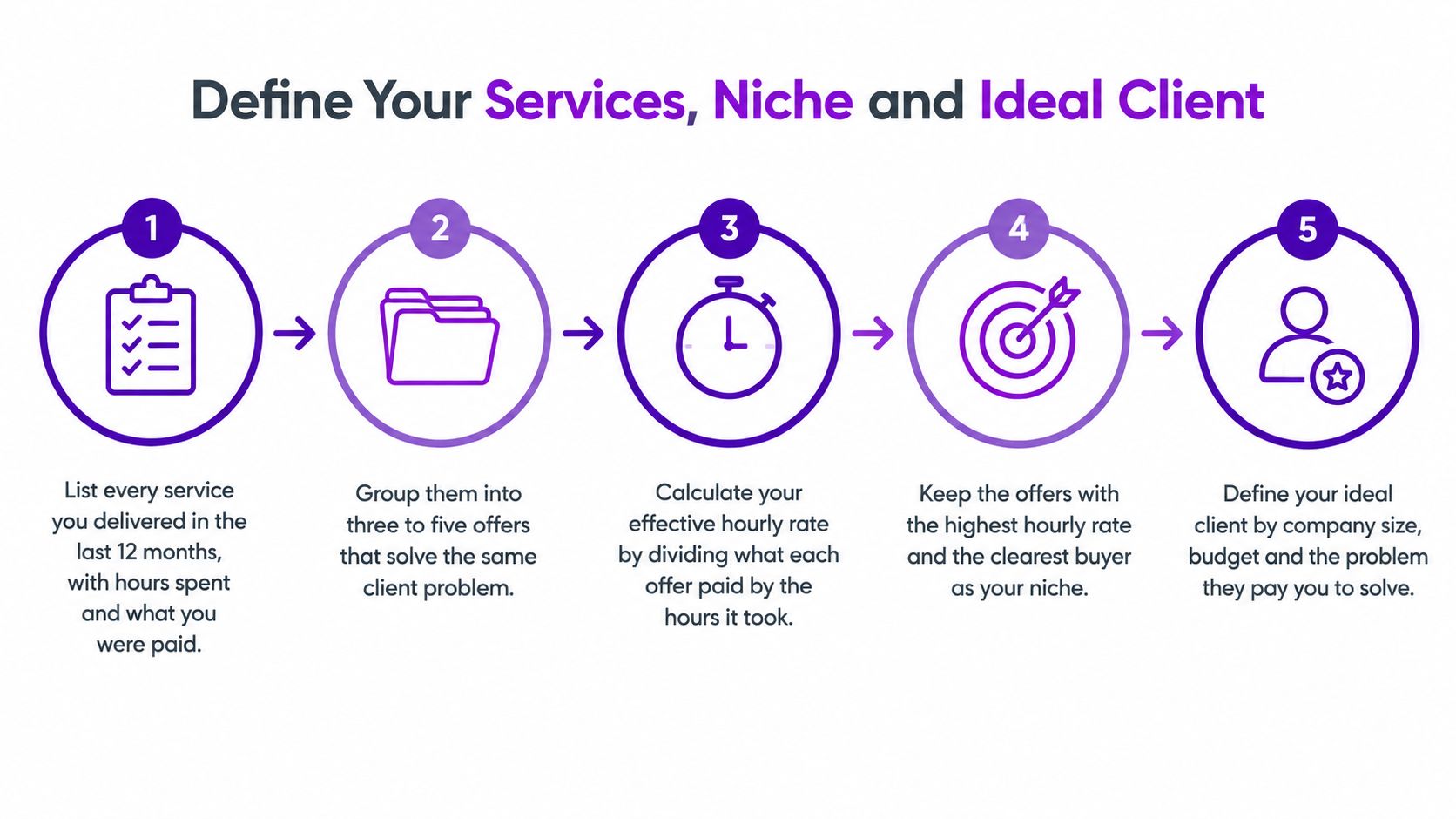
List every service from the last 12 months. Write hours and what you were paid. Memory flatters the interesting jobs and hides the ones that ate a week for a small fee.
Group the list into two or three offers. A sprint, a retainer, and one productised package is enough. Three to five offers that solve the same problem can work. Five unrelated offers usually don't.
Test each offer against three niche questions. Does the buyer have budget, is the problem recurring, and can you name ten companies that fit? If you can't name ten, the niche is a vibe, not a market.
Write a one-sentence ideal client. Include industry, company size, and the trigger that makes them buy. "SaaS founders at companies under 50 people, buying when a launch is inside 90 days" is usable. "Anyone who needs words" is not.
Attach a fixed deliverable and a timeframe. Vague scope is where margin disappears. "Homepage and three feature pages in ten working days, two revision rounds" can be priced. "Help with the site" cannot.
What a broad niche actually costs
A copywriter based in Lisbon looked at 2024 and found 14 clients across nine industries. Proposals ran long because every pitch had to teach a new sector. Case studies stayed weak because no two projects looked alike. Cutting to two offers for SaaS founders made the portfolio repeatable and the sales conversations shorter.
A broad niche costs you in non-billable time. You rewrite the same proposal, you can't reuse proof, and referrals get fuzzy because past clients can't describe you in one line.
If you have no history yet, run a 30-day test. Pick one buyer, publish two samples aimed only at that buyer, and send a small batch of pitches. Keep the niche if replies mention the problem you named. Drop it if people ask you to do unrelated work. The test is about message fit, not about landing a full book of business in a month.
Price Your Work and Set Revenue Targets
Start from the money you need to live on, not from what a peer posted on social media. This build-up turns a take-home goal into a rate and a sprint price.
| Line item | Example value | How it is calculated |
|---|---|---|
| Take-home target | $60,000 | Personal annual income goal |
| Business expenses | $6,000 | Software, insurance, coworking, accounting |
| Tax reserve rate | 25% | Share of gross set aside; adjust to your jurisdiction |
| Gross revenue needed | $88,000 | ($60,000 + $6,000) divided by 0.75 |
| Billable hours per year | 1,000 | Capacity after sales, admin, and rest |
| Effective hourly rate | $88 | $88,000 divided by 1,000 hours |
| Price for a 40-hour sprint | $3,520 | 40 times $88 |
Where the hourly math usually goes wrong
Billable hours are not the working year. A full-time year is about 2,080 hours. Once you count sales, admin, and actual rest, roughly half of that is a realistic billing target, which is why this example uses 1,000 hours rather than every weekday on the calendar. People who divide their income goal by 2,080 quote a rate they can't hit, then feel behind all year.
The tax line is a reserve, not a tax return. 25% is a planning share of gross set aside so a good quarter doesn't get spent before the bill arrives. Change it for your jurisdiction. The expenses line is easy to understate if you travel. Coworking, accounting, insurance, and software belong in the $6,000, and so does anything you pay every month whether a client is live or not.
Price-setting choices sit on top of the rate:
Quote one currency per client. Don't mix currencies inside a single contract. State who pays transfer fees.
Trade a 10% retainer discount for a fixed monthly commitment. The discount buys predictability, not a permanent markdown on project work.
Hold a hard floor. Below that rate, decline the work. A floor you break "just this once" becomes your real price.
Our guide on how to price freelance services is the companion piece if you want benchmarks beside this build-up.
US clients paying in dollars and EU clients paying in euros can move what you keep by several percent once conversion and banking fees land. Build that gap into the price instead of discovering it on the payout. Replace every example number with your own, then check the resulting rate against your last three invoices. If those invoices paid less per hour after revisions and chasing, the floor is still too low.
Model Cash Flow in Three Scenarios
Profit and cash are different problems. You can finish a year of profitable projects and still be unable to pay rent in March because a client paid 45 days late. Profit says the work made money. Liquidity says the money is in the account when the bill is due.
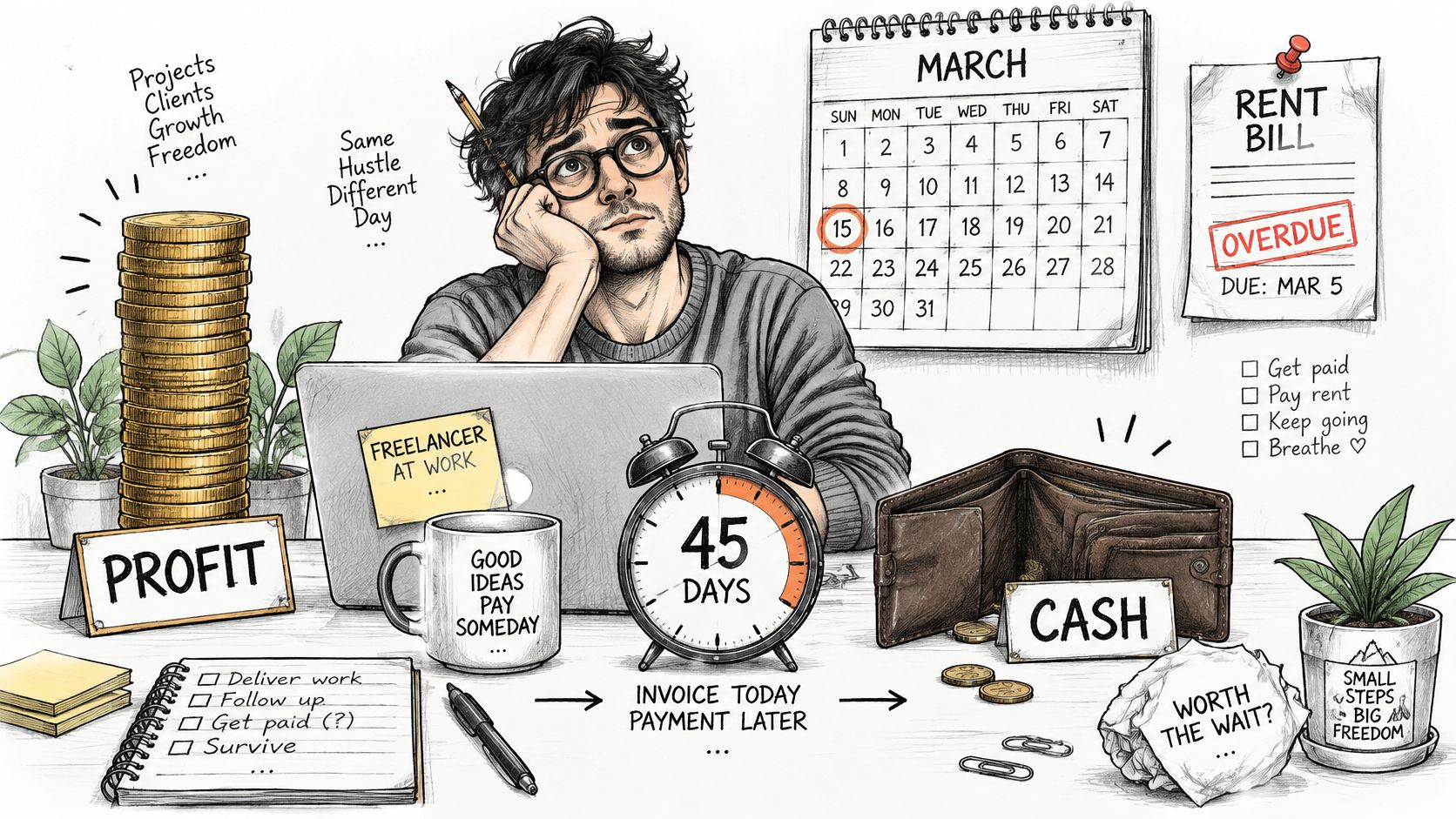
Annual forecasts hide that gap. A 2025 Japanese survey found that 32.4% of full-time freelancers had at least one month with no income, while the average high month was ¥570,000 and the average low month was only ¥128,000. A separate 2025 report found that 70.8% of surveyed freelancers used emergency savings during the year, 34.6% could not pay a critical bill, and 59.3% felt stressed about lacking a financial plan, as reported in Mynavi's freelancer income research. For anyone moving between countries, conversion, international payment delays, banking fees, and a changing cost of living make a thin month thinner.
The useful plan is a minimum viable monthly cash-flow system, not a hopeful growth chart.
| Scenario | Revenue assumption | Payment timing | Trigger action |
|---|---|---|---|
| Baseline | Contracted work plus probable revenue, with unsigned leads counted at a conservative share | Invoices paid within 14 days | Keep current outreach and tax set-asides |
| Downside | 50% of target after one client leaves | Invoices paid within 45 days | Cut discretionary spending; double weekly outreach once reserves fall below two months |
| Capacity-constrained | Full target, but 90% of billable hours already booked | Invoices paid within 30 days | Raise rates on new work, decline low-value requests, and move outreach to next quarter |
Reserves and the Monday forecast
Build the baseline from contracted and probable revenue only. Unsigned leads get a conservative share, not the full proposal value. Hope is not a line item.
Set the reserve from fixed costs. Add personal and business fixed costs, multiply by three, and hold that amount before any discretionary spending. At $5,500 a month in fixed costs, the reserve target is $16,500. That figure is rent, food, insurance, software, and tax set-asides, not a vacation fund.
Keep a rolling 13-week cash-flow forecast and update it every Monday. List each expected inflow by client and its likely payment date. List each outflow, including the tax slice. Startup and operating costs belong in that outflow list. The breakdown in startup costs for an online business is a useful checklist when you first separate personal spending from business spending.
Trigger rules should be written before you need them. When reserves fall below two months of fixed costs, cut discretionary spending and double weekly outreach. Don't wait for the account to hit zero.
A short walk-through of uneven months makes the forecast less abstract.
Build a Pipeline and a Revenue Mix That Holds
A revenue target means nothing until you know how much selling it takes to hit it. In one worked funnel, 20 outreach messages produced six replies, three discovery calls, two proposals, and one signed client.
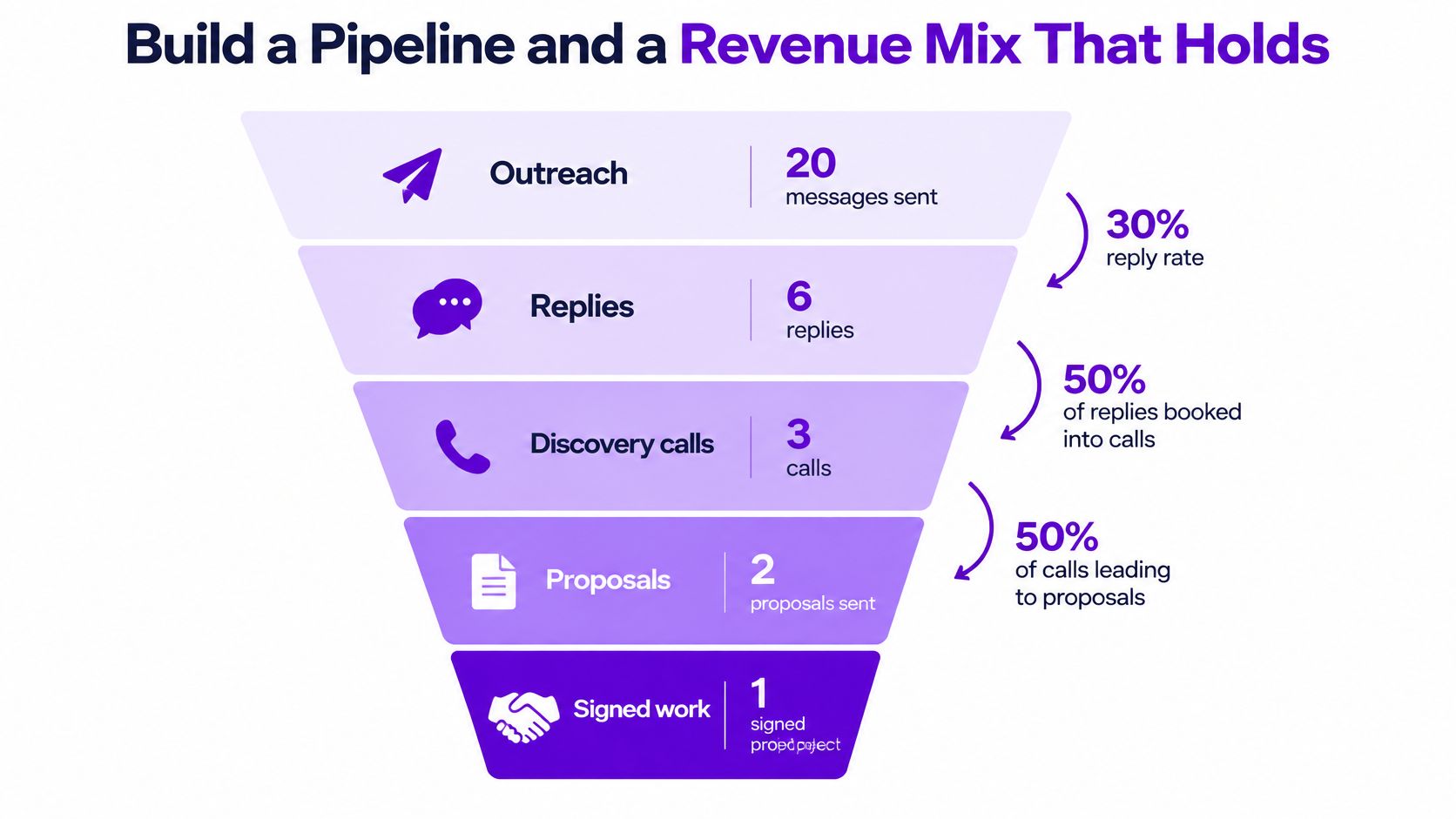
At that conversion, landing two new clients a month means about 40 messages on the calendar, every month, including the slow ones. Track your own rates for a month and reverse the arithmetic. The stages are outreach, replies, discovery calls, proposals, and signed work. Skip tracking one and you will never find the leak.
Finding clients is the part that breaks most freelance plans. The 2025 Freelancer Study named project acquisition the biggest challenge for 58% of respondents, ahead of uncertainty in planning at 45% and fluctuating income at 39%. A plan that treats pipeline as optional is betting against the exact problems freelancers rank at the top.
Rank sources before you add another offer
Five weak income streams can eat the hours you needed for one strong client. Diversification only helps when each stream earns its place. Rank every revenue source on five criteria: stability, margin, sales effort, payment risk, and geographic exposure.
A workable target mix is 50% retainers, 35% repeat project work, and 15% experimental. The experimental slice is where a small product or a new segment lives, capped so it can't grow into a second business you never meant to run. Geographic exposure matters more for mobile work: a client who only pays into one country's banking setup can stall your income the week you change cities, and a slow currency conversion lands in the same week your rent is due.
Watch the numbers that turn concentration into fragility: revenue concentration by client, renewal rate, average payment delay, effective hourly rate after sales and admin, and the share of revenue already predictable 30, 60, or 90 days ahead. When one client holds most of your cash and pays late, cheap extra projects crowd out the outreach that would replace them.
The channels that work stay boring on purpose. Past-client check-ins, referrals from complementary freelancers, and one niche newsletter beat a new platform every quarter. Set one revenue-mix target and review it monthly. If the experimental slice keeps blowing past its cap, you're collecting hobbies, not building income.
Set Up Contracts, Invoicing and Risk Cover
The risk row in your eight-part plan needs paper behind it. A handshake doesn't survive a sick week or a client who goes quiet.
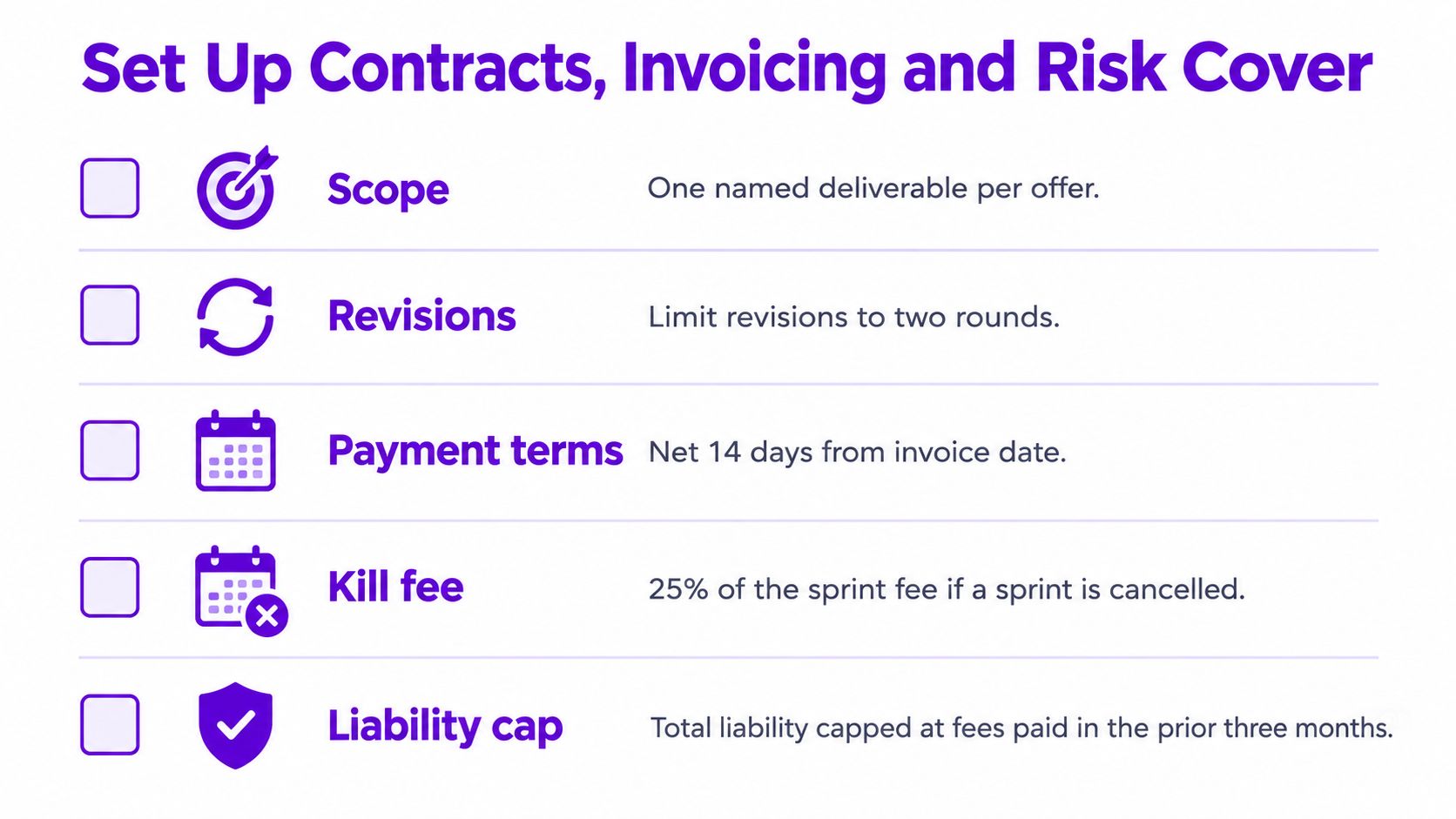
Put these terms in every agreement:
Scope: One named deliverable per offer, so "the homepage" can't become "the whole site."
Revisions: Two rounds. A third round is a new line item.
Payment terms: Net 14 from the invoice date, not from whenever someone feels like approving it.
Kill fee: 25% of the sprint fee if a sprint is cancelled after you've blocked the time.
Governing jurisdiction: Name it. Hoping you'll "work it out" is not a clause.
Liability cap: Total liability capped at fees paid in the prior three months, so one project can't become an open-ended claim.
Invoices, hours that overlap, and cover
Bill on milestones, not on the last day of the project. State the currency on every invoice and say who pays bank fees. Add a late-payment clause with a stated monthly interest rate so the cost of waiting is visible. A clean first invoice is part of onboarding, which is why a client onboarding checklist belongs next to the contract, not in a separate folder you forget.
Time zones need a written window. A freelancer in Bali (UTC+8) with clients in Berlin (UTC+1) can offer Bali 15:00 to 19:00, which is Berlin 08:00 to 12:00. That's four overlapping hours. Everything else is asynchronous, with written updates so nobody expects a live reply at midnight.
Risk cover is the rest of the answer to "what breaks if I'm sick, offline, or unpaid."
Health and travel insurance that matches where you currently live, not the country on an old mailing address.
An emergency fund sized to the reserve target from the cash-flow plan.
A backup person for each core offer, whether that's a subcontractor or a client who can pause without ending the relationship.
A tax and residency check before every move, done before you book the flight, not after you've been somewhere for months.
Invoice details and client names are sensitive. Information entered into Mazurly's tools stays on your local device and is never sent to any server, third party, or external service, which matters when contracts and invoices live on a laptop you carry between countries.
Review the Plan Every Quarter, Starting Today
Open the file this week. Don't wait for a quiet month, because quiet months are when the plan is supposed to already be in use.
Fill the eight-part table with the last three months of invoices. Mark every guess with a question mark. Real payments beat a tidy forecast.
Build the first 13-week cash-flow forecast. List each expected payment by client and its expected date, plus tax set-asides and fixed costs.
Set the reserve at three months of fixed costs. Write the first trigger you'll use if reserves fall below two months, in one sentence you can follow on a bad Monday.
Book a quarterly review with three questions. Did revenue track the baseline, which client share grew or shrank, and did reserves hold?
Keep the routine small. One page. The same three questions. Check the revenue-mix target from your pipeline every month, not only at quarter-end. For the billing step, reuse the invoice checklist you already wrote: milestone billing, currency named, fees assigned, late interest stated.
Mazurly's Free Invoice Generator is there when you need to send that invoice without standing up a whole accounting stack. Pricing on the platform is coming soon, and everything on Mazurly is free in the meantime, so you can run the billing step while the plan is still a simple file.
After one quarter the plan should feel quieter. Less guessing, clearer decisions about which work to take and which week to protect.
A business plan for freelancers only works if the cash, the contracts, and the next invoice live in the same habit. Mazurly is built for people running that kind of work from more than one country, with practical guides and free tools for invoicing, pricing, and remote operations. When you're ready to put the plan into the tools you use every day, start at Mazurly.