
LLC vs Corporation vs Sole Proprietorship: Key Differences
Table of contents
- Three Structures Compared and Defined
- Where each structure starts
- Who each structure suits
- Two kinds of corporation, two sets of limits
- The control question
- Liability Protection and Where It Breaks Down
- Where the shield stops
- How Each Structure Is Taxed
- Self-employment tax is the number that moves
- When the S election changes the math
- State taxes sit on top
- Setup Costs and Ongoing Compliance Compared
- The costs that actually recur
- Delaware doesn't remove your home state
- Open the bank account at the same time
- Jurisdiction Caveats for Globally Mobile Operators
- The layers you have to keep separate
- Personal residence is a separate question
- Which Structure Fits Your Situation
- The rows that get handled wrong
- Reassess at each threshold
- Confirm Your Structure Before You File
Most freelancers assume the risky choice is running a business with no entity at all. The Census Bureau's research shows how common that choice is: in a study using 2019 data, active nonemployer firms, meaning businesses with no paid employees or payroll, numbered 31.5 million, up from 27.5 million in 2014, and sole proprietorships accounted for 68.4% of those firms (U.S. Census Bureau nonemployer research). Two thirds of solo businesses never file articles of organization. Many of them are fine, because their real risk is small and their contracts and insurance do the work an entity would otherwise do.
That's where most LLC vs corporation vs sole proprietorship comparisons go wrong. They present one decision when there are three: who is legally on the hook, how the profit gets taxed, and where tax authorities think the business lives. Blur those layers and you end up paying for an LLC that changes nothing on your tax return, or staying unincorporated while signing six-figure contracts from three countries.
Three Structures Compared and Defined
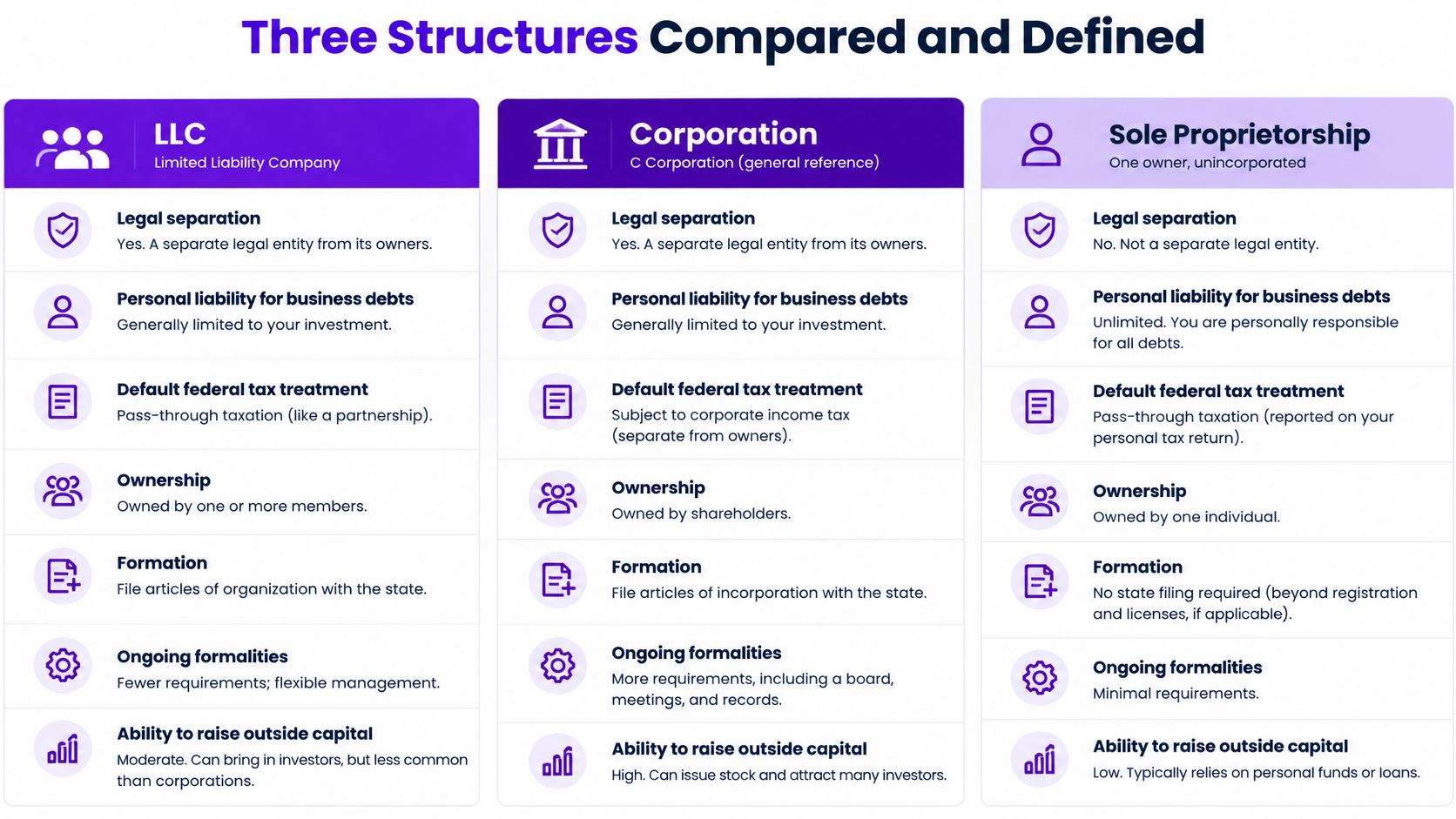
| Criterion | Sole proprietorship | LLC | C corporation |
|---|---|---|---|
| Legal separation from owner | None | Yes | Yes |
| Owner personal liability for business debts | Full, personal assets exposed | Generally limited to investment | Generally limited to investment |
| Default federal tax treatment | Owner reports on Schedule C | Pass-through (disregarded or partnership) unless elected otherwise | Corporation pays its own tax, dividends taxed again |
| Ownership | One owner | One or more members | Unlimited shareholders, multiple stock classes |
| Formation | Automatic, trade name registration optional | Articles of organization filed with state | Articles of incorporation, bylaws, board and shareholders |
| Ongoing formalities | Minimal | Annual report or fee in most states | Minutes, annual report, board and shareholder records |
| Raising outside equity | Not practical | Possible but often restructured before venture funding | Standard structure for venture investors |
Two sentences cover the decision. A sole proprietorship differs from the other two mainly in paperwork and personal exposure. An LLC and a corporation differ from each other mainly in tax treatment and ownership flexibility.
The U.S. Small Business Administration frames the legal side the same way: the choice determines whether the business is legally separate from its owner and how liability and taxation operate (SBA business structure guide). The agency points out that a sole proprietorship is created automatically when someone conducts business without registering another entity, with no legal separation, so the owner can be personally liable for business debts and lawsuits. An LLC is a separate legal structure whose owners generally receive personal liability protection while profits pass through to their personal returns, which the SBA describes as corporate-style protection combined with partnership-style taxation. Corporations are separate legal entities as well, and shareholders generally aren't personally liable, but a traditional C corporation pays income tax on its profits and those profits can be taxed again at the shareholder level when paid out as dividends.
Where each structure starts
A sole proprietorship needs nothing filed to exist. You invoice a client as yourself and you're trading. A trade name registration is optional and only changes the name on the door.
An LLC starts with articles of organization filed with the state, plus an operating agreement that sets management roles, profit splits and transfer rules. The operating agreement is where design work happens, and skipping it is the most common early mistake.
A corporation starts with articles of incorporation and bylaws, with shareholders electing directors who then appoint officers.
Who each structure suits
Freelancers and consultants with low start-up needs. Sole proprietorship, often for the first year or two, while written contracts and insurance carry the risk.
Owners with property to protect. A single-member LLC, provided the formalities are maintained after formation.
Founders expecting outside investors. A C corporation, because preferred stock and board governance are what venture money expects to buy into.
Two kinds of corporation, two sets of limits
A C corporation has no shareholder limit and can issue several classes of stock, which is why it's the default wrapper for venture-backed companies. An S corporation is a tax election rather than a separate entity type, limited to 100 shareholders, one class of stock and eligible owners only.
The control question
A sole proprietor or a single-member LLC owner decides alone and can act the same day. A corporation's control runs through governance records: board resolutions, shareholder minutes, officer appointments, all kept current. If you can't keep minutes, you'll struggle to defend the structure when a dispute tests it.
Answer three questions before going further. How much personal exposure does this business carry? Will the profit stay inside the business or be paid out? Do you expect outside investors within a few years? Those answers narrow the field faster than any feature comparison.
Liability Protection and Where It Breaks Down
Liability protection is a property boundary, and it only holds where it was built and maintained. The legal shield is separate from tax classification: an LLC can change who may sue whom while leaving the owner's federal tax treatment unchanged, and an S corporation election can change taxation without creating a new liability wall.
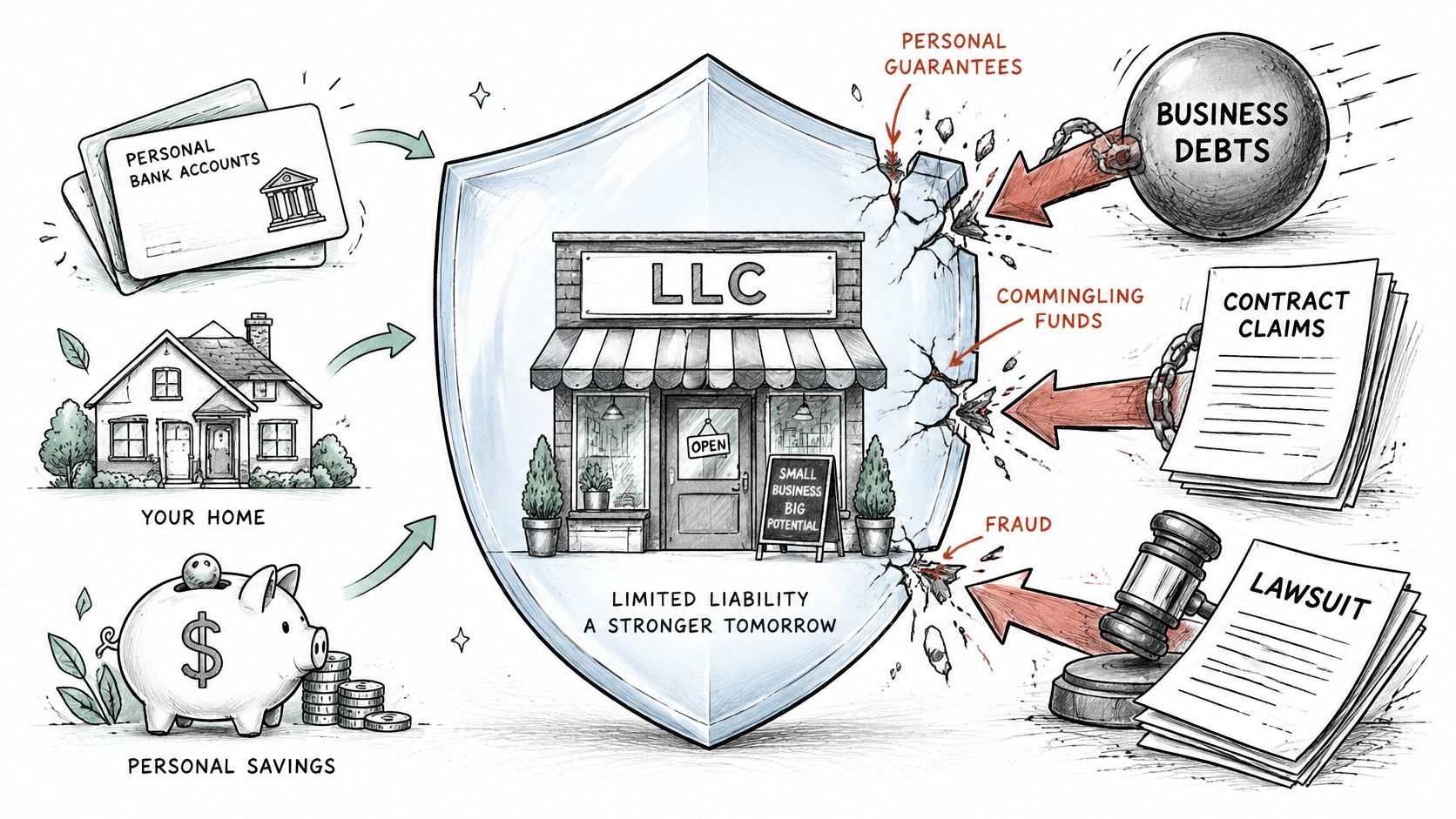
The boundary an LLC or corporation draws is specific: personal savings, a home and personal accounts stay out of reach of business debts, unpaid vendor invoices and most contract claims, as long as the business is the party that signed. Where you live and where the claim lands still matter, because guarantees, insolvency and collection rules are set by jurisdiction.
Where the shield stops
Personal guarantees. Leases, equipment loans, business credit cards and some vendor accounts arrive with a guarantee clause. Sign it and you've handed the protection straight back.
Your own professional errors. A negligence or malpractice claim against you personally sits outside the entity, whatever the letterhead says.
Commingled money and missing records. Paying personal groceries from the business account, skipping annual reports, or running the company with no capital gives a court a reason to disregard the entity entirely.
Payroll taxes. Withheld employee taxes are a personal obligation, and the trust-fund portion follows the responsible person rather than the company.
A freelance designer misses a deliverable and gets sued. As a sole proprietor, home equity is on the table. As an LLC with a separate account, a contract signed in the company name and no personal guarantee, the claim is generally limited to what the business holds. If that same designer signed a guarantee on an office lease, the lease sits outside the shield and the landlord can pursue them personally.
Practical rule: buy professional liability cover before you buy an entity. The policy covers errors the shield never covers, and it usually costs less than an annual report plus a return you don't need yet.
When a guarantee outruns the business, the questions become personal insolvency questions, and the rules are national rather than federal. If the exposure is abroad, consult a licensed insolvency lawyer in that jurisdiction; for Singapore exposure, get help with personal bankruptcy in Singapore is the kind of local counsel to contact.
For a low-risk operator with small contracts, insurance and a signed scope of work do more than an entity filing. The shield is worth paying for when there are real assets behind it and real claims in front of it.
How Each Structure Is Taxed
| Structure | Default federal classification | Self-employment tax on owner earnings | Entity-level federal income tax | Available elections |
|---|---|---|---|---|
| Sole proprietorship | Schedule C on owner's return | Yes, on net earnings | None | None, no entity election |
| Single-member LLC | Disregarded entity, same as sole proprietorship | Yes, on net earnings | None by default | Election to be taxed as an S corporation (Form 2553) or a C corporation |
| Multi-member LLC | Partnership | Yes, on active members' earnings | None by default | Election to be taxed as an S corporation or a C corporation |
| C corporation | Separate corporate taxpayer (Form 1120) | Not on dividends, payroll tax on wages | Yes, flat 21% federal rate | Can elect S corporation status if eligible |
| S corporation | Pass-through, Form 1120-S | On wages paid to the owner-employee only | None federally | Must meet eligibility rules for owners and stock |
The row that surprises people is the second one. Forming an LLC doesn't change your federal tax classification. The SBA's launch counseling material describes the LLC as a legal entity with classification flexibility rather than a tax regime: a single-member domestic LLC is disregarded by default so its activity flows onto the owner's individual return, and a multi-member LLC is generally treated as a partnership unless it elects corporate treatment (SBA launch guide). Two businesses can both be LLCs and file completely differently, with different payroll treatment and different tax economics.
Self-employment tax is the number that moves
A sole proprietor reports business income and expenses on Schedule C and pays self-employment tax on net earnings: 15.3% up to the Social Security wage base, plus 2.9% above it. A disregarded single-member LLC owes exactly the same, because the IRS never stopped looking at the owner. Forming the LLC buys liability separation, not a tax cut.
A multi-member LLC files Form 1065 and issues a Schedule K-1 to each member, who then pays self-employment tax on their active share of earnings. A C corporation files Form 1120, pays federal tax at a flat 21%, and shareholders pay again on dividends.
When the S election changes the math
An LLC or corporation can elect S status with Form 2553 if it qualifies. Under the election, the owner-employee takes a reasonable salary that carries payroll tax, and the remaining profit distributed to owners generally escapes self-employment tax.
The test worth running first: does the salary-plus-distribution split save more than the added payroll service, the extra filing and the higher state fees? If it doesn't clear that bar in a normal year, the election is paperwork for its own sake.
State taxes sit on top
Some states impose entity-level taxes or minimum fees whether or not the business made a profit, which is why an election that looks clean on the federal side can lose money overall. Model at least three scenarios for the owner: retained earnings, owner compensation, and distributions. Then rerun the model whenever your residence, your customers' location or your business nexus changes.
Setup Costs and Ongoing Compliance Compared
| Item | Sole proprietorship | LLC | Corporation |
|---|---|---|---|
| State formation fee | None | One-time filing fee set by the state | One-time filing fee set by the state, usually higher |
| Annual state report or fee | Usually none | Annual report or fee in most states | Annual report plus franchise taxes in some states |
| Registered agent | Not required | Required in most states | Required in most states |
| EIN | Optional unless hiring | Required if multi-member or when hiring | Required |
| Governing documents | None | Operating agreement recommended | Bylaws, board and shareholder minutes |
| Separate bank account and books | Strongly recommended | Strongly recommended | Required in practice |
The formation fee is the headline and the smallest number in the budget. What recurs every year is bookkeeping, payroll, the annual report, registered agent service and an additional tax return.
The costs that actually recur
Annual report and franchise fee. Most states want a filing each year, and some charge a minimum tax whether or not you made money. Check your state's business registry for the current figure before you file, because these numbers change.
Registered agent. Required in most states. It can be you at a physical in-state address during business hours, or a commercial service if you'd rather not have your home address on the public record.
Tax preparation. A Schedule C is cheap. A partnership return with K-1s, a corporate return and payroll filings are not, and the gap widens every year you add an owner or an employee.
Delaware doesn't remove your home state
Forming in Delaware, Wyoming or Nevada is popular because those states market themselves hard to remote founders. It rarely removes the obligation to register as a foreign entity in the state where you operate, and your home state's annual report and fees still apply. For most solo operators, forming where you live and work is cheaper and simpler.
Open the bank account at the same time
The account is part of the structure, not an afterthought, and it's easier to open at formation than six months later when you're chasing a client invoice. Our guide to opening a bank account without an SSN covers the documentation banks ask remote founders for.
Jurisdiction Caveats for Globally Mobile Operators
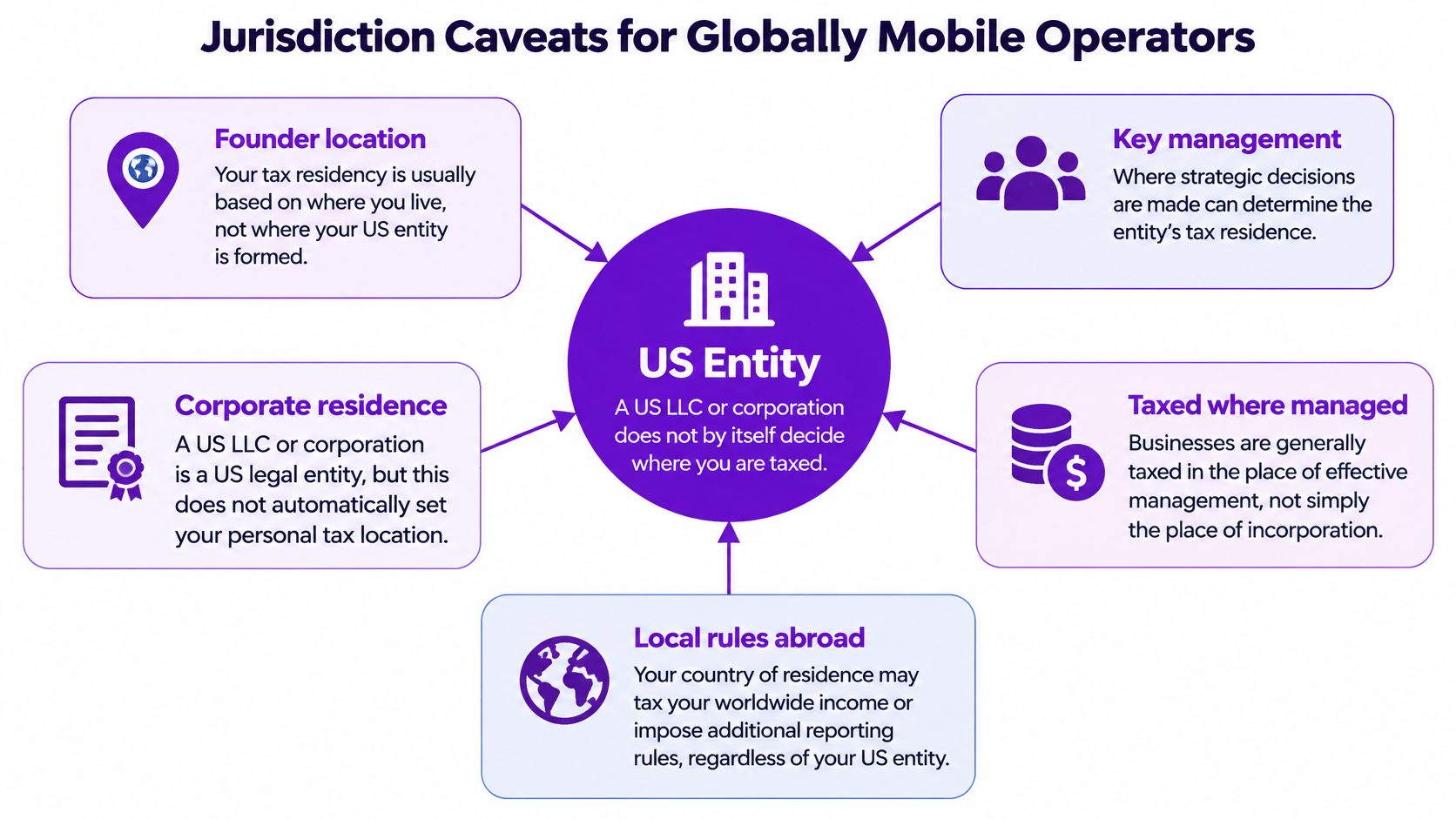
Choosing a US LLC or corporation does not settle where the business is taxed if you live somewhere else. Residence rules look at where decisions get made, not at which state stamped your articles.
That assumption breaks fast under scrutiny. Recent OECD-related analysis reports that 71% of jurisdictions don't determine corporate residence strictly from the place of incorporation and instead consider where key decision-makers are located (KPMG analysis of permanent establishment risk). Incorporating abroad doesn't stop another country from asserting corporate-tax residence, permanent-establishment exposure, employer obligations or local filing requirements if strategic decisions and revenue-generating work happen there.
The layers you have to keep separate
Entity law. Where the company is registered and what liability separation it gives you.
US federal tax. How the IRS classifies the entity and who pays self-employment or corporate tax.
State obligations. Annual reports, franchise fees, registered agent and state income or gross receipts tax.
Foreign tax residence. Where you personally live, and where the business is managed.
Mixing those layers is what produces the expensive mistakes. A founder moves to Lisbon, keeps a Wyoming LLC, keeps signing contracts from a laptop in Lisbon, and assumes the US structure settled everything. It didn't.
Personal residence is a separate question
US citizens and green-card holders generally file US returns on worldwide income whatever the entity, and a foreign country can claim tax on business activity that's managed inside its borders. The same residence logic shapes investing while living abroad, and it doesn't bend because the company is American.
The factors that create exposure are factual, not cosmetic: where you physically sit while running the company, where your customers are, who holds contracting authority, whether you have employees or dependent agents, how long you stay, and whether a tax treaty applies. Get cross-border advice before you relocate while the company is active, and test each layer on its own rather than asking one adviser to bless the whole picture.
Which Structure Fits Your Situation
| Situation | Likely best fit | Main reason |
|---|---|---|
| Low-risk freelancer with few clients | Sole proprietorship, with a trade name if needed | Lowest setup and upkeep, exposure limited by insurance and contracts |
| Consultant with client contracts and personal property | Single-member LLC | Separates business claims from personal assets, if formalities are kept |
| Remote founder planning to raise venture capital | C corporation | Investors expect preferred stock and standard governance |
| Two partners running a service business | Multi-member LLC | Pass-through tax and a flexible operating agreement for profit splits |
| Long-term business with employees and equity plans | C corporation or S corporation | Formal governance and equity structures, S status only if eligible |
| Small side business with modest revenue | Sole proprietorship or single-member LLC | Simple paperwork now, reassess when liability or revenue rises |
The rows that get handled wrong
The consultant row is the one most often handled badly. Someone signs client contracts worth more than their savings, keeps trading as a sole proprietor because the paperwork felt heavy, and only forms the LLC after a dispute. The entity costs less than a single month of lost sleep, and it should have existed before the biggest contract, not after.
The venture row gets mishandled in the other direction. Founders form an LLC for the cheap filing fee, then discover at the first term sheet that investors want a Delaware C corporation with a stock plan and a board. Converting later is doable, but it creates new filing obligations and possibly taxable events, and it happens on the investor's timeline instead of yours.
The side-business row is where over-incorporation shows up. A modest freelance income doesn't need a corporation, a payroll service and two tax returns. Start simple, keep clean records, and let revenue justify the next layer.
Reassess at each threshold
The right answer changes with revenue, the number of owners, funding plans and where you live. Treat the choice as a checkpoint rather than a tattoo. An LLC can usually be converted or elected into corporate tax treatment later, and a sole proprietorship can become an LLC in a single filing, but each change should be planned before it's forced.
Confirm Your Structure Before You File
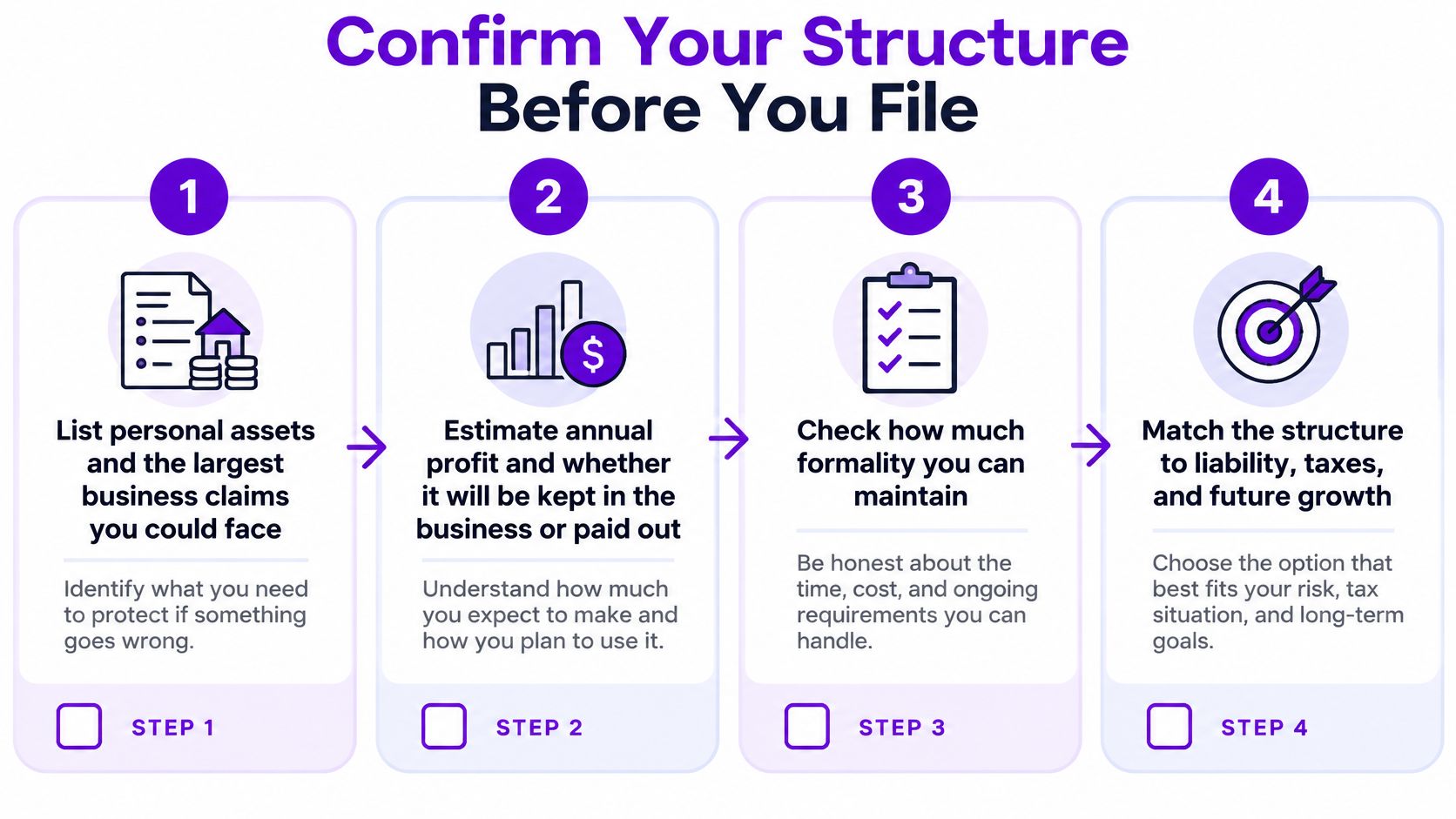
List your personal assets and the largest claim you could realistically face. That comparison, not a generic risk ranking, sets how much protection is worth paying for.
Estimate annual profit and where it goes. Money kept in the business and money paid out to you are taxed differently once an entity is involved.
Confirm whether co-owners or investors need a specific structure. Two partners or a term sheet will settle the question faster than any comparison table.
Model three scenarios. Retained earnings, owner compensation and distributions, run through the tax table above.
Total the actual annual cost. State fees, annual reports, tax preparation, payroll and bookkeeping for each option, not just the filing fee.
Check where you live and where key decisions are made. If you move while the business is active, get cross-border advice before the move, not after.
File, open the separate account and start the records. The structure only holds if the paperwork behind it stays current.
Use the cost floor as a tiebreaker. Your minimum viable rate is the target annual owner pay plus taxes, insurance, software, equipment, training, unpaid leave and overheads, divided by realistic billable hours. If the extra compliance cost of an entity pushes that floor above what your market will pay, a simpler structure is the honest answer for now. If you're still building the revenue side, our guide on how to start a business online walks through the order of operations before entity paperwork becomes urgent.
The single next step is a review with an accountant licensed in your state, and a cross-border tax adviser if you live or plan to live outside the US. Bring the three scenarios and the cost totals with you. That conversation costs far less than a structure you outgrow in eighteen months.
Choosing a structure is the first operational decision of many, and it works best when it's reviewed as your revenue and geography change. Mazurly builds the tools and guides that sit around that decision, from invoicing and pricing to banking, payments and the cross-border admin that follows a founder between countries. Take a look at the business operations resources at Mazurly before you file, and put the structure question to rest with numbers instead of guesswork.