How to Start a Business Online: A 2026 Step-by-Step Guide
Table of contents
- Launch Roadmap at a Glance
- Set the gate before doing the work
- Validate Demand in 30 Days
- Choose reachable buyers before interviewing them
- Put a price in front of the customer
- Choosing a Business Model That Fits Your Skills
- Choose according to your constraints
- Setting Up Payments, Invoicing and Compliance
- Choose cross-border payment routes deliberately
- Build a Minimal Site Around One Offer
- Build the buying path
- Test the experience without coaching
- Finding Your First Customers and Fixing Checkout Leaks
- Separate browsing from payment friction
- Scale what you can explain
The most popular advice about starting an online business gets the order wrong: pick a name, buy a domain, build a website, then look for customers. That sequence lets you spend money without confronting the hardest question: will anyone pay for what you're offering?
If you're learning how to start a business online, begin with a priced offer and a payment test. Build the website after buyers commit, and set up the money operations before accepting orders you can't deliver or reconcile. A location-independent business needs more than portable work. It needs dependable revenue, clear margins, and records that still make sense when customers, contractors, and banks operate in different countries.
Launch Roadmap at a Glance
| Phase | Planned time budget | Output you hold | Gate to pass |
|---|---|---|---|
| Validate demand | Reserve an initial sprint | Interview notes and a priced pilot offer | Several paid pilots or preorders |
| Choose model and offer | A focused planning block | An offer with price, deliverable, and delivery time | Price covers delivery labor and overhead at your target margin |
| Set up operations | Before collecting customer money | Invoicing, payments, tax, and data checklist | A test invoice paid and reconciled end to end |
| Build minimal site | A short, capped build window | Landing page with booking or checkout | Visitors reach the next step without help |
| Acquire first customers | A bounded channel test | A tracked acquisition channel | Acquisition cost below first-order contribution |
| Review and scale or pivot | Monthly review | Margin, retention, and repeat-buyer report | Positive contribution across consecutive reviews |
Treat these time budgets as planning choices, not promises about first revenue. A ready-to-sell service and an inventory-backed product require different preparation. Neither should advance just because its allotted calendar window has ended.
The U.S. Census Bureau's Business Formation Statistics distinguish tax-ID applications from employer-business formations, which are identified through the first occurrence of payroll-tax liabilities. Apply that same discipline to your launch: administrative activity isn't commercial proof.
Set the gate before doing the work
Write down what qualifies as progress and when you'll review it. Record delivery time, costs, and buyer objections alongside sales, so an apparently successful pilot doesn't hide unpaid labor.
Use our online business startup-cost guide to separate necessary expenses from purchases you can postpone. Once transactions begin, Snyp's guidance on automating bookkeeping when starting a business can help you identify record-keeping tasks worth systematizing, rather than automating an unsettled process.
Stage-gate rule: If you miss a gate, stay in that phase. If you keep missing it, rewrite the offer or customer segment instead of adding tools and spending.
We focus on helping readers grow their businesses and work smarter. This isn't a blueprint for overnight success.
Validate Demand in 30 Days
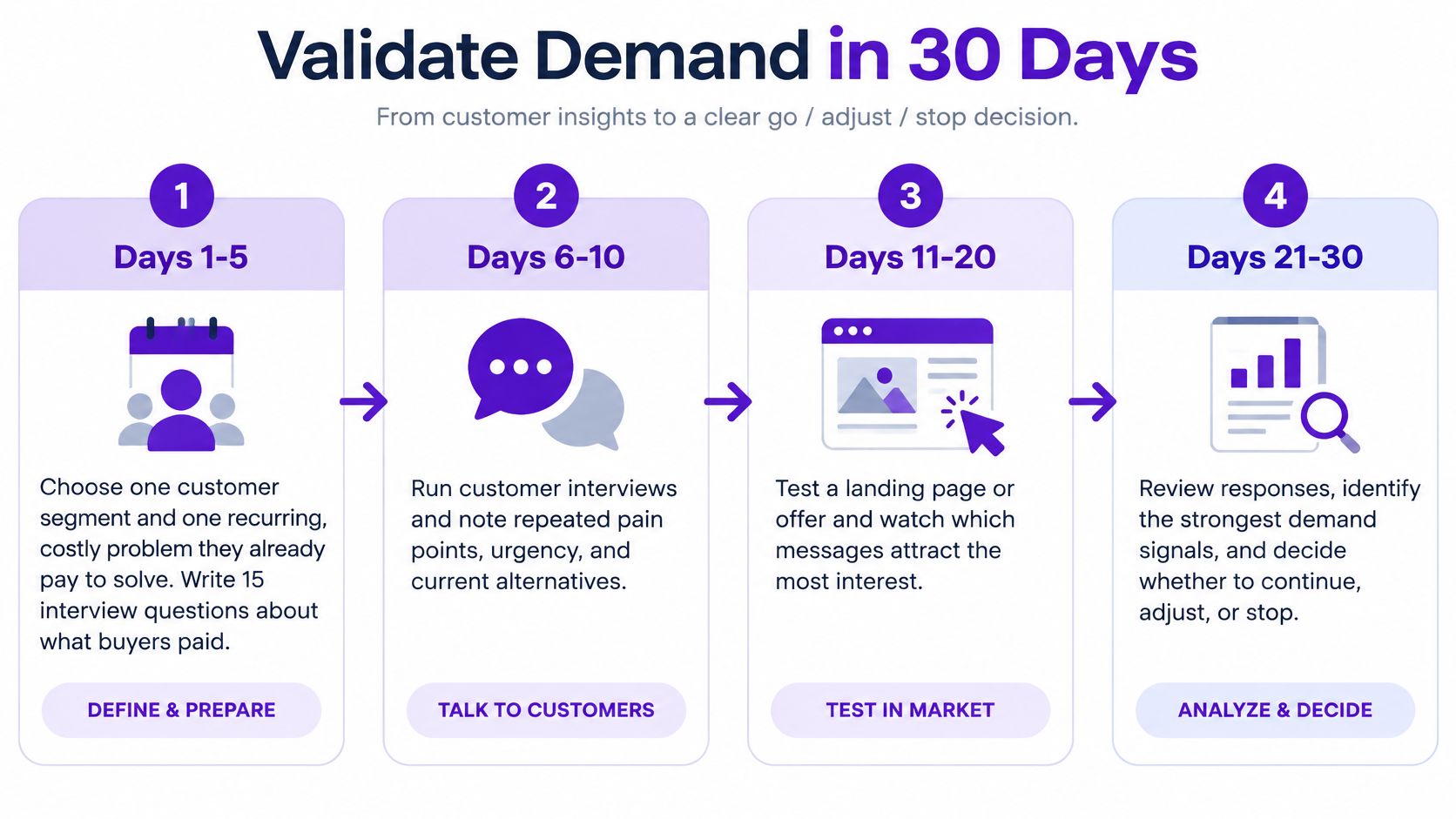
Use the month as a scheduled experiment, not a forecast that your business must succeed by its end. Before starting, define the customer, the offer you intend to test, the evidence you'll accept, and the review date.
The sprint moves from conversations to a buying decision.
Choose reachable buyers before interviewing them
- During the opening days, narrow the segment. Choose a buyer with a recurring, expensive problem and an identifiable way of finding them. A proposal-writing service for independent engineering consultants is more testable than writing services for businesses.
Write interview questions about the buyer's last attempt to solve the problem. Cover what triggered the purchase, who approved it, what alternatives they considered, what they paid for, and what remained frustrating.
- Check whether you can reach and serve them. The World Bank reports that 70.3% of the world's population used the internet in 2025, measuring access from any location during the previous three months. Online availability isn't universal, and access alone doesn't establish purchasing ability.
Confirm which channels your intended buyers use, their working language, their devices, and whether they can use your proposed payment method. A desktop-heavy buying process won't necessarily suit customers who manage everything by phone.
- Use the middle of the sprint for buyer interviews. Keep a spreadsheet with columns for outreach sent, replies, interviews completed, current solution, purchase trigger, objections, and exact customer wording. Distinguish the person experiencing the problem from the person authorized to spend.
Ask when they last paid to address it. If they've never bought a solution, find out whether they use staff time, tolerate the problem, or don't consider it urgent. Those answers imply different offers.
Put a price in front of the customer
- Turn repeated pain into a minimum viable offer. Specify the deliverable, exclusions, delivery date, price, and what the buyer must provide. For a service, define completion in terms the customer can verify rather than promising an outcome you can't control.
Test the price directly with interviewees. Don't replace the buying question with a request for feedback. Someone can like your idea while having no budget, authority, or intention to purchase.
- Use the final part of the sprint to request payment. Send the offer to qualified interviewees and provide a deposit, pilot-contract, or preorder route that's lawful and appropriate for your market. Complete the necessary business and payment checks before collecting money.
State clearly whether the offer is a pilot or preorder, when delivery will occur, and what happens if you can't fulfill it. Don't charge merely to manufacture a validation result.
A signup tells you someone wants information. A payment tells you they're willing to give something up to get the offer.
At the review, make a go, revise, or stop decision. Continue when unrelated buyers commit money for substantially the same problem and you can deliver responsibly. Revise when buyers recognize the pain but reject the scope, price, or timing; stop when the problem lacks urgency or you can't reach buyers economically.
Record which gate you passed and the assumption you'll test next. Count refusals too. Without a record of who received the offer, a few enthusiastic responses can create a misleading picture.
Choosing a Business Model That Fits Your Skills
| Model | Startup cost drivers | Route to first revenue | Margin profile | Best when |
|---|---|---|---|---|
| Freelance or consulting service | Existing tools, insurance, outreach | Sell a scoped engagement directly | Strong before owner labor, constrained by capacity | You have a skill buyers already purchase |
| Digital product or template | Production, hosting, support | Presell a defined solution | Attractive reproduction economics, with ongoing support costs | You repeatedly solve the same problem |
| Subscription or membership | Content, software, customer support | Sell continuing access or service | Recurring revenue with retention obligations | Buyers face a continuing need |
| Physical product sold online | Samples, inventory, shipping, returns | Sell stocked goods or a clearly disclosed preorder | Sensitive to fulfillment and returns | You have supplier access and working capital |
| Affiliate or content site | Publishing, production, distribution | Earn commissions from qualified traffic | Traffic- and partner-dependent | You can build useful content without immediate income |
Read each row as a statement about what you must fund and deliver, not a ranking of the best business models.
The illustration highlights the central choice: match the model to your skills and operating constraints.
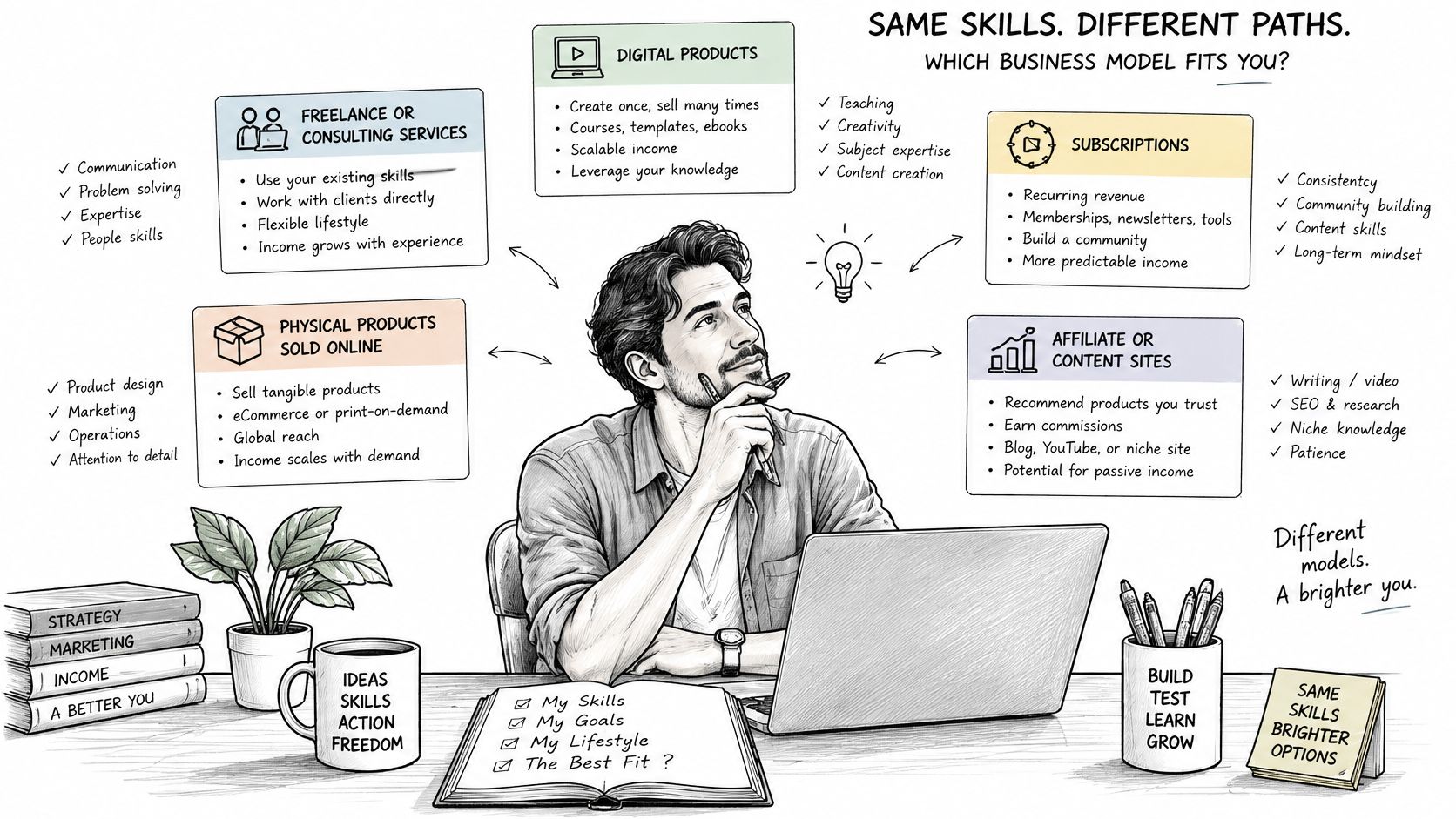
Services let you sell expertise before building a large asset, but every custom request consumes capacity. Digital products package repeated work, yet customers still need documentation, updates, and support. Subscriptions add ongoing delivery obligations, while physical products put cash into stock and expose you to shipping and return costs.
Content and affiliate businesses avoid inventory, but you must earn attention before monetizing it. Don't choose that route solely because publishing appears inexpensive.
Choose according to your constraints
The U.S. Census Bureau estimated that retail e-commerce represented 16.4% of total U.S. retail sales in the third quarter of 2025. That establishes digital selling as a substantial retail channel, not evidence that an undifferentiated offer will attract buyers.
Say you're a copywriter with limited savings. Selling a tightly scoped writing package lets you test demand without buying inventory. You might later turn repeated client work into a template, using service revenue to fund production.
Sketch out a business plan for freelancers to connect capacity, positioning, and income requirements before expanding the offer.
For another perspective on the launch process, use this video alongside your own buyer evidence.
Price from delivery economics. Include your target labor compensation, overhead allocation, payment costs, and room for profit. Then measure actual time, including revisions, meetings, and support.
Choose the model that provides the shortest credible route from your present skills to a paid commitment. Revisit that decision after delivery reveals the margin.
Setting Up Payments, Invoicing and Compliance
Complete the operating checklist before collecting customer money. You don't need an elaborate finance stack, but you do need a lawful way to trade and a reliable way to trace each payment.
Business structure: Determine the appropriate legal form and complete applicable registrations in your country.
Separate finances: Use a business account appropriate to your structure and keep personal spending out of business records.
Invoice terms: Define currency, due date, deposit requirements, deliverables, and responsibility for conversion or transfer fees.
Payment coverage: Confirm that your processor supports your business location and your customers' countries.
Tax and insurance: Check income-tax, VAT or GST, reporting, and insurance obligations with qualified local advisers.
Customer data: Document what you collect, where it's stored, who can access it, and when you delete it.
Reconciliation: Connect each invoice to the gross payment, deductions, refund, and eventual bank settlement.
When comparing tools, TopToolAdvisor's software shortlists for freelance billing provide a starting point. Evaluate candidates against your currency, export, tax-document, and reconciliation requirements rather than choosing from invoice appearance alone.
Choose cross-border payment routes deliberately
FXC Intelligence estimates that the global cross-border payments market generated $625 billion in revenue in 2025. That market revenue isn't the amount businesses send internationally, nor does it tell you what a particular transaction will cost.
Compare routes using the actual transaction:
| Decision | What to verify |
|---|---|
| Client location | Can the customer use the method without unusual bank arrangements? |
| Transaction size | How do fixed charges and percentage fees affect the net receipt? |
| Settlement | When are funds available, including possible holds? |
| Disputes | What evidence is needed for chargebacks or payment challenges? |
| Accounting | Can you export fees, exchange rates, and payout references? |
Say a consultant invoices a U.S. client in dollars but pays expenses in another currency. The invoice total isn't the spendable amount: processing, conversion, intermediary charges, and settlement timing can all affect the result. Compare the expected net receipt before quoting, and document who bears those costs.
Customer collections and contractor payouts are separate workflows. A convenient checkout method may be unsuitable for paying an overseas contractor. Retain contractor invoices, payment confirmations, and any locally required documentation.
International sales can diversify your customer base, but they also create administrative work. Price that work into the engagement.
If you change where you live or operate, reassess registration, tax, banking, and processor requirements. Don't assume an arrangement remains valid because your website hasn't changed.
Build a Minimal Site Around One Offer
Your launch site should let a qualified visitor understand the offer, judge whether it fits, and take the next step. It doesn't need to express every service you might eventually sell.
Use a hosted page builder or a simple WordPress page you can maintain yourself. Choose based on reliable checkout or booking integration, mobile usability, and ease of editing, not the number of templates.
Build the buying path
Write the offer before designing the page. State who it serves, what the buyer receives, what it costs, and when delivery happens. Include important exclusions close to the offer so customers don't mistake a limited package for open-ended help.
Add proof you can substantiate. Use permissioned feedback from paying pilot customers, a relevant sample, or a clear demonstration. Don't turn interview enthusiasm into a testimonial suggesting someone purchased or achieved a result.
Choose the right action. Use booking when you must establish fit or scope before agreeing to work. Use checkout for a defined product or fixed package that a customer can purchase without negotiation.
Explain the terms. Make cancellation, refund, delivery, and subscription conditions accessible before commitment. Add contact details and required legal or privacy information.
Connect measurement. Record page views, offer-button clicks, checkout starts, and confirmed purchases using your analytics platform. Apply relevant consent requirements, and avoid sending sensitive payment or customer information into analytics events.
Test the experience without coaching
Ask a prospective buyer to use the page while you watch. Can they explain what they're buying, find the price, and reach the correct booking or checkout screen? If you have to narrate the journey, change the wording or navigation.
Run the full route on mobile and desktop. Check confirmation messages, failed-payment behavior, calendar availability, delivery emails, and the support contact. Use the processor's testing tools where available, then verify the live configuration appropriately.
Keep the main action obvious: Don't surround checkout with unrelated offers.
Remove unfinished distractions: An empty blog or abandoned social feed doesn't help a buyer decide.
Keep access under your control: Maintain ownership of the domain, site account, and payment account.
The build gate is independent completion: visitors can reach the intended next step without assistance, and you can fulfill what the page promises.
Finding Your First Customers and Fixing Checkout Leaks
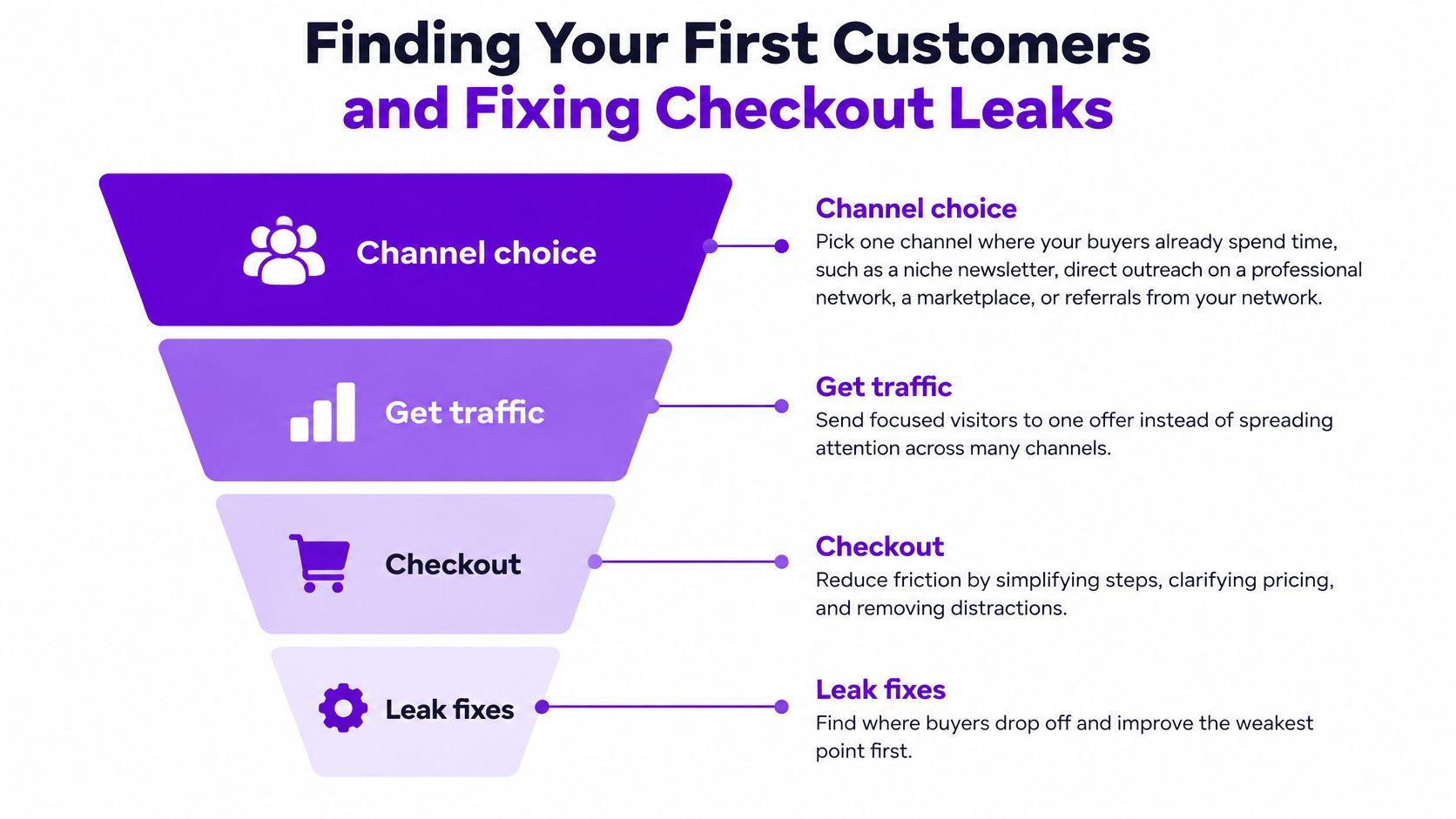
Pick a channel where your intended buyers already spend time: referrals from interviewees, a professional network, a specialist marketplace, or a relevant newsletter. Set a spending ceiling and review date before you begin. Don't open additional channels just because outreach feels uncomfortable.
Track the buying path rather than judging the campaign by impressions.
| Funnel stage | Metric to track | Warning sign |
|---|---|---|
| Site visit | Cost per visit by traffic source | Most visits come from low-fit sources |
| Offer view | Click-through to pricing or booking | Click-through declines across reviews |
| Checkout start | Share of offer views starting checkout | Interested visitors rarely begin purchasing |
| Purchase | Completed orders and conversion rate | Drop-off concentrates at shipping or tax disclosure |
| Repeat purchase | Returning buyers over an appropriate buying cycle | Customers don't return when another purchase would make sense |
The funnel helps you locate the problem before deciding what to change.
Separate browsing from payment friction
Baymard's checkout benchmark places average cart abandonment at about 70.19%, while 42% of surveyed U.S. online shoppers reported abandoning because they were browsing or weren't ready to buy. Abandonment alone doesn't establish that your checkout is broken.
Segment results by device, country, traffic source, payment method, and new versus returning visitor. If low-fit traffic leaves before examining the offer, fix targeting or messaging. If qualified visitors repeatedly fail at payment, inspect the transaction path.
Prioritize observed problems:
Unexpected costs: Disclose shipping, taxes, currency, and recurring charges before the final commitment.
Unnecessary effort: Offer guest checkout where appropriate and remove fields you don't need for fulfillment.
Payment failures: Check supported methods, error messages, authentication, and mobile behavior.
Uncertainty: Make delivery timing, refund conditions, and support access clear.
Web Mage's guide to remove friction from the payment process can help you turn those observations into a focused improvement list. Test a specific change against completed purchases, refunds, and contribution, not button clicks alone.
Scale what you can explain
Calculate contribution from revenue after variable delivery, payment, fulfillment, and acquisition costs. Include owner delivery labor at a realistic rate when deciding whether a service is commercially sustainable.
Use permission-based follow-up and our email marketing best practices to support interested buyers without treating every address as permission to send campaigns. Automate follow-up only when manual conversations have established which messages help customers decide.
Expand advertising when you can explain who buys, why they buy, and what remains after serving them. More traffic won't repair an offer that loses money on each sale.
Mazurly offers practical tools and operational guides for building revenue and managing a location-independent business, including pricing, invoicing, payments, and cross-border administration. Visit Mazurly to work through your next launch checkpoint and put a clear process behind your first paid offer.