
How to Use Credit Card Points Without Losing Value

Table of contents
- Redemption Options and Their Real Value
- Run the Calculation Yourself
- Why the Balance Has No Fixed Value
- Earn, Track and Protect Points Step by Step
- The Two Slips That Cost the Most
- How to Decide
- Three Checks Before You Wait
- A Freelancer Example
- Redeem Now or Save
- How to Redeem Points for Flights and Hotels
- Hotel and Upgrade Math
- Keeping Business-Earned Points Clean
- The Reporting Distinction
- A Clean-Records Routine
- Confirm Your Redemption Rules This Week
You've got a points balance sitting in an app, a flight you need to book next month, and no clear idea whether those points are worth $200, $600, or almost nothing once taxes are added. That's the normal position, not a failure on your part. Points aren't cash. They're a conditional, depreciating asset whose value changes with the redemption path, the program rules, and your cash flow.
Learning how to use credit card points well means doing the math before you transfer anything. You compare paths, protect the balance from expiry, and redeem only for spending you'd have done anyway. If you carry a balance or chase a bonus with unplanned purchases, the rebate disappears fast.
Redemption Options and Their Real Value
The same balance can be worth several times more in one place than another. These are typical ranges, not promises, and issuers can change them with little notice.
Typical value per point by redemption path
| Redemption path | Typical value per point | Best for | Main risk |
|---|---|---|---|
| Statement credit | about 1 cent | Immediate cash-flow relief | Low ceiling, rarely beats travel |
| Issuer portal travel booking | about 1 to 1.5 cents | Simple trips without award searching | Portal pricing markup |
| Airline or hotel transfer | often 1.5 cents or more on premium cabins | Long-haul flights and hotel stays | Transfer risk, partner availability, taxes and fees paid in cash |
| Gift cards or retail merchandise | often under 1 cent | Rarely recommended | Poor value and no price protection |
Run the Calculation Yourself
Don't trust a headline earn rate. Use this formula every time:
Value per point = (cash price minus taxes and fees) divided by points required
Say a flight costs $800 in cash, or 60,000 points plus $60 in taxes. Subtract first: $800 minus $60 is $740. Divide $740 by 60,000 and you get about 1.2 cents per point. That's better than a 1 cent statement credit, but it's not the exceptional deal portal marketing often implies.
Compare that result with the table. If your calculation lands below 1 cent, you're usually better off paying cash and keeping the points, unless expiry or cash flow changes the decision. If it clears 1.5 cents for a trip you've already planned, a transfer starts to make sense.
Why the Balance Has No Fixed Value
The scale explains the pressure to manage this properly. The Consumer Financial Protection Bureau circular on credit card rewards programs reported that consumers earned more than $40 billion in rewards from major general-purpose credit cards in 2022, and outstanding consumer rewards balances exceeded $33 billion at the end of 2022. Cash back is typically paid as statement credits, while points and miles are more often redeemed through issuer portals or partner loyalty programs, so value varies by method.
That variation is the point. A point held for a statement credit, a point spent in a portal, and a point transferred to an airline aren't interchangeable units. Issuers and partners can also devalue rewards, hide eligibility conditions, or fail to deliver them when systems malfunction.
Record the value you obtained at each redemption, not the value advertised when you earned the points. Run the calculation before every redemption, and run it again after any devaluation notice, partner change, or change to taxes and fees. If you're booking across countries, include currency conversion and travel taxes in the cash side of the comparison. Those costs can turn an apparently strong award into a mediocre one.
Earn, Track and Protect Points Step by Step
Earning is the easy part. Keeping the value requires a control process you repeat on schedule.
The two opening moves are shown below, choosing cards around spending you already do and checking the terms before a balance builds up.
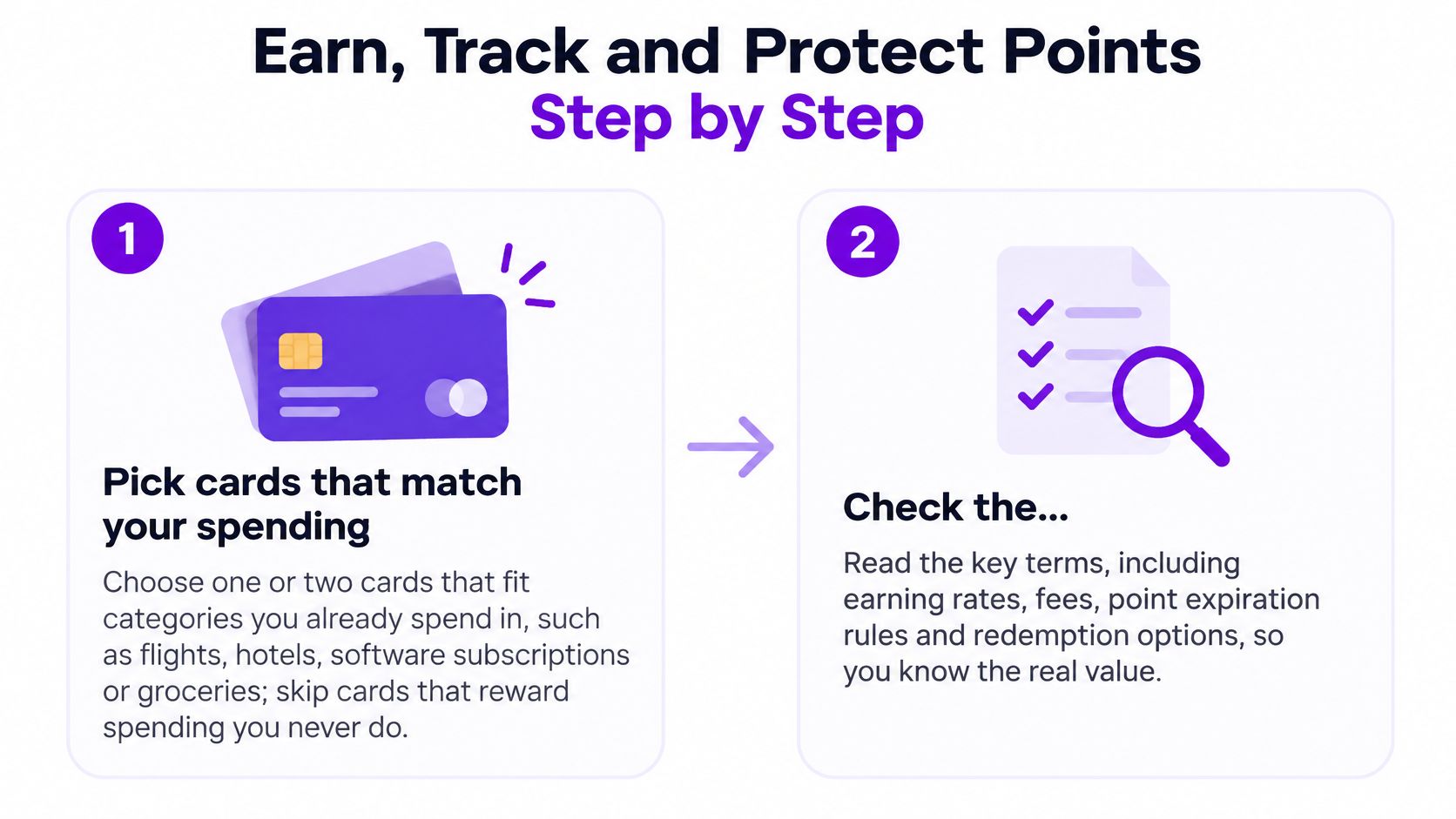
Pick one or two cards that match your real spending. Choose categories you already use, such as flights, hotels, software subscriptions, or groceries. Skip a card that rewards spending you never do, because a high multiplier on an irrelevant category earns nothing.
Plan any sign-up bonus around purchases already scheduled. Check the minimum spend and deadline, then list planned bills that reach it naturally. Don't manufacture purchases or bring forward discretionary spending just to earn a bonus.
Set autopay for the full statement balance. This is the step that protects everything else. Interest on revolving debt applies to the unpaid balance, while rewards are only a small percentage of spending, so a carried balance can erase a year of points in a short period.
Download the current rewards terms. Note expiration, inactivity, minimum-redemption, account-closure, and clawback rules in one spreadsheet. The FDIC guidance on credit card rewards warns that unredeemed rewards can expire or be forfeited when deadlines, inactivity conditions, or minimum thresholds apply.
Review balances every quarter. Log each balance on the same date and flag points expiring within 90 days. A quarterly check catches partner changes, missing points, and inactivity risk while you still have time to redeem through ordinary planned spending.
Redeem before closing or product-changing a card. Closure can forfeit the balance, and a downgrade can move you to a weaker rewards structure. Confirm in writing what happens to points before you request either change.
Save proof of every transfer. Keep screenshots, confirmation numbers, dates, and the before-and-after balances. If points are deducted without the promised benefit, that record is what lets you dispute the transaction quickly.
The Two Slips That Cost the Most
The first is carrying a balance to earn rewards. I would treat any month with interest charged as a month where the points strategy failed, regardless of how many points posted. Measure net rewards after annual fees, interest, foreign-exchange charges, and forfeited points. If that number is negative, use a simpler cash-back card or stop using credit for that spending until the balance is cleared.
The second is ignoring inactivity and expiry rules until the balance is gone. Points can disappear after account closure, under expiration policies, after partner changes, or through redemption glitches. A small planned purchase may preserve activity where the terms allow it, but don't buy something useless just to reset a clock if redeeming the points outright is cheaper.
Treat points like inventory with an expiry date, not like savings in a bank account. Inventory you don't track gets wasted.
Your spreadsheet doesn't need to be complex. One row per program, with balance, expiry date, annual fee date, transfer partners, and last activity date, is enough to prevent most losses. Update it quarterly and whenever an issuer sends a program-change notice. That habit matters more than finding one extra bonus category.
How to Decide
The standard advice says you should hoard points for a premium flight. Real behaviour is more split than that. The USAA Bank Credit Card Rewards Report found that 36% of consumers use rewards to offset everyday expenses, while 37% save for large or aspirational redemptions, and 72% redeem monthly or as soon as possible, compared with 24% who accumulate points.
Neither group is automatically right. The correct choice depends on liquidity, the value gap, and program risk. Immediate redemption can be a budgeting tool. Delayed redemption exposes you to devaluations, expiring rewards, and award seats that disappear.
Three Checks Before You Wait
Liquidity check: Can you cover the next three months of expenses without using the statement credit? If you can't, redeeming now may prevent interest charges that cost far more than the extra travel value you'd gain later.
Value gap check: Is the award clearly above 1.5 cents per point for a trip you've already planned? A theoretical high value on a trip you wouldn't otherwise take isn't a saving.
Program risk check: Is there a devaluation notice, a transfer partner change, or an expiry date approaching? If yes, waiting has a cost even when the current award price looks attractive.
If you fail the liquidity check, redeem. If you pass all three checks and you have a dated trip, saving can be rational. If the value gap is small, say 1.1 cents for travel against 1 cent as a statement credit, I would usually take the simpler option and remove the risk.
A Freelancer Example
Say a consultant has a $3,000 tax bill due in March and holds 40,000 points. As a statement credit at 1 cent per point, that's $400 now. Saved for a flight, the same points might be worth about $600 later.
Waiting looks better until you add the cash gap. If the missing $400 forces part of the tax bill onto a revolving card balance, interest can exceed the $200 value difference quickly. Redeeming now is the financially stronger move because it protects liquidity. A person with stable income, an emergency fund, and a flight booked six months out faces the opposite calculation and can wait.
That's why irregular income favours faster redemption. Freelancers, founders, and globally mobile workers often have lumpy receipts and fixed obligations in different currencies. Keeping the right account structure matters alongside points, which is why it helps to review options for the best international banking setup before a currency or payment delay turns into card debt.
Redeem Now or Save
Redeem now when cash flow is tight, points expire soon, a devaluation has been announced, or the travel value is only slightly above statement credit value. Redeem now also when you earned the points on reimbursable business spending and a quick, documented statement credit keeps the records cleaner.
Save when you have at least three months of expenses covered, a specific trip is planned, the award is available at a strong value, and there's no near-term expiry. Saving without a target trip isn't a strategy. It's exposure to program changes while your balance earns no interest and buys nothing.
How to Redeem Points for Flights and Hotels
Decide the trip before you move any points. Transfers are often hard to reverse, and a transferred balance is trapped in that partner program if award availability changes.
Before you search, have your passport details, flexible dates, and cash budget for taxes ready, as in the planning setup below.

Search the award calendar first. Compare at least two departure dates and one nearby airport. Award pricing can change sharply by day, and a nearby airport may open a direct flight that your home airport doesn't offer.
Compare points plus taxes with the cash fare. Use the same route, cabin, and baggage allowance in both prices. Don't compare a basic cash fare with no bag against an award that includes one, or you'll overstate the value.
Confirm availability before transferring. Search results can show phantom availability that disappears at checkout. Go as far as the partner booking flow allows without paying, and check transfer timing too, because some transfers post quickly and others take longer.
Transfer the exact amount needed, plus a small buffer. The buffer covers minor price movement or fees. Don't transfer your full balance on speculation, because surplus points stranded in an airline program lose the flexibility that made them valuable.
Book immediately after the transfer posts. Popular award seats can disappear within minutes. Confirm the booking inside the partner account, not only on a confirmation screen in the issuer portal.
Check names and fare rules. The passenger name must match the passport exactly. Read change and cancellation fees before you pay the taxes, especially on partner awards booked through a different airline from the one operating the flight. For routing problems and rebooking traps, the award booking insights from INVOLUNTARY REROUTE are a useful companion when you're comparing partner options.
Save the confirmation and recheck expiry dates. Store the booking reference, receipt for taxes, and transfer confirmation together. Then check whether any remaining balance in another program expires soon, because one successful booking often distracts people from a second balance about to lapse.
The walkthrough below is worth watching before your first partner transfer, so you can see the booking sequence before your own points are at risk.
Hotel and Upgrade Math
Say a category 4 hotel costs $450 per night in cash for three nights, or 20,000 points per night. The cash total is $1,350 and the points total is 60,000, giving 2.25 cents per point before any taxes or resort fees still payable in cash. That's strong value, provided you'd have paid for that hotel standard. If you'd otherwise book a $180 per night property, value the award against $540, not $1,350, and the result falls to 0.9 cents per point.
Upgrades need the same discipline. Say an economy to premium economy upgrade on a long-haul segment costs $250 in cash, or 8,000 points plus $40 in taxes. The calculation is $250 minus $40, divided by 8,000, which gives about 2.6 cents per point. Book it only if your ticket class is eligible, the upgrade can clear before departure, and you'd value the extra comfort at close to the cash price.
Never transfer points to chase an award you haven't seen available in the partner's own booking flow.
The common mistakes are booking cash travel before a transfer posts, forgetting that taxes and fees are paid in cash, and assuming a search result guarantees a seat. Build the taxes into your travel budget from the start. On some routes they're minor. On others, especially premium long-haul awards, they can be large enough to make a cash economy fare the cheaper total trip.
Keeping Business-Earned Points Clean
A consultant earns points on client travel, receives a sign-up bonus, and later redeems the balance for a personal holiday while working across two countries. Nothing about that is unusual, and it's exactly where clean records matter. Maximising points can be operationally worse if it creates disputed ownership or unexpected taxable income.
How points from different expenses are usually treated
| Expense type | Usual treatment | Records to keep |
|---|---|---|
| Reimbursed client travel | Points usually follow the person who paid, so check the reimbursement policy | Receipt, reimbursement claim and card statement |
| Personal spending on a business card | Usually treated as personal rewards; keep separate from business totals | Card statement and account owner details |
| Sign-up bonus or referral reward | May be reported as income depending on jurisdiction | Issuer tax form and bonus terms |
| Business-earned points used for a personal trip | Can convert a business rebate into a personal benefit | Redemption date, trip purpose and who paid |
The Reporting Distinction
U.S.-focused reporting in Management.org's guide to credit cards for freelancers indicates that ordinary rewards are generally treated as purchase discounts, while certain cash bonuses, referral incentives, and promotional rewards may trigger information reporting, with one report citing a $600 reporting threshold, increasing to $2,000 in 2026. Treat that as a prompt to keep issuer forms, not as tax advice for your country.
The personal-benefit issue is separate. If a business paid for the spending that earned the points and you redeem them for a personal vacation, a business-related rebate may become a personal benefit. Depending on your structure and jurisdiction, that may need disclosure, reimbursement to the business, or inclusion in your personal tax records.
Client work adds another layer. If a client reimbursed the flight that earned the points, check the contract and expenses policy before assuming the points are yours to spend freely. Some clients don't care. Others expect rebates and rewards from reimbursed travel to be disclosed or applied against future travel for that client.
A Clean-Records Routine
Record who paid: Note the cardholder, the business or client who bore the cost, and whether the expense was reimbursed.
Separate the streams: Keep reimbursed, non-reimbursed business, and personal spending in different spreadsheet tabs or accounting categories.
Log every statement credit: Record the date, points used, cash value received, and what bill it offset.
Retain issuer tax forms: Save bonus terms and any reporting forms with the tax return they relate to.
Ask locally: Consult a tax professional in each country where you live or earn, because treatment varies by jurisdiction.
Separation is easier when your banking matches your work pattern. If you're operating outside your home country, review how to open a bank account for non-residents so reimbursements, personal funds, and business receipts don't get mixed in one account.
I would rather earn slightly fewer points on a card that produces clean statements than squeeze out an extra category bonus with records nobody can reconstruct later. When a client, business partner, or tax authority asks who paid and who benefited, you need an answer that takes minutes to produce. That operational clarity is part of the value.
Confirm Your Redemption Rules This Week
Do this once, properly, and you'll stop guessing. The goal for this week is one saved spreadsheet and one redemption either booked or scheduled for a specific date.
Here's the working setup to copy, with balances, expiry dates, and a task list in one place.
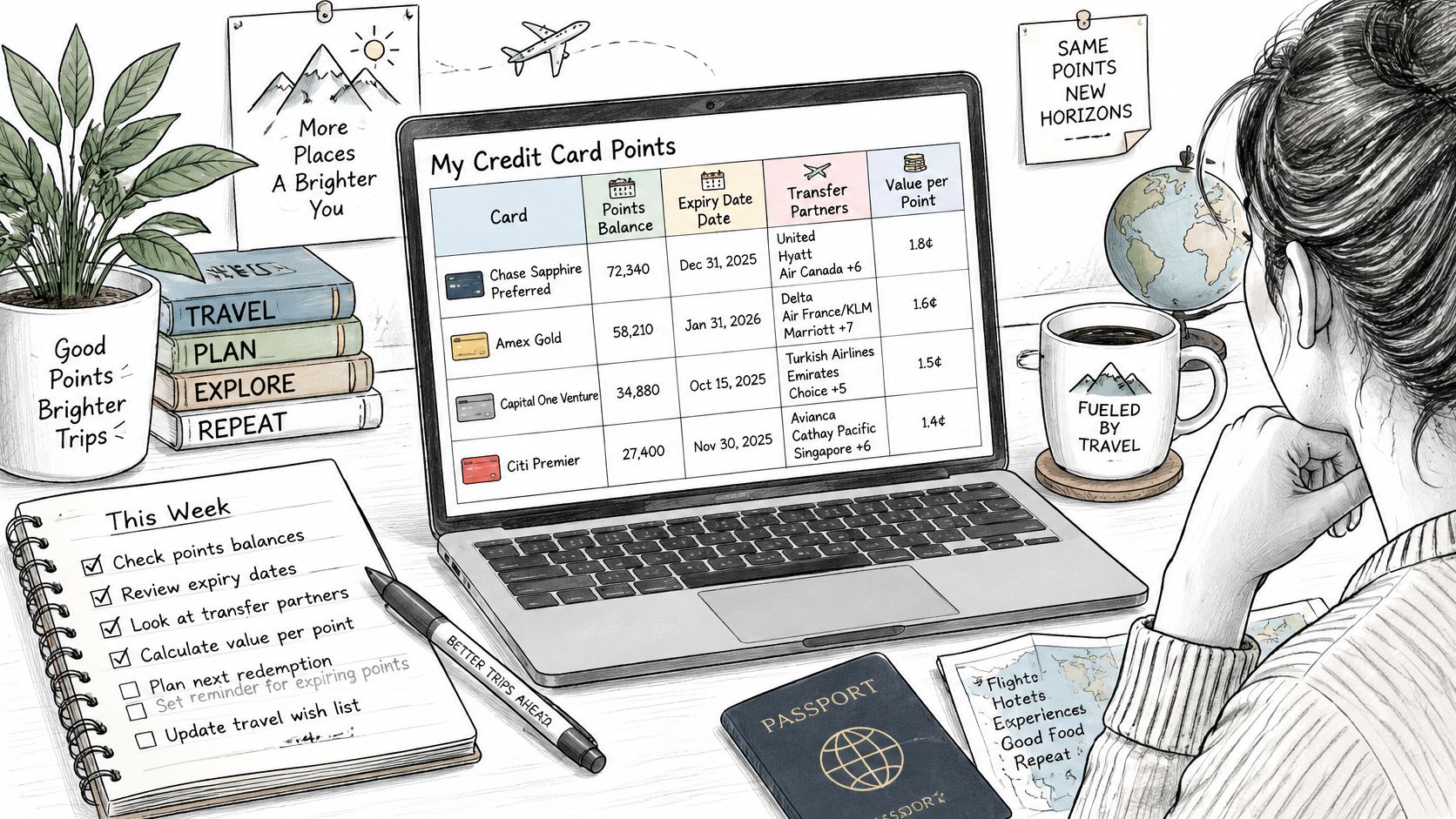
List every card and program today. Add the current balance, expiry date, transfer partners, annual fee, and the value per point you'd realistically get from each redemption path. Use your own past redemptions where you have them, not advertised maximums.
Add a net value column. For each option, take the expected award value and subtract the annual fee, any interest, foreign transaction fees, cash taxes, and points you'd forfeit. Compare that figure directly with the statement credit alternative.
Note cross-border restrictions. Record transfer rules, blackout dates, partner programs that only book from certain countries, and fare classes that disappear for non-resident bookings. These details decide whether a high-value award is bookable from where you live.
Set the next quarterly review. Put it in your calendar now and write each expiry date beside its card. If you're planning the trip itself alongside the booking, our Travel section covers smart visas, eSIMs, and cost of living for the destination side of the decision.
Pick your first redemption. Choose a trip or bill you already have, run the cents-per-point calculation, and confirm award availability before transferring anything. Stop when the spreadsheet is saved and that first redemption is booked or dated.
Keep the scale in mind while you do it. The Federal Reserve analysis of 238 million consumer cards found cash-back products generally returned about 0.5% to 3% of purchase volume, and estimated the average reward card generated approximately $13.34 in rewards per month. That's a useful rebate on planned spending. It isn't a reason to spend more or carry debt.
If you're running a business across borders, your points strategy should sit alongside clean banking, visa planning, and destination costs, not in a separate spreadsheet you forget about. Visit Mazurly to use our guides and tools for globally mobile founders, freelancers, and remote operators, and turn scattered travel and finance admin into workflows you can repeat every quarter.