How to Open a Bank Account Without SSN
Table of contents
- Why You Can Open a Bank Account Without SSN
- Documents Banks Accept Instead of an SSN
- Assemble documents that match
- How to Apply With an ITIN or Foreign Tax ID
- If you have or need an ITIN
- If you're documenting foreign status
- What an Account Still Will Not Let You Do
- Test the transaction, not the account label
- Comparing U.S. Banks Fintech and Accounts Abroad
- Compare the route with the payment
- Tips That Prevent a Frozen or Useless Account
- Your Next Step After the Account Opens
A client invoice is ready, the founder's payout is due, and the U.S. bank application asks for a Social Security number. You don't have one. That can make the form feel like a closed door, especially when the money is meant to cover ordinary business expenses, not a complicated financial setup.
For many non-U.S. persons, it's legally possible to open a U.S. bank account without an SSN. But getting an account approved is only the first hurdle. The useful question is whether it can receive your client's payment, send the transfers you need, and support the way your business operates across borders.
Why You Can Open a Bank Account Without SSN
A freelance invoice has been approved, or a founder payout is on its way, but the application form has a required SSN field. If you're a non-U.S. applicant, that field doesn't always mean you're ineligible. Federal customer identification rules require banks to collect information that allows them to identify each customer, but an SSN isn't the only possible identification number for every applicant.
Under the Customer Identification Program rules, a bank generally needs your name, date of birth, address, and an identification number before opening an account. For a non-U.S. person, that number may be a taxpayer identification number, a passport number and country of issuance, an alien identification number, or the number and country of issuance of another government document showing nationality or residence and containing a photograph or comparable security feature. The Office of the Comptroller of the Currency's guidance on customer identification describes these identification options.
That makes eligibility possible, not automatic. A bank can set stricter requirements to form a reasonable belief that it knows who you are. Depending on your residence, tax status, and expected account activity, it might ask for an ITIN, proof of a U.S. address, immigration documents, or an in-person appointment. One bank may accept a foreign passport online; another may want documents reviewed at a branch.
Practical rule: Treat “no SSN” as a question to resolve with the institution, not a reason to misstate information on an application.
For people comparing financial systems across countries, it can also help to look beyond the United States. Inpro's guide to UAE banking for non-residents offers another perspective on how eligibility and documentation can vary by jurisdiction. The broader point is the same: the right paperwork depends on the institution and the account you're applying for.
A foreign passport may satisfy a core identity requirement, but it doesn't settle questions about address, tax documentation, or payment activity. What matters most is finding a bank that will accept your documents and support the transactions your work depends on.
Documents Banks Accept Instead of an SSN
Federal consumer guidance recognizes an ITIN as an alternative to an SSN for many U.S. bank account applications. The FDIC's account-opening guide lists an SSN or ITIN alongside a date of birth and government-issued identification. Examples of government ID include a driver's license, state identification card, U.S. passport, or military identification. Some banks and credit unions may also accept a foreign passport, a consular identification card, an alien identification card, or another government-issued identification number.
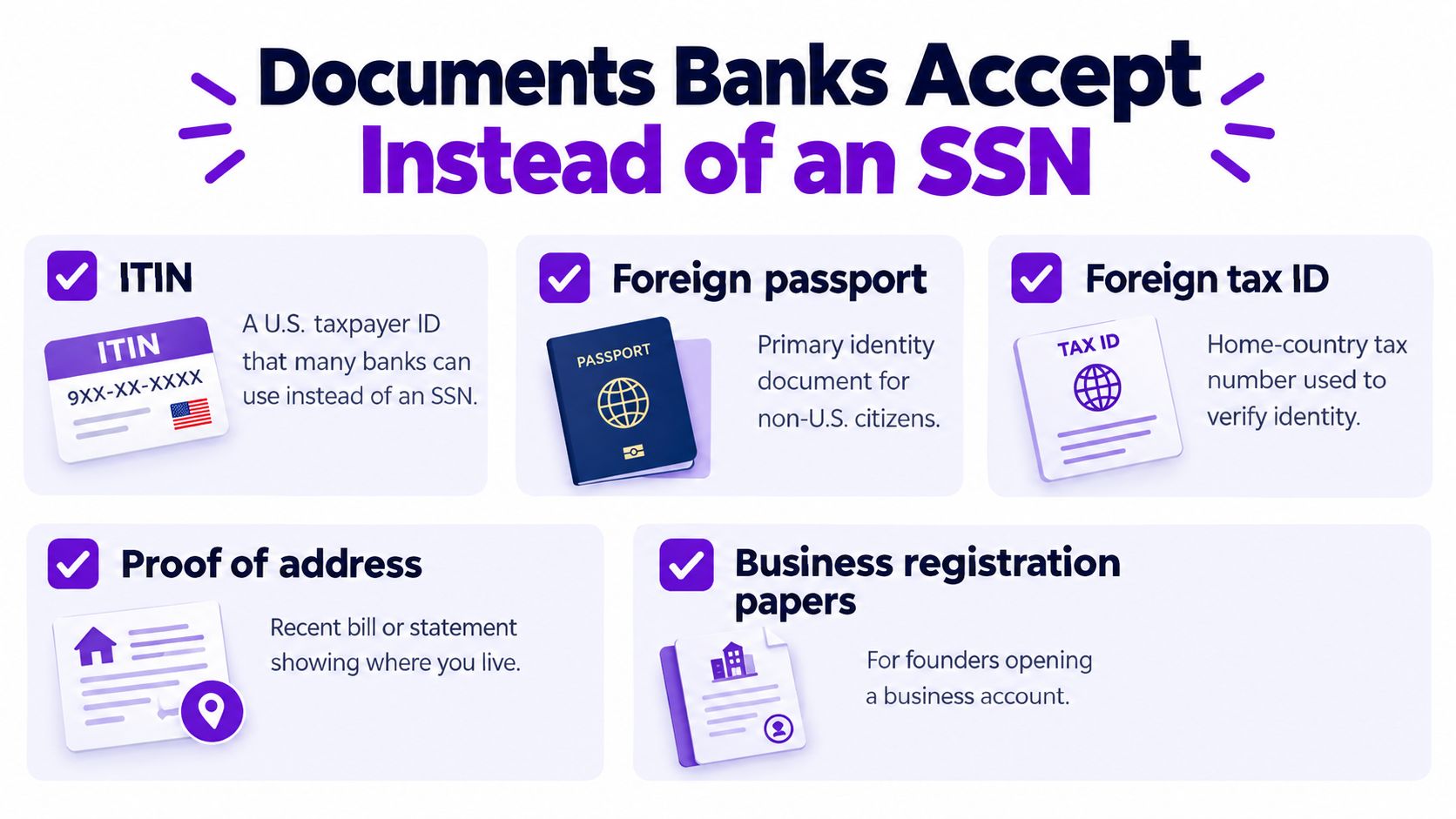
The reason banks ask for these details isn't just branch preference. The Customer Identification Program, established under the USA PATRIOT Act framework, requires banks to collect and verify core information before opening accounts. A teller's comfort with a document isn't a substitute for the bank's formal verification procedures.
Assemble documents that match
Before you start an application, gather the identity documents you already have and check them for consistency. The name spelling, address, and dates should match across your passport, bank forms, and tax paperwork. A discrepancy may prompt a review, even if each document is genuine.
A useful starting packet may include:
Passport details: Have the passport available and note its number and country of issuance.
Tax identifier: If you have an ITIN or a foreign tax ID, ask whether the bank accepts it for the account you want.
Address information: Be ready to provide your current address and ask whether the bank needs separate proof.
Additional government ID: Ask whether a consular ID or another government document is acceptable.
Don't assume every bank treats these documents alike. Some may still request an ITIN, or limit access to interest-bearing products. Before applying, ask the institution which documents it accepts for the specific product, whether it allows non-U.S. applicants, and whether the process requires an in-person visit. That saves time and keeps you from submitting an application that can't pass the bank's own verification checks.
How to Apply With an ITIN or Foreign Tax ID
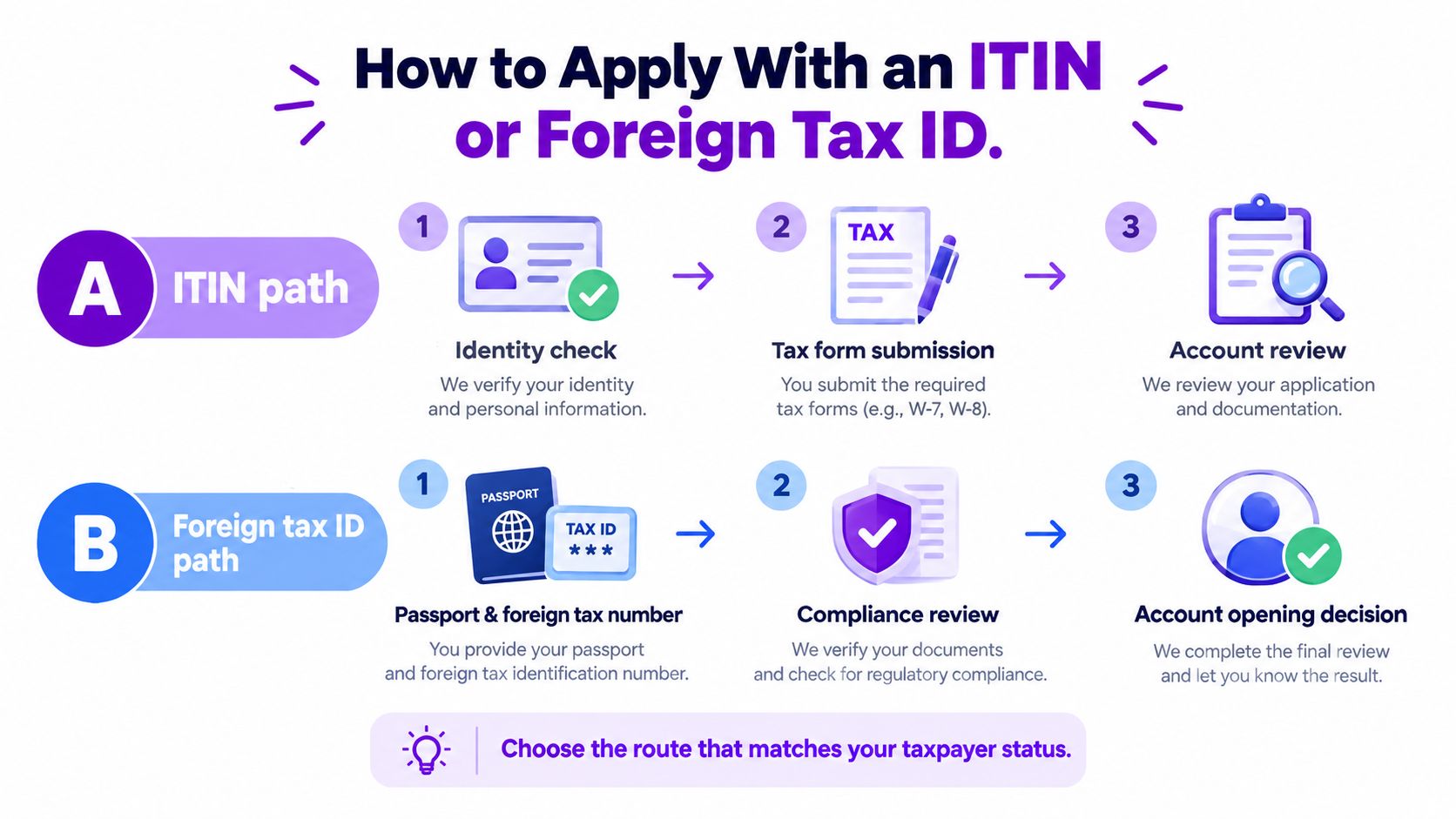
Identity verification and tax documentation are related, but they aren't the same task. An ITIN is a U.S. tax identifier, not a promise that you'll qualify for every bank account, credit card, or other financial product. Before applying for one for banking purposes, ask whether the institution accepts it for the exact account and services you need.
If you have or need an ITIN
Confirm the bank's requirement before treating an ITIN as the solution to an application problem. A bank may accept it for identity verification, but its policies for account features and other products can differ. Keep the ITIN information consistent with the name and other details on your bank application.
If you're documenting foreign status
A foreign individual may need Form W-8BEN to establish foreign status with a U.S. financial institution or payer. First identify your tax residence and obtain the tax-identification number issued by that country, if one exists. Complete Form W-8BEN rather than incorrectly filing Form W-9 when the foreign-status route applies. Make sure your name, address, citizenship, and tax-residency details match your passport and account application, and keep records that support your foreign status.
The IRS instructions for Form W-8BEN say that the form can require a foreign tax-identification number. If your country hasn't issued one, the instructions require an explanation of why it wasn't issued. The form must reach the withholding agent or payer before relevant income is paid or credited.
That timing matters for a freelancer or founder expecting U.S.-source income. The bank may approve an account while tax documentation for a payment is still missing. Opening the account and satisfying the tax paperwork are separate compliance actions, so don't treat one as a substitute for the other. For a wider look at how non-resident account applications work in another market, RNC Group's guide to non-resident banking provides useful context on navigating banking outside your country of residence.
What an Account Still Will Not Let You Do
A bank can approve your identity and still decline to provide the financial functionality you need. Permission to open a deposit account doesn't guarantee a debit card, international wires, overdrafts, credit, or business banking. You may also encounter a delayed review or questions about where funds come from. An ITIN is primarily a tax identifier, so it doesn't automatically qualify you for every account or credit product. The FDIC's supervisory guidance on customer identification and account access notes that institutional policies and restrictions can affect what customers can access.
Consider a consultant whose client pays from another country. The client needs to pay an invoice made out to the consultant's business, but the available account is a personal checking account. Even if a transfer arrives, the account may not support the business-name match, the desired international wire, or the currency handling the consultant expects. The account exists, but the payment workflow still doesn't work.
| Need | Often possible without SSN | Often still restricted | Question to ask first |
|---|---|---|---|
| Personal checking | A bank may accept alternative identity documents | Debit access, interest-bearing options, or approval timing may vary | Does this account accept my passport and tax ID? |
| Business banking | A bank may review an application without an SSN | Business-name verification and documentation can be stricter | Can the account receive payments made to my business name? |
| Debit versus credit | A deposit account may be available | Credit underwriting can require different eligibility checks | Does approval include a debit card, and what does it not include? |
| ACH versus wires | Domestic transfer access may be offered | International wires or particular payment routes may be limited | Can I receive the expected client payment and send the wires I need? |
| Opening versus ongoing review | The account may be opened after identity checks | Later reviews may request more information about activity or funds | What records should I keep for cross-border transfers? |
Test the transaction, not the account label
Before you apply, ask whether the bank accepts a foreign passport, foreign tax ID, temporary U.S. address, and non-U.S. source of funds. Then ask whether those documents support the transactions you expect, including client receipts, business-name payments, domestic transfers, and international wires.
A basic personal account may be enough for everyday spending but not for business operations across borders. A bank may also review activity after opening, so prepare clear records explaining the purpose and origin of expected payments. Don't choose an account based only on the fact that its application accepts your documents.
Comparing U.S. Banks Fintech and Accounts Abroad
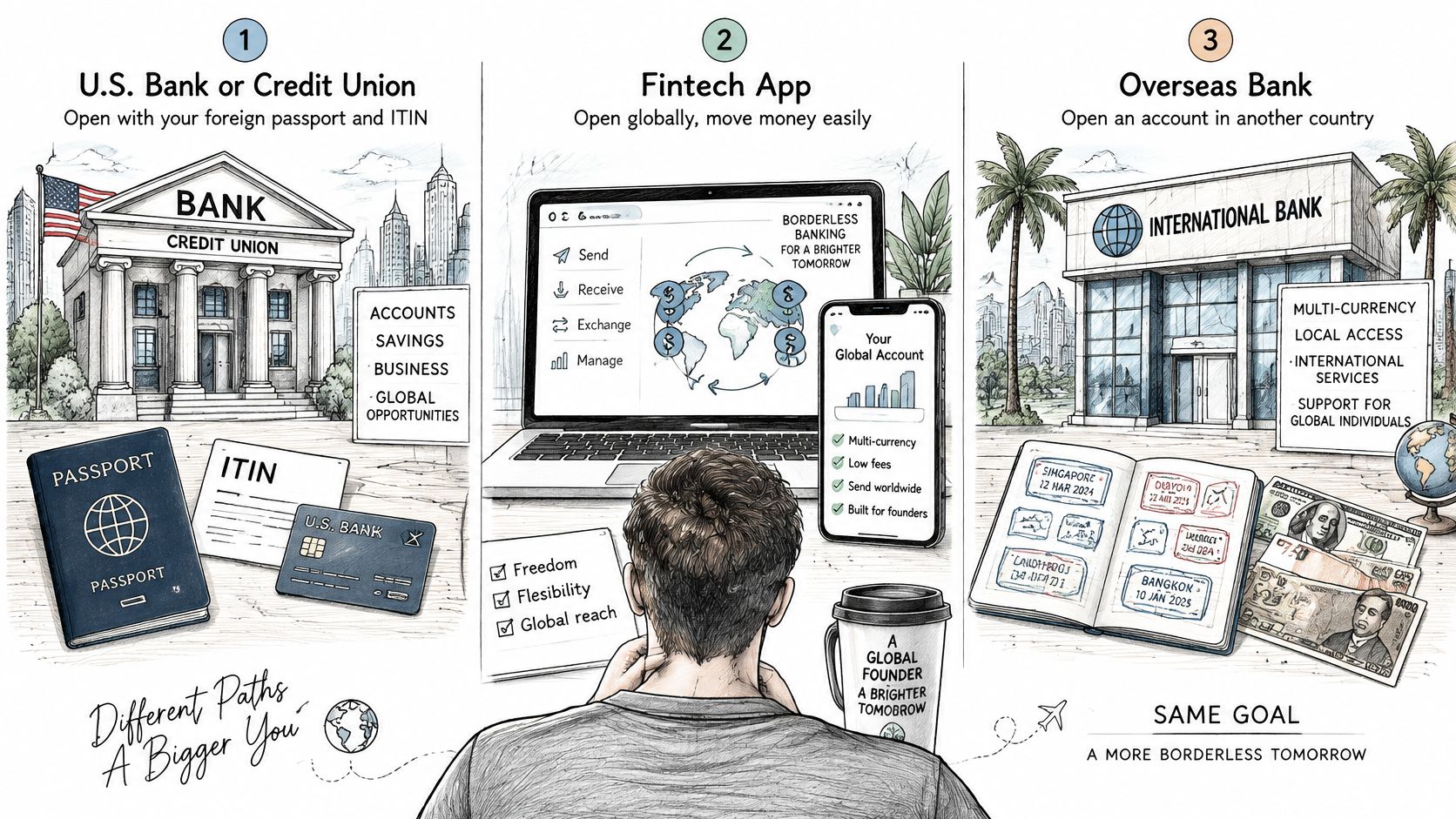
A U.S. bank, an account abroad, and a fintech or multi-currency service solve different problems. The best choice depends less on the word “bank” in the provider's description and more on where your clients send money, which currency you need to use, and what documentation you can provide.
Compare the route with the payment
A U.S. bank or credit union may suit you if you need an account in the United States and can meet that institution's identity and address requirements. A foreign passport or ITIN may be relevant, but an application could still involve proof of address, immigration documents, or an in-person appointment. Confirm which transactions and account features are available before you move client money.
An account in your country of residence or citizenship may be more straightforward if your local documents and address are easier to verify. Its limitation may be operational: it might not provide the U.S. payment route your client expects. Someone considering another destination can also review Jasumo's guide to banking in Japan as a foreigner to understand how local requirements shape the choice.
A fintech or multi-currency account may help with receiving and managing international payments, but it isn't interchangeable with a bank. A non-bank provider may have its own verification process and limits, and you should check whether it supports the particular payment route, business identity, and currency you need. Don't assume that an app's ability to move money means every bank service is available.
| Route | May fit when | Check before relying on it |
|---|---|---|
| U.S. bank or credit union | You need U.S. banking and can meet the institution's requirements | Address rules, in-person process, account features, and payment types |
| Account abroad | Your residence or citizenship makes local onboarding practical | Whether it handles the U.S. payment rails and client requirements you need |
| Fintech or multi-currency service | You need a digital way to manage cross-border receipts | Provider status, verification, transaction limits, and business-name support |
Choose based on the next invoice, not the provider's marketing category. Work out where the payer will send funds, which name will appear on the invoice, and whether you need to convert or transfer the money after it arrives. Then confirm that the route you're considering accepts your documents and supports that flow.
Tips That Prevent a Frozen or Useless Account
An approved application can still lead to a payment problem if the information on it doesn't match your supporting documents. Don't use a different spelling of your name, an address you can't explain, or a tax form that doesn't reflect your status. If you're documenting foreign status, don't submit a W-9 by default when the appropriate form is W-8BEN.
A personal checking account may also fail to accept a payment sent to your business name. Before giving clients the account details, confirm what name the bank expects on incoming payments and whether the account is appropriate for the activity you plan to run through it. If a payment comes from abroad, keep a clear record of what it is for and where it originated.
Approval means the bank believes it knows you, not that every payment rail is open.
If approval is delayed, ask the bank to identify what's holding the application. Be specific: is it asking for an ITIN, proof of address, immigration papers, source-of-funds information, or an in-person visit? A clear answer lets you decide whether to provide the missing item or apply elsewhere.
Restricted accounts need the same scrutiny. An account may open without a debit card, international wire capability, or an interest-bearing option. Ask about those limits before transferring client money or relying on the account to pay a contractor. If the bank can't confirm that it supports your expected activity, keep looking rather than treating the approval notice as a completed solution.
Your Next Step After the Account Opens
Write down the one transaction you need to complete next. It might be receiving a client payment, sending an international wire, or separating business income from personal spending. Then match that transaction to one institution and the documents it has already confirmed it accepts.
Keep the application plan simple. Note your passport and tax-ID status, whether you're using an ITIN or documenting foreign status with W-8BEN, and the bank's answers about address, source of funds, and payment access. Only submit the application once those details fit the account you're seeking.
Cross-border finances often connect to other decisions, from invoicing and currency workflows to how you manage investments while living abroad. Mazurly's guide to investing while living abroad can help you think about those related admin needs alongside your banking setup.
The practical test is straightforward: if the account you choose can't move the next invoice, it isn't the right account yet.
Mazurly helps globally mobile founders and freelancers organize the practical work around running a business across borders, including invoicing, payments, and international admin. If you're comparing banking options and want to connect that choice to the rest of your operating workflow, visit Mazurly.