
Spain Long Term Visa: Types, Eligibility and How to Apply
Table of contents
- Spain Long-Term Visa Types Compared
- How to read the comparison
- Entry, Residence and Work Are Separate Permissions
- What a national visa does and doesn't do
- Living in Spain Without Working
- The financial test step by step
- Insurance and the identity card
- Remote Work Eligibility and Proof of Income
- The relationship tests
- The income figure and what sits behind it
- Evidence by applicant type
- Apply From Abroad or From Inside Spain
- A decision tree in five steps
- Costs to Plan for Before You Apply
- Money you must show
- Money you must spend
- Application Steps, Renewals and Living Compliance
- The application sequence
- The renewal calendar
- Choose Your Route and Take the First Action
What if the passport you hold isn't the question that decides your Spain long-term visa at all? Many applicants start by asking which visa their nationality allows, then discover Spain asks something different first. What will you do in Spain, how long will you stay, and where are you when you apply? Answer those three questions clearly and the route usually narrows fast. Answer them loosely and you can end up with a visa that lets you live in Spain but not earn, or work remotely but not for the clients you have.
Spain Long-Term Visa Types Compared
The Spain long-term visa you can use depends on what you'll do in Spain and how long you'll stay, not only on your passport. That's the direct answer, and everything else follows from it. Four routes cover most readers. Non-lucrative residence suits people who won't work. The international teleworker visa suits remote staff and freelancers paid by non-Spanish companies. Digital nomad residence suits eligible people already lawfully in Spain. Employment residence suits people hired by a Spanish employer.
How to read the comparison
| Route | Best for | Work allowed | Initial validity | Main income or eligibility test |
|---|---|---|---|---|
| Non-lucrative residence | Retirees and financially independent people | No | Up to 365 days, then renewal | 400% of IPREM for the applicant plus 100% per dependant |
| International teleworker visa (apply from abroad) | Remote staff and freelancers working for non-Spanish companies | Yes, remote work for foreign clients | One year from a Spanish consulate | Income of at least 200% of monthly minimum wage |
| Digital nomad residence (apply inside Spain) | Eligible non-EU nationals already lawfully in Spain | Yes, remote work for foreign businesses | Up to three years | Qualifications or three years of relevant experience plus proof of foreign work |
| Employment residence | People hired by a Spanish employer | Yes, for the sponsoring employer | One year initially, renewable | Confirmed job offer and employer work authorisation |
Treat this table as a starting point, not a verdict. Two people with the same income can land on different routes because one invoices foreign clients and the other plans to take a Spanish job. A founder who owns the company paying them faces different evidence questions than an employee with a payroll contract. The documents often change the answer the headline suggests.
Before you read further, run a quick check on yourself.
What will you do for income in Spain? Nothing, remote work for foreign clients, or work for a Spanish employer.
Where are you living right now? Outside Spain, or already lawfully inside it.
How long do you plan to stay? A single year, or several years with renewals.
If you're still weighing Spain against other bases, it's worth comparing the structure of these routes with the best digital nomad visas elsewhere, and you can also explore destination guides from BubblyPhone to sense-check daily life in places you're considering. Student, family and residency by investment routes exist too, but they sit outside this comparison and follow their own logic.
Entry, Residence and Work Are Separate Permissions
Think of a long stay in Spain as three separate permissions, like a building entry pass, a lease and a job badge. You can hold one without the others. Each can be granted or refused on its own, and each carries its own conditions. Confusing them is where most mistakes start.
The diagram below shows why holding one permission doesn't automatically give you the other two.
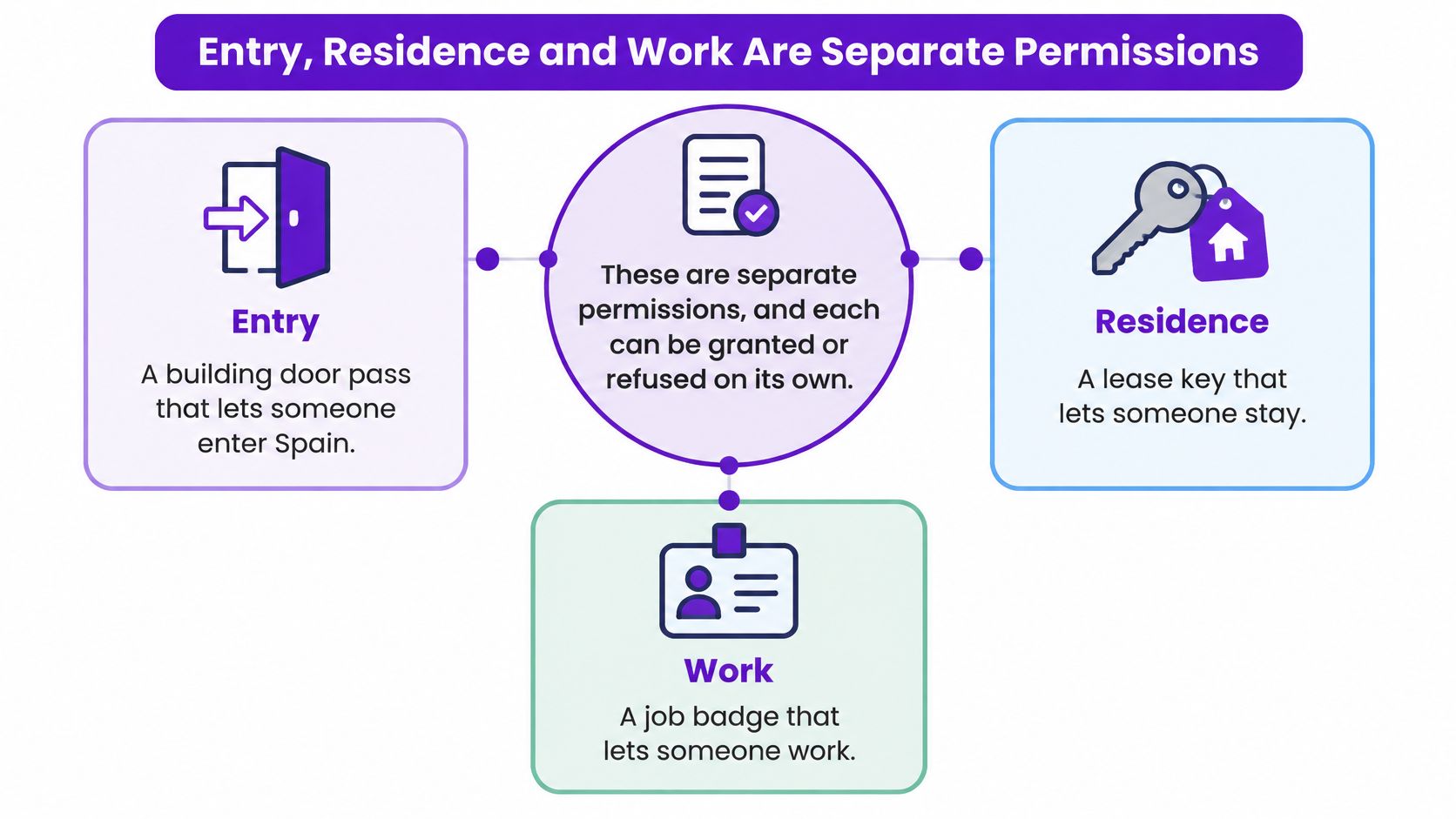
Entry authorization covers arriving at the border. Residence authorization covers living in Spain beyond the short-stay limit. Permission to work covers what you may earn while you're there. Spain's national visa framework is built for non-EU and non-Schengen nationals who intend to remain for more than 90 days within a 180-day period, and a national visa is required when the purpose is establishing residence, working or studying, according to the Spanish consular guidance on national visas. A Schengen visa or visa-free entry generally covers short visits only.
What a national visa does and doesn't do
A Spanish national visa lets you travel to and transit through other Schengen states for up to 90 days, but it doesn't give you the right to live in those countries. Your residence right stays Spanish. There's another catch people miss. Third-country nationals may need a national visa even for work periods under 90 days in certain circumstances, so a short trip isn't automatically a work-free zone.
Say a freelancer enters Spain on a short visit, then starts billing Spanish clients from a rented flat in Valencia. The entry was legal. The work isn't covered by it, because the purpose of the stay has changed. That gap between legal entry and unauthorised activity is exactly what the three permissions model helps you spot. If a Spanish employer is your goal, browsing Spain sponsorship jobs matched to your resume can show you what sponsored roles look like before you assume remote work is your only path.
This short video walks through how these permissions interact in practice.
Test yourself in three steps. State your purpose, state your duration, state your activity. Then check each one against the routes in the comparison. If any of the three doesn't match the route you're considering, that route is wrong for you.
Living in Spain Without Working
Could your income support a year in Spain without requiring you to work? The non-lucrative residence route is designed for people who will live there without gainful employment or professional activity. Retirees, pensioners and people relying on savings or passive income may fit. If your income depends on work, even for clients abroad, this route is not the right match.
The financial test step by step
The main applicant must show financial means equivalent to 400% of IPREM, plus 100% of IPREM for each dependent family member, according to the consular guidance on the non-lucrative residence visa. IPREM is Spain's Public Multiple Effects Income Indicator. Because its value can change, use the figure applicable when you apply.
Calculate the required amount in three steps:
For yourself: use 400% of IPREM.
For each dependant: add 100% of IPREM.
For the initial residence period: check that the funds cover 12 months.
For example, a main applicant with one dependant needs 500% of IPREM in total. With two dependants, the total is 600%. The calculation is straightforward; the evidence must show that the required funds are available for the full initial period, not just a few months.
Insurance and the identity card
You must also have health insurance covering your stay. A travel policy may not meet the route's requirements. Reviewing private medical cover for non-lucrative visa applicants can help you understand the type of cover intended for this visa.
After arriving in Spain, arrange your Foreigner Identity Card shortly after arrival. The residence authorization and the card serve different purposes: the authorization grants residence, while the card documents your identity and status in Spain.
This visa does not authorize work. It does not permit active professional or commercial activity, even when all your clients are outside Spain.
That distinction matters for online business owners. If you need to keep working or billing clients while living in Spain, choose a route that permits your activity rather than relying on the non-lucrative visa.
Remote Work Eligibility and Proof of Income
The remote work route is built on activity and relationships, not nationality. Spain's international teleworker route is designed for third-country nationals performing remote employment or professional services for companies established outside Spain, using computer, telematic and telecommunications systems, under the Spanish government guidance on international teleworkers. You need a genuine employment or commercial relationship with that foreign company. A plan to find clients later won't pass.
The relationship tests
Two time tests do most of the work. Your relationship with the foreign company must have existed for at least three months at the application date. The foreign company or group must show at least one year of real and continuous operation. Limited Spanish activity can be accommodated, but your core work must stay tied to foreign businesses. This route isn't an unrestricted local employment permit, and treating it as one invites refusal.
You also need suitable qualifications or at least three years of relevant experience. Notice what this means in practice. A newly formed client company, a contract signed last week, or a career you can't document will each weaken the file, even if your income looks strong on paper.
The income figure and what sits behind it
Official consular guidance states digital nomad applicants must demonstrate income of at least 200% of Spain's monthly minimum wage, and one 2026 consular page gives a threshold of €2,762.66 per month, according to the consular page for the digital nomad visa. Meeting that number doesn't make you application-ready. Spain's new Immigration Regulation, RD 1155/2024, took effect on May 20, 2025, and the documentary standard around the number matters as much as the number itself.
The checklist can require proof of at least three months' prior work for a foreign company, evidence of qualifications or experience, health insurance, an NIE obtained before application, legalized or apostilled criminal record documents, and a declaration addressing social security compliance. Travel insurance isn't accepted for this route. Your health cover needs to come from an insurer authorized to operate in Spain.
Practical rule: Don't ask only whether you earn enough. Ask whether a stranger could follow your income from contract to invoice to bank payment without you explaining anything.
Evidence by applicant type
| Applicant type | Income and relationship evidence | Social-security point to confirm |
|---|---|---|
| Employee of a foreign company | Employment contract, payslips and an employer letter confirming the remote role | Confirm how your employment and social-security position is declared |
| Freelancer or contractor | Signed client contracts, invoices and payment records covering at least three months | Confirm how your self-employed or contractor status is declared |
| Founder-shareholder | Company registration, ownership proof and client contracts showing operating history | Confirm the position of both the company and you personally |
| Accompanying dependant | Proof of relationship and evidence of the family's financial support | Confirm the dependant is covered under the main applicant's declaration and insurance |
Employees have the cleanest paper trail, but they still need their employer's explicit consent to work remotely from Spain. Contractors should show recurring work, not a single large invoice. Founder-shareholders face the hardest questions, because you must separate your personal income from company revenue and show the business operates. Keep signed contracts, invoices, payment records and company registration or tax evidence together from the start.
Dependants raise the financial figure you must prove, so calculate for the whole household rather than for yourself alone. Then run a final self-check. Do you have three months of documented client or employer history? Is that client demonstrably operating? Does most of your income come from outside Spain? If you can't answer yes to all three, you're not ready yet. The key question isn't "Can I afford Spain?" It's can you prove a compliant, durable income structure to Spanish authorities?
Apply From Abroad or From Inside Spain
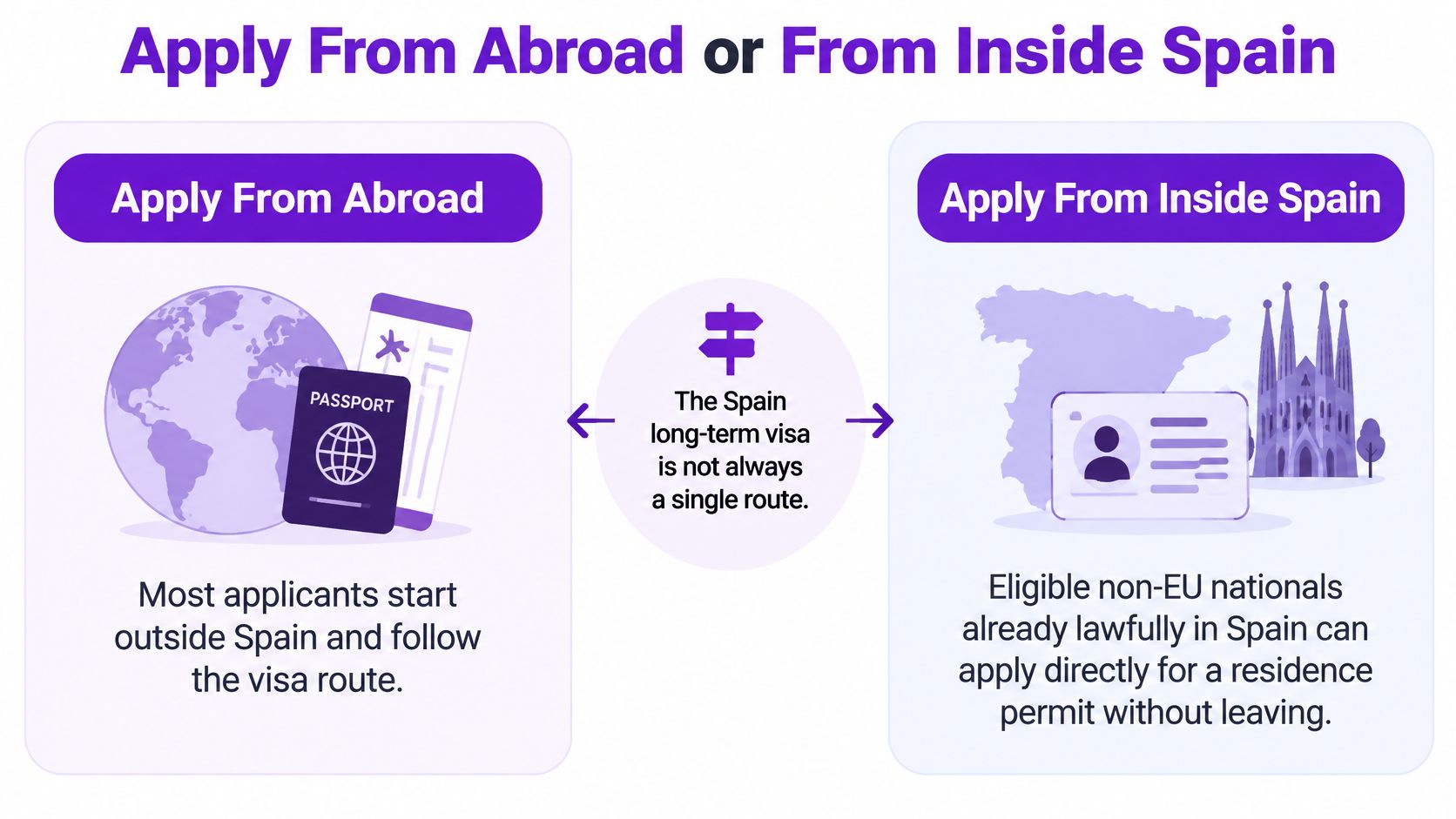
Most guides treat the Spain long-term visa as a single route. That assumption is wrong, and it can cost you months. Official guidance indicates eligible non-EU nationals already lawfully in Spain may apply directly for a residence permit without first obtaining a visa, and that permit can last up to three years, as described on the consular page for the digital nomad visa. Where you stand when you apply changes the whole shape of the process.
The comparison below sets the two starting points side by side.
A decision tree in five steps
Step one is location. Applying from outside Spain points you to the consular visa, which runs for one year before you move to residence or renewal. Applying from inside Spain, if you're eligible and lawfully present, can lead to the longer residence permit directly.
Step two is lawful status. Confirm exactly how long your current permitted stay lasts and make sure it doesn't lapse while your application is pending. Becoming unlawfully resident while waiting is a real risk, not a technicality.
Step three is timing. The consular checklist requires an NIE before you apply, and appointment availability varies by country. The in-country route is governed centrally, which can reduce your dependence on one consulate's calendar.
Step four is family. Check how dependants are included in each application, since the mechanics differ.
Step five is refusal. Ask what happens if you're refused and whether you can remain lawfully while you appeal or reapply.
Say a remote developer is already lawfully in Spain, works for a foreign company and has three years of experience. The in-country route may suit them well. The same developer living abroad would apply at a consulate instead. Same person, same job, different door.
Entering Spain legally first may be operationally simpler for eligible applicants, but you must independently confirm your eligibility, lawful-stay limits and the current procedure before relying on it.
That caution matters. This comparison helps you plan, but it doesn't replace the official page for your situation.
Costs to Plan for Before You Apply
Separate two kinds of money before you budget anything. There's money you must show, and money you must spend. Confusing them leads people to feel richer or poorer than they really are.
Money you must show
Funds you demonstrate for a means test aren't fees. They stay yours, but you must be able to evidence them for the initial residence period. The non-lucrative test is built on IPREM and rises with each dependant. The teleworker test is built on the monthly minimum wage and rises for a household too. Either way, don't count money that's committed elsewhere, and don't assume last year's figure still applies when you file.
Money you must spend
Health insurance is usually the largest real expense, because cover must be extensive, run for the whole stay and come from an insurer authorized in Spain. Document costs add up. Budget for the NIE process, apostille or legalization of criminal record documents, and any sworn translations your consulate requires. Add travel to consulate appointments, which may mean more than one trip if documents come back with queries.
Official fees. Check the current consulate fee schedule and note the date you checked it, since amounts change.
After arrival. Set aside time and any fee connected with the Foreigner Identity Card where it applies.
Delay buffer. Keep a reserve for reissued documents, extra translations and appointment gaps.
While you plan, it's also worth sanity-checking your monthly budget against a cost of living comparison across countries, because passing an income test and living comfortably in your chosen Spanish city aren't the same thing. The rule is simple. Budget for the funds test, the fees and a buffer for delays, then confirm every number on the official page before you pay anything.
Application Steps, Renewals and Living Compliance
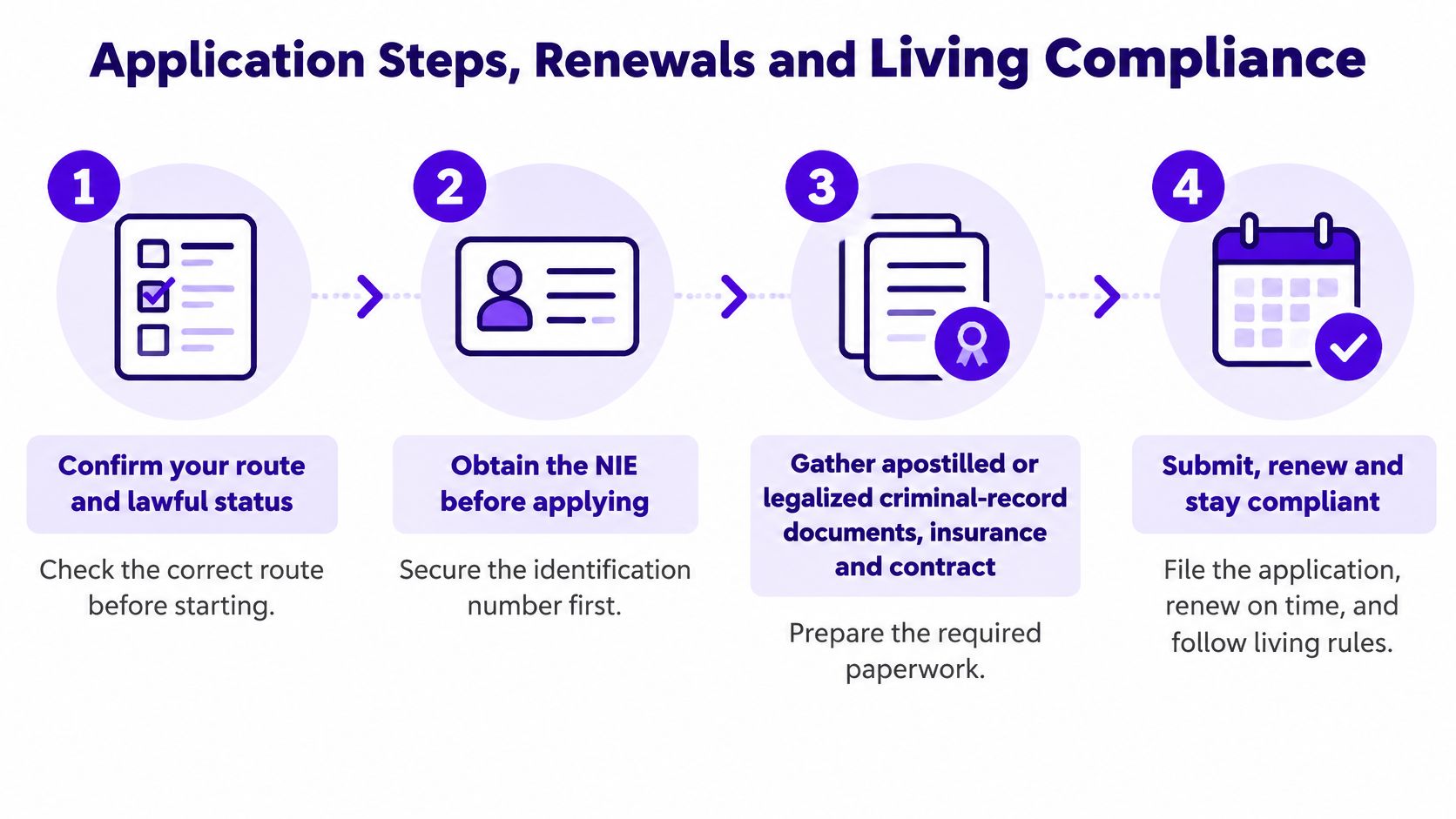
Work through the application in order, because several steps can't be rushed or reordered. Criminal record documents and legalization take the time they take. Start there mentally even though they sit third on the list.
The application sequence
Confirm your route and lawful status. Match your activity, duration and location to one route before gathering anything.
Obtain the NIE before applying. The consular checklist expects it in hand, not in progress.
Gather your evidence. Apostilled or legalized criminal record documents, qualifying insurance and contract evidence go into one organised file.
Book your consulate appointment. Availability varies by country, so don't build travel plans around a hoped-for slot.
Submit and track the decision. If you're refused, confirm whether you can remain lawfully while you appeal or reapply.
Handle arrival admin. Obtain the Foreigner Identity Card within one month of entering Spain where it applies, and open local arrangements early, including looking into a bank account for non-residents if you'll need Spanish banking before your card arrives.
The four-step overview below condenses that sequence into the order that matters most.
The renewal calendar
Applicants outside Spain generally obtain the teleworker visa through a consulate, and it authorizes residence and work for one year, while holders may apply for the initial residence authorization only while the visa remains valid and when no more than 60 days remain before expiry, according to the government digital nomad FAQs. Once granted, that residence authorization can be renewed for two-year periods if the original qualifying conditions continue. Health insurance must be public or private cover from an insurer authorized in Spain, and travel insurance is not accepted.
| Milestone | Rule | Action |
|---|---|---|
| Initial teleworker visa | One year from a Spanish consulate | Record the expiry date |
| Residence application window | Only while the visa is valid and no more than 60 days remain | Have documents ready several months before the window |
| Renewal | Two-year periods while original conditions continue | Recheck contracts and insurance before each renewal |
| Foreigner Identity Card | Within one month of entering Spain where it applies | Book straight after arrival |
| Health insurance | Comprehensive cover for the whole stay from a Spain-authorized insurer | Confirm the renewal date each month |
That 60-day window is unforgiving. Begin document collection several months before it opens, and verify your contracts and foreign company activity are still current. A policy that lapsed or a client contract that ended without a replacement is a common cause of failure. Keep a dated tracker with your expiry date, the day your window opens and every document's issue date, and review it monthly. Living compliance isn't dramatic. It's just never letting the file go stale.
Choose Your Route and Take the First Action
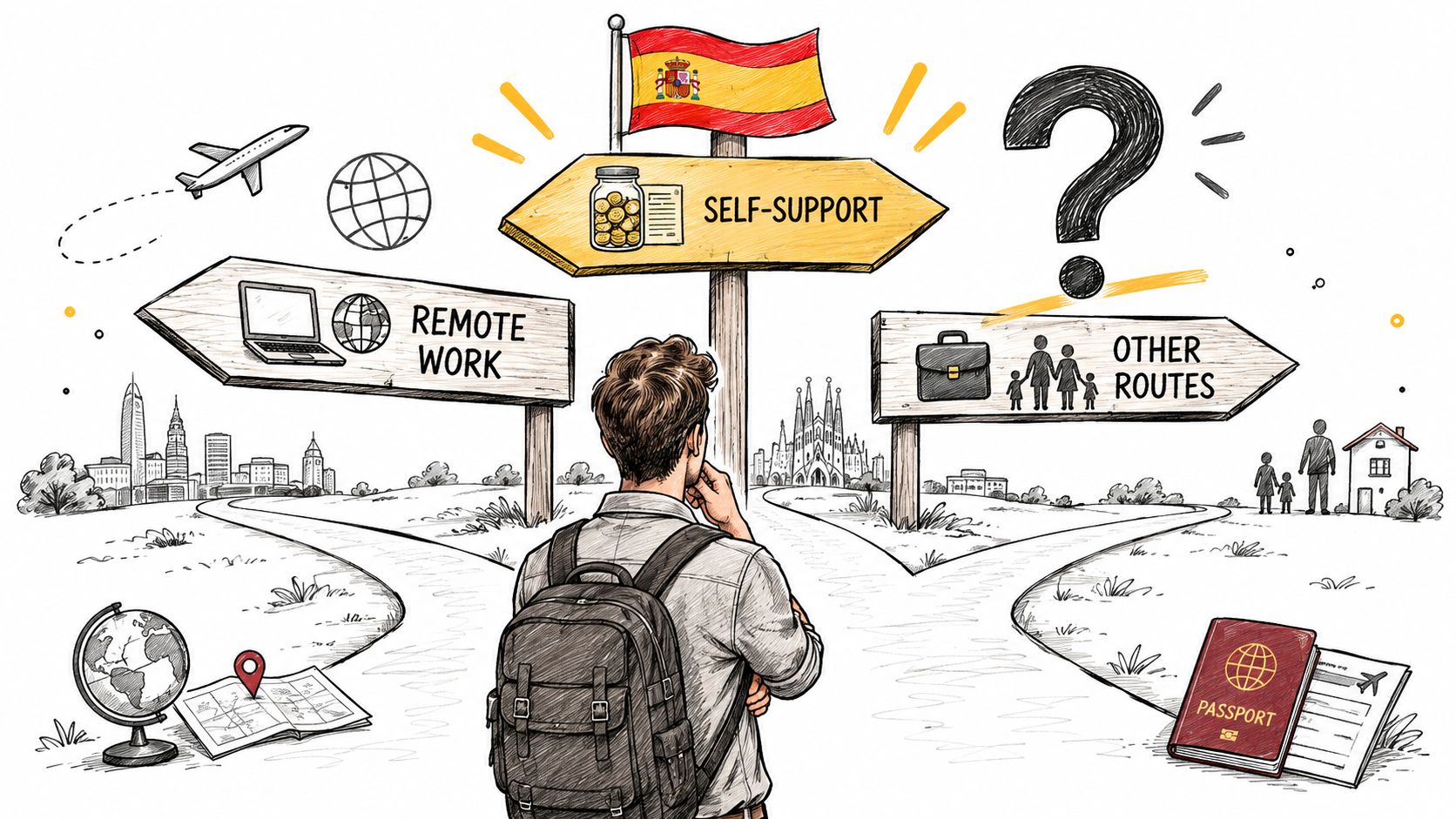
Reduce your case to one question and the route usually answers itself. Are you outside Spain doing remote work for foreign employers or clients? That's the international teleworker visa. Are you funded and not working? That's non-lucrative residence. Are you already lawfully in Spain and eligible? Consider digital nomad residence from inside Spain. Have you been hired by a Spanish employer? Follow the employment route and verify its specific tests with the sponsoring employer and official guidance.
The image below captures that fork in the road, where your activity points to your route.
Take one action this week. Write down your activity, intended duration and current location in a single sentence each. Pull three months of client or employer evidence into one folder. Then check what the NIE step requires in your country. If you're unsure which requirements apply to your passport and plans, our Travel Visa Requirements Finder tool can help you frame the questions before you book anything.
Before you pay any fee, check the official consular or ministry page for your country, because rules and IPREM figures change. Residency by investment is a separate route with its own official criteria, so verify those independently before planning around them. For complex cases, such as founders with several companies or families with dependants, confirm your eligibility with an official source and a qualified adviser.
Choosing a Spain long-term visa comes down to matching your work, income evidence and location to the right permission, and that is exactly the kind of cross-border decision Mazurly helps globally mobile founders, freelancers and remote professionals work through with practical tools and clear operational guides. Visit Mazurly to explore visa, banking, insurance and cost of living resources that turn scattered relocation admin into a plan you can put into practice.