How to Promote an App: A Launch-to-Growth Playbook
Table of contents
- Promotion Timeline and KPIs by Phase
- Give every phase an exit condition
- Keep the budget conditional
- Position the App and Plan Measurement Without Perfect Attribution
- Make decisions without pretending attribution is complete
- Store Listings and Landing Pages That Match Each Audience
- Walk through the listing in order
- Test the promise, not just the download button
- Launch Window Tactics for Early Traction
- Before release and on launch day
- During the rest of the launch window
- Paid, Referral and Partner Channels Compared
- Choose according to intent and available evidence
- Use trust-based channels when the product earns it
- Scale Spend Only When Retention and LTV Hold
- Read the economics in the right order
- Reject misleading budget signals
- Confirm Your First Two Weeks Before You Spend
- Decide what would justify another invitation
The most popular advice about how to promote an app starts with channels: run ads, find influencers, optimize the store listing. That's the wrong starting point for a small team. Buying installs before you know what makes someone stay gives you a larger audience for an unfinished onboarding experience.
Start with activation, retention, and payback instead. Define the useful action a new user should complete, check whether those users return, and work out whether their revenue can repay acquisition costs. Then choose the channels that can bring more people like them.
Promotion Timeline and KPIs by Phase
| Phase | Timing | Main job | KPI to check |
|---|---|---|---|
| Positioning and tracking setup | Weeks 6-8 before launch | Define the promise and the value event | Tracking events firing for every test user |
| Beta testing | Weeks 3-5 before launch | Find and fix onboarding drop-off | Onboarding completion and Day-7 retention |
| Store and landing page setup | Weeks 2-4 before launch | Build one page per audience | Page view to install conversion |
| Launch window | Days 0-14 after launch | Collect early users, reviews and press | Installs and activation in the first 14 days |
| Paid and referral tests | Weeks 3-8 after launch | Find channels that bring activated users | Cost per activated user by channel |
| Retention and scaling | Months 2-6 after launch | Scale only proven channels | Day-30 retention and predicted LTV against acquisition cost |
Treat this as a sample operating schedule, not a benchmark or a promise of growth. The overlapping windows are deliberate: store assets, beta feedback, and analytics need to develop together rather than wait for separate handoffs.
Beta testing comes before meaningful acquisition spending because you need to find onboarding failures while you can still speak directly with the people affected. The concentrated launch window gives the team a defined period for coordinated outreach and fast fixes, rather than an indefinite announcement campaign.
Give every phase an exit condition
Positioning is ready when someone can explain the app's job without listing its features. Tracking is ready when a test installation produces the expected events, with the correct audience, platform, and acquisition labels attached.
For beta testing, record where users abandon the flow and whether people who finish it return. Don't count a founder-assisted walkthrough as proof that onboarding works independently.
Store setup requires a different check. A page can attract downloads while promising something the product doesn't deliver, so preserve the audience label from the page through onboarding. Otherwise, you won't know which promise attracted the wrong users.
Keep the budget conditional
Set a fixed weekly test cap per channel, using an amount the business can afford to lose while learning. Don't commit a yearly acquisition budget before you've established whether a useful customer can be acquired economically.
Give each test an owner, a decision date, and a written outcome. A failed test should still tell you whether the audience, message, onboarding, or channel needs changing.
Practical rule: No phase closes until its KPI is recorded for each audience segment. Missing information is a reason to investigate, not permission to move on.
If your app is already live, you haven't missed your only opportunity. Start with event verification and onboarding repairs, then run a focused relaunch around a clearly defined use case. Buying traffic to compensate for missing preparation usually makes diagnosis more expensive.
Position the App and Plan Measurement Without Perfect Attribution
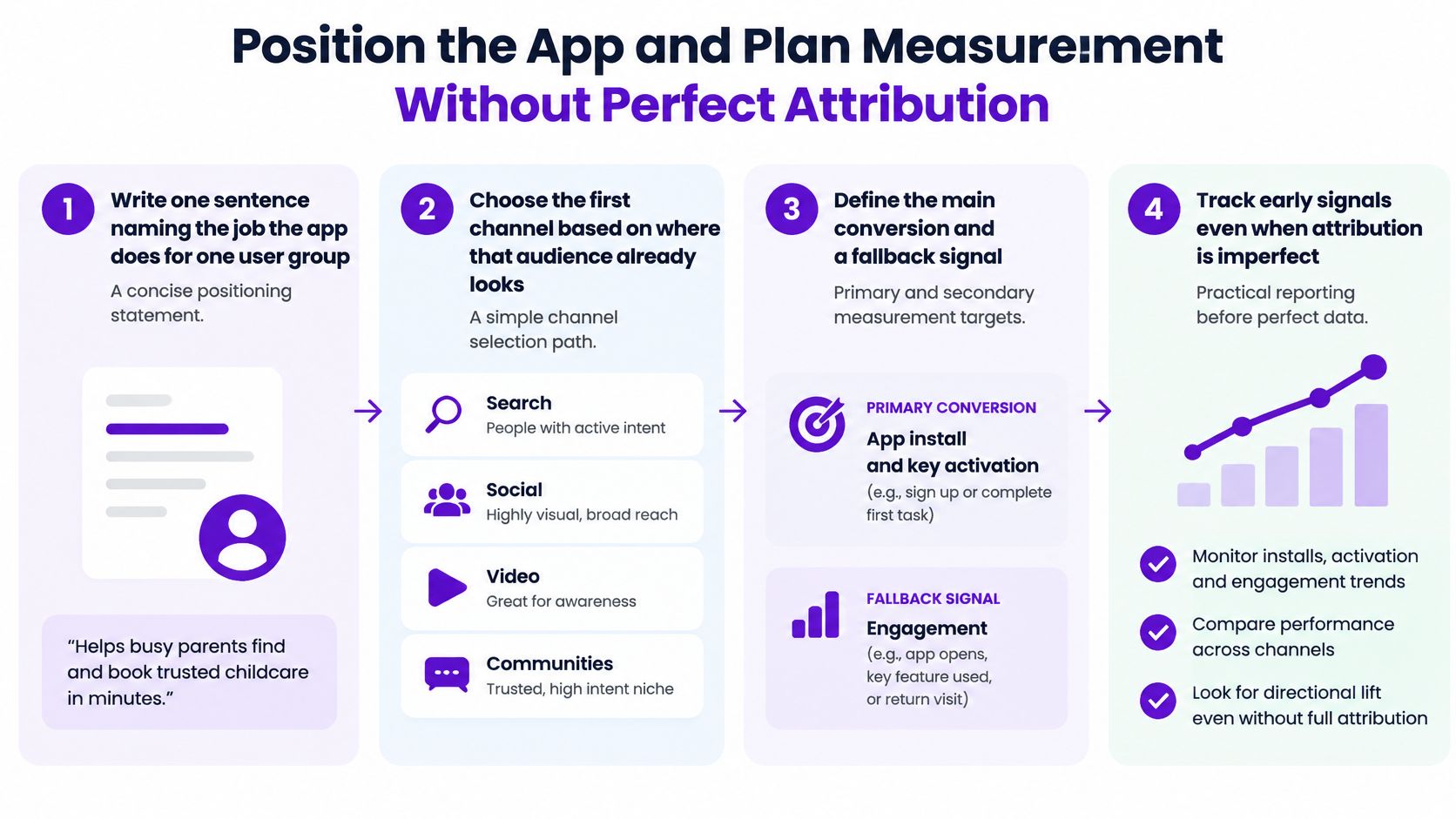
Write a job-specific promise. Name one user group and the task they need to finish, such as helping independent consultants prepare international invoices. If you're still choosing the problem, use these micro-SaaS ideas to narrow the workflow before building a broader positioning statement.
Choose a value event. Account creation proves that someone registered, not that the app helped. A completed invoice, saved destination comparison, or finished mobility checklist is a stronger activation event because it records the job happening.
Define outcomes beyond installation. Calculate activation rate as activated new users divided by new installers, using a consistent observation window. Track retention by acquisition cohort and payback as the time needed for customer contribution to recover acquisition cost.
Assign a source of truth to each metric. Use store reporting for store downloads, product analytics for in-app actions, and payment records for collected revenue. Keep ad-platform claims separately, and log reporting gaps rather than forcing unlike totals to match.
Recruit a small, relevant beta group. Watch people attempt the core workflow without coaching, then fix the blockers that prevent useful completion. Ask what they expected at each point of confusion, because the repair may be clearer wording rather than another feature.
Use this flow to keep positioning, channel selection, and measurement connected.
Make decisions without pretending attribution is complete
In Branch's State of App Growth survey, 41% of app marketers said privacy changes made cross-channel attribution harder, and 74% reported costly measurement blind spots. Your dashboard should acknowledge that uncertainty instead of presenting every attributed conversion as a proven result of advertising.
When a channel looks unusually effective, compare total activation and revenue against a reasonably comparable geography or period without the same promotion. Keep other changes limited, record differences between the groups, and treat a weak comparison as directional evidence rather than a controlled experiment.
For a deeper explanation of that distinction, SourceLoop's guide to measuring incremental returns on ad spend is useful when platform-reported returns and business results disagree.
Measure fewer outcomes consistently. A stable definition of activation is more useful than a crowded dashboard whose event names change with every release.
Before launch, set an onboarding completion target for each priority market and name the people or communities you'll approach first. If you can't explain who should benefit, what action proves it, and where those people already seek help, you're not ready to pay for reach.
Store Listings and Landing Pages That Match Each Audience
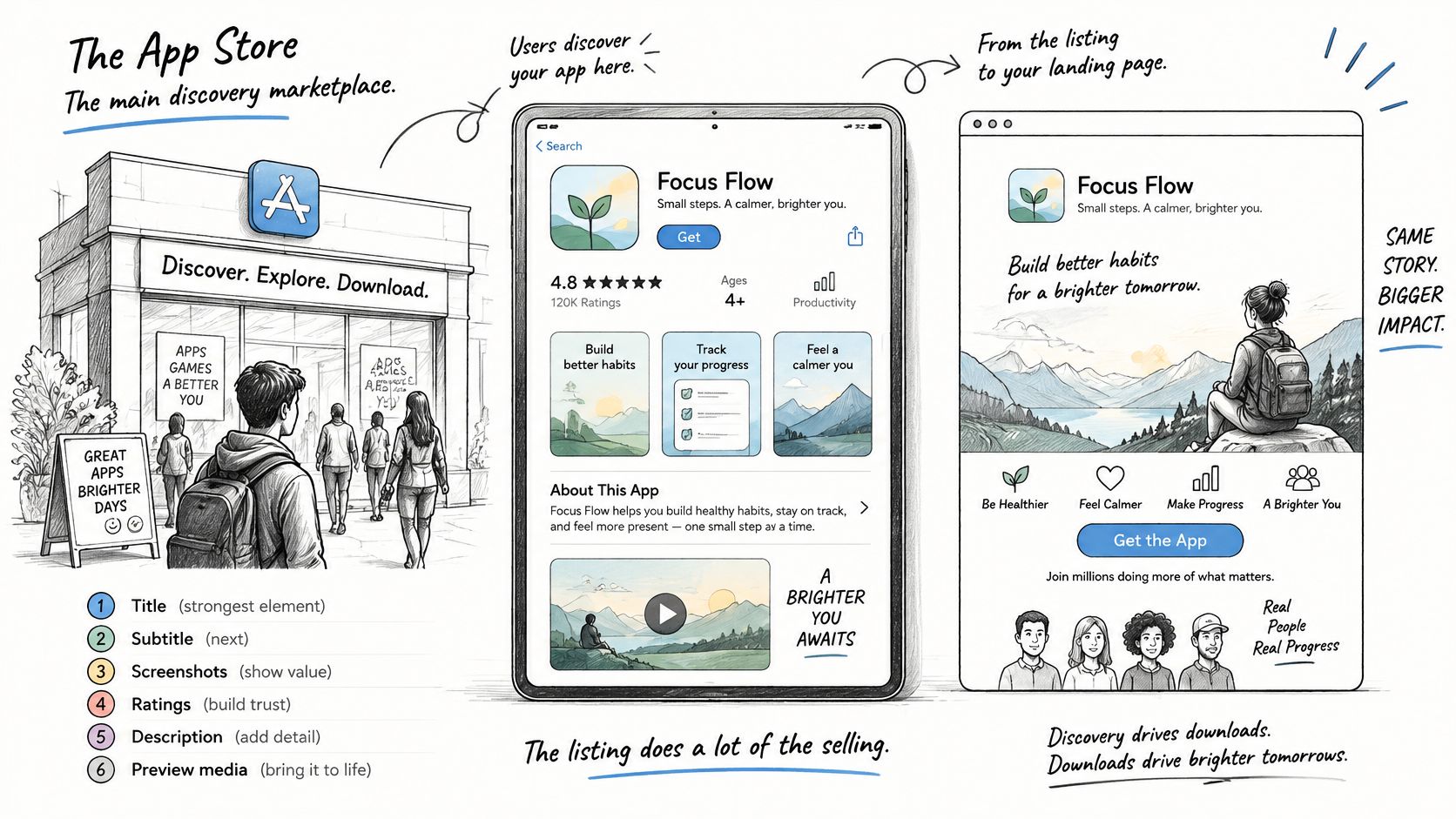
App stores are discovery marketplaces, but your listing still has to sell the specific job. Apple reported more than 650 million average weekly visitors in its App Store ecosystem analysis. That scale makes clarity important, not optional.
Build a continuous path from the discovery message to the first useful action.
Walk through the listing in order
Start with the title and subtitle. Use language your intended customer would search for, while keeping the product name readable. Don't cram unrelated keywords into a description that no human would naturally say.
Make the opening screenshots explain the outcome before the interface. Show the completed task, then the action that produces it. A preview video should reach useful product behavior quickly, without a long logo animation.
Say you're promoting a remote-work app. Its audience-specific pages could use these promises:
Freelancers: Manage international invoices, supported by a completed invoice preview.
Remote employees: Coordinate async work across time zones, illustrated with a practical handoff.
Globally mobile founders: Compare cities before moving, demonstrated through a saved comparison.
Give each promise matching screenshots and a relevant landing page or custom product page where supported. Repeat the same promise on the opening onboarding screen, then route the person toward that task rather than a generic feature tour.
The embedded video offers additional app-promotion context.
Test the promise, not just the download button
The product-page matching approach described in AppsFlyer's app marketer guidance supports connecting campaign intent with store assets and downstream activation. Apply that principle without assuming another app's conversion result will transfer to yours.
Change a single variable, such as the leading screenshot or headline, while leaving the audience and offer consistent. Let the test cover a complete acquisition cycle, randomize traffic where available, and judge the result using activated users or downstream revenue.
Avoid screenshots crowded with feature lists, country-specific claims presented as universal, and early winner declarations based on immature cohorts. A listing that attracts more unsuitable users isn't an improvement.
Keep these diagnostic measures visible by page and market: impression-to-product-page view, page-to-install conversion, and onboarding completion. Together, they help distinguish weak discovery, an unconvincing listing, and a broken post-install experience.
Launch Window Tactics for Early Traction
A 2022 peer-reviewed study of 330 newly launched U.S. Apple App Store gaming and productivity apps found that gaining traction shortly after release was critical and that influencing downloads became harder as apps matured. That's a reason to coordinate launch work, not a guarantee that a busy launch day creates lasting demand.
Consider a hypothetical app for independent consultants who invoice overseas clients. Its launch should revolve around completing an invoice, not attracting everyone interested in remote work.
Before release and on launch day
Build a waitlist around that task. Explain who the app is for, show the intended result, and ask subscribers what currently makes the workflow difficult. Separate curious subscribers from people willing to try the product when it becomes available.
Prepare outreach before release. A relevant newsletter editor needs a concrete hook, such as a useful workflow demonstration for their readers, not a generic announcement that another app exists.
On launch day, send people directly to the relevant store page. In communities, answer an existing question or share a genuinely useful walkthrough, disclose your connection, and follow the community's promotion rules.
Give beta users a clear route to provide honest feedback and reviews. Don't reward positive ratings or ask people to describe an experience they haven't had.
A useful launch creates conversations with the right users. A noisy launch creates notifications for the team.
During the rest of the launch window
Give niche practitioners access and a specific task to test. Ask them to report where they hesitated, what they completed, and whether they would use the workflow again. Let their assessment remain their own.
Creator reporting needs more than screenshots of views. Clipatra's guide explains ways to track verified installs from creator campaigns; use campaign-specific links alongside product events so you can separate attention from useful adoption.
Review installs, first-session completion, support messages, and reviews daily during the launch push. If users repeatedly stall at permissions, setup, or an empty dashboard, repair that step before inviting a larger audience.
Keep the initial release focused on a named segment and priority market. Expanding across unrelated audiences at once makes a disappointing result difficult to diagnose: you won't know whether the issue was the promise, language, distribution, or product itself.
The next outreach wave should use what early users completed successfully, not the feature the team most wants to advertise.
Paid, Referral and Partner Channels Compared
| Channel | Best for | Judge it by | Starting test |
|---|---|---|---|
| Apple Search Ads | People searching the App Store for an app like yours | Cost per activated user | Brand and category keywords in a chosen country |
| Google App campaigns | Search and video users in chosen countries | Cost per activated user | A selected country and language |
| Meta | Interest and lookalike audiences, where available | Activation rate by audience | A distinct interest hypothesis per ad set |
| TikTok | Short demo videos showing the first useful action | Day-7 retention by creative | A small set of creator-style demonstrations |
| Creator seeding | Trusted voices in the niche | Installs and activation via unique link | A small practitioner group with free access |
| Referral program | Users who already rely on the app | Invite conversion and referred-user Day-30 retention | A reward tied to a useful paid feature |
| Partnerships | Niche communities and complementary tools | Activated users from partner links | A named partner for each target segment |
Choose according to intent and available evidence
Apple Search Ads can reach people explicitly searching for a solution. Keep brand and category traffic separate so existing awareness doesn't make generic discovery look more effective than it is.
Google App campaigns can distribute across different placements, including search and video. Don't assume every installation reflects search intent. Use the chosen country, language, assets, and activation event to keep the initial test interpretable.
Meta and TikTok require a different judgment. Start Meta with a clear audience hypothesis rather than overlapping ad sets that compete for similar people. For TikTok, show the useful action early and compare the users each creative attracts, not just the clicks it generates.
For a narrow international niche, organize campaigns around the workflow before multiplying geographic variants. A consultant's invoicing problem may remain similar across countries, while payment expectations, language, and proof need local adaptation.
Use trust-based channels when the product earns it
Creators and partners should have an obvious connection to the task. A small newsletter about freelance operations may be a better fit than a broad travel account, even if the latter offers more reach.
Give partners a useful asset, such as a workflow guide, demonstration, or complementary template. Agree on the audience, destination page, campaign labels, and definition of an activated referral before publishing.
Referral rewards should extend product value. An extra export or temporary access to a useful paid feature can fit better than an unrelated giveaway. Introduce the invitation after users complete something worthwhile, then check whether referred users continue using the product.
Budget discipline: Pause a channel that delivers cheap installs but consistently weak activation. A low purchase price doesn't make an unsuitable user valuable.
Start with a paid channel you can operate competently, then add referrals when users demonstrate repeat value. Add partnerships when you can name the community and explain why its members need the workflow.
Keep creative production, campaign tools, partner fees, and founder time in the acquisition budget. This guide to startup costs for an online business provides a useful planning context for keeping promotion spending separate from the rest of your operating commitments.
Scale Spend Only When Retention and LTV Hold
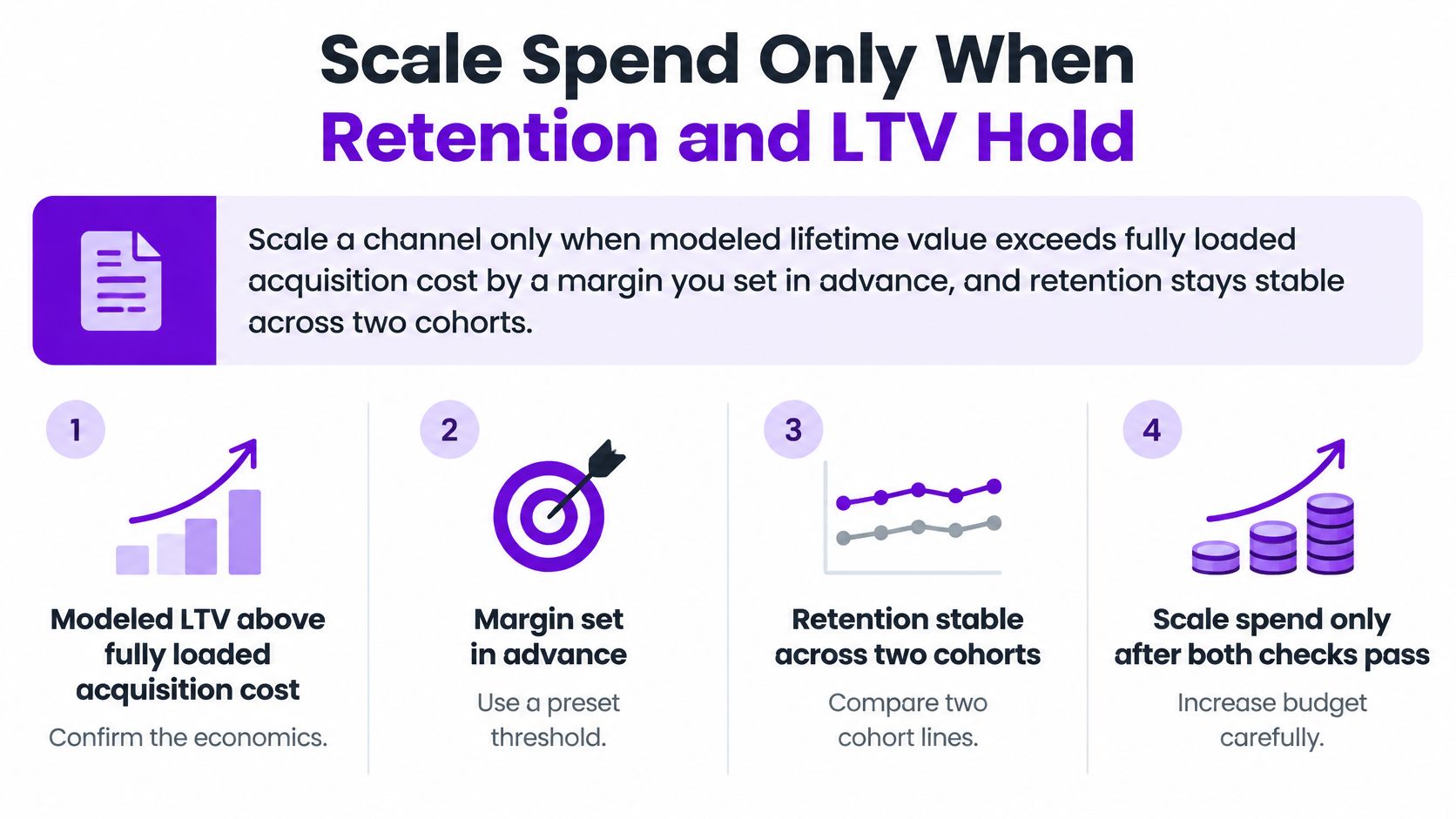
Scale a channel only when modeled lifetime value exceeds fully loaded acquisition cost by a margin you set in advance, and retention stays stable across two cohorts. Use a provisional learning window of 7–14 days before reallocating spend, while recognizing that this doesn't establish mature long-term value; the measurement-first approach in AppsFlyer's Performance Index guidance supports evaluating activated users and retention rather than installs alone.
Use these checks before approving a larger budget.
Read the economics in the right order
Start with cost per activated user: attributable acquisition spending divided by people who complete your chosen value event. Include creative, tools, and delivery costs when calculating fully loaded customer acquisition cost, and keep its denominator distinct from activated-user cost.
Then inspect retention as the share of an install cohort that reopens on the specified measurement day. Match cohort age, platform, country, and activation definition before comparing channels.
Finally, estimate lifetime value and payback using customer contribution after relevant delivery costs, not subscription revenue alone. Keep an early forecast conservative, document its assumptions, and update it as renewal and cancellation behavior becomes observable.
If pricing or the paid conversion path is unclear, use these app monetization strategies to assess the revenue model before treating predicted LTV as a reliable spending allowance.
| Phase | Cap or scale rule |
|---|---|
| Positioning and tracking setup | No paid spend until tracking passes on a test day |
| Beta testing | Spend only on beta recruiting |
| Store and landing page setup | Creative tests only |
| Launch window | Raise only after onboarding fixes ship |
| Paid and referral tests | Set per channel and country; pause on weak activation |
| Retention and scaling | Raise only when modeled LTV exceeds fully loaded CAC by a preset margin |
Reject misleading budget signals
Separate platforms. Don't compare an iOS cohort with an Android benchmark and call the difference a channel effect.
Preserve interpretable changes. Avoid changing bids, audiences, and creative together.
Exclude prior owned-channel engagement. Existing subscribers shouldn't inflate your estimate of newly acquired demand.
Inspect priority markets. A blended average can conceal an unprofitable country.
Challenge attributed lift. Platform conversions don't prove those users wouldn't have arrived anyway.
Community activity needs the same scrutiny. Bazzly's Reddit marketing guide is a useful planning resource if Reddit fits your audience, but include participation time when judging its economics.
Say a hypothetical campaign generates cheaper installs but brings users who rarely complete the core task or return. Reduce its budget while investigating the mismatch. Don't automatically transfer that money elsewhere, either: the alternative channel still needs to pass your contribution and payback requirements.
Confirm Your First Two Weeks Before You Spend
A launch is ready when the team can connect a promise to observable user behavior. Finish these checks before approving acquisition spending.
Align the promise and the product. Write the audience-specific promise beside the value event. Check that the store listing and opening onboarding screen lead toward that same outcome, without introducing an unrelated setup task.
Run a complete tracking rehearsal. Install through the intended campaign path, finish the workflow, and inspect the resulting records. Reconcile differences between store, advertising, and analytics tools rather than expecting their totals to match automatically.
Choose a focused release. Select the audience and priority country, prepare the matching product page, and schedule waitlist and beta outreach. Name who will answer support messages and who can ship an onboarding repair.
Book the decision meeting. Review the phase KPIs weekly, choose a specific change, and write down the expected effect before making it. Preserve the previous version so a disappointing result can be reversed.
Decide what would justify another invitation
Don't make the review meeting a presentation of downloads, impressions, and follower counts. Read support conversations alongside the funnel and ask whether users accomplished what the promotion promised.
A person who finished the workflow but didn't return may have a different problem from someone who never understood how to begin. Investigate that distinction before buying another audience.
If the first-session benefit is still unclear, return to the store promise and onboarding route rather than commissioning more ads. The readiness question is simple: Which activated user would tell a friend, and what did that user do in the first session?
Our Build section covers marketing, growth, and monetization, with practical guides, expert advice, and help automating marketing. Visit Mazurly to plan your app's next acquisition test around a useful first session, retained users, and a spending decision you can explain.