Colombia Digital Nomad Visa: 2026 Requirements, Costs and Taxes
Table of content
- Why Colombia Matters for Remote Workers
- What makes the country practical
- Who tends to do well here
- Digital Nomad Visa vs Tourist Entry
- What changes when you hold the visa
- What the nomad visa does not solve
- Who Qualifies for the Colombian Digital Nomad Visa
- The core eligibility pattern
- What you should assemble
- Income Requirements and Proof Standards
- Why the threshold keeps moving
- What proof tends to hold up
- How to Apply for the Visa V Nómadas Digitales
- What to do before you submit
- A practical sequence that avoids rework
- Tax Residency Traps Most Guides Miss
- The mistake most people make
- Why the consequences are broader than the visa file
- Duration, Registration, and Local Compliance
- The registration mistake that causes friction
- What to keep current
- Is the Colombian Digital Nomad Visa Right for You
- Best-fit and poor-fit scenarios
- The decision framework
The Visa V Nómadas Digitales lets you stay in Colombia for up to 2 years, and the income you show must be at least three Colombian legal minimum monthly wages from foreign sources only. If you're already living on client work, a remote salary, or a foreign business, that's the starting point, not the finish line.
You can land in Bogotá, Medellín, or Cartagena and feel like the hard part is over once the visa is approved. It usually isn't. The work that matters starts when you decide whether you're just visiting for a long stretch, or building a stay that won't unravel under tax, banking, and residency rules.
Why Colombia Matters for Remote Workers
A remote worker lands in Medellín with a laptop, a shortlist of neighborhoods, and the idea that a tourist stamp is enough. That holds until the days turn into routines. The harder work starts when you decide whether you're just visiting for a long stretch, or building a stay that won't unravel under tax, banking, and residency rules.
What makes the country practical
Bogotá fits people who want a capital-city pace and easier access to business services. Medellín attracts remote workers who want a strong expat network and weather that makes daily life easier. Cartagena suits people willing to trade routine for coastal living, but it can feel less practical for long work weeks if you need quiet, stable space more than scenery.

Colombia stands out because it combines livability with a formal route for remote workers. The country did not just tolerate long stays, it created a dedicated path through the Visa V Nómadas Digitales, which gives a clearer basis for staying longer than ordinary short-stay entry permissions do official digital nomad visa framework.
Who tends to do well here
Remote employees with a stable foreign salary usually adapt fastest because their income trail is clean. Freelancers can also do well, but only when their payments are consistent enough to satisfy a three-month review. Online founders, consultants, and product builders who work with overseas clients often find Colombia attractive because they can keep earning abroad while living in one place for longer than a tourist stay allows.
Budget still matters. If you want a quick check before committing to housing and longer-term logistics, use a cost of living comparison across countries to see whether Colombia fits your runway and lifestyle. compare everyday costs across countries
Practical rule: if your work is already foreign-sourced and location-independent, Colombia can be a comfortable base. If you still need local clients to make the month work, this visa is the wrong tool.
Digital Nomad Visa vs Tourist Entry
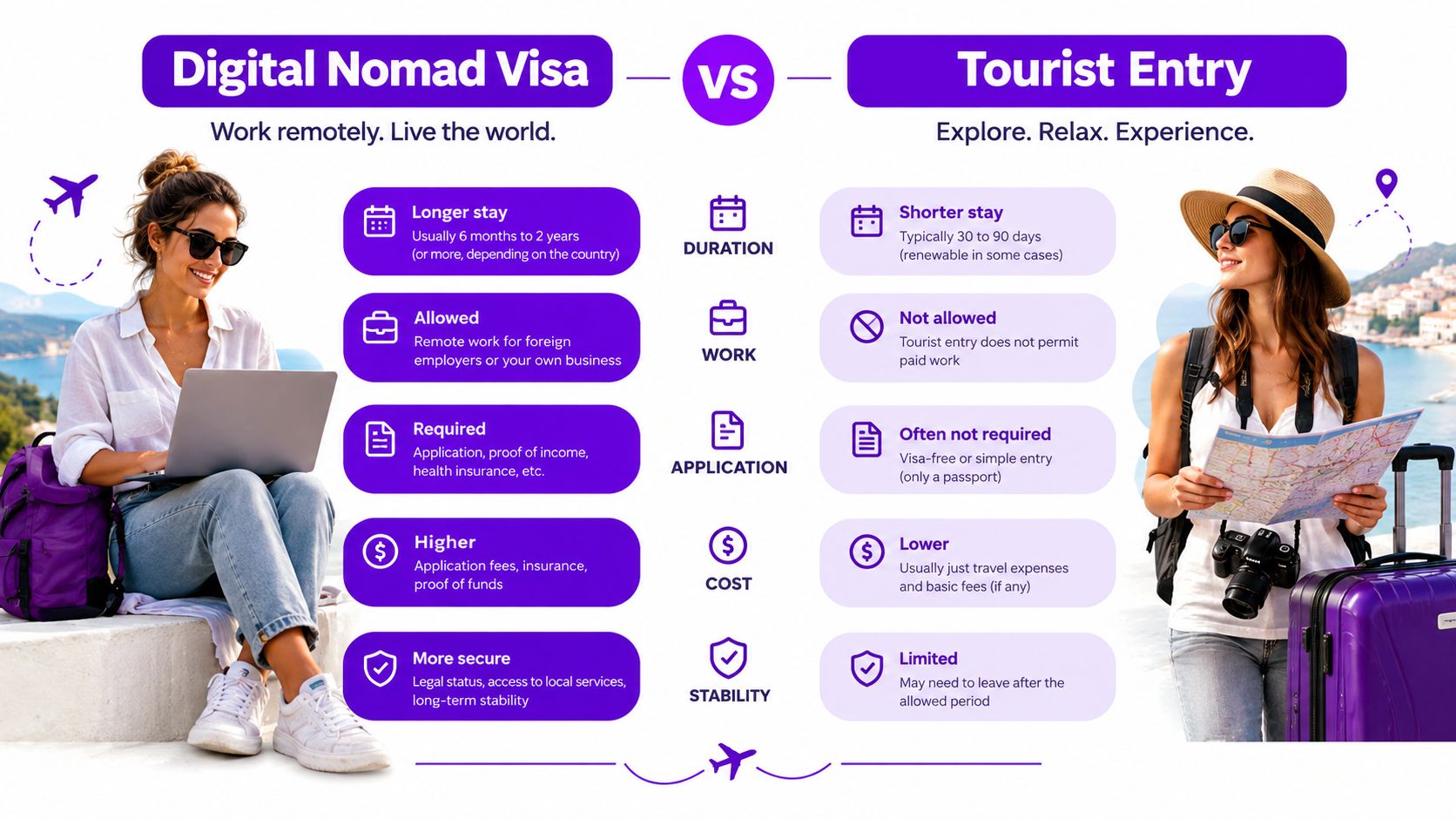
A tourist entry can feel convenient at first. It is easy to get, and it works for short trips, but it is still a short-stay permission. Colombia's visa category overview treats the nomad route as a separate immigration path for remote work, which gives your stay a clearer legal basis from the start Foreign Ministry guidance on short stay versus nomad visa.
What changes when you hold the visa
With the nomad visa, your stay sits inside a formal immigration category. That reduces the uncertainty that comes with repeated short entries. It also makes day-to-day logistics easier to explain to landlords, insurers, and banks, because your status is no longer just a sequence of arrivals and departures.
Tourist status is more fragile. Colombia's Foreign Ministry says eligible visitors may generally remain for fewer than 90 days, with a possible extension to 180 days, while the nomad visa can run for up to 2 years short-stay versus visa guidance. That difference affects lease terms, return-flight planning, and how much risk you carry if a short trip turns into a longer stay.
What the nomad visa does not solve
It does not create permission to work for Colombian individuals or companies. The legal scope stays tied to foreign employers, foreign clients, or foreign business activity visa scope and income rules. A visa holder can work online from Colombia, but local invoicing is still a separate issue, and that is where many people get tripped up.
The bigger trap sits after approval. A valid visa does not automatically settle tax residency, and that is where real compliance starts to matter. If you stay long enough to trigger local tax rules, the question shifts from “Can I enter?” to “How do I structure my stay?” For some remote workers, the right move is to keep the visa as a temporary base. For others, it makes more sense to prepare for long-term residency instead of stretching a visitor setup past what it was designed to handle.
Who Qualifies for the Colombian Digital Nomad Visa
Colombia's Visa V Nómadas Digitales turns on the source of your income, regardless of your job title. It is for people who work remotely through digital means for foreign companies, whether as employees or independent contractors, and for certain entrepreneurs whose projects are of interest to Colombia official scope description.
The core eligibility pattern
You generally need to be from a country or territory exempt from Colombia's short-stay visa requirement, and you need to show that your work relationship is foreign. For employees, that usually means an employer letter that identifies the contract and remuneration. For founders who own or co-own a foreign company, the file has to show that the work remains remote and is not tied to a local Colombian engagement.
The hard part is mixed income. A freelancer who still invoices Colombian clients is creating avoidable risk, even if most of the work is online. The visa is designed around foreign-sourced work, so a blended client base can weaken the application quickly.
What you should assemble
The cleanest files usually line up across three items, the contract or employment letter, the bank statements, and the insurance coverage. If those documents tell different stories, reviewers have a reason to slow the case down. If they all point to the same foreign relationship, the file is easier to understand.
Health coverage for the stay is required, and the policy should cover Colombia for illness, hospitalization, maternity, disability, death, and repatriation under the visa's requirements list. That detail matters because a generic travel policy may not meet the standard.
Approval is only half the job. Once you are in Colombia, the key compliance question is whether your stay starts creating tax residency exposure. If your footprint is light and temporary, the visa can work as a base for remote work. If your stay is likely to become long term, it is smarter to prepare for residency rules instead of stretching a visitor-style setup past what it was built for.
If your income trail looks mixed, the burden is on you to make it coherent. Clean documentation beats persuasive explanations every time.
Income Requirements and Proof Standards
Colombia ties the income test to 3 legal minimum monthly wages, so the benchmark changes whenever the minimum wage changes. Because the threshold floats with the statutory minimum, a fixed dollar figure quoted in any guide will be out of date within a year.
For current planning, recent coverage places the 2026 threshold at COP 5,252,715 per month after the minimum wage rose to COP 1,750,905 2026 threshold coverage. That figure moves with the calendar and the exchange rate, which is why the same salary can look safer one month and thin the next. If your income is paid in USD, EUR, GBP, or crypto, you need more room than the bare minimum.
Why the threshold keeps moving
The wage floor follows Colombia's labor rules, and the visa follows that benchmark. A salary that clears the line on paper can slip close to it once your bank converts deposits at a weaker rate. That is where applicants create avoidable risk.
I would not plan to sit exactly on the minimum. A small cushion gives you room for exchange swings, delayed invoices, and a reviewer who wants the file to read clearly rather than cleverly.
What proof tends to hold up
Authorities usually want a three-month paper trail. Recent coverage also says scrutiny has tightened around inconsistent deposits and irregular freelance income, so bank statements need to match the rest of the file in a clean way income proof commentary. Statements on their own rarely carry the application unless the deposits line up with contracts, invoices, or an employment letter that shows recurring foreign income.
For a practical look at how reviewers read statements, see autobankstatement on statement verification. The point is simple, every deposit should explain itself without extra back-and-forth.
A file that usually holds together has three parts:
- Three clean months of bank statements: Deposits should line up with client or payroll timing.
- One matching income narrative: The payer, currency, and working relationship should stay consistent.
- Support that mirrors the cash flow: Contracts and invoices should explain what the account shows.
If your income only barely clears the line, treat that as a warning. The approval is only the first check. Once you are in Colombia, the actual issue is whether your stay starts to look like tax residency, because that can change the rules on you fast.
How to Apply for the Visa V Nómadas Digitales
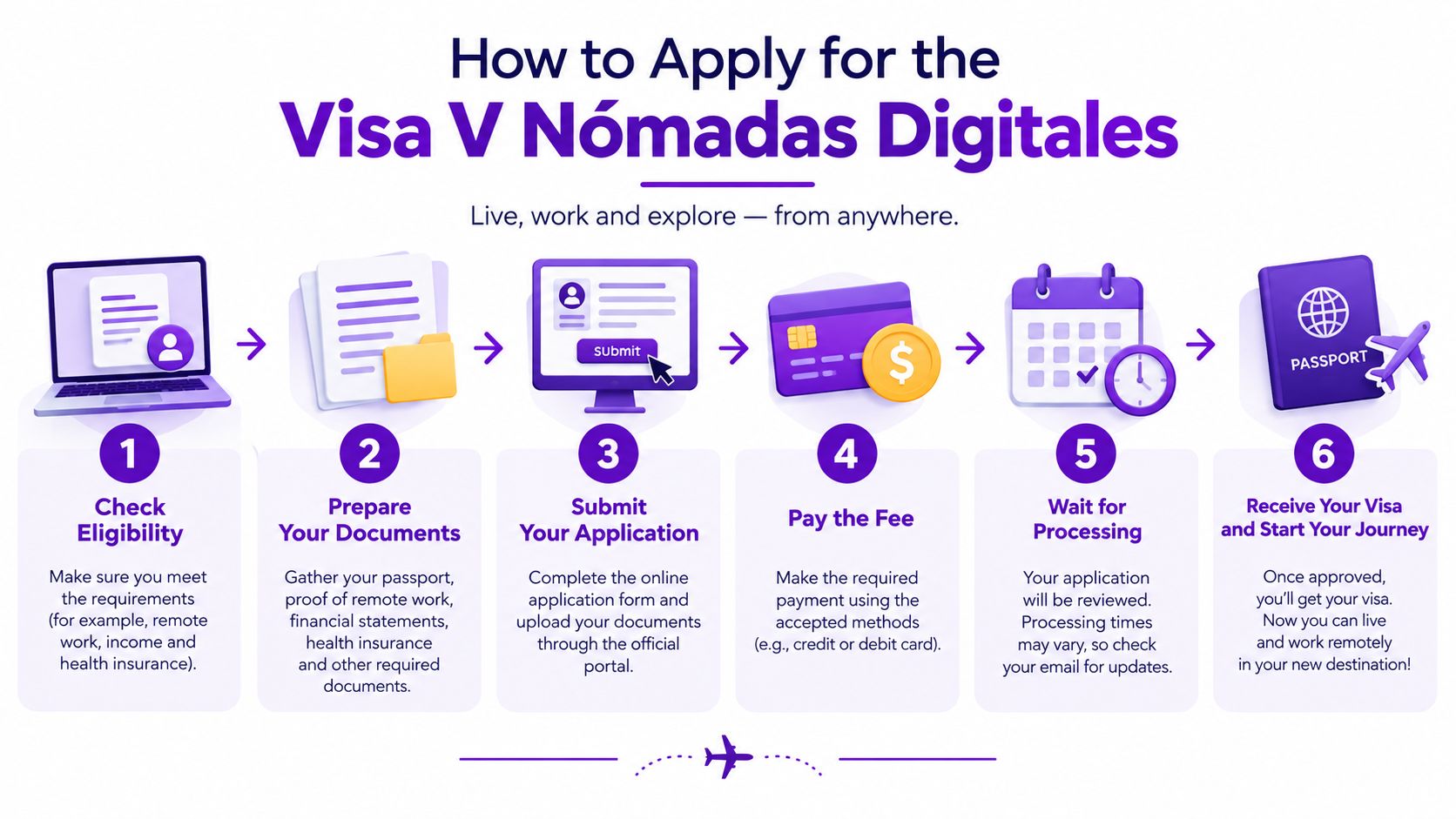
Start on the Foreign Ministry's online portal, where the application is filed. The real challenge lies before and after the upload. A file only helps if it can survive a request for originals or clarification, so prepare it as if a reviewer will compare every document line by line official application guidance.
What to do before you submit
Handle the weak documents first, not the form fields. A vague employer letter, bank statements that do not match the income story, or insurance wording that does not clearly cover Colombia can stall the file before it gets a fair read. Colombia's general visa rules also make clear that submitting every requirement does not guarantee issuance visa approval caveat.
The application is digital, but the paperwork is not always treated that way. Keep a printable folder with the source documents, especially employment letters, proof of income, and insurance certificates. If an officer asks for originals, you need to answer fast.
A practical sequence that avoids rework
- Confirm the category first. Make sure the nomad route fits your work setup before you commit to the file.
- Match every document. Your contract, payment trail, and insurance should tell the same story.
- Submit clean scans. Poor image quality creates avoidable back-and-forth.
- Keep originals ready. If officials request them, you should not lose time hunting paperwork.
- Track the case with realism. Uploading the file is only the first step; the file must also survive a request for originals or clarification.
For people comparing routes or checking whether they fit a long-stay category, a travel visa requirements finder helps before they commit to a country or visa type. It is a simple way to spot mismatches before the application clock starts.
Tax Residency Traps Most Guides Miss
A Colombian digital nomad visa gets you legal stay, but it does not protect you from tax residency. If you spend 183 days or more in Colombia during any 365-day period, DIAN can treat you as a tax resident and expect worldwide income reporting under its residency rules tax residency guidance. The visa can still be valid while your tax position changes underneath it.

The mistake most people make
People count by calendar year and assume the clock resets on January 1. Colombia uses a rolling test, so time spent late in one period can combine with time spent early in the next and push you over the line without much warning.
Treat your calendar as a tax document once your stay approaches 183 days in any 365-day window. That matters before you sign a year-long lease or decide that Colombia will be your base for work.
Why the consequences are broader than the visa file
Tax treatment can turn on domicile, treaty rules, income source, and reporting duties. A visa approval does not sort out any of that.
If you hold investments across borders, review investing while living abroad before the day count catches up. The reporting picture changes fast when you earn from multiple countries or run a company while working remotely, and the practical tax risk often grows before the immigration side does.
For a closer look at cross-border structures, navigating international tax compliance is the kind of advisory topic worth reviewing before you commit to a relocation plan.
A simple framework helps:
- Short stay with light ties: Lower complexity, fewer residency issues.
- Long stay with foreign income only: Immigration may work, but tax risk rises.
- Long stay with mixed income or company ownership: Get advice early, before the day-count threshold becomes a problem.
A nomad visa helps you stay legally, but it does not erase cross-border obligations. If your time in Colombia is stretching, the tax file deserves the same attention as the visa file.
Duration, Registration, and Local Compliance
The visa can run for up to 2 years, so your stay planning needs to shift from short visits to a longer operating setup. That affects housing, travel, and insurance, and it also changes how carefully you should handle local paperwork after approval.
The registration mistake that causes friction
Approval gives you a valid stay category, not a finished compliance file. Freelancers splitting time between two bases usually get caught here, because they sign a lease, start using local services, and only later sort out the registration step that makes day-to-day life easier.
If you expect to stay the full term, line up the practical pieces in the same order. Lease length should match your real stay, insurance should cover the same period, and your travel calendar should leave room for appointments and follow-up documents. Signing a long lease before you know when your registration will be completed is where avoidable problems start.
What to keep current
Keep your visa approval, passport pages, insurance proof, and income records together in one place. If your insurer changes, your address changes, or your work setup changes, update the paper trail right away. That matters more than people expect when a landlord, bank, or immigration office asks for consistency.
The main issue is not the visa itself. A longer visa gives you room to settle in, but it also gives small compliance gaps more time to turn into actual problems, especially once foreign income, local housing, and cross-border movement all overlap.
Longer validity only helps if your paperwork stays current. Otherwise, you have more time for a problem to surface.
Is the Colombian Digital Nomad Visa Right for You
This visa fits best if your money comes from abroad, your work already runs online, and you want a longer stay without building a Colombian client base. Remote employees usually have the cleanest path. Freelancers can qualify too, but the more irregular the income, the more careful the documentation needs to be.
Best-fit and poor-fit scenarios
If you're a consultant with foreign contracts and a predictable payment trail, Colombia can work well. If you're a founder with a foreign company and clear remote operations, it can also be a strong option. If most of your revenue depends on Colombian clients, or if you're trying to use the nomad route as a back door into local work, it's the wrong category.
For people comparing careers or opportunities across the region, tech jobs in Latin America can help frame whether your next move is remote, local, or somewhere in between. That matters because the best visa strategy depends on how your income is built, not just where you'd like to live.
The decision framework
Choose the nomad visa if you want legal certainty for a medium-term stay and your income is already foreign-sourced. Choose a different residency path if Colombia is becoming your long-term base and your work or tax life needs a more durable structure. Get professional advice if you're close to the tax-residency line, own companies in multiple countries, or can't make your bank statements tell one coherent story.
If you want Colombia to be a real base instead of a prolonged visit, treat the visa as one piece of a broader plan. The right move is the one that keeps your immigration status, tax exposure, and work model aligned.
Mazurly helps remote workers compare destinations, check visa requirements, and organize the logistics that sit around a move, not just the paperwork itself. If you're weighing Colombia against other long-stay options, visit Mazurly to use practical tools and guides that make the decision clearer.