
Digital Nomad Visa Canada: What Remote Workers Can Do

Table of contents
- Canada Has No Digital Nomad Visa, But You Have Options
- Four Routes Side by Side
- Which Remote Work Is Allowed and Which Crosses the Line
- Documents to Prove You Qualify as a Remote Worker
- Moving From Visitor Status to a Canadian Job or Residence
- When Long Stays Create Canadian Tax Exposure
- What to Document
- Three Remote Work Myths That Still Trip Up Visitors
- Confirm Your Entry Plan Before You Book
Canada has no dedicated digital nomad visa. Visitors may work remotely during a stay of up to six months when their employer or clients are outside Canada and their work is for that foreign business.
Canada clarified how existing visitor rules apply to digital nomads; it did not create a new visa stream. The IRCC operational bulletin on digital nomads places them under ordinary temporary-resident visitor rules. Visitor status addresses whether you may work remotely while in Canada. It does not settle whether you can extend your stay, owe Canadian tax, or take a job in Canada.
Canada Has No Digital Nomad Visa, But You Have Options
Canada offers remote workers a visitor route, not a dedicated digital nomad visa. The IRCC operational bulletin on digital nomads says visitors may stay for up to six months while working remotely for a foreign employer or, if self-employed, serving clients outside Canada. That permission does not authorize work for a Canadian employer.
Your next step depends on whether you need more time, want a Canadian job, or intend to settle. A visitor record may extend your stay, but approval is discretionary. A work permit or permanent residence requires a separate application and the relevant eligibility.
Four Routes Side by Side
| Route | Who it suits | Typical duration | Can you work for a Canadian employer? |
|---|---|---|---|
| Visitor status for remote work | Employees of foreign companies and self-employed people with clients outside Canada | Up to 6 months per stay | No |
| Visitor record extension | Visitors who need more time on the same basis | Beyond the initial 6 months, if approved | No |
| Temporary work permit | People holding a job offer from a Canadian employer | Set by the permit, often tied to the employer | Yes |
| Permanent residence | Long-term settlers, often through economic programs such as Express Entry | Permanent | Yes, after status is granted |
Choose the row that matches your plan. If your employer and clients are outside Canada and you will leave when your authorized stay ends, visitor status may fit. If you need more time, apply for an extension before your status expires; an extension is not automatic. A Canadian job requires the appropriate work authorization, while permanent residence requires an approved application.
If you are comparing places to stay between Canadian visits, this guide to where remote workers should base themselves can help frame your destination search. For a broader comparison of country-specific options, see Mazurly's guide to the best digital nomad visas.
Which Remote Work Is Allowed and Which Crosses the Line
Three questions decide whether your working day fits visitor status. Where does your employer or client sit? Where does the money come from? Where is the service performed? Officers reason in roughly that order, and clean answers on all three usually end the conversation at the border.
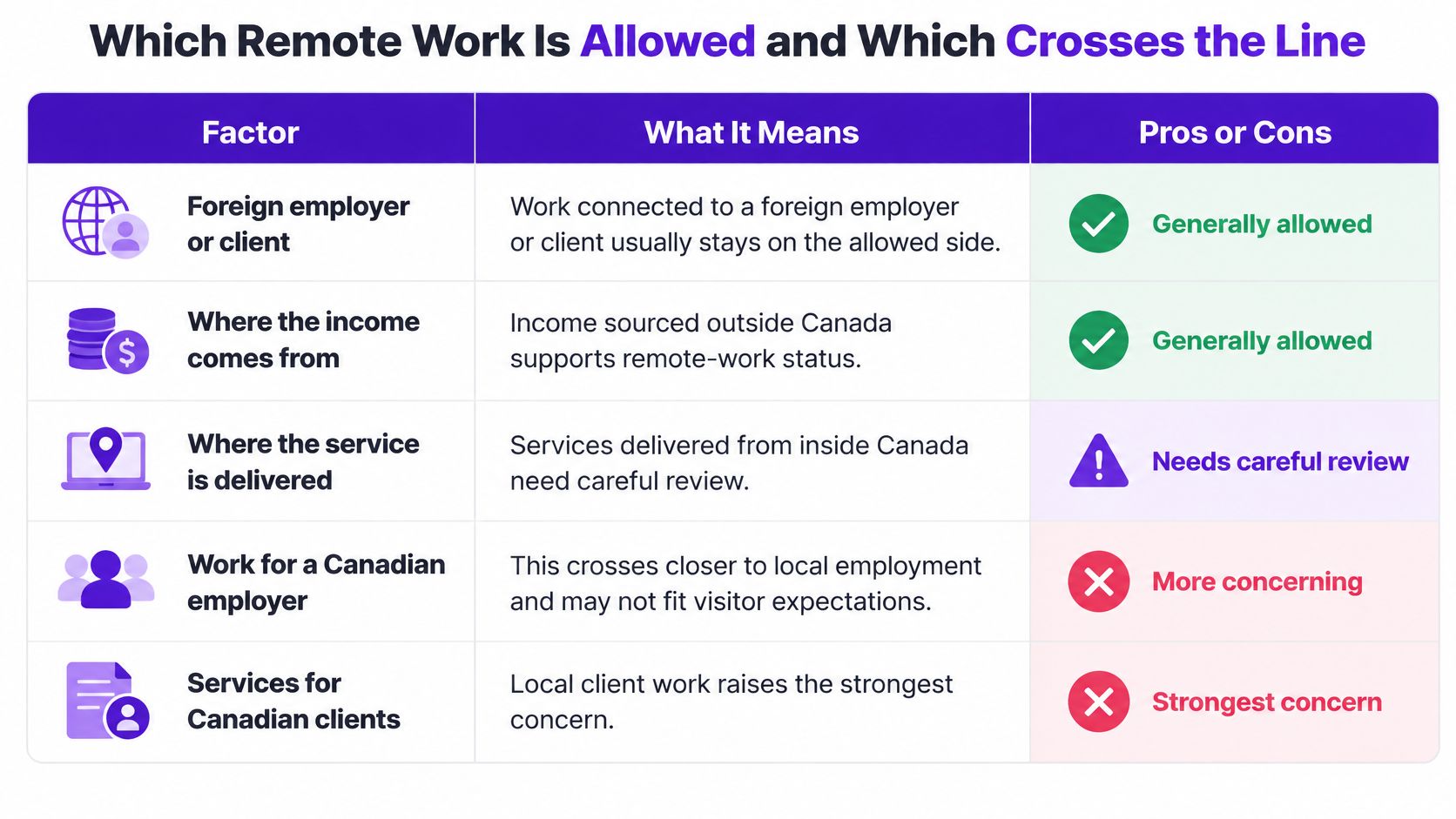
A remote job for a company back home clears every question. The employer is abroad, the payroll is abroad, and the work is delivered from a laptop in a Canadian apartment. Freelance work for clients outside Canada works the same way, which is why self-employed visitors can keep invoicing as long as those invoices never point at a Canadian customer.
The rows that fail do so for one reason: Canadian labour market contact.
A remote job with a Canadian employer needs a work permit or a specific exemption, even though you never set foot in an office.
Freelance work for Canadian clients isn't covered by the visitor rule at all. Canadian clients mean Canadian-sourced income, and that's an assessment, not a guess.
In-person work for a Canadian business is the clearest line of all. Physical work in Canada for a Canadian employer requires a permit.
| Activity | Status on visitor status | Why it matters |
|---|---|---|
| Remote job for an employer outside Canada | Generally permitted | Employer and income sit outside Canada |
| Freelance work for clients outside Canada | Generally permitted for self-employed visitors | Clients and income sit outside Canada |
| Remote job for a Canadian employer | Needs a work permit or an exemption | Involves the Canadian labour market |
| Freelance work for Canadian clients | Not covered by the visitor rule, assess before taking | Canadian clients create Canadian-sourced income |
| In-person work for a Canadian business | Needs a work permit | Physical work in Canada for a Canadian employer |
The grey zone is the freelancer with a mixed client list. One Toronto agency in an otherwise European portfolio doesn't automatically disqualify you, but it does change the analysis, and you want that analysis done before you fly rather than at secondary inspection. The upside of this route is real: no application, no sponsorship, no government fee, no employer paperwork. The downside is equally real: no access to Canadian employers, no guaranteed extension, and no permanent status that flows from a visitor record. If your income depends on video calls, find the right upload speed for the specific address before you sign a lease, because a listing photo tells you nothing about the connection.
Documents to Prove You Qualify as a Remote Worker
An officer isn't assessing your lifestyle. They're assessing where the work is performed, who pays for it, and who the client is. Everything you carry should answer one of those three questions in under a minute.
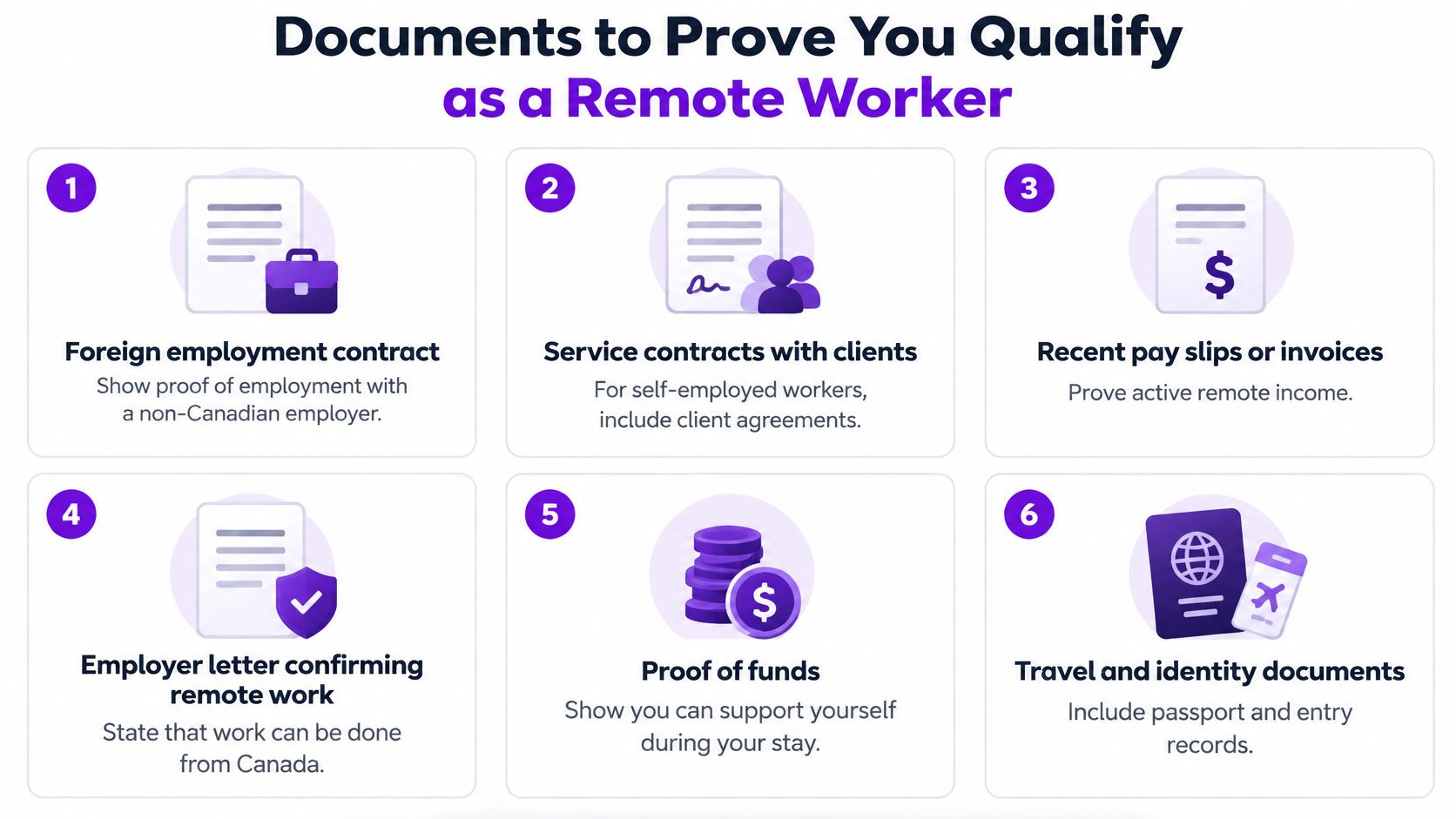
A foreign employment contract, or for self-employed people, service contracts with clients outside Canada. This is the anchor document and the first one asked for.
Recent pay statements from the foreign employer. Three months is a sensible minimum, and the deposits should match the contract.
Foreign business registration, such as a company certificate from your home country, if you invoice through an entity.
Sample invoices addressed to non-Canadian clients, which show the client's address, the currency, and the service described.
Home-country tax documents, which tie your income to another tax system and support the claim that you're a visitor, not a resident.
Bank statements showing sufficient funds for the stay, separate from the income evidence.
Two standard visitor conditions ride alongside that list. You must show you intend to leave Canada when your authorized stay ends, and you must show that your income is earned entirely outside Canada. A return ticket, a lease abroad, or an employer letter confirming your work location all support the first. The second is where the evidence list does the work.
The edge case deserves its own sentence. A freelancer with one Canadian client has a mixed income picture, and the visitor rule doesn't absorb that client just because the rest of the portfolio is foreign. Flag it, assess it, and don't assume.
Practical habit: build one folder before you book anything. Contracts, payslips, registration, invoices, tax filings, bank statements, in that order, exported as PDFs and named clearly. You may never be asked. If you are, you answer in ninety seconds instead of forty minutes.
Moving From Visitor Status to a Canadian Job or Residence
On June 27, 2023, Canada launched its first Tech Talent Strategy, which named digital nomads as a group to attract, then kept visitor status as the entry route instead of creating a dedicated nomad residence permit (IRCC's Tech Talent Strategy update on digital nomads). That single decision shapes everything that follows.
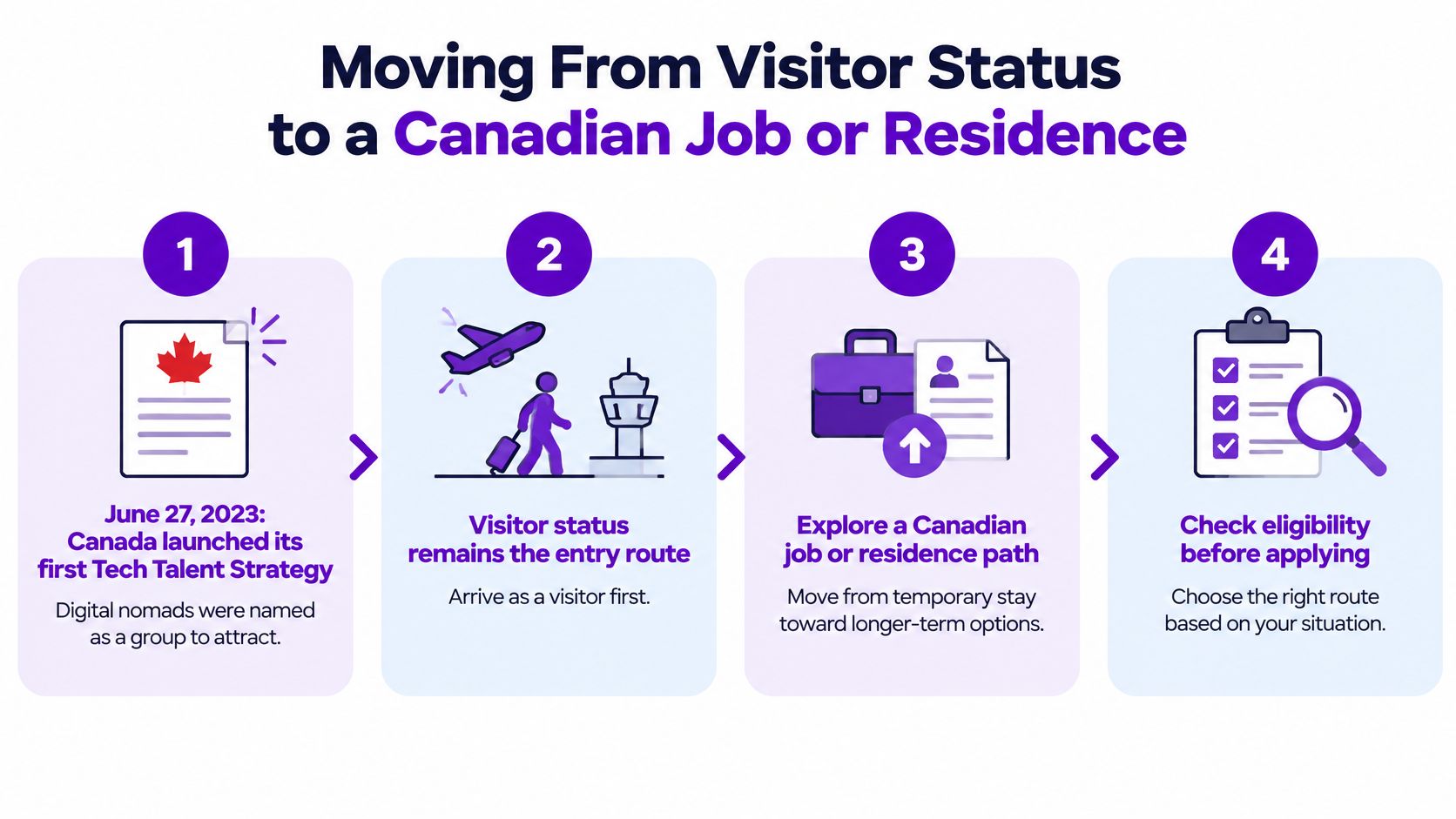
The pathway runs in stages, and each stage has its own gatekeeper.
Enter and work remotely on visitor status. Employers and clients outside Canada, income earned abroad, and a departure date you intend to honour.
Request a visitor record if you need more time on the same basis. An officer decides, and continued compliance with visitor conditions is the price of staying in the running.
Get a job offer from a Canadian employer. This is the pivot point. The employer may need to secure a labour market approval before anything else can move, unless a specific exemption applies to the role.
Apply for a temporary work permit built on that offer. The permit sets the terms, and those terms are often tied to that employer, which means changing jobs later usually means a new application.
Explore permanent residence through economic programs such as Express Entry if your work history and qualifications fit. This is a separate assessment with its own scoring and its own evidence.
Put a face on it. A software developer works remotely for a German company while on visitor status in Vancouver, meets a Toronto firm at a meetup, and accepts an offer. Nothing about the visitor stamp converts into work authorization. The Toronto employer deals with the labour market step, the developer files a work permit application, and the permit, once issued, defines what work is legal and for whom.
The government's own framing describes this as encouraging skilled remote workers to spend time in Canada, interact with Canadian employers, and potentially transition into the Canadian economy. Notice the word potentially. It's a two-stage design, not a residence permit with a waiting period.
Completing one step never guarantees the next. A visitor record is discretionary, a work permit depends on an employer's approval, and permanent residence depends on a points assessment that has nothing to do with how long you've been paying rent in Toronto.
When Long Stays Create Canadian Tax Exposure
Visitor status answers an immigration question. Tax residency is decided by entirely different facts, and you can be in perfect compliance with the immigration side while owing Canadian tax. The distinction is the one most guides skip: a border rule about months and a tax rule about ties are not the same rule.
Visitor status may allow remote work for foreign employers or clients, but it does not by itself determine Canadian tax residency, which turns on residential ties, days present, and potentially tax treaties (CloudAcc's guide to digital nomads and Canadian tax residency).
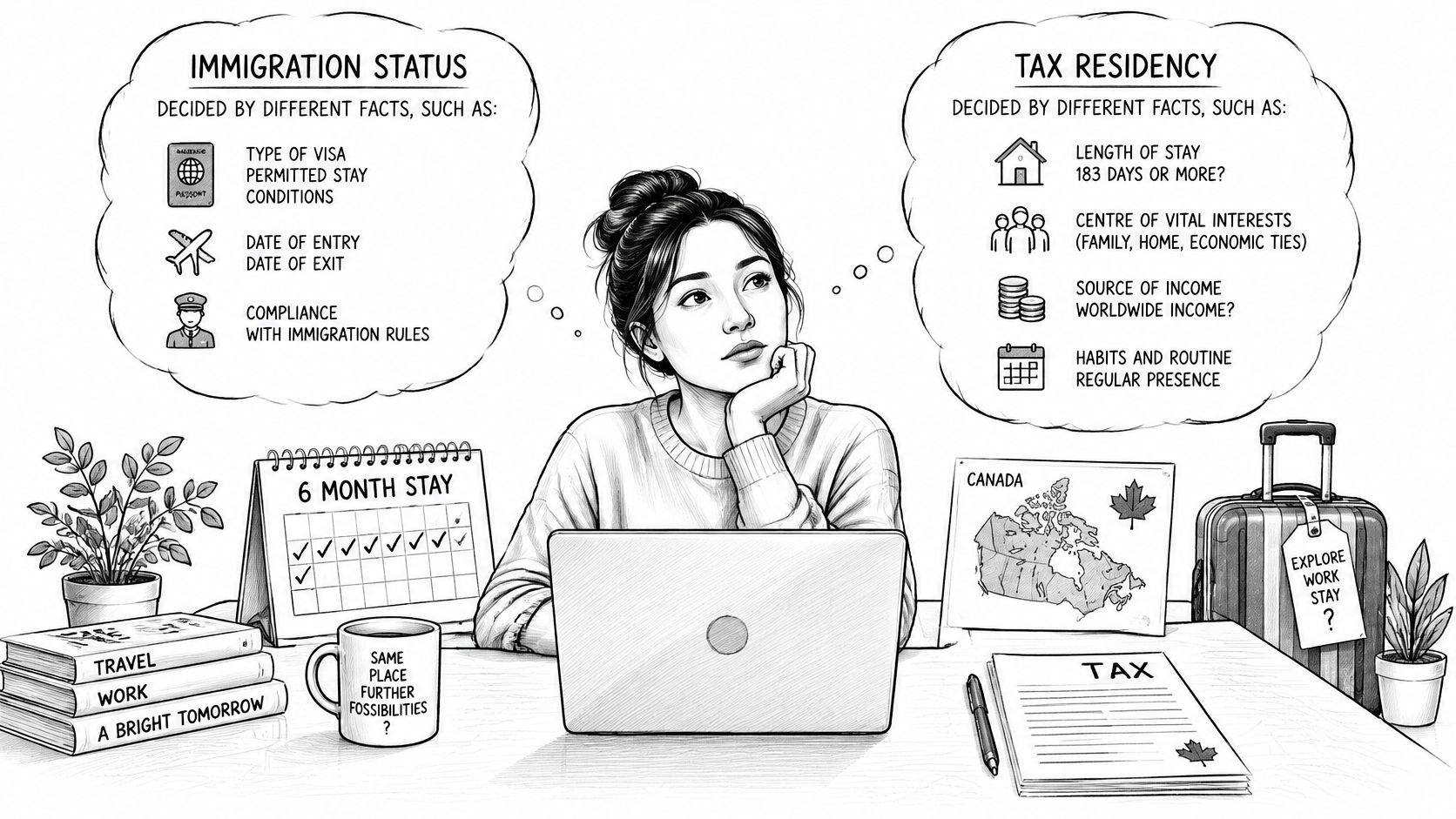
Here's the calendar-year problem. You count days per year, not per visit. Someone who leaves before the visitor window closes, comes back twice, keeps a partner and a leased apartment in Canada, and files no tax return anywhere else has a residency profile that looks nothing like a tourist's, even though every individual stay was legal. Repeating short stays doesn't reset the underlying question of where your life is anchored.
Founders make a related error. They assume that because the invoices are foreign, there's no Canadian tax question. The analysis can run through individual residency, corporate residency, permanent-establishment concerns, payroll, sales taxes, and treaty relief. A company managed from a Canadian kitchen table is a different entity in tax terms than one managed from Lisbon.
What to Document
| Factor | What to document | Why it matters |
|---|---|---|
| Days present in Canada | Days in each calendar year, not per visit | Long calendar-year presence is a strong signal of residency |
| Residential ties in Canada | Homes, spouse, dependants, and where they live | Significant ties point toward Canadian residency |
| Ties to another country | Home, family, and tax filings abroad | Stronger ties elsewhere can support non-residency |
| Where clients or employer sit | Contracts, invoices, and place of service | Shapes the business and withholding analysis |
| Business structure | Company registration and where management occurs | Corporate residency and permanent-establishment risk |
| Tax treaty | Treaty country list and tie-breaker rules | Resolves dual-residency conflicts between countries |
Treat the day count as a strong signal rather than the whole test, and treat a treaty as the mechanism that breaks a tie between two countries rather than a magic wand. Treaty relief can resolve double taxation without removing filing and reporting duties, which is the part people discover late.
The expensive mistake: assuming a decade-old stay is closed because you left. Records of your entries persist, and assessments can arrive years later with interest attached.
If you're planning repeated or long stays, get a Canadian tax adviser to review the whole picture before your next entry, and keep your own day log in a spreadsheet rather than reconstructing it from memory. The parallel question of what you do with the money you earn while mobile is worth settling at the same time, which is why our guide to investing while living abroad sits alongside this one.
Three Remote Work Myths That Still Trip Up Visitors
Chaining short stays back to back avoids the limit. Leaving and re-entering to restart the clock can read to an officer as an attempt to remain in Canada, and that impression follows your file into future applications. A consultant who exits for a day and returns a week later, every few months for two years, isn't invisible; the pattern is the point.
A visitor record arrives automatically once you pass the visitor window. An extension depends on officer approval and on continued compliance with visitor conditions. A nomad who assumes approval and stays past the authorized date has no legal basis to remain, and the fix afterwards is considerably more expensive than the extension application would have been.
Running your company from Canada is just a remote job. A founder managing a foreign company from a Canadian apartment on visitor status raises two separate questions that don't answer each other. Immigration asks whether the activity still fits visitor conditions. Tax asks about corporate residency and permanent establishment. A founder who makes every board decision from Toronto for eight months should have both reviewed before continuing, and the review is cheaper than either outcome.
The common thread is that all three myths treat a permission as a status. A visitor stamp is a permission with conditions and an end date, not a membership.
The correction is unglamorous. Read the conditions attached to your specific entry, keep evidence that you meet them, and treat any change in how you work, who pays you, or how long you stay as a trigger to re-check rather than a detail to sort out later.
Confirm Your Entry Plan Before You Book
Work through this in order. Each step either confirms the plan or flags it.
Find your row in the entry-routes table. Visitor status, extension, work permit, or permanent residence.
List every employer and client with a country next to each. Any Canadian entry on that list needs an assessment before you travel, not after.
Assemble the document set from the checklist into one folder, exported and clearly named.
Count planned days per calendar year, not per trip. Write the number down and keep updating it.
Check the official entry requirements for your nationality on the government's own pages. Our Travel Visa Requirements Finder is a fast way to see what your passport triggers before you start reading primary sources.
Book a Canadian tax adviser if your stays are long or repeated, and bring the day count with you.
Then make a decision rather than collecting more tabs. Proceed on visitor status only if every step fits without a workaround. If any step needs one, stop and reconsider the route: a work permit through a Canadian employer, or a different country entirely, is a cleaner answer than an entry you'll have to defend at the border and again at tax time.
If you want the practical companion to this piece, Mazurly's travel section covers digital nomad visas, banking across borders, and international health insurance, and our free tools include the Travel Visa Requirements Finder, an invoice generator, and a time zone converter built for people working across several of them.
Mazurly is built for the operator side of this life, where visa rules, tax exposure, banking, and client work all land on the same desk. If you're mapping a Canadian stay or comparing it against other routes, our guides and free tools are written to help you decide before you book rather than after. Start at Mazurly and work through the visa, money, and insurance questions in one place.