
Digital Nomad Communities and How to Choose

Table of contents
- What a Community Does and Where It Breaks
- Look for working infrastructure
- Recognize the failure modes
- Six Community Types and Who They Fit
- Match the format to the missing function
- Distinguish a destination from a membership
- How to Find Score and Join
- Run a practical joining test
- Separate commitment from enthusiasm
- Belong Locally Without a Nomad Bubble
- Make room for ordinary participation
- Make housing part of the relationship
- Three Stays and the Community That Fit
- A brief stop in Chiang Mai
- A working spell in a mid-size city
- A longer base with permission to remain
- Commit to One Community for This Move
- Prepare the working setup
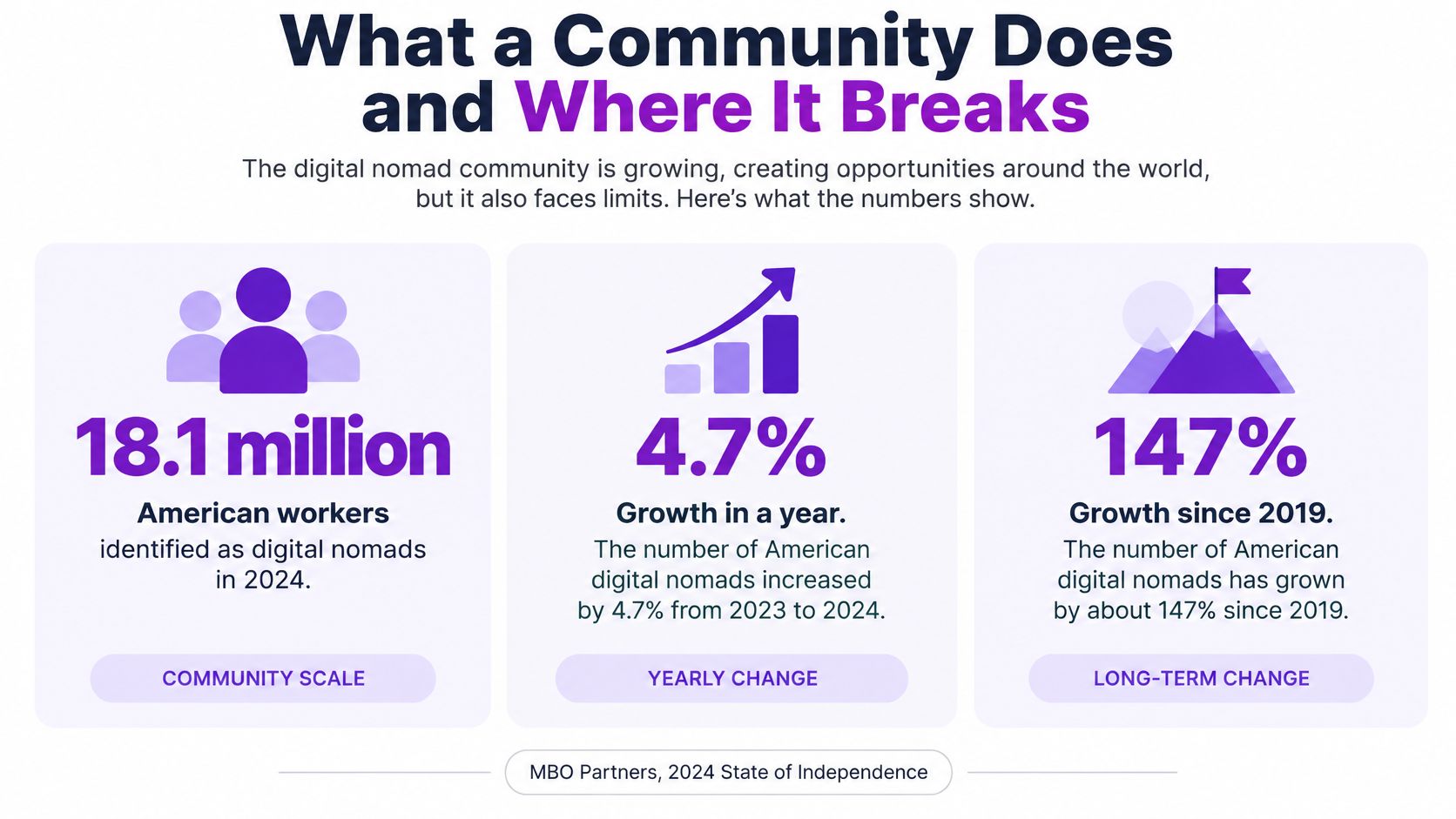
18.1 million American workers identified as digital nomads in 2024, up 4.7% from the previous year, according to MBO Partners' State of Independence study, cited in Beyond Borders. That's a substantial working population, not just a travel niche. For people earning a living while moving, the useful question isn't where everyone's gathering. It's which community will help you work reliably and participate responsibly in the place you've chosen.
What a Community Does and Where It Breaks
A digital nomad community is the people, places, and routines that replace parts of a missing office. Desks and Wi-Fi are the building, repeated faces are the hallway, and shared problems are the water cooler. A busy chat group isn't necessarily that infrastructure.
The American benchmark includes independent professionals, entrepreneurs, and employees. It isn't a world census, because definitions and measurement methods differ across countries.
Look for working infrastructure
A coworking study published by Wiley identifies linked functions: reliable facilities, repeated social interaction, and a recognizable community identity. In practice, that means somewhere to finish a proposal, someone who can recommend an accountant, and familiar people who notice when you return.
Measure usefulness through concrete outcomes:
Qualified introductions: Someone connects you with a relevant collaborator, not merely another attendee.
Retained help: Advice, referrals, and shared knowledge remain accessible after an event.
Working continuity: You establish a routine and keep participating beyond the initial welcome.
Recognize the failure modes
A study of New Zealand's coworking ecosystem found that pandemic closures disrupted social and material support, not just access to desks. Chat apps couldn't fully replace those connections.
Large mixers can also leave you with contacts you never meet again. Visitor-only groups need deliberate ways to preserve knowledge when members leave. For organizers, PostSyncer's lasting community building guide is a useful companion when planning that online continuity.
Practical rule: Combine a local hub with an asynchronous channel, but keep a separate workspace backup.
Keep ordinary safeguards, too. Share plans with someone you trust, don't lend money because a new housemate seems friendly, and keep work accounts off shared computers.
Six Community Types and Who They Fit
| Type | Best for | Typical access | Main risk |
|---|---|---|---|
| Online city or niche group | Questions before you arrive | Free or low-cost chat app | Shallow ties and outdated tips |
| Coworking membership | Daily focus and weekday contacts | Day pass or monthly desk | Closes or empties and the routine vanishes |
| Coliving house | First weeks alone in a new city | Room plus programmed social time | High rent and a closed visitor bubble |
| City nomad hub | Easy meetups and services | Events, cafes, and coworking clusters | Tourist circuit with little local life |
| Visa-linked destination circle | Stays up to about a year, where the permit allows | Permit plus local chats and coworking | Paperwork, income thresholds, insurance, tax exposure |
| Local founder circle | Clients, hires, and partnerships | Introductions and small recurring groups | Slow entry and language or status barriers |
Visa-linked circles grew alongside formal residence pathways: by the end of July 2024, more than 40 jurisdictions offered digital nomad or remote-worker visas or permits, and approximately half allowed eligible workers to reside for up to a year, according to EY's Global Immigration Remote Work and Digital Nomad Index. A permit makes a longer stay possible. It doesn't automatically supply friends, workspace, or permission for every business activity you might undertake.
Match the format to the missing function
Online groups are reconnaissance tools. A city Discord can help you ask whether a neighborhood suits evening calls. A specialist Slack can connect you with people doing similar work. Before acting on a recommendation, check when it was posted and whether the person has direct knowledge.
Coworking is closer to renting a dependable office routine. Choose it when you need separation between sleeping and working, somewhere appropriate for calls, or familiar weekday company. Inspect the actual working environment rather than choosing from photographs of an attractive lounge.
Coliving bundles several decisions together. You get accommodation, shared domestic space, and opportunities to socialize through the same arrangement. That can simplify arrival, but it also concentrates risk: if the atmosphere doesn't suit you, both home and social life may feel wrong.
Ask about quiet hours, call spaces, visitors, cancellation terms, and whether activities are optional. A shared kitchen can create easy conversation; compulsory togetherness can make downtime feel like another meeting.
Distinguish a destination from a membership
A city nomad hub, such as Chiang Mai, isn't a single organization. It's a collection of workspaces, cafes, services, and overlapping groups. You can use that convenience without joining every event or assuming everyone shares your priorities.
Visa-linked circles are useful for exchanging administrative questions and finding people expecting to remain nearby. Treat their advice as leads to verify, particularly when immigration, employment arrangements, or tax obligations are involved. Another member's successful application doesn't establish your eligibility.
Local founder circles serve a different purpose. A professional association, industry breakfast, or recurring business workshop may suit someone seeking collaborators or market knowledge better than a general nomad gathering.
Entry can take patience. Attend as a participant, learn what members are working on, and offer something useful before asking for introductions. Don't mistake a slower welcome for a weaker community.
Choose a primary format for the job you need done. Keep another channel as backup, not another calendar to maintain.
For example, a remote employee might choose coworking for concentration and a city chat for practical questions. A consultant developing local partnerships might prioritize a professional circle and use occasional workspace access around meetings. Neither needs the entire ecosystem.
How to Find Score and Join
Treat these as screening rules, not universal performance benchmarks. You're testing whether a community can support your next stay before committing money.
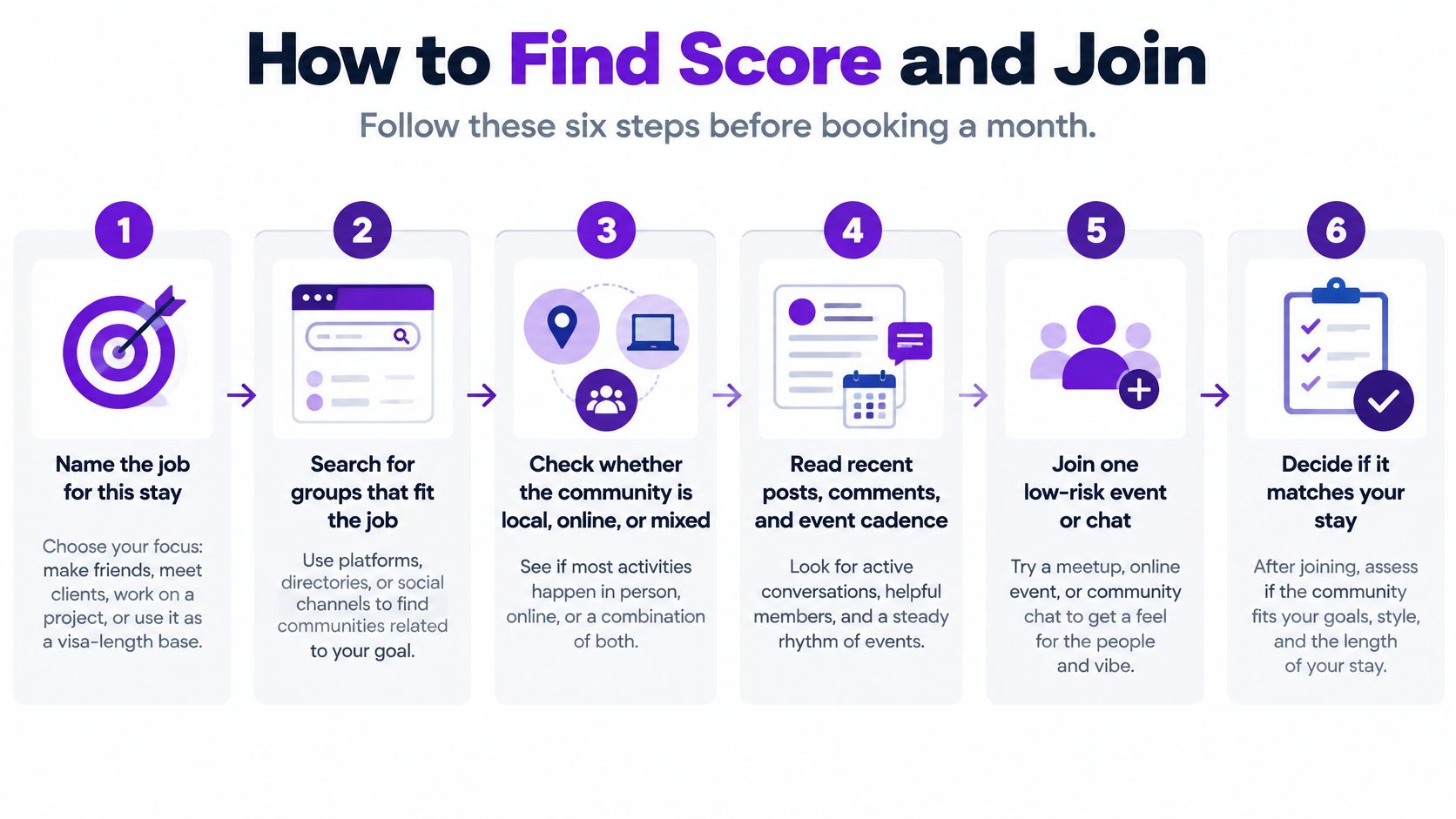
Use this process as a low-risk starting point.
Run a practical joining test
Name the job for this stay. Choose focus, friendship, clients, or a longer-term base as your priority. Pass an option only if you can explain how its normal activities serve that priority; reject it if the appeal is mostly attractive branding.
Search a limited set of channels. Check local coworking websites, an active city or industry chat, and a professional association. Read recent conversations, not just membership totals. Treat a group with no recent substantive replies as an information archive rather than an active support network.
Score the operating details. Look for a human response within a day, a recurring small-group activity, a workspace contingency, transparent monthly costs, and access to residents or local operators. These are your acceptance criteria. A friendly sales reply alone doesn't pass the test.
Visit during a normal workday. Upload a representative work file, make a test call with permission, inspect the call booths, and check noise during your actual meeting hours. Notice whether a host introduces newcomers. Pass only if the working conditions match your needs, not just the tour.
Join with a specific request. Ask to join a scheduled focus session or meet someone in your industry. Offer relevant help in return and put a review date on your calendar. Pass if someone can explain the next concrete action, rather than directing you to an endless event feed.
Review and downgrade when necessary. After a trial period, ask whether you've gained a useful contact or a workable routine. If neither has happened, stop paying for the promise of eventual belonging. Keep useful online access if available and move your spending elsewhere.
A specific ask should be easy to answer. Someone seeking telecommunications work, for example, can share a relevant role from Premier Broadband's career page for broadband hiring and ask whether anyone understands that kind of position. That gives people more to work with than a general request for opportunities.
Separate commitment from enthusiasm
For a brief stop, favor flexible access. For a stay measured in months, prioritize an activity you can attend repeatedly. For a longer base, leave space to develop professional relationships beyond the newcomer circuit.
If your choice assumes a residence permit, use the digital nomad visa comparison to organize your questions, then verify current conditions with the relevant authority. Don't sign housing or membership commitments on the assumption that an application will succeed.
You can also watch the accompanying video before making your shortlist.
Community scorecard before you pay
| Check | Pass | Fail |
|---|---|---|
| Response time | A real person replies within a day | Messages sit unanswered for a week |
| Meeting format | A small recurring group | Only large one-off parties |
| Backup place to work | A second site, plus an async channel for coordination | One building is the whole community |
| Price clarity | Month price and what it includes | Vague day rates and surprise fees |
| Local path | A route to residents or local operators | Only other short-stay visitors |
Mark each row against evidence, such as a written quote, an actual calendar, or a named alternative workspace. An asynchronous channel preserves contact, but it doesn't provide a quiet desk or power outlet.
Belong Locally Without a Nomad Bubble
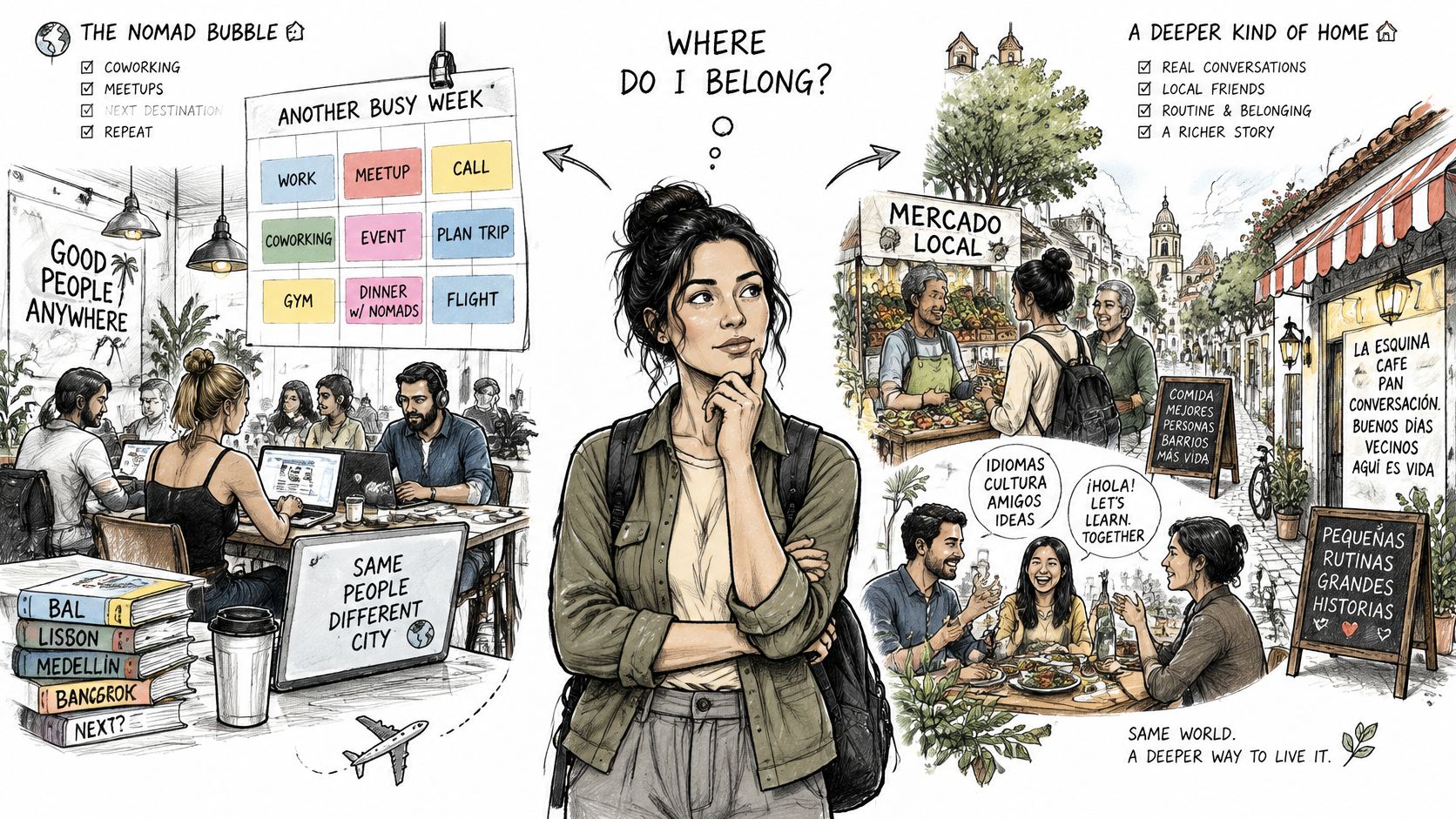
The busiest nomad calendar and the cheapest room aren't reliable measures of belonging. You can attend events every evening and still know almost nothing about the neighborhood where you sleep.
A review published in Tourism Geographies discusses a study of Digital Nomad Anji in China that identifies physical, emotional, cultural, economic, and relational embeddedness, while describing resident interactions that are often transient, superficial, or commercial. Those dimensions help distinguish being physically present from participating in local life.
Make room for ordinary participation
Embeddedness means becoming connected to a place through everyday life. You don't need to claim local identity or achieve instant intimacy. You do need to stop treating every interaction as a service purchased or a lead acquired.
Choose commitments you can keep:
A recurring activity: Join a neighborhood sport, language exchange, public workshop, or class that welcomes temporary participants.
A resident-owned routine: Return to a nearby shop or restaurant, learn names naturally, and respect busy working hours.
A useful contribution: Ask an established organization what help it needs, rather than arriving with a project designed around your interests.
Say you're staying for a short work assignment and have evening calls. A daytime language exchange may be realistic; a volunteer role requiring dependable evening attendance isn't. Be honest about your availability and departure date before anyone relies on you.
Introductions should begin with participation. Ask how a class works, whether beginners are welcome, and what equipment to bring. Don't open by requesting business contacts from someone who came to play a sport.
A better belonging test: Would you return to the activity if nobody there could become a client?
Protect the time deliberately. Put the commitment beside client meetings on your calendar, and decline optional nomad events when they crowd it out. Familiarity comes from showing up, not collecting recommendations.
Make housing part of the relationship
Housing choices deserve the same care as social choices. Don't assume a room is a responsible choice merely because it fits your foreign-income budget or carries a community label.
Before committing, compare the quote with ordinary residential listings, investigate the recent direction of local rents, and look for reliable information about local wages. Ask what kind of building you're booking and whether short-term occupancy is permitted. A polished listing doesn't answer those questions.
Use a longer lease only when your legal stay and work plans justify it. Read notice periods, deposit terms, utility responsibilities, and restrictions carefully. A longer contract that you can't honor isn't a contribution to housing stability.
If Greece is on your shortlist, separate the residence decision from the lifestyle pitch with the Greece digital nomad visa guide. A destination's appeal doesn't settle whether its rules suit your employment and household arrangements.
Spread spending beyond internationally oriented cafes when practical, without treating residents as exhibits of authenticity. Local businesses deserve ordinary customers, not performances of cultural discovery.
Judge your stay by a local relationship that repeats and a housing decision you could explain respectfully to a resident. Those tests ask more of you than event attendance, but they're also more meaningful.
Three Stays and the Community That Fit
Consider these hypothetical stays as different tool choices, not destination rankings. Your time available, working obligations, and certainty about remaining should determine how much you commit.
A brief stop in Chiang Mai
Say you're stopping for ten days with a client deadline. Buy a couple of coworking day passes, ask the city chat for a workspace recommendation, and avoid a coliving deposit that adds unnecessary commitment.
Your money goes toward flexible access rather than a monthly social package. Schedule the difficult work first, then accept an invitation that fits around it.
If the problem is personal accountability rather than finding people, consider the approach described in Boss as a Service for nomads. Don't buy more social access to solve an execution problem.
Keep-or-leave test: Keep using the workspace if you finish work comfortably and have someone relevant to ask for practical help. Leave if noise or travel time undermines the deadline.
A working spell in a mid-size city
For a hypothetical six-week stay, try a monthly desk after the workday visit. Join a recurring small group, then add a local class once your working schedule is stable.
Your spending has a predictable membership component rather than repeated spontaneous purchases. Before renewing, check whether the people you hoped to work alongside attend during your hours.
Housing deserves particular attention. A Tourism Geographies study covering 668 destinations found Airbnb cost and safety among the strongest local predictors of nomad attractiveness, while the associated discussion of Delhi neighborhoods describes both business benefits and rising rents and property values from nomad inflows.
A destination can therefore look attractive to mobile workers without being an uncomplicated housing choice. Use a country cost-of-living comparison for broad budgeting, then inspect neighborhood listings and resident perspectives before choosing a property.
Keep-or-leave test: Retain the desk if weekday attendance supports useful contact. Downgrade if you're paying to sit alone in a room that adds little to your apartment.
A longer base with permission to remain
For a hypothetical year-long stay supported by an appropriate permit, begin with flexible accommodation, coworking, and administrative tasks. Add a local professional circle when you understand your working rhythm.
Only move toward a longer lease once permission to remain, income continuity, and neighborhood suitability are clear. The money shape becomes membership plus a genuine housing commitment, not a string of expensive arrival arrangements.
Keep a simple decision log covering collaboration, practical assistance, housing terms, and participation outside visitor spaces.
Keep-or-leave test: Maintain commitments that support both your business and ordinary local life. Reduce memberships that no longer serve either purpose rather than retaining them from habit.
Commit to One Community for This Move
Write a sentence naming your stay length, primary community type, and the job it must do. If options tie, choose the one with demonstrated follow-through and a credible route into local life. Keep the other as a backup channel.
Before making a long commitment, verify permitted stay, income conditions, insurance, and any restrictions relevant to your work. Review housing separately from the community fee. A welcoming group doesn't make an unsuitable lease sensible.
Prepare the working setup
Reserve focus time: Put a working block on your calendar and use asynchronous updates where live calls aren't necessary.
Arrange backup connectivity: Buy a compatible local or regional eSIM data plan before arrival, check activation instructions, and confirm hotspot support.
Set a review point: Decide in advance what evidence would justify renewing or leaving.
We bring the planning layer together through our Travel coverage of digital nomad visas, banking across borders, and international health insurance, alongside our Travel Visa Requirements Finder. Our community offers remote entrepreneurs opportunities to connect, collaborate, share ideas, seek a mentor, and get peer support.
This week, score a pair of real options. Choose the stronger fit for a 30-day trial, then review useful introductions, retained help, working conditions, and housing costs rather than counting events.
Visit Mazurly to organize your visa, insurance, and cross-border planning before committing to a community or accommodation. Use our practical resources and remote-entrepreneur community as the online support layer while you test a local place to work and belong.