
How to Price Freelance Services with Confidence: Rates, Packages and Raises

Table of content
- Why Most Freelancers Undercharge Without Knowing It
- The three numbers that matter
- Calculating Your Real Cost Floor
- Build the calculation in five passes
- Why market data still matters
- Hourly, Project, Retainer, and Value Pricing Compared
- A fast decision rule
- Adjusting Rates for Market, Specialty, and Location
- Packaging Proposals That Win Without Discounting
- Make the middle option earn its place
- Track proposals like a business experiment
- Cash Flow, Currency, and the Cross-Border Freelancer
- Match payment terms to client risk
- Choosing the Right Pricing Model on Your Next Project
- Run the next proposal through this checklist
The most popular freelance pricing advice is backwards. “Check what others charge, then pick a number that feels comfortable” treats your rate like a market label, when it's a cash-flow and risk decision. A quote can look profitable and still leave you financing the client's project, absorbing unpaid revisions, losing money on currency conversion, and waiting months to get paid.
Two freelancers can quote the same hourly rate and take home very different amounts. One may have predictable clients, tight scope, prompt payments, and low overhead. The other may spend hours on proposals, coordinate across time zones, pay platform fees, handle extra revisions, and convert income into a weaker currency.
That's why copying a competitor's rate is one of the most expensive habits in freelance work. If you're building a location-independent business, even decisions connected to where you live, such as those covered in this guide to a digital nomad visa for Colombia, can affect your tax planning, insurance, banking, and operating costs.
The reliable approach has four parts:
Establish a cost floor below which the work isn't sustainable.
Use market data to check whether your positioning is credible.
Adjust for specialty, urgency, expertise, and business value.
Add protection for payment delays, scope risk, fees, and currency movement.
Pricing isn't a confidence test. It's profit engineering.
Why Most Freelancers Undercharge Without Knowing It

The most common pricing mistake is treating the quoted amount as income. It isn't. Your real income is what remains after taxes, software, insurance, payment fees, unpaid sales work, revisions, currency conversion, and the cost of waiting for approval.
A freelancer who charges a seemingly strong rate can still run a weak business if the project expands without a change order. A client who pays promptly and respects scope may be far more profitable than one who accepts a higher quote but takes months to approve invoices and expects constant availability.
The number on the proposal is not your profit. The money that survives delivery and collection is your profit.
This is particularly important for cross-border professionals. Your bank balance can be affected by exchange rates, withholding tax, transfer charges, platform deductions, and the country where you're registered. Those factors don't make your service less valuable. They make careless pricing more dangerous.
The three numbers that matter
You need three separate numbers, not one vague “market rate.”
Cost floor: The minimum sustainable rate based on required compensation and realistic billable capacity.
Market check: A comparison with similar services, specialties, seniority, geography, and hiring channels.
Value-adjusted quote: The price after considering business impact, urgency, uncertainty, complexity, and cash-flow risk.
The cost floor protects you from accepting work that cannot support the business. The market check prevents an offer that buyers may consider implausible. The value adjustment captures expertise and outcomes that a simple hourly calculation misses.
Research on online labor marketplaces supports this multidimensional view. Freelancers consider multiple pricing factors, and value-based pricing means setting a fee according to the value delivered or the distinctive value of the freelancer's capabilities relative to competitors, as described in this research on freelance rate-setting and value pricing.
Don't ask, “What do freelancers like me charge?” Ask, “What price lets me deliver this work profitably, collect the money reliably, and justify the result to the right buyer?”
Calculating Your Real Cost Floor
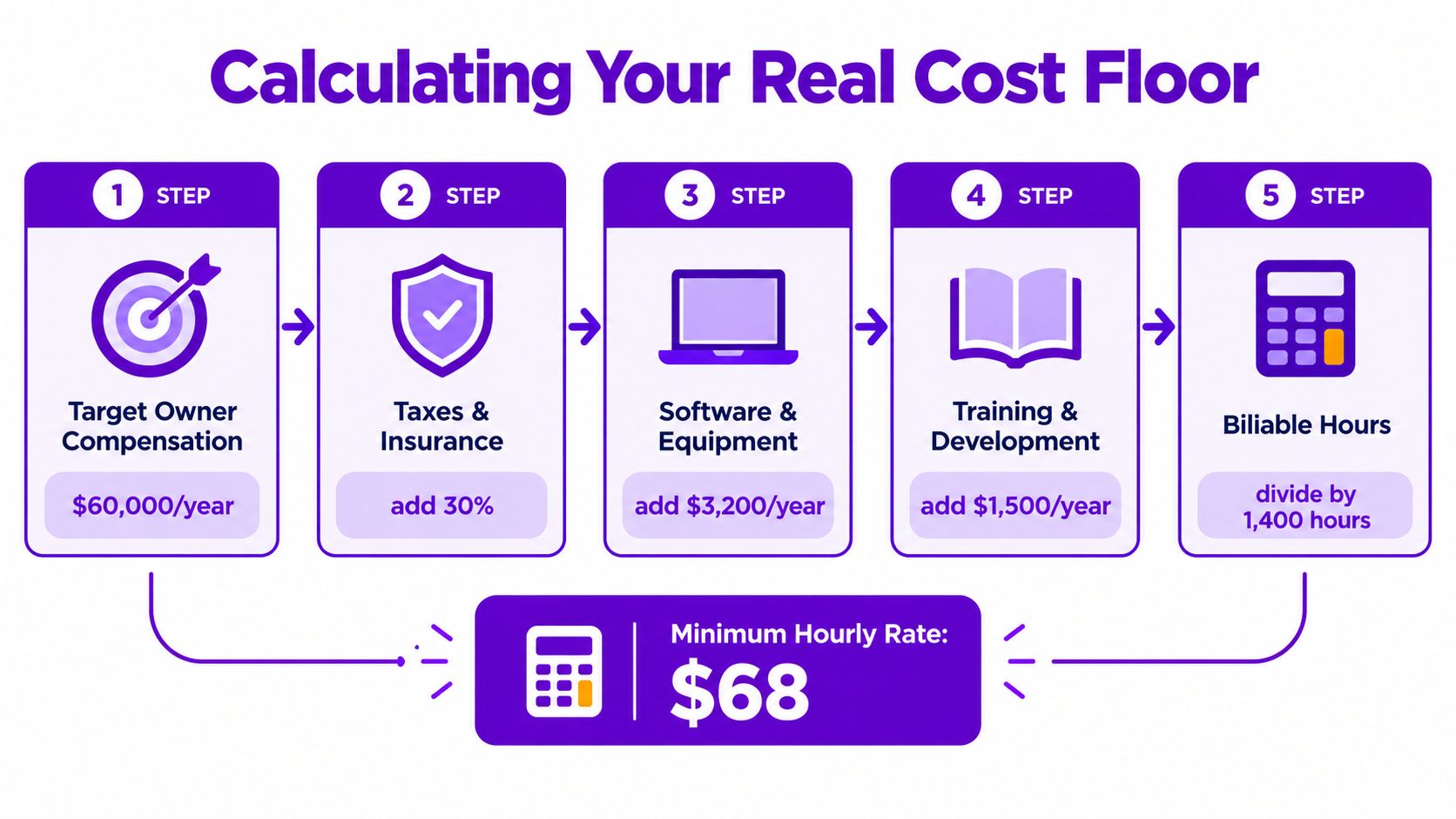
Your cost floor is the minimum rate that keeps the business from subsidizing a client through your savings, personal income, or unpaid hours. It is a private decision rule, not the price you must show every prospect. Quotes below it create a cash-flow problem, even when the project appears profitable.
Use this formula:
(Target annual owner compensation + taxes + insurance + software + equipment + training + unpaid leave + business overhead) ÷ realistic billable hours
The denominator must reflect your actual capacity. Exclude prospecting, proposals, administration, learning, holidays, sick time, internal planning, and unpaid revisions. Plan on 40% to 60% utilization, meaning that share of working time is available for paid delivery. Treat this as a planning assumption, then compare it with your own calendar and time records. Cross-border freelancers should also account for transfer charges, currency conversion, withholding, and platform deductions before accepting a rate.
Build the calculation in five passes
Start with the money you need to pay yourself. Add the costs that continue when a client pauses work: taxes, insurance, accounting, software subscriptions, equipment replacement, education, unpaid leave, and a reserve for slow periods. These expenses determine whether revenue becomes income or disappears before you can use it.
Then estimate billable capacity. Subtract time spent finding work, writing proposals, joining sales calls, invoicing, managing projects, studying, taking holidays, and correcting work caused by unclear requirements. A full calendar can still produce a weak month if too little of that time is paid delivery.
For a simple example, use these planning inputs:
Target owner compensation: $60,000 per year
Taxes and insurance: 30% added to compensation
Software and equipment: $3,200 per year
Training and development: $1,500 per year
Realistic billable capacity: 1,400 hours per year
The resulting minimum rate is approximately $68 per hour. This is an illustrative calculation, not a universal recommendation. Replace every input with your own obligations, tax position, location, currency costs, and capacity.
Keep the rate sheet to one page. Review it quarterly, and whenever costs, workload, tax obligations, or client mix change. You can use a tool to estimate your billing rate, then check the result against your records rather than accepting the output blindly.
Why market data still matters
A cost floor protects your sustainability, but it cannot establish a credible price for every segment. A 2024 survey of 3,424 freelancers and self-employed professionals reported an average hourly rate of €98, according to the Freelancer Study 2024. Treat that figure as a benchmark, not a target. Country, discipline, seniority, client type, and specialization can change the appropriate rate substantially.
The common mistake is dividing desired income by every hour in the year. That produces an attractive number, then unpaid sales, administration, leave, and collection delays erase the margin. Calculate the floor first. After that, test the quote against the buyer, the work, and the risk of waiting to be paid.
Hourly, Project, Retainer, and Value Pricing Compared
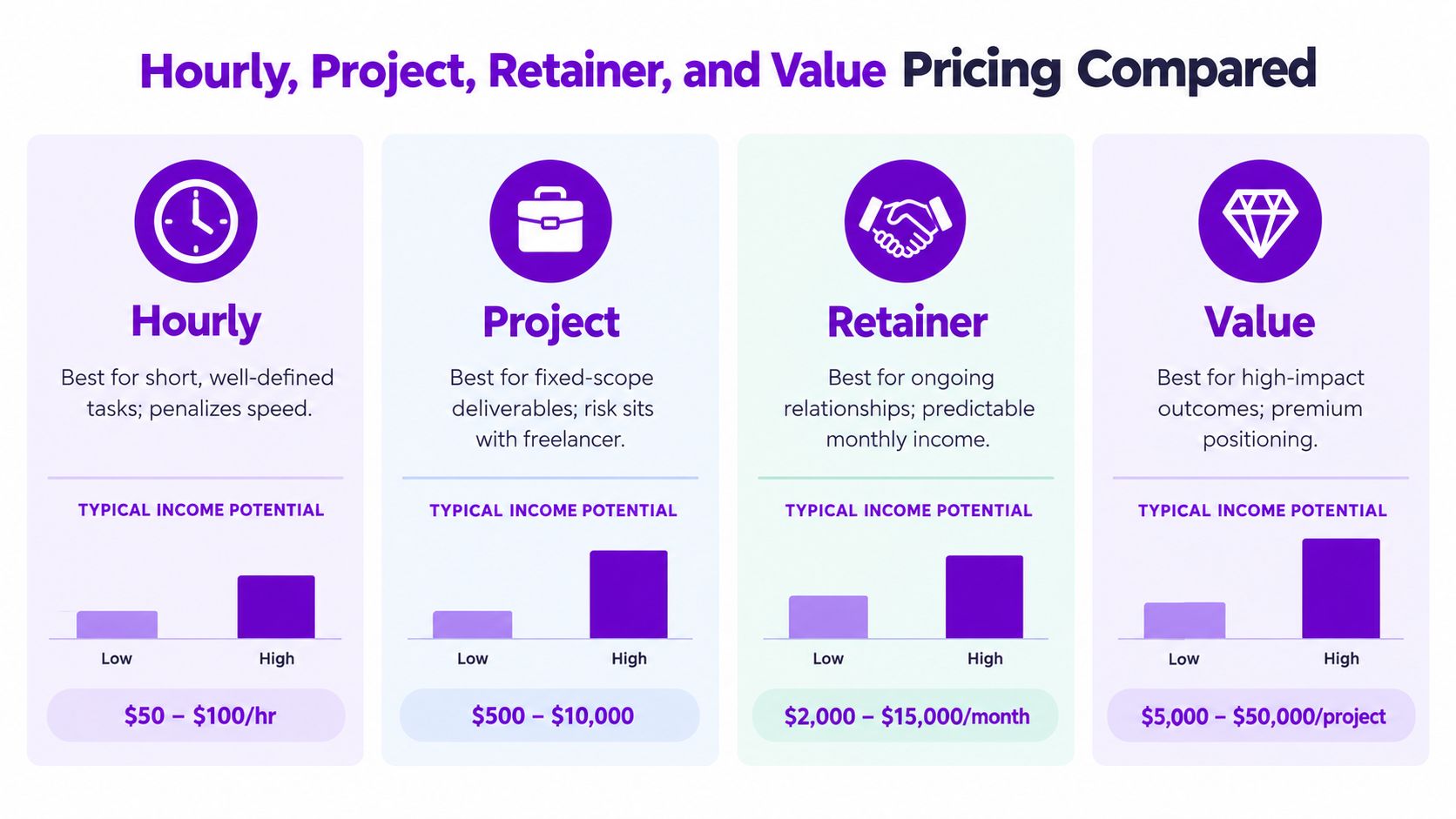
Pricing models are risk decisions, not interchangeable labels. Choose the model that keeps uncertain work from consuming your margin, especially when currency conversion, client delays, or cross-border payment friction can reduce an apparently profitable quote.
Hourly pricing fits uncertain scope. Use it for discovery, troubleshooting, open-ended technical work, advisory calls, or projects where the client controls key inputs. Set a minimum booking, define the availability window, and require written approval before work exceeds the estimate.
Hourly billing has a clear limitation: it rewards time rather than expertise or speed. If your experience lets you solve a difficult problem quickly, the model can cap your income. It also leaves you carrying the risk of unbooked time between tasks.
Project pricing suits work with defined deliverables, assumptions, and acceptance criteria. Estimate the delivery hours internally, add a documented allowance for project risk, and present a fixed fee externally. The client gains predictability, while you benefit from efficient execution. Because you carry the delivery risk, write precise scope boundaries, revision limits, dependencies, and payment milestones.
Retainers work for ongoing access, production, maintenance, or strategic support. Sell reserved capacity and defined outputs, not unlimited availability. State how unused capacity is handled, when requests must arrive, and which work falls outside the monthly allocation. A retainer should protect your schedule, not turn every client request into an emergency.
Value pricing fits high-impact work where the client is buying an outcome rather than a deliverable. Discovery must examine the client's product, budget, traffic, team, approvals, and execution capacity. Charge for meaningful business impact, but separate your fee from outcomes the client controls and never present uncertain upside as guaranteed.
A fast decision rule
Ask four questions before choosing a model:
Can both sides define the finished result? If yes, consider a project fee.
Will the client's actions determine much of the outcome? If yes, separate delivery fees from performance upside.
Will needs recur with predictable capacity? If yes, propose a retainer.
Is the scope exploratory or volatile? If yes, use hourly billing or a paid discovery phase.
One consultant can use all four models in a single client relationship: hourly billing to diagnose a broken analytics setup, a fixed fee to implement the agreed tracking plan, a retainer for monthly monitoring, and a value-adjusted fee for a conversion program tied to agreed measurement rules.
Choose the model that protects the work from its biggest uncertainty. That choice usually matters more than making the quote sound polished.
Adjusting Rates for Market, Specialty, and Location
Your cost floor sets the minimum. Market evidence helps you decide how buyers will judge the offer, but it should not override cash flow, delivery risk, or the value of scarce expertise.
Public benchmarks vary widely. Upwork lists typical rates of $15 to $55 per hour for many programming and design categories, while machine-learning work can reach $50 to $200 per hour, according to its freelance earnings benchmarks. Use these figures as reference points, not targets. A low benchmark does not make a specialized service cheap, and a high benchmark does not support a rate you cannot defend with proof, scope, or reduced client risk.
Adjust your base rate across four practical axes:
| Adjustment Axis | Direction | Typical Effect on Base Rate |
|---|---|---|
| Specialty demand | Higher demand raises the rate | Move upward when the skill is scarce or commercially important |
| Seniority and proof | Stronger experience raises the rate | Charge more when you reduce supervision, rework, or decision risk |
| Urgency | Shorter timelines raise the rate | Add a rush premium when the client displaces planned work |
| Geography and client segment | Purchasing power changes the context | Adapt positioning and packaging without treating location as a discount |
Location affects your expenses, but it should not dictate your market price. A consultant living in Lisbon and one living in Buenos Aires may face different operating costs, taxes, banking friction, and personal targets while serving the same international market. Both can charge rates that support a sustainable business. Use cost-of-living comparisons across countries to assess your baseline, then price for the client's market, the work's risk, and the capacity you give up.
Review rates when demand changes. Raise them when qualified leads accept quickly, your delivery calendar stays full, inbound demand grows, or your specialization becomes more valuable. Cross-border freelancers should also account for payment delays, currency conversion, tax exposure, and banking friction before calling a quote profitable.
If buyers resist, reduce scope before reducing price. A smaller engagement protects your margin better than a discount that leaves the same obligations in place. Pricing should be reviewed as workload, expertise, demand, and operating risk change.
Packaging Proposals That Win Without Discounting
One quote forces the client to accept or reject your entire recommendation. Three well-designed packages create a better conversation because the buyer can choose the level of support, speed, and risk coverage that fits the situation.
A strong package ladder might look like this:
Essential: Core audit, prioritized findings, one review call, and a defined delivery window. The client handles implementation.
Standard: Audit plus implementation, documented handover, and a limited revision round. This is often the most operationally attractive option.
Strategic: Implementation plus monitoring, decision support, stakeholder coordination, and a review period. The client buys more accountability and less internal workload.
The difference must be technical and observable. Don't create three versions by changing the font, adding vague “priority support,” or inflating a deliverable list. Specify what gets done, who supplies inputs, how quickly you deliver, how many revisions are included, how communication works, what outcome is measured, and what is excluded.
Make the middle option earn its place
The standard package should be the option you can deliver efficiently and recommend. It shouldn't exist only as a psychological anchor. Price it so the scope, margin, and client result make sense without requiring the buyer to choose the highest tier.
A Mailchimp & Co benchmark of more than 2,000 freelancers and agencies found that 24% offered at least three price points, and that group acquired over 20% more new business than respondents offering only one price point, according to Mailchimp's pricing benchmark. That association doesn't prove that package count alone causes better results. It does justify testing structured choices instead of assuming a single quote is optimal.
Track proposals like a business experiment
Create a proposal log with the lead, package viewed, quoted value, outcome, sales cycle, estimated delivery hours, gross margin, and revision hours. Review 20 to 30 comparable proposals before changing your pricing. A small sample can reflect one unusually good or bad client.
Your proposal should also state the change-order rule. For example: “The quoted fee covers the listed deliverables and included revision rounds. Requests that change the deliverables, assumptions, or approval process require written approval and a separate fee.” Add payment milestones before work begins, not after a scope dispute.
Cash Flow, Currency, and the Cross-Border Freelancer
A profitable project can still damage your business if you finance it for the client. This is the part most rate guides ignore.
The 2025 State of Freelance Work reports that 85% of surveyed freelancers experience late invoice payments at least some of the time, while only 15% are always paid on time, according to the report on freelance work. Late payment isn't just an administrative annoyance. It can force you to use savings, delay taxes, absorb exchange-rate changes, or decline better work because your capacity is trapped in an unpaid project.
Use a cash-flow-adjusted quote:
Target compensation + financing cost + currency buffer + payment fees + delayed-payment reserve
You don't need to expose every internal calculation to the client. You do need to price as if collection has a cost.
Match payment terms to client risk
New clients should normally pay a larger deposit before production starts. Established clients with a strong payment record may qualify for more flexible milestones. Companies with long procurement or approval cycles should receive shorter billing stages, because you shouldn't deliver the entire project before discovering how slowly their finance department operates.
Write terms that are unambiguous:
Deposit: Work begins after the agreed upfront payment clears.
Milestones: Each stage has a deliverable, approval window, and invoice date.
Late payment: Overdue invoices may incur a stated late fee where legally permitted.
Pause right: Work pauses when an invoice passes its due date.
Kill fee: If the client cancels after work begins, completed work and committed capacity remain payable.
Currency: State the billing currency, payment rail, and who absorbs conversion fees.
Withholding tax: Require the client to provide documentation for any deduction and clarify whether the quoted fee is gross or net.
A practical contractor payment terms playbook can help you turn these principles into contract language. Have a local accountant or lawyer review terms where tax residency, withholding, or enforceability is complicated.
For multi-currency work, quote in the currency that matches your costs when possible. If the client insists on another currency, build the conversion risk into the fee or define an exchange-rate rule. Payment platforms, intermediary banks, and receiving accounts can all reduce the amount that reaches you.
Cash-flow planning also belongs beside your broader financial system. Guidance on investing while living abroad is separate from pricing, but the same discipline applies: know which currency you earn, which currency you spend, and how much liquidity you need before committing money elsewhere.
Choosing the Right Pricing Model on Your Next Project
Use a short decision process instead of debating pricing models abstractly. First define the deliverable. Then identify who controls the outcome. Finally estimate how much revision, coordination, and scope risk the engagement carries.
If the deliverable is clear, the client can provide inputs on time, and acceptance criteria are objective, use a fixed project fee. Calculate your internal hours, add a documented risk allowance, and write tight assumptions.
If the work is exploratory, diagnose-first, or likely to change as you learn more, use hourly billing or a paid discovery phase. Don't promise a fixed result before you understand the problem. If the client needs recurring capacity, use a retainer with a defined allocation and response window.
For uncertain business outcomes, split the quote into three parts:
Guaranteed delivery fee: Payment for the work you control, such as research, implementation, writing, design, or configuration.
Risk premium: Compensation for ambiguity, stakeholder complexity, rushed timing, dependencies, and likely rework.
Optional performance upside: A bonus tied to measurement rules, reporting access, time frames, attribution limits, and the client's responsibilities.
That structure prevents a common mistake: accepting a low fixed fee in exchange for vague promises about future success. You can't control the client's budget, product quality, traffic, approvals, sales process, or follow-through. Price the work you guarantee, then define upside separately.
Run the next proposal through this checklist
Outcome: Can the finished result be described without interpretation?
Inputs: Has the client committed to providing access, materials, feedback, and approvals?
Scope: Are deliverables, exclusions, revision limits, and meeting rules written down?
Risk: What could expand the work, delay payment, or force coordination across time zones?
Model: Does hourly, project, retainer, or hybrid pricing assign risk fairly?
Cash flow: Are the deposit, milestones, currency, fees, and late-payment terms adequate?
Evidence: Does the quote reflect your cost floor, market position, specialty, and proof?
Review: Will you record delivery hours, revision hours, margin, and payment timing?
Transaction evidence indicates that the median freelance gig can cost 37% more than its advertised price after platform fees, revisions, and scope additions. In a typical $500 project, the freelancer reportedly retains about $310, according to the freelance pricing data study. The lesson is simple: price the work as it will be delivered, not as it appears in the initial brief.
If you want to strengthen the commercial side of your business, a practical pricing workshop for business owners can provide a structured setting for reviewing margins, offers, and pricing decisions. Then test your next quote, record the result, and review the evidence instead of changing your rate based on nerves.
Pricing is a system, not a number you defend forever. Recalculate your floor, check your market, protect your cash flow, and adjust the offer when the risk changes.
Mazurly helps digital nomads and independent professionals make better location, cost-of-living, travel, and remote-work decisions with practical guides and browser-based tools. Visit Mazurly to compare living costs, plan cross-border work, and build a freelance business that supports your actual income goals.