Business Travel Packing List: 8 Essentials for 2026
Table of contents
- 1. Universal Travel Adapter with GaN Charging
- What to check before buying
- 2. Power Bank for Airline-Compliant Travel
- Picking capacity you'll actually carry
- 3. Noise-Cancelling Headphones for Focused Work
- Fit, modes, and the wired backup
- 4. Packing Cubes and Compression Organizers
- Which cubes earn space
- 5. Carry-On Laptop Backpack with Protective Sleeve
- The laptop compartment is a security decision
- 6. Wrinkle-Resistant Business Wardrobe
- A capsule that covers three cities
- 7. Unlocked Smartphone with eSIM for Global Connectivity
- The order of operations
- 8. Secure Travel Document Organizer
- Build the backup before the trip
- How the eight business travel packing essentials compare
- Turn Your Business Travel Packing List Into a Repeatable System
You land at 6:40 a.m., the airport Wi-Fi won't authenticate, and the three things you need most are the three things you can't find. The charger is in the seat pocket of the plane you just left. Your phone shows no local network because the second SIM stayed in a drawer at home. The visa confirmation you meant to print lives on a laptop at 3% battery.
None of those is an exotic failure. They're the ordinary result of packing from memory at 11 p.m. the night before.
Packing early doesn't fix it either. A 2026 survey of 2,000 Americans who traveled for business or leisure, commissioned by Navan and conducted by Talker Research, found that respondents began packing about three days before departure and still forgot roughly three items per trip (Navan's survey release). Chargers and toothbrushes were each forgotten by 32% of respondents, and the average estimated cost of replacing forgotten items was $363.
Read that $363 with a currency conversion in mind. A replacement charger in Zurich costs more than one at home, and the adapter you need at 9 p.m. before a 7 a.m. workshop may not exist in the hotel gift shop.
So this list isn't organized by what fits in a suitcase. It's organized by what keeps work running: power that crosses borders, connectivity that survives a new country, clothing that arrives presentable, and documents that hold up at a border. Every entry answers a failure that recurs trip after trip.
1. Universal Travel Adapter with GaN Charging
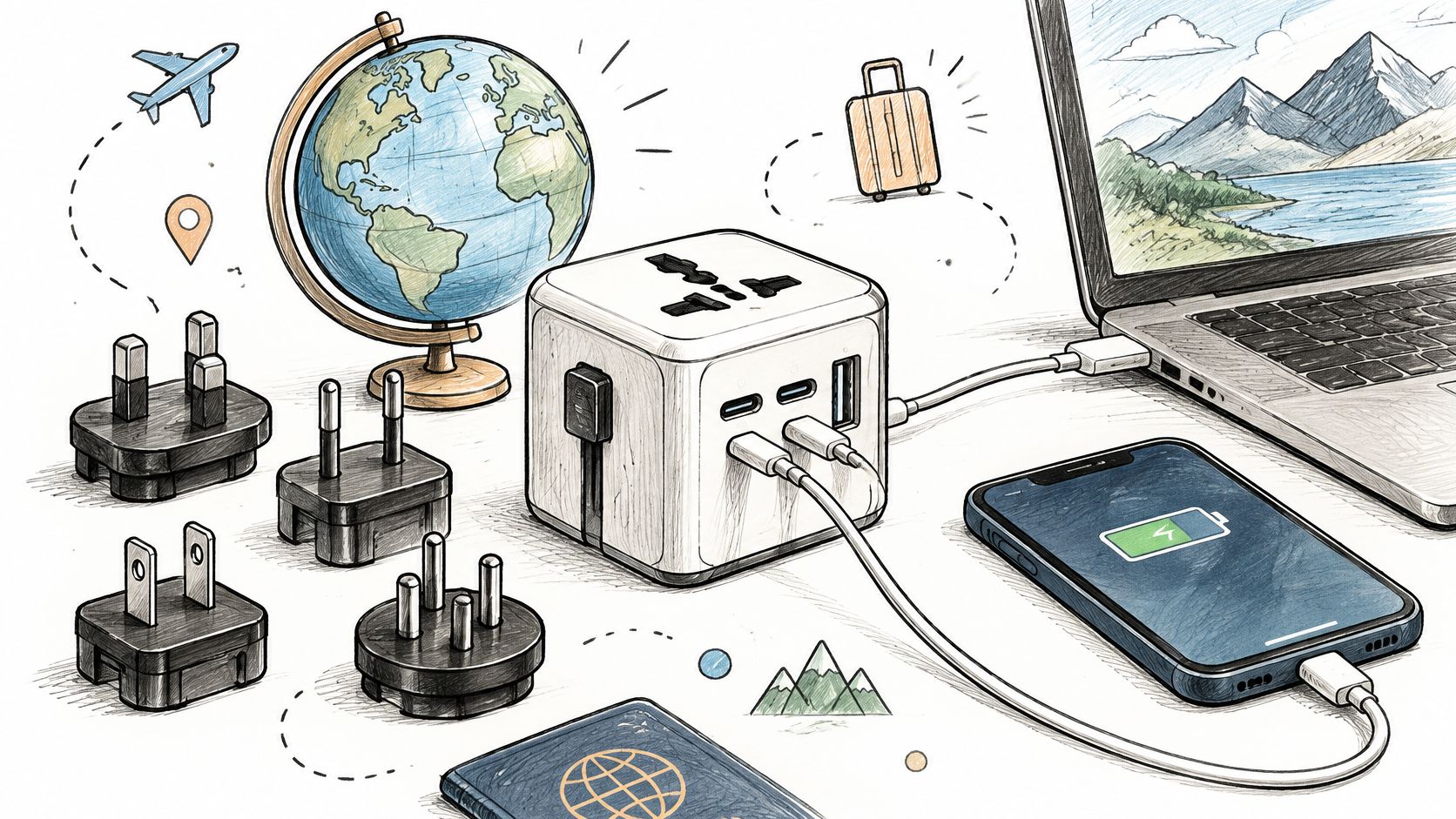
Everything else in the bag depends on power, so get this item right first. A universal adapter connects one charger to the range of wall outlets you'll meet in a year of moving between countries. The version worth carrying adds GaN charging: gallium nitride components run cooler and squeeze more ports into a smaller body, so a single brick charges a laptop, a phone, and earbuds at once instead of three separate chargers rattling around the bag.
A consultant working from a Lisbon coworking desk and then a Bali rental plugs into the same unit both times, with nothing to buy in between.
What to check before buying
Voltage range: look for 100V to 240V printed on the laptop power supply. Most current bricks handle it; older or region-locked ones don't.
Safety certification: UL, CE, or an equivalent mark. Unbranded adapters are the one place I won't trade safety for price.
Cable rating: a short USB-C cable rated for your charger's output wattage. A thin cable caps fast charging and you'll blame the brick.
Interchangeable heads over sliding pins: separate plug heads survive drops and loose sockets better than the all-in-one units whose pins loosen after a few months.
Label the adapter and each cable with a wrap of tape or a sticker. Black charging gear multiplies inside a shared hotel room, and the one you need always ends up in the other bag.
Practical rule: If the bag holds more than two chargers, one is a duplicate. Consolidate to one high-wattage brick and one small backup.
Money moves with power, and a card that adds a fee to every purchase costs more across a trip than the adapter does. Our guide to the best debit card for travelling covers which fees matter at an ATM abroad.
2. Power Bank for Airline-Compliant Travel
Security lines treat lithium differently from everything else in your bag. Power banks travel in the cabin, never in checked luggage, and screeners look for the watt-hour figure printed on the shell. Buy a unit whose markings stay legible, because a bank with a rubbed-off label is the item most likely to be pulled out of your tray and left behind.
Capacity maps to a use case. A 10,000 mAh bank covers a phone and earbuds through a long transit day. A 20,000 mAh unit, which works out to roughly 74 Wh, carries a phone and noise-cancelling headphones across a transatlantic flight and still has charge on landing. Charging a laptop needs a bank rated for the machine's input wattage, so look for a high-output USB-C port rather than the 18W port that shares space with two others.
Picking capacity you'll actually carry
Fly with the bank you'll use: a 20,000 mAh brick that stays in a drawer at home is worth nothing. Choose the weight you'll tolerate in a day bag.
Check passthrough charging: the ability to charge the bank and a phone from one outlet overnight matters in a room with two sockets.
Keep it away from heat: a bank left on a car dashboard or beside a radiator ages fast and holds less charge.
Carry the cable you need: a bank without a working cable is a paperweight, so put a short USB-C cord in the same pouch.
A freelancer on a six-hour transatlantic flight charges a phone and a pair of headphones from one 20,000 mAh bank, lands with a working phone, and never goes hunting for an outlet in the terminal.
Airline limits on lithium batteries vary by carrier, so confirm the figure your airline allows before you pack. If you want a technical comparison of port types and charging standards, this plain-English guide to travel charging is a reasonable starting point.
3. Noise-Cancelling Headphones for Focused Work
Aircraft cabin noise sits in the low frequencies, which is exactly where active noise cancelling works best. The processing uses external microphones to subtract the steady drone of engines and ventilation. Speech is harder: ANC softens a neighboring conversation, it doesn't erase it. If you need silence for a recorded call, book the room.
The true benefit is the uninterrupted block of time a flight provides. A consultant on a ten-hour flight completes a client report in one sitting, with no seat-back announcements interrupting the middle of a paragraph.
Fit, modes, and the wired backup
Test fit before the long trip: clamping pressure varies a lot between models, and a pair that feels fine for an hour can ache by hour four.
Use transparency mode at the gate: you need to hear the boarding call and the gate change, and pulling headphones off every ten minutes is worse.
Carry the audio cable and the charging cable: seat-back entertainment still wants a cord on some aircraft, and ANC drains the battery.
Update firmware at home: call quality and noise handling often improve with updates you won't install on airport Wi-Fi.
For calls, the microphone array matters more than the drivers. A remote employee joining a daily standup from a busy café gets usable audio from a set with beamforming mics and unusable audio from a set with a single microphone near the ear cup.
Buy headphones you'd wear for four hours on the ground before you trust them with nine hours in the air. Comfort problems appear in hour three.
4. Packing Cubes and Compression Organizers
Carry-on travel isn't a fringe habit among people who work on the move. A 2025 luggage-market analysis put carry-on luggage at a $9.23 billion product category, with 73% of business professionals reportedly preferring carry-on luggage, while checked-bag fees commonly average $30 to $50 per flight (DataIntelo's business luggage market report). That's the arithmetic that justifies organizing properly: two avoided bag fees pay for a good set of cubes.
Which cubes earn space
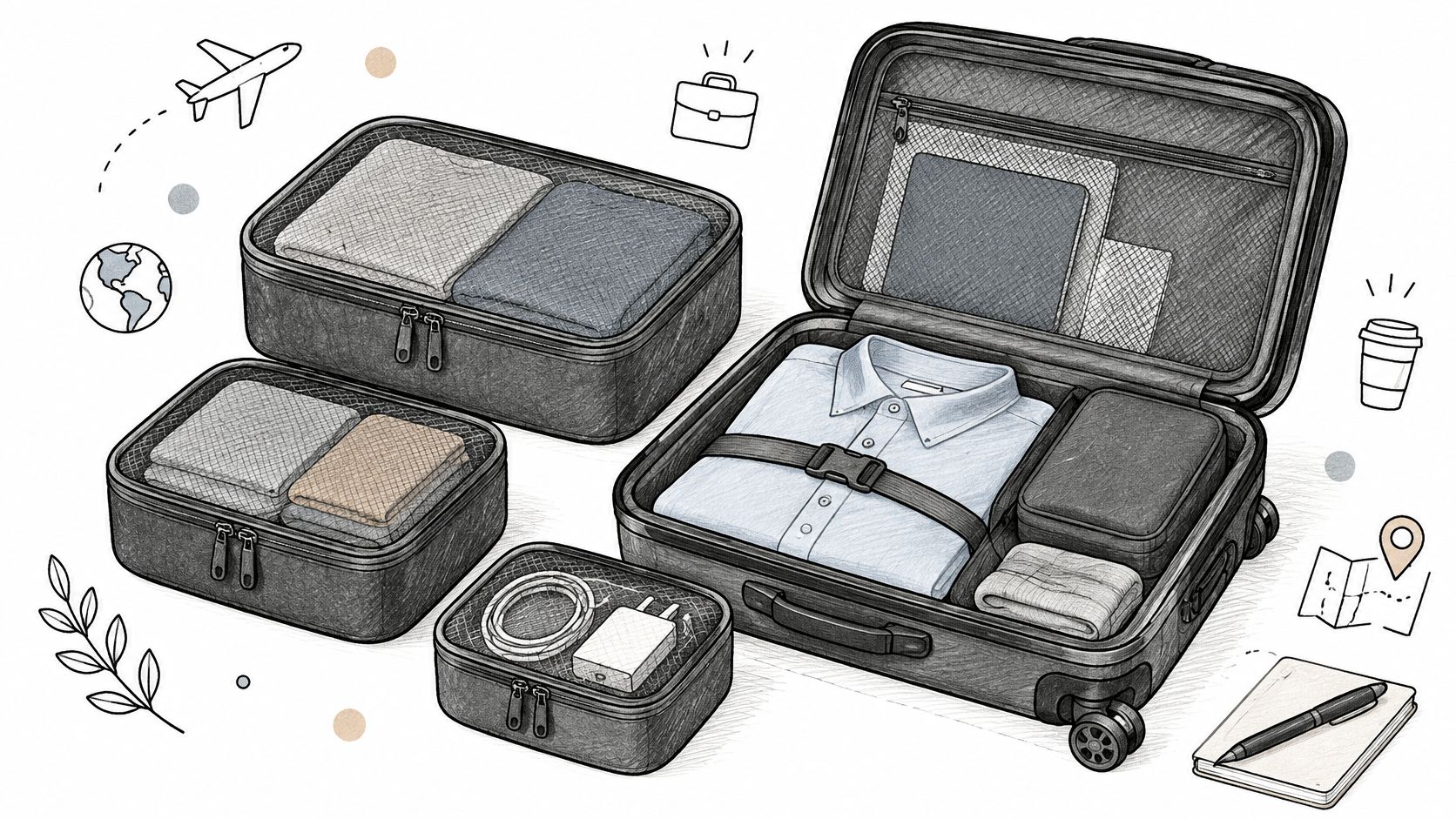
Shirt cube, firm-sided rather than compressed: dress shirts go in folded flat and come out with fewer creases than anything squeezed.
Cable cube: chargers, adapters, and cords in one place, so security screening doesn't mean unpacking the whole bag.
Toiletry pouch: separate and waterproof, because a leaked bottle ruins a shirt cube faster than a bad fold.
Laundry bag: mesh or waterproof, and it travels home full. Mixing worn clothes with clean ones undoes every gain.
Compression organizers work on soft, bulky items: fleeces, knitwear, down layers. They don't help shirts, and over-compressing creates the creases you were trying to avoid. A consultant traveling six weeks with one carry-on rotates a fixed set of cubes between cities, which turns repacking in a hotel room into a five-minute job instead of a 40-minute one.
The demonstration below shows a fold-and-roll routine that fits a week of clothing into a single cube.
For a lighter setup on short trips, these compression packing cubes for weekend travel are worth a look before you commit to a full set.
5. Carry-On Laptop Backpack with Protective Sleeve
"Carry-on compliant" isn't a product attribute. It's a route constraint. IATA identifies 56 × 45 × 25 cm, including wheels and handles, as a common reference maximum, while noting that limits vary by airline, aircraft, fare class, and operating carrier, and that some carriers begin weight restrictions at 5 kg (IATA baggage standards). A bag that clears one airline's sizer with room to spare can fail another's by two centimeters.
The practical move is to build around the tightest carrier on your itinerary, then measure the loaded bag rather than the empty shell. Handles and side pockets count. On multi-airline itineraries, check the operating carrier's rule, not the airline that sold the ticket.
The laptop compartment is a security decision
A padded sleeve protects the machine from drops, and front-access laptop storage gets you through screening without unpacking. Both are baseline.
For higher-risk trips, the calculation changes. In a 2025 global survey of 3,750 business travelers across 24 markets, 16% said they were much more concerned about data breaches during business trips than the year before, with concerns including phishing and pressure at some borders to open laptops or disclose social-media credentials, and some firms now provide temporary replacement devices for high-risk destinations (SAP Concur's global business travel report). If you're carrying client data into that situation, decide before departure whether the trip needs your normal laptop or a clean device holding only the files you'll use.
Comfort matters too: padded straps, a sternum strap, and a bag that sits at the right height for a 20-minute walk from the station. A solo founder traveling for two weeks on one backpack holds a laptop, a tablet, and meeting clothing only if the bag was built for that rather than borrowed from a daily commute.
6. Wrinkle-Resistant Business Wardrobe
Trips have changed shape. In a 2025 GBTA poll, 39% of travel buyers reported more linked, multi-meeting or multi-destination trips, and 33% reported longer trip durations (GBTA's business travel outlook). One bag now has to cover a client meeting, a coworking day, and a dinner in a different climate, often inside the same week.
Fabric does most of the work. Merino wool resists odor and recovers its shape after a night in a cube. Technical blends with a little stretch shed creases. Stretch cotton is the compromise that looks closest to a normal shirt. Build the set in neutral tones that all coordinate: navy, charcoal, white, one accent. When everything matches, three shirts and two pairs of trousers produce nine combinations.
A capsule that covers three cities
One blazer, worn on the plane rather than packed, in a dark color that hides travel grime.
Three shirts in a fabric you can sink wash and dry flat overnight.
Two pairs of trousers, one of them a technical fabric that dries in a few hours.
Two pairs of shoes maximum, one worn, one packed with socks stuffed inside to hold its shape.
Roll casual clothes and fold shirts flat into a firm cube. Hang shirts in the bathroom while you shower and the steam relaxes the fold lines. A small bottle of travel detergent plus a sink wash beats hunting for a laundry on a short trip.
The trade-offs are real. Merino costs more, wants cool washing, and pills if you treat it badly. Black hides a lot but shows lint under office lighting. A travel blazer with too much stretch can look shiny in a meeting room, so buy one you'd wear to a meeting at home.
7. Unlocked Smartphone with eSIM for Global Connectivity
Connectivity failures cost more per minute than any other packing mistake. A phone with eSIM support lets you buy a data plan digitally and have it live before you land, without hunting for a shop or swapping a plastic card at the airport.
The sequence matters more than the hardware. Install the plan at home or in the lounge while you still have working internet, label both lines clearly in settings, and leave the home number active for bank verification codes. Turning off data roaming on the primary line while keeping SMS alive is an easy detail to overlook.
The order of operations
Check compatibility first: confirm your exact model supports eSIM with your carrier, since regional variants of the same handset differ.
Store the activation QR code in a password manager, not in a screenshot on the phone you're about to switch plans on.
Set the data line explicitly for mobile data, and keep the home line for calls and texts.
Test the plan on arrival with a short call or a map load before you're standing outside a client's office.
A freelancer installs an eSIM for travel to Europe plan before a flight into Bangkok, keeps the home number live for banking alerts, then moves to a local plan when a long-stay rental in Mexico City stretches into six weeks. Comparing regional and global options before you buy is worth an hour, and this roundup of eSIM options for international travel covers the differences in coverage and top-up rules.
One trade-off to plan for: a handset with no physical SIM tray, or a carrier that locks you to its eSIM, leaves you without a fallback if a plan won't activate. Know where your tray is and whether the phone runs two eSIMs at once.
8. Secure Travel Document Organizer
A founder lands for a Tuesday client meeting and stands at baggage reclaim watching the carousel empty out. If the passport copy, visa printout, and insurance certificate were in that checked bag, the meeting is the least of the problems.
SITA reported 6.3 bags mishandled per 1,000 passengers globally in 2024, 33.4 million bags in total, with transfer mishandling behind 41% of incidents and more than 66% resolved within 48 hours (SITA's baggage report). Two days is a minor delay on a holiday. It is a cancelled trip when your documents were in the hold.
The rule: documents stay on your body. A single organizer holds passports, visas, insurance cards, boarding passes, and emergency contacts, with RFID-blocking slots for cards you don't want read at a distance. Keep it in the same pocket of the same bag every trip, because consistency is the only system that survives a tired arrival.
Build the backup before the trip
Physical copies separate from originals: a photocopy of the passport photo page in a different pocket, and one left with someone at home.
Encrypted scans: passport, visa, insurance certificate, and the front and back of two payment cards in a password manager you can reach from any device.
Calendar reminders: passport and visa expiry dates, set twelve months out and again at six.
Embassy and insurer contacts: written down, not just saved in a phone that may have no local network.
Entry rules vary enough that checking them belongs on the packing list rather than in the airport queue. We built a Travel Visa Requirements Finder for exactly that step, and it flags the visa and entry conditions for your destination before you commit to a flight. If the stay is long enough to count as a move, travel insurance for expats is a different product from a week-long holiday policy, and worth reading before you assume your existing cover follows you.
How the eight business travel packing essentials compare
Read the table by column. The spec column is what to check before buying; the risk column is what can still go wrong at the gate or the border with the right gear in hand. Four rows carry real cross-border exposure. The rest are comfort buys.
| Item | Main Benefit | Key Spec to Check | Airline or Border Risk |
|---|---|---|---|
| Universal Travel Adapter with GaN Charging | Charges several devices from one compact unit | USB-C PD wattage, plug coverage, safety certification, and device voltage range | Does not convert voltage; check device compatibility |
| Power Bank for Airline-Compliant Travel | Keeps devices charged away from outlets | Watt-hour (Wh) rating and USB-C PD output | Carry in cabin baggage only; over 100Wh may require airline approval |
| Noise-Cancelling Headphones for Focused Work | Reduces background noise for work and calls | ANC performance, battery life, and transparency mode | Low risk; keep accessible for announcements |
| Packing Cubes and Compression Organizers | Keeps luggage organized and can reduce clothing bulk | Cube sizes, material, and compression design | Low risk; compression may make carry-on exceed size limits |
| Carry-On Laptop Backpack with Protective Sleeve | Protects work gear and keeps essentials accessible | Bag dimensions, laptop size, and padding | Check airline carry-on limits; strict carriers may charge extra |
| Wrinkle-Resistant Business Wardrobe | Helps maintain a professional appearance with less ironing | Fabric, breathability, and quick-drying properties | Low risk; customs rules may apply to some treated or specialty materials |
| Unlocked Smartphone with eSIM for Global Connectivity | Provides local mobile data without swapping SIM cards | Unlocked status, eSIM compatibility, and carrier support | Check local eSIM availability and device import rules |
| Secure Travel Document Organizer | Keeps passports, visas, and travel documents together | Pocket layout, water resistance, and document fit | Keep required originals accessible; document rules vary by destination |
Turn Your Business Travel Packing List Into a Repeatable System
The list above isn't one list. It's a base that scales with trip length, and the skill worth building is knowing which version you're packing.
A three-day client visit needs one cabin bag: two shirts, one pair of trousers, the blazer worn onto the plane, a single shirt cube, the laptop and its charger, and no laundry plan at all. Anything beyond that is weight you carry for nothing. A ten-day multi-city run gets packed as five days plus one laundry session, so you add a second shirt cube, the sink-wash detergent, and a duplicate charger in the work bag. A six-week stay gets packed as one week plus local laundry and local purchases: buy toiletries at the destination rather than carrying liquids, and keep the cubes identical so repacking becomes muscle memory.
The luggage decision underneath all three is personal, and the survey data reflects that. In a 2024 Japanese survey of 500 adults published by AT Press, 44% said carry-on only was their ideal luggage amount, while 53% preferred one checked bag plus carry-on (AT Press survey coverage). Neither answer is wrong, but the answer should be deliberate rather than a reaction to the fee counter.
Those fees are not small. U.S. airlines collected $7.27 billion in checked-baggage fees in 2024, according to federal figures reported by the BBC (BBC on airline baggage fees). If you check a bag on every trip, that's a standing line item in your business costs, and it belongs in the same budget as your software subscriptions.
Then run the ten-minute review after every trip, before the bag goes back in the closet. Three questions: what did you buy on the road, what never left the bag, and what broke. Anything you bought twice becomes permanent. Anything untouched on two consecutive trips comes out. Anything that failed gets replaced before the next departure, not during it.
Photograph the bag once it's packed well. The photo becomes the packing reference for the next trip, and it settles arguments with yourself at 11 p.m. about whether the adapter made it in.
Mazurly is built for people who run a business from wherever they land, and the travel side of that work deserves the same systems treatment as invoicing or client onboarding. Our travel coverage walks through digital nomad visas, banking across borders, and international health insurance, and our free tools include the Travel Visa Requirements Finder, the Free Invoice Generator, the Free Time Converter, and Free Bulk Email Blocking. Visit Mazurly before your next departure, and turn the night-before scramble into a checklist you run once and reuse for years.