Best Debit Card for Travelling: Fees, Limits and Backups
Table of contents
- Which Debit Card Fits Your Travel Pattern
- Why acceptance comes before rewards
- What Card Payments and ATM Withdrawals Really Cost
- The cost stack line by line
- Dynamic currency conversion is the charge you choose by accident
- The arithmetic for one realistic month
- Score Your Card and Run Issuer Checks Before You Fly
- The scoring procedure
- A worked example you can copy
- Issuer checks to confirm in writing
- Acceptance, Wallets and a Backup Payment Stack
- What the shifting mix tells you
- Build four layers
- Fraud Protection and Keeping Travel Money Isolated
- Why security outranks price for many travellers
- The cash-flow difference from credit
- Controls to check before you travel
- Long Stays, Remote Income and Multi-Currency Balances
- Withdrawal fees across three months
- The double conversion on remote income
- Choose Your Card and Confirm the Setup Before You Fly
- Verdicts by situation
In a 2024 survey of 2,000 UK holidaymakers commissioned by Post Office Travel, 45% had incurred charges for using a bank card outside the UK during the previous 12 months, with an average annual cost of £21.79. That figure reframes the search for the best debit card for travelling. The problem isn't usually one dramatic fee. It's a stack of small charges, limits, and failure points that you only notice after the trip, unless you price the whole setup before you leave.
Which Debit Card Fits Your Travel Pattern
No card wins every trip, so the best debit card is the one with the lowest total cost that also passes acceptance and fraud checks. Start with your travel pattern, not a ranking. The right priority changes with how you spend.
| Travel pattern | Main spend | Cost to minimise first | Must-have feature |
|---|---|---|---|
| Short holiday in one country | Hotels, meals, transit | Foreign transaction fee | Zero foreign fee, chip-and-PIN, contactless |
| Multi-country trip under four weeks | Mixed card spend and cash | ATM fixed fee plus FX markup | Wide ATM access, high daily withdrawal limit |
| Long stay of three months or more | Rent, bills, regular ATM cash | Cumulative ATM and conversion costs | Low-cost withdrawals, multi-currency balance, instant freeze |
| Remote worker paid in foreign currency | Client receipts, online purchases | Conversion on income and spend | Transparent exchange rate, multi-currency account |
| Business traveller paying trip expenses | Flights, accommodation, client meals | Dispute and fraud exposure | Separate account, virtual card, fast dispute process |
Why acceptance comes before rewards
Debit choice is first a reliability decision because you use the card for transit, coffee, groceries, and small merchants where a decline stops the day. The U.S. Federal Reserve Diary of Consumer Payment Choice reported that consumers made an average of 46 payments per month in 2023, with debit cards representing 30% of all monthly payments and credit cards 32%. The same research found cash and debit cards were used equally for purchases below $25, the first time cash wasn't the leading instrument for smaller-value purchases in that diary's history.
That pattern matters abroad. If your card handles a flight booking but fails on contactless transit, chip-and-PIN fuel pumps, or online top-ups, you've bought the wrong kind of cheap. Check network reach, contactless capability, fraud controls, and international transaction handling before you compare cashback or secondary perks.
Find the row that matches your trip and note the one column you can't compromise on. A short holiday punishes a percentage fee. A multi-country trip punishes fixed ATM fees and low limits. A long stay or remote-work base punishes anything that repeats weekly, because small costs compound across months.
What Card Payments and ATM Withdrawals Really Cost
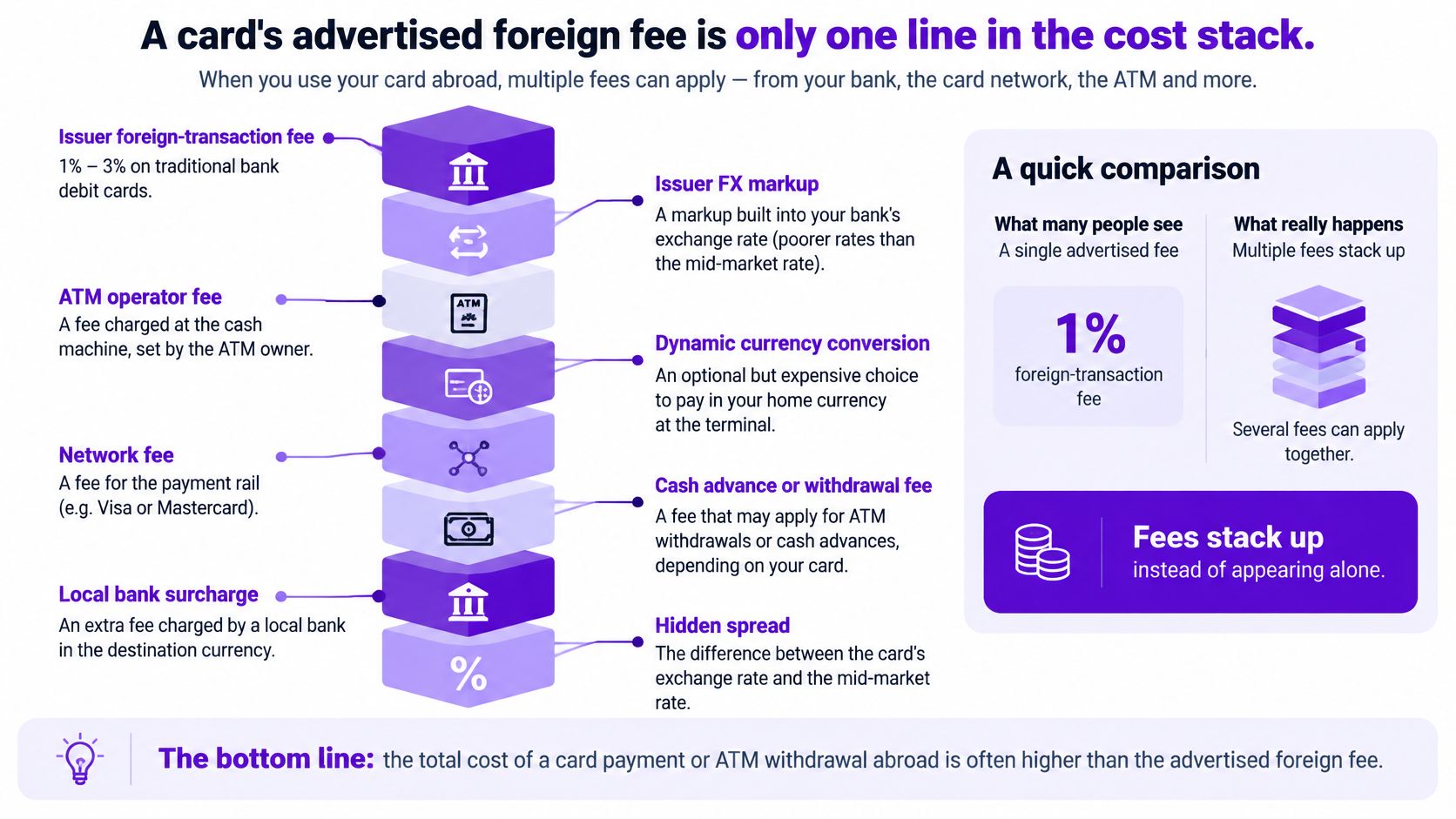
A card's advertised foreign fee is only one line in the cost stack. Issuers market the line they control. You pay every line that applies.
The visual below separates the charges so you can price them individually rather than trusting a headline claim.
The cost stack line by line
Traditional U.S. bank debit cards commonly add a 1% to 3% foreign-transaction fee, while international ATM withdrawals may add a fixed US$2 to US$5 issuer fee plus the foreign ATM operator's charge, according to Yahoo Finance guidance on foreign transaction fees. On US$1,000 equivalent monthly travel spend, a 3% issuer fee alone costs US$30. Four cash withdrawals could add another US$8 to US$20 before local ATM charges.
Network charges sit underneath the issuer's pricing. U.S. government guidance cited there reports Visa applies a 1.0% International Service Assessment when foreign-currency conversion is required, while Mastercard applies a 1.0% currency-conversion fee. Mastercard can also apply a 0.8% cross-border fee when a foreign transaction is processed in the card's home currency. Whether your issuer absorbs a network charge or passes it through determines whether "no foreign fee" means what you think it means.
| Cost component | Typical range | Applies when | What to check |
|---|---|---|---|
| Issuer foreign-transaction fee | 1% to 3% on traditional bank debit cards | Every card payment abroad | Written fee in the card's pricing schedule |
| Issuer ATM fixed fee | US$2 to US$5 per withdrawal | Each cash withdrawal abroad | Fee per withdrawal and any monthly allowance |
| Visa International Service Assessment | 1.0% | When foreign-currency conversion is required | Whether the issuer passes it through |
| Mastercard currency-conversion fee | 1.0% | When foreign-currency conversion is required | Whether the issuer passes it through |
| Mastercard cross-border fee | 0.8% | Foreign transaction processed in the home currency | Whether the issuer adds its own charge |
| Dynamic currency conversion markup | Markup set by merchant or ATM at the terminal | Terminal or ATM offers a home-currency charge | Decline it and pay in the local currency |
Dynamic currency conversion is the charge you choose by accident
When a terminal offers to charge you in your home currency, the merchant or ATM controls the conversion. Visa consumer travel guidance recommends declining that conversion and choosing local currency instead, allowing the card network or issuer to perform the exchange. Visa also warns an international ATM withdrawal can involve both an ATM operator fee and a foreign-exchange charge from the issuer, and notes ATMs at more than 2 million locations worldwide.
Coverage, then, isn't usually the constraint. Cost per withdrawal and the daily limit are. A card that caps cash too low forces extra withdrawals, and each extra withdrawal can trigger another fixed fee and another operator fee. That's why a low percentage fee can still lose to a card with a higher limit and fewer, larger withdrawals.
The video below walks through how these foreign transaction charges appear in practice, which helps when you're comparing issuer pricing schedules side by side.
The arithmetic for one realistic month
Say you spend US$1,000 equivalent on card payments in a month and withdraw cash four times. At a 3% issuer fee, card spend costs US$30. The four withdrawals add US$8 to US$20 in issuer fixed fees alone, before any foreign operator charge. Your visible issuer total is already US$38 to US$50 for the month, and that's before any conversion charge your issuer passes through or any dynamic currency conversion you accept at a terminal.
Push cash use higher and the fixed fee takes over. Eight withdrawals cost US$16 to US$40 in issuer fees at US$2 to US$5 each. If you're comparing two cards, one with zero foreign fee but a US$5 ATM charge and one with a small conversion cost but cheap withdrawals, the winner depends entirely on your cash frequency.
Practical rule: Price card spend and cash withdrawals as two separate products. A card can be excellent for one and poor for the other.
Treat the card as an access and risk-control system too. FDIC travel guidance confirms most cards used domestically can generally access foreign ATMs, but recommends verifying destination-specific ATM and foreign-transaction fees with the issuing bank before departure. That check should cover the daily ceiling, geographic restrictions, and whether the bank charges a foreign fee merely because an overseas merchant processes a transaction in your home currency.
Before you shortlist any card, read our guide on how to avoid foreign transaction fees and apply the same test here. Expected spend, withdrawal count and size, and pass-through policy give you a total. A headline gives you marketing.
Score Your Card and Run Issuer Checks Before You Fly
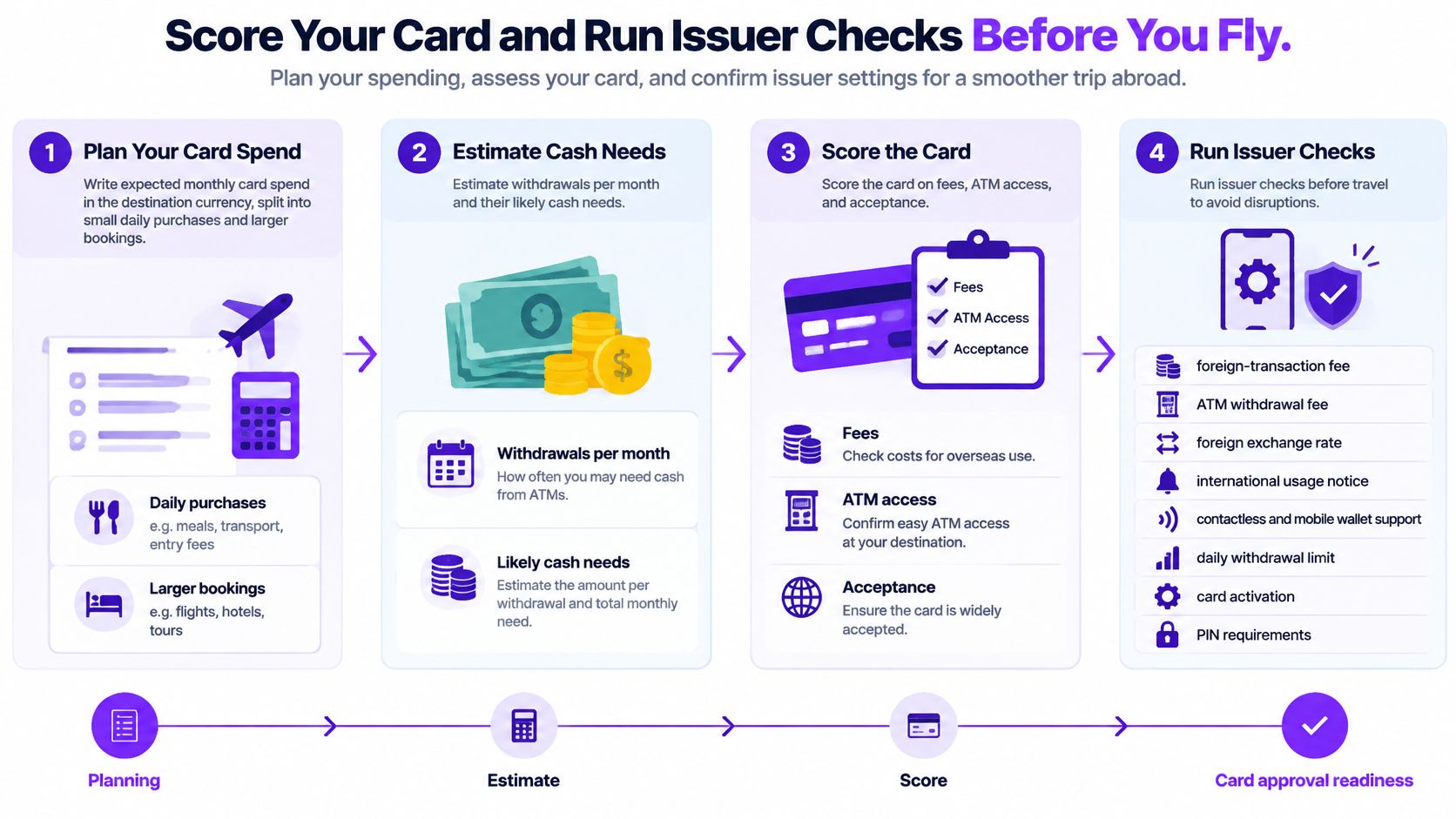
Score first, apply second. You'll need your expected spend, your cash pattern, and each card's written pricing schedule.
The flow below turns those inputs into a comparable monthly and annual total.
The scoring procedure
Write expected monthly card spend: Split it into small daily purchases and larger bookings, because limits and holds affect them differently.
Estimate withdrawals per month: Note the average size and the largest single cash need, such as a deposit or rural transport.
Apply the foreign-transaction rate: Multiply the rate by card spend. Then add the issuer ATM fixed fee multiplied by your withdrawal count.
Add pass-through conversion charges: Include any network conversion fee the issuer passes on. Assume you'll decline dynamic currency conversion and choose local currency.
Test the daily withdrawal limit: Confirm it covers your largest cash need without forcing repeated trips and repeated fixed fees.
Score acceptance: Check your main destinations, chip-and-PIN behaviour, contactless support, and whether your wallet option works if a terminal is offline.
Score fraud exposure: Rate freeze speed, alert reliability, virtual card availability, and dispute support.
Compare annual totals: The lowest total wins only when acceptance and fraud scores are acceptable. A cheap card you can't use or can't freeze isn't cheap.
Use the withdrawal table to do the fixed-fee multiplication quickly. The foreign operator fee is extra on every row.
| Trip pattern | Withdrawals | Total issuer fixed fee |
|---|---|---|
| Week-long trip with two withdrawals | 2 | US$4 to US$10 |
| Month abroad with four withdrawals | 4 | US$8 to US$20 |
| Long stay with eight withdrawals | 8 | US$16 to US$40 |
| Cash-reliant trip with 30 withdrawals | 30 | US$60 to US$150 |
A worked example you can copy
Take US$1,000 monthly spend abroad, a 3% issuer fee, and four withdrawals. Card spend costs US$30. Withdrawals add US$8 to US$20. Your starting total is US$38 to US$50 per month, or roughly three times that across a three-month stay if the pattern holds.
Now change only the ATM fee to zero and the total falls by US$8 to US$20 a month. Change only the foreign fee to zero and it falls by US$30. That tells you which feature to hunt for first. Card-heavy travellers should chase the percentage. Cash-heavy travellers should chase the fixed fee and the daily limit.
Don't average your trip into a fictional normal month if your first week includes deposits, intercity transport, and cash-only landlords. Score the expensive week separately.
Issuer checks to confirm in writing
Each check below prevents one specific failure. If an issuer can't answer clearly, switch before departure rather than testing it at an airport ATM.
Foreign and ATM fees for your destination: Prevents discovering a destination surcharge after landing.
Daily ceiling and geographic restrictions: Prevents a declined withdrawal when you need rent, a deposit, or onward transport.
Default blocking of unfamiliar countries: Prevents your first genuine purchase abroad from triggering a freeze you can't lift quickly.
International support number and emergency replacement steps: Prevents a lost card from becoming a lost week. Test the channel before you fly.
Chip-and-PIN capability: Prevents failure at unattended terminals, tolls, and transit gates that don't accept signature or swipe.
Home-currency processing charges: Prevents paying a foreign fee on a transaction an overseas merchant runs in your home currency.
Real-time alerts and in-app freeze: Prevents a compromised card from draining funds while you sleep across time zones.
Backup on a different network: Prevents a single network or institution outage from removing all card access.
Keep the role of the debit card narrow. It suits ATM access and controlled daily spending. It doesn't suit large deposits or prepaid hotel and car-rental holds as well, because holds tie up your own cash and debit disputes don't restore your balance while you wait. Use another payment method for those holds where you can, and keep the debit card for money you intend to spend.
Acceptance, Wallets and a Backup Payment Stack
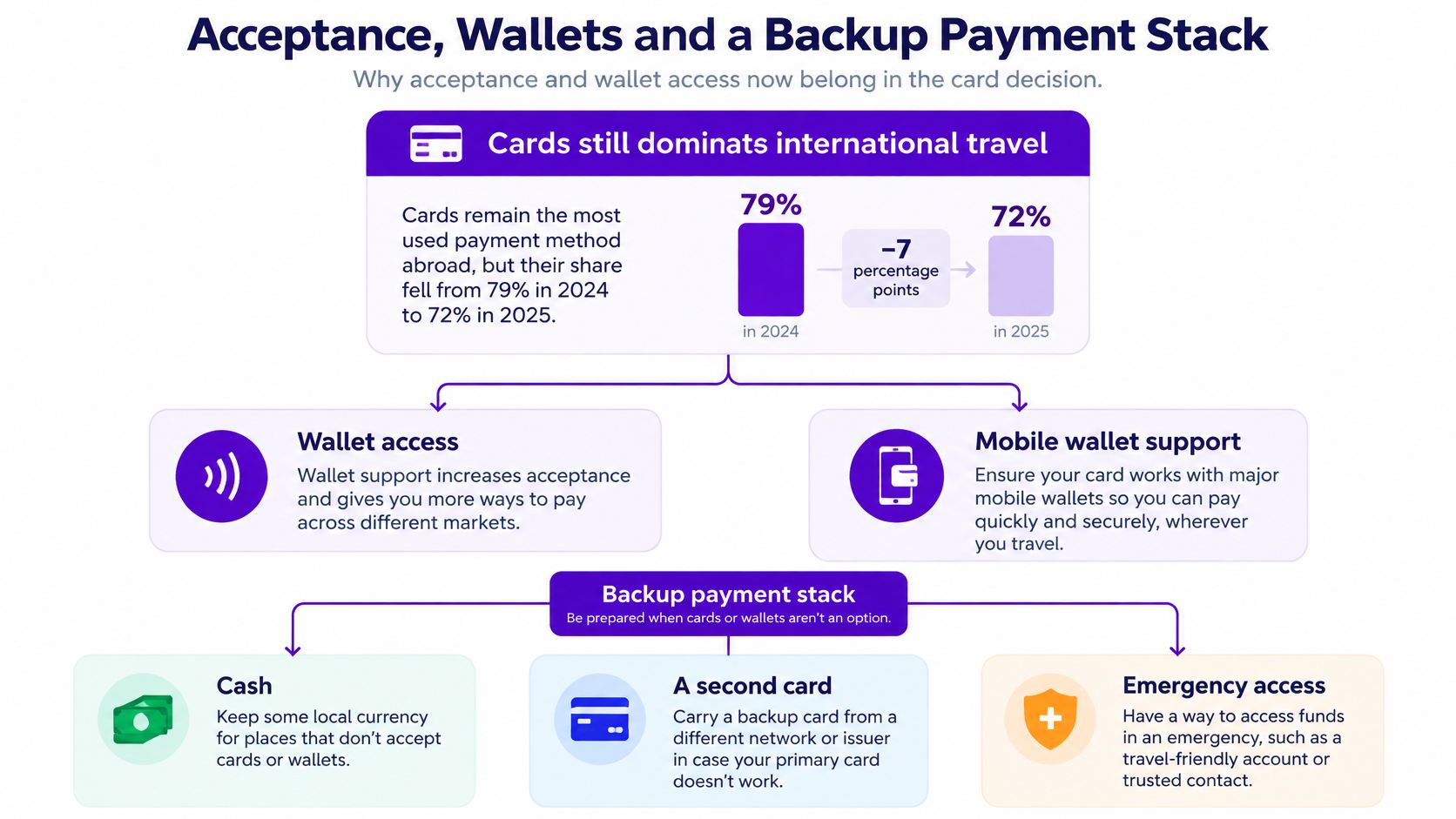
A single card is a single point of failure. Acceptance and wallet access now belong in the card decision because the payment mix itself is shifting.
The hierarchy below shows why a layered stack beats a card-only plan.
What the shifting mix tells you
Cards still dominate international travel, but their share fell from 79% in 2024 to 72% in 2025, while digital-wallet use rose from 20% to 28%, according to an IATA press release on passenger payment trends. Independent survey data cited there shows debit cards and credit cards each accounted for 42% of reported payment use abroad, while cash remained close behind at 40%.
Read those numbers as a design brief. Cards lead, wallets are growing, and cash hasn't disappeared. A setup built on only one of the three ignores how people pay.
Build four layers
Primary debit card: Your lowest-total-cost card for daily spend and ATMs, carried in your everyday wallet.
Backup card: A different payment network or a different institution, stored separately so one theft, freeze, or outage doesn't remove all access. If you separate cards across bags, trackable options such as CITYSHEEP wallets with AirTag slots can help you keep tabs on where each card physically is.
Cash reserve: Enough local currency for merchants that refuse cards, small transport, and the gap while a replacement card is arranged.
Phone wallet: A secondary option for contactless terminals, not your only plan. It fails when the phone is lost, the battery dies, or a terminal is offline.
Store the primary and backup cards in separate bags. Keep the emergency cash apart from both. If everything sits in one wallet, you don't have redundancy, you have a bundle.
Some merchants also prefer local instant-payment systems that a foreign travel card can't always replace. That's another reason cash stays in the stack. For larger bookings where rewards or stronger dispute handling matter more than cash access, our guide on how to use credit card points covers when a credit card earns its place alongside your debit setup.
Fraud Protection and Keeping Travel Money Isolated
A debit card's lowest fee can be a poor trade if a fraud alert or dispute leaves your travel money inaccessible. Because the funds come directly from your available balance, an unauthorised transaction can disrupt payments while the issuer investigates.
Why security outranks price for many travellers
Transaction security was the leading payment-method concern in a 2025 consumer survey, cited by 51% of respondents, ahead of convenience at 45% and transaction fees at 37%, according to a Paysafe Inside the Wallet report. The report also cites a global study in which 48% of financial-industry respondents identified card testing as an encountered attack vector. Criminals use small authorisations to check whether stolen card details work, then may attempt larger charges.
For prepaid travel products, check how reliably you can access the account and how the provider handles complaints. These points matter alongside the exchange rate.
The cash-flow difference from credit
With credit, a disputed charge affects the issuer's funds while it is investigated. With debit, the money has already left your account. For a freelancer or founder, that can leave less available for payroll, software, or tax while the dispute is unresolved.
Keep only an amount on the travel card that you could manage without while a dispute is investigated.
Controls to check before you travel
Real-time alerts: Check that transactions trigger immediate notifications, including small test charges.
Instant freeze and unfreeze: Confirm you can lock the card in the app without calling the issuer across time zones.
Virtual cards: Use separate numbers for online bookings where available, so a compromised merchant does not expose your physical card details.
Spending limits: Set a daily limit below your account balance to restrict what can be spent in a single day.
Notification reliability: Test alerts on roaming data and hotel WiFi. Delayed notifications can delay your response.
Separate accounts: Keep personal, business, and travel funds apart so a card issue does not affect every balance.
A low-balance travel account limits the amount exposed if the card is compromised or frozen. Top it up as needed. A card with higher fees may still cost less overall if its freeze controls and dispute handling help limit the financial disruption of an incident.
Long Stays, Remote Income and Multi-Currency Balances
Long stays change the maths because repetition replaces the headline fee as the main cost driver. What costs a few dollars on a holiday can cost hundreds across a season.
Withdrawal fees across three months
A three-month stay with eight withdrawals costs US$16 to US$40 in issuer ATM fees at US$2 to US$5 each, before any operator charge, using the fee range in the cost stack above. Increase withdrawal frequency and that fixed fee becomes the lever to test first. A card with low-cost withdrawals, a multi-currency balance, and instant freeze usually beats a card that only advertises a low foreign-transaction percentage.
Size your cash reserve to the daily withdrawal ceiling. If the ceiling won't cover a month's rent deposit in one or two withdrawals, you'll pay more fees and make more trips. Confirm account limits for larger payments such as rent before you commit, since a debit card can decline amounts your home bank would process without comment. If you're planning a base abroad rather than a trip, relocation advice for new expats helps you sequence the non-banking decisions that sit around the move.
The double conversion on remote income
Remote workers paid in foreign currency face a second cost. Your income may be converted when it arrives, then converted again when you spend it. Compare the rate on income conversion with the rate on card spend, and check whether a multi-currency account can hold income in its original currency until you need it.
Test the conversion on income first if most of your money arrives in a currency you don't spend. Test withdrawal fees first if most spending is local cash. Our guide to the best international banking options covers account structures for holding balances across currencies. If income lands in the same account your travel card draws on, move card spend to a low-balance account so a compromised card can't reach a full month's earnings.
Choose Your Card and Confirm the Setup Before You Fly
There's no single best debit card for travelling. There's the card whose total cost and failure protection fit your trip.
The path is short. Find your row in the quick-pick table, run the scoring steps with your real spend and withdrawal count, complete the issuer checks in writing, then carry a primary card and a backup on a different network.
Verdicts by situation
Short holiday: A zero-foreign-fee card with chip-and-PIN, contactless, and a backup card stored separately.
Long stay: A low-cost ATM card with multi-currency balances and instant freeze, scored on cumulative withdrawal cost.
Business travel: A separate account with virtual cards and fast dispute handling, isolated from operating funds.
Remote worker paid in foreign currency: A transparent exchange rate on both income conversion and spend, with balances held in the currency you receive.
The cheapest card can be the worst choice if losing it removes access to your operating funds.
Once the card is chosen, complete the wider travel setup. Mazurly's Travel section covers smart visas, eSIMs, and cost of living, which sit alongside banking in any long-stay plan.
Choose the card this week, run the issuer checks before you book anything non-refundable, and save the issuer's emergency phone number in two places that don't depend on the same phone. Then test the card with one small foreign-currency purchase or ATM withdrawal early in the trip, while fixing a problem is still cheap.
Build your travel money setup alongside the rest of your location-independent systems at Mazurly, where we publish practical guides and tools on banking, payments, visas, eSIMs, and cost-of-living decisions for founders, freelancers, and remote workers. Pick your card using the scoring steps above, then use our destination and mobility resources to plan where that card needs to work next.