
Startup Costs for Online Business Models in 2026
Table of contents
- Why the Headline Number for Online Business Costs Is Misleading
- Launch Cost Is Not Survival Cost
- The Core Cost Categories Every Online Business Shares
- Fixed, Variable, and Personal Costs
- Comparing Four Online Business Models Side by Side
- The Hidden Trade-Off
- Line-Item Budgets for E-Commerce, SaaS, Freelance, and Content
- E-Commerce
- SaaS
- Freelance Services
- Content
- How Location and Cost of Living Change the Real Budget
- Personal Burn Is a Business Variable
- Building a Budget Template That Includes Runway
- Columns Your Template Needs
- Cost-Saving Strategies That Actually Work
- Spend in Stages
- Your First 30, 60, and 90 Days With a Tight Budget
- Days 1 to 30 Validate
- Days 31 to 60 Launch the Minimum Version
- Days 61 to 90 Keep, Cut, or Pivot
Start an online business for almost nothing. You've heard that pitch, probably from someone selling a course. It's bad advice, and it gets founders killed financially.
A website isn't a business. A domain, a theme, and a payment account don't pay for customer acquisition, taxes, refunds, or the months you'll spend earning less than you expected. Startup costs for online business success aren't defined by what you buy on day one. They're defined by how long you can keep operating while you learn what customers want.
Budget for survival first. Build second.
Why the Headline Number for Online Business Costs Is Misleading
Most guides compress every model into one broad range, roughly $50 to $10,000+, or a wider $1,000 to more than $60,000, without separating freelancing, digital products, SaaS, affiliate publishing, and inventory based e-commerce, as shown in BestMoney's summary of small business startup cost ranges. That range tells you nothing useful. It doesn't tell you your monthly burn, your break-even point, or how long your cash lasts if sales arrive slowly.
That same analysis notes working capital can represent 40–60% of first-year expenses and may require 6–18 months of operating runway, while customer acquisition can cost approximately $45–$200 per customer depending on the industry. Read that carefully. The launch purchase is often the smaller problem. Surviving to repeatable revenue is the expensive part.
Launch Cost Is Not Survival Cost
A cheap launch fails when the founder has no reserve for testing. A more expensive launch can be safer if part of that budget is untouched runway, staged marketing tests, and money for revisions. Your sales cycle matters. A freelancer who closes a client in two weeks faces a different cash problem than a SaaS founder waiting through trials, onboarding, and monthly billing.
If you're pricing the website itself, UK small business website costs explained is a useful starting point for that one line item. Don't mistake it for the full budget. The website is infrastructure, not demand, compliance, or income replacement.
Practical rule: If your budget ends at launch day, you don't have a startup budget. You have a shopping list.
Ask three questions instead. What's my one-time setup cost, what's my monthly operating burn, and how many months can I sustain both business and personal expenses before revenue must arrive? The third answer determines whether your plan is credible.
The Core Cost Categories Every Online Business Shares
Every online model draws from the same buckets. The model you choose decides which bucket empties your account first.
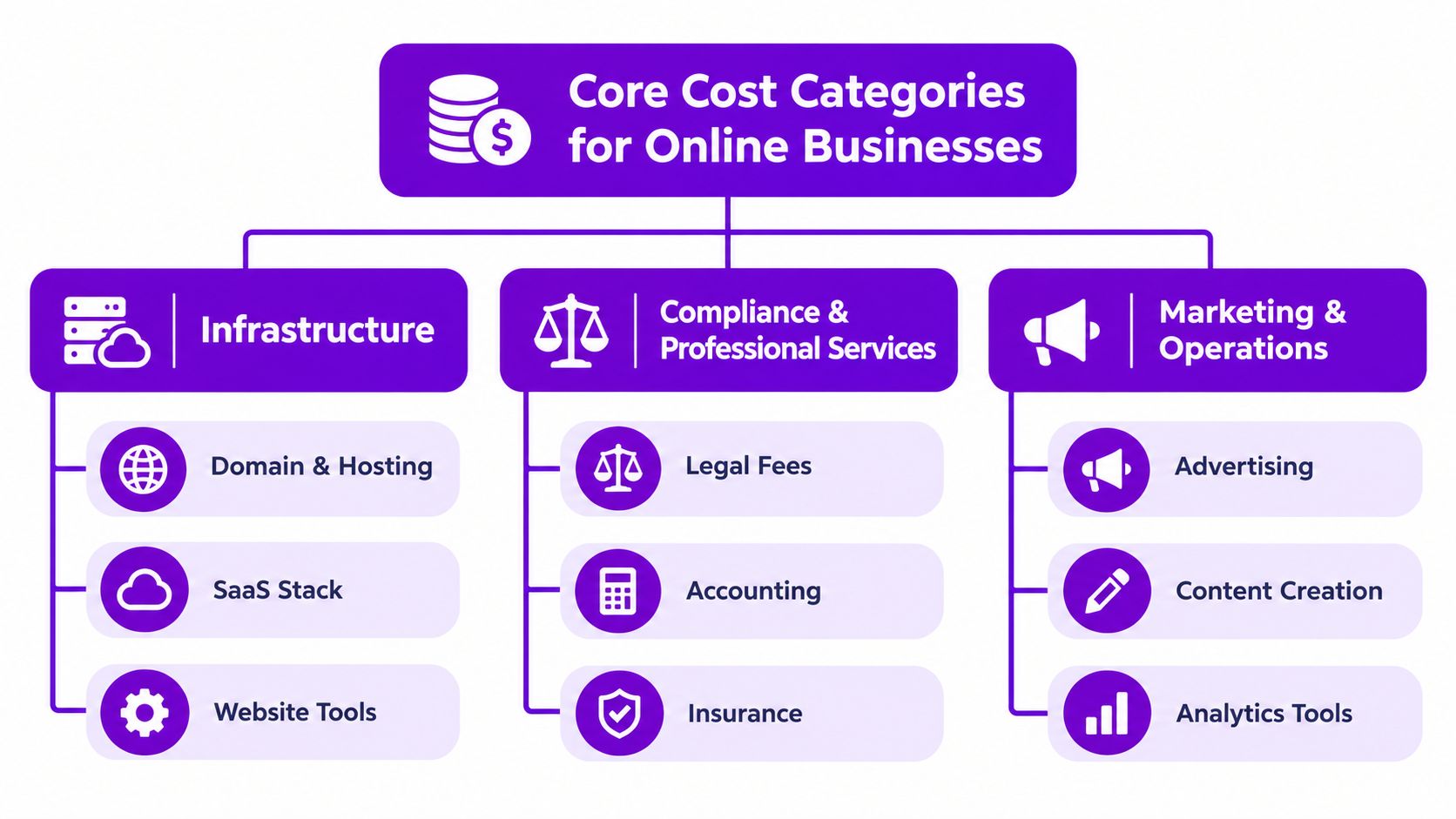
The U.S. Small Business Administration's business planning guidance identifies recurring startup categories including communications, licenses and permits, insurance, legal and accounting services, advertising and marketing, market research, and website development. For an online venture, translate those into domain and hosting infrastructure, software subscriptions, payment processing, cybersecurity, localization, professional advice, content production, and customer acquisition.
The diagram below groups those shared costs into three practical buckets.
Fixed, Variable, and Personal Costs
- Infrastructure: Domain, hosting, email, website tools, and your core SaaS stack. These are usually predictable and monthly, which makes them easy to budget and easy to overbuy.
- Compliance and professional services: Business registration, contracts, accounting, tax advice, privacy documents, and insurance where relevant. Founders cut this first and regret it later.
- Marketing and operations: Advertising, content production, freelancers, analytics, customer support tools, and market research. Uncertainty lives here because spend does not guarantee revenue.
- Variable per-sale costs: Payment fees, marketplace commissions, shipping, refunds, and currency conversion. These rise with sales, but they also reduce what each sale is worth.
- Personal runway: Rent, food, healthcare, tax reserves, and debt payments. If the business must support you, your living costs are part of the funding requirement.
Solo founders often think they've eliminated payroll. They haven't. They've replaced it with their own unpaid time, outsourced help, and personal burn. That's still a cost, even when no salary leaves the business account.
Separate one-time launch expenses from monthly operating costs in your spreadsheet. Mixing them hides the date your cash runs out.
Comparing Four Online Business Models Side by Side
Don't ask which model is cheapest. Ask which model's cost structure matches your skills, cash, and patience.
A freelancer can start selling expertise with minimal inventory, but revenue stops when prospecting stops. A content business avoids client delivery, but it may require months of production before traffic compounds. E-commerce can validate demand through direct sales, yet inventory, shipping, returns, and advertising consume cash before profit is clear. SaaS offers recurring revenue potential, but product development, support, and longer evaluation cycles delay payback.
| Model | Typical Launch Cost | Main Ongoing Cost | Break-Even Range |
|---|---|---|---|
| E-commerce | Moderate to high, driven by inventory and store setup | Advertising, inventory replenishment, shipping, payment fees | Depends heavily on margin and repeat purchases |
| SaaS | Moderate to high, driven by product development | Hosting, development, support, customer acquisition | Usually slower because trials and onboarding delay revenue |
| Freelance services | Low cash cost, high owner time cost | Prospecting, software, accounting, professional insurance | Potentially fastest if you already have demand and referrals |
| Content | Low to moderate, driven by production time | Content creation, SEO tools, email software, promotion | Usually gradual because audience growth takes time |
The Hidden Trade-Off
Low launch cost often means high time cost. High launch cost often means you're buying speed, inventory, or product capability before proof exists. Neither is automatically smarter.
Operations software follows the same logic. A growing e-commerce or SaaS business eventually needs systems for orders, finance, and customer data, and this practical ERP buying guide helps you think through that infrastructure decision before it becomes urgent. Don't buy enterprise complexity at the validation stage. Buy the simplest stack that records money accurately and lets customers pay without friction.
Choose the model where you can survive the slow period, not the one with the prettiest launch screenshot.
Line-Item Budgets for E-Commerce, SaaS, Freelance, and Content
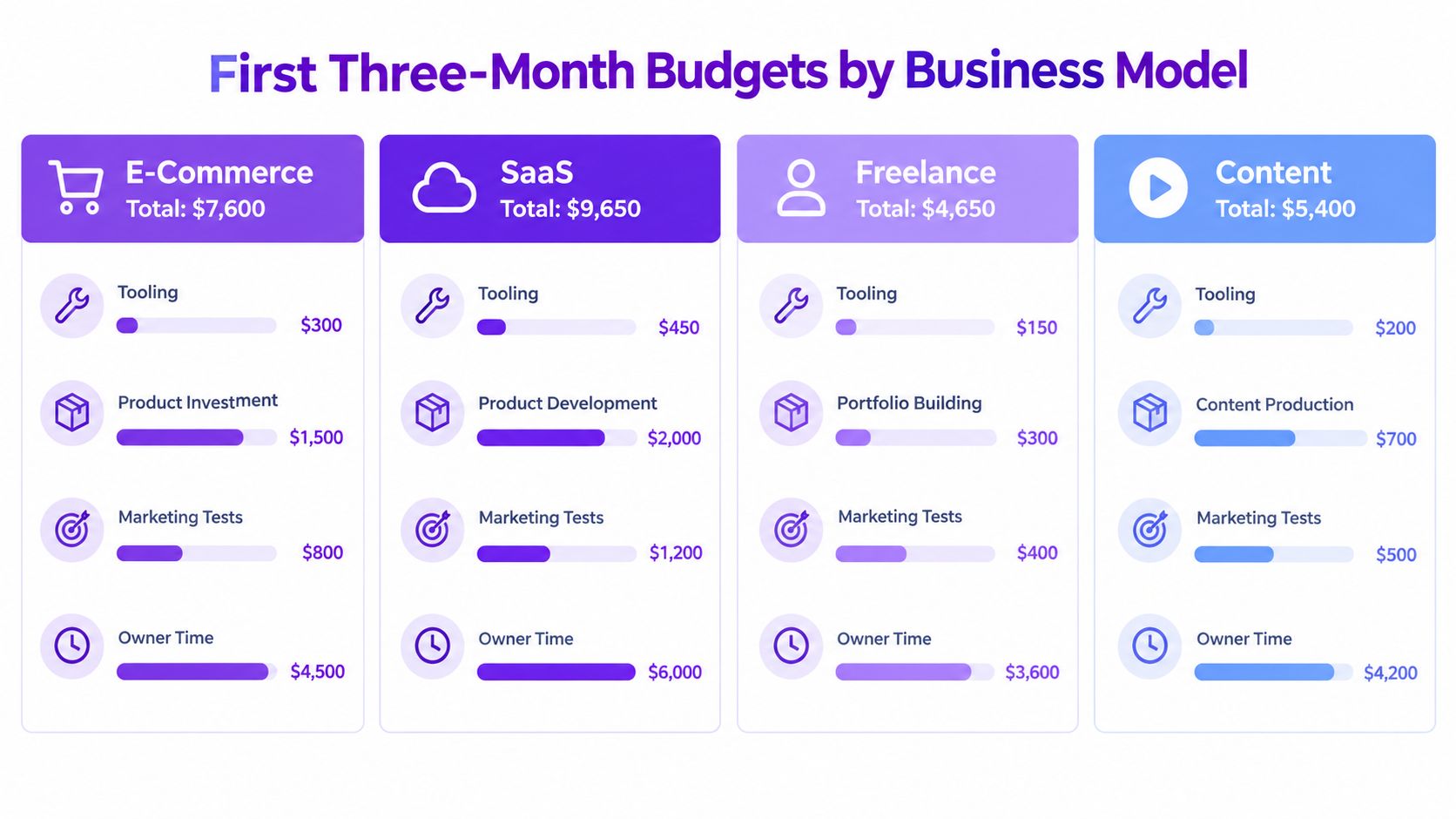
Build your first budget around three months of evidence, not twelve months of optimism. You need tooling, product or content investment, marketing tests, and owner time recorded as a real economic cost.
The chart below compares how those categories differ across the four models.
E-Commerce
Budget for your store platform, domain, product photography, initial inventory or samples, packaging, shipping setup, returns handling, analytics, and paid traffic tests. Payment processing belongs in the unit economics, not buried as a generic software expense. Stripe's standard U.S. online card pricing is 2.9% plus $0.30 per successful domestic-card transaction, with an additional 1.5% for international cards and 1% when currency conversion is required.
That fixed fee punishes low priced products. On a low ticket order, processing can consume a painful share of margin before advertising and shipping. Bundles, minimum order thresholds, and higher value offers reduce that pressure. Where founders overspend: buying deep inventory before proving which variant, size, or message sells.
SaaS
Your early lines include hosting, databases, authentication, email delivery, analytics, error monitoring, design tools, and payment infrastructure. If you can't code, development help becomes the dominant cost. If you can code, your time becomes the dominant cost, even when your cash spend looks low.
Keep the first version narrow. One workflow, one user type, one paid outcome. Where founders overspend: building integrations, dashboards, and admin features before a customer has paid for the core result.
Freelance Services
Freelancing needs a portfolio site, proposal and contract tools, invoicing, accounting, a reliable laptop, and time for outreach. Software is rarely the constraint. Unpaid discovery calls, proposals, revisions, and late payments are the constraint. Use this guide on pricing your freelance services to protect your margin before you copy hourly rates from competitors who may have lower living costs or a full client pipeline.
Where founders overspend: buying lead databases and branding packages before they've had enough direct conversations to know which offer buyers understand.
Content
A content business spends on hosting, design, keyword and analytics tools, email software, editing, graphics, video equipment if needed, and promotion. Production time is your inventory. Every article, video, or newsletter issue is an asset you're funding before sponsorships, affiliates, or product sales repay it.
Track cost per publishable piece, not just monthly subscriptions. Where founders overspend: hiring a full content team before one format and topic cluster has produced consistent traffic or subscribers.
This walkthrough is useful if you want to see how early budget choices play out in practice.
Across all four models, protect the marketing test budget. A polished offer with no distribution budget is just an expensive private project.
How Location and Cost of Living Change the Real Budget
Your platform doesn't care where you live. Your bank account does.
Two founders can launch identical freelance businesses with identical software costs and face completely different survival math. One lives in a lower cost city with modest rent and public healthcare access. The other pays high rent in a major hub, buys private coverage, and invoices in a currency that loses value during conversion. The second founder needs revenue sooner, charges differently, and has less room for a slow sales month.

Personal Burn Is a Business Variable
If you're leaving employment, include unpaid sales time, income volatility, health coverage, tax reserves, and personal living expenses. Pretending those sit outside the business doesn't make them optional. It just makes your runway estimate false.
Use a country by country cost of living comparison when relocation is part of the plan. Compare rent, food, transport, coworking, connectivity, healthcare, and visa related expenses together. A cheap apartment doesn't help if unreliable internet forces paid coworking, backup mobile data, and missed client calls.
Cross-border selling adds another layer. Customer location, your residence, your nationality, and your payout currency can affect tax registration, invoicing, payment delays, and conversion charges. Fit Small Business's breakdown of online business startup costs covers the standard setup categories, but founders selling internationally must also model VAT exposure, data privacy duties, marketplace withholding, and chargebacks.
Online doesn't mean geographically frictionless. A global customer base can cost more to administer than a local one.
Lowering your personal burn buys experiments. That's why location can be a startup strategy, not just a lifestyle preference.
Building a Budget Template That Includes Runway
Build a spreadsheet that answers one question. How many months can this business operate if revenue is late, weak, or uneven?
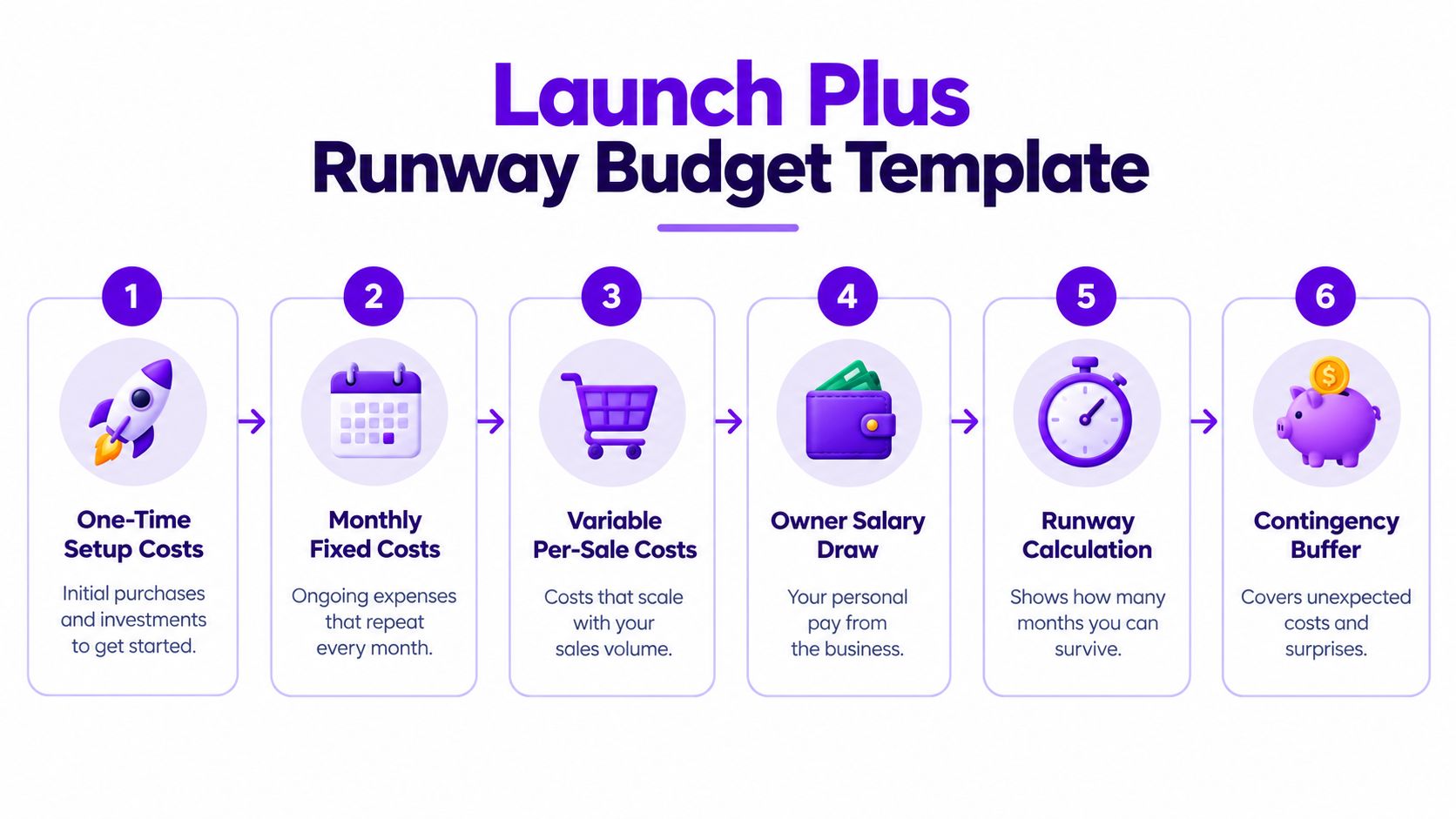
The template below shows the sequence I want every founder to follow.
Columns Your Template Needs
- One-time setup: Registration, initial design, equipment, deposits, samples, and launch production.
- Monthly fixed costs: Hosting, software, insurance, accounting, communications, and minimum contractor retainers.
- Variable per-sale costs: Payment fees, shipping, commissions, refunds, conversion charges, and delivery costs.
- Expected monthly sales: Units, clients, subscribers, or orders, entered as a range rather than a single heroic number.
- Personal monthly expenses: Your minimum owner draw, including tax reserve and healthcare.
- Cash reserve target: Total monthly burn multiplied by the number of runway months you intend to protect.
Calculate contribution margin per sale first. Start with price, subtract percentage fees, fixed transaction fees, cross-border surcharges, conversion charges, refunds, and expected chargebacks. Then divide monthly fixed business costs plus your owner draw by that contribution margin. The result is the number of sales needed to break even.
For broader operating budget structure, this 2026 small business budget guide is a solid companion when you're turning categories into monthly routines. Adapt it to runway, though. A normal budget tracks spending. A startup budget must forecast survival.
Add a downside scenario beside the base case. Cut expected sales, delay the first revenue month, and keep fixed costs unchanged. If that scenario wipes you out immediately, your launch plan is too fragile.
Cost-Saving Strategies That Actually Work
Cutting costs isn't the goal. Cutting waste without cutting proof is the goal.
Start with conversion. Customer acquisition can dominate early spend because you pay for clicks before revenue exists. A 2025 benchmark of more than 16,000 Google Ads campaigns reported an average cost per click of $5.26, up 12.88% year over year. At that rate, 500 clicks cost approximately $2,630 before landing page software, creative production, analytics, or payment fees.
If your page converts poorly, more traffic just burns money faster. Improve the offer, page clarity, proof, load experience, and checkout path before raising the ad budget. Under the same traffic assumptions, improving conversion can reduce acquisition cost more efficiently than finding slightly cheaper clicks.
Spend in Stages
- Validate before building: Sell the service manually, pre-sell the digital product, or run a concierge version of the SaaS workflow. Revenue evidence beats feature speculation.
- Rent tools monthly at first: Annual SaaS discounts only save money if you're certain you'll still use the tool after your model, audience, and workflow stabilize.
- Match payment architecture to price: Low ticket offers need bundles, aggregated billing, or stronger margins because fixed transaction fees take a larger share.
- Outsource narrowly: Hire for a defined output, such as a contract review or landing page build. Don't hire ongoing help to compensate for an unclear offer.
- Protect compliance and tax reserves: Skipping legal setup, bookkeeping, or tax planning isn't lean. It's deferred cost with penalties attached.
Don't cut measurement either. You need click to lead and lead to purchase tracking from the first test. Without it, you can't tell a bad channel from a bad page, and you'll cut the wrong thing.
The cheapest decision is the one you don't have to reverse after customers arrive.
Your First 30, 60, and 90 Days With a Tight Budget
Spend the first ninety days buying evidence in the smallest useful increments. Survival data matters here. U.S. Bureau of Labor Statistics establishment survival data show 66% of new establishments were still operating two years after birth, while only 44% remained four years later for establishments born in the second quarter of 1998. Long term survival is earned through staged decisions, not a perfect launch.
Days 1 to 30 Validate
Interview buyers, study competitors, define one painful problem, and draft one clear offer. Build your runway spreadsheet now, before subscriptions and deposits start. Select only essential tools, register the business properly, and outline tax and payment requirements for the countries you'll sell into.
Don't build the full product yet. A landing page, sample deliverable, waitlist, prototype, or manual service pilot is enough to test whether strangers care.
Days 31 to 60 Launch the Minimum Version
Release the smallest paid version that delivers the promised outcome. Run contained acquisition tests through search, partnerships, communities, direct outreach, or content distribution. Record every cost by category and every conversion step by source.
For service businesses, tighten delivery while you sell. A usable client onboarding checklist for repeatable delivery reduces unpaid clarification calls, missing assets, and scope confusion, all of which consume margin.
Days 61 to 90 Keep, Cut, or Pivot
Review contribution margin, acquisition cost, refund reasons, sales cycle length, and owner hours. Keep tools that support paying customers. Cancel tools bought for a future version of the business. Improve the weakest conversion step before buying more traffic.
Before the next spend, confirm three things. You still have a runway reserve, you know your measured acquisition cost, and you've reserved money for taxes and compliance. If one answer is no, fix that before scaling anything.
Ready to plan your launch around real survival costs instead of a misleading headline number? Mazurly gives digital nomads, freelancers, and online founders practical guides, cost of living comparisons, and browser based tools for invoicing, planning, and working across borders. Visit today and build your next budget with your location, runway, and revenue model in the same picture.