Digital Nomad Visa France: A Practical 2026 Guide
Table of contents
- Why France Has No Digital Nomad Visa
- Start with your work structure
- The Three Visa Branches Remote Workers Fit Into
- If you're a freelancer or consultant
- If you're a founder
- If you're an employee
- Eligibility, Duration, and Renewal Compared Side by Side
- How to choose
- How to Apply Without Missing the Timing Traps
- Tax and Social Security Exposure Most Guides Overlook
- Don't treat 183 days as a safe harbor
- Ask about payroll and social security too
- France vs Portugal Spain and Germany for Remote Workers
- A Realistic Relocation Scenario From Lisbon to Paris
- Action Checklist and Common Questions
The most popular advice about a digital nomad visa in France often starts with the wrong assumption: that France has a remote-work visa you can apply for. It doesn't. The practical question is which existing French immigration category, if any, fits how you earn a living, and what obligations come with it.
That distinction matters. A foreign employee, a freelancer with overseas clients, and an online business founder may all work from a laptop, but they don't necessarily fit the same visa route. Choose by work structure first, then check residence, tax, and social security consequences before you book the move.
Why France Has No Digital Nomad Visa
France has no dedicated permit for digital nomads. Search results for “digital nomad visa France” may point to visitor visas, business visas, or long-stay guidance, but those categories do not create a general authorization for remote work. France's public-service guidance organizes long-stay visas around purposes such as study, employment, and family.
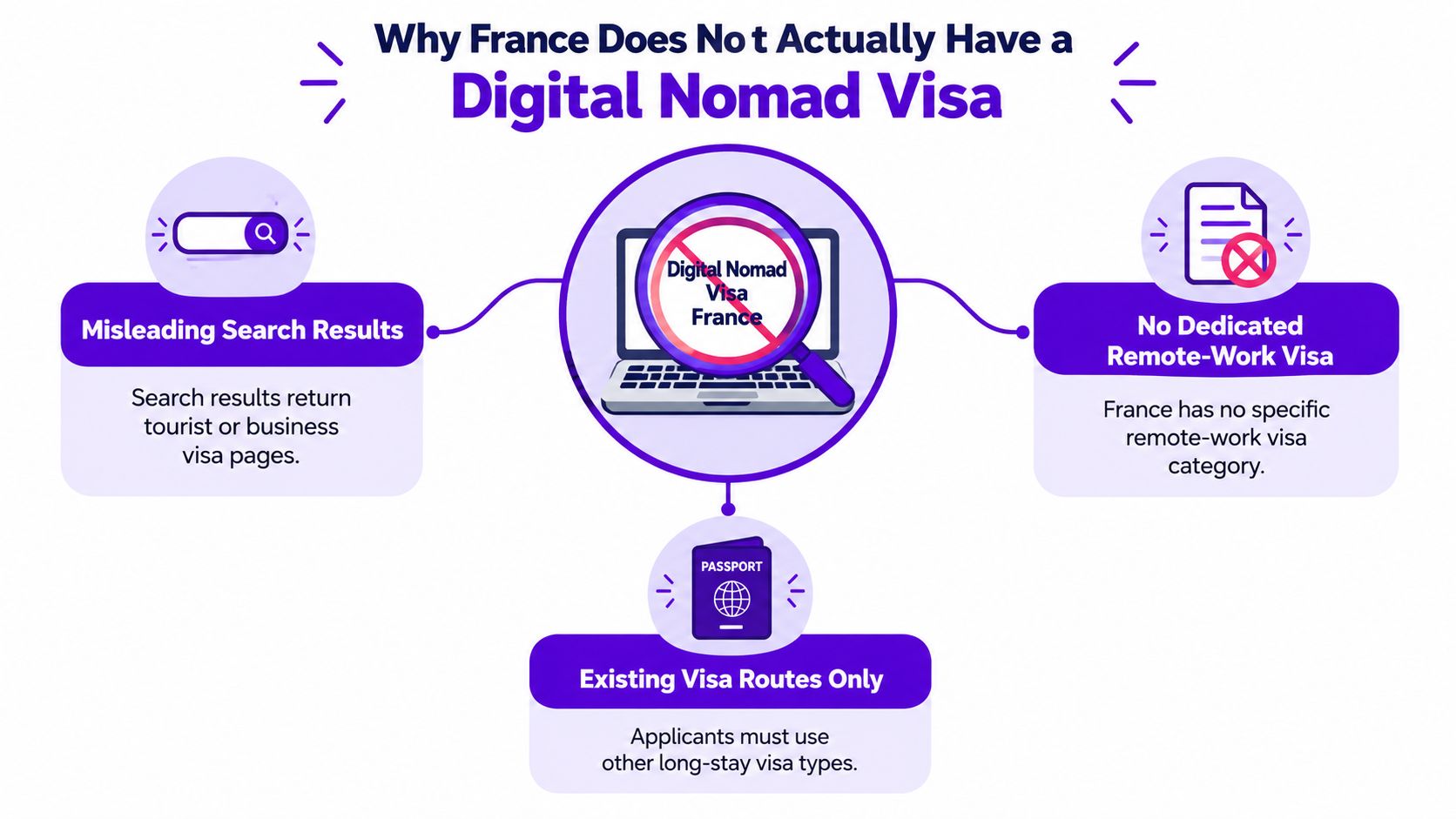
For a stay longer than three months and up to a year, the usual framework is a type-D long-stay visa issued by a French consulate. It authorizes residence for a defined purpose, not remote work of any kind. Your work arrangement determines which category to investigate and what proof and obligations to prepare for.
Start with your work structure
If you are an employee, an overseas employer does not automatically settle the French authorization question. The salaried route may require an employment contract and, for French activity lasting more than three months, work authorization obtained by the employer. If your company has no French presence, get a case-specific assessment before relying on a visitor visa.
If you are a freelancer, the entrepreneur/profession libérale category may fit an independent economic activity established or pursued in France, provided the activity is viable. A founder may fit a relevant Talent Passport category, including certain business founders or applicants with projects recognized by a public entity. These routes call for different evidence and carry different compliance and tax considerations, so do not choose by job title alone.
The useful mental model: France assesses the activity you will carry out, its connection to France, and the immigration category that authorizes it.
Countries with a named digital-nomad permit treat remote work as an explicit visa purpose. France instead requires applicants to fit their circumstances into an existing category. Start with your actual work structure, then confirm the matching route before assembling your application.
The Three Visa Branches Remote Workers Fit Into
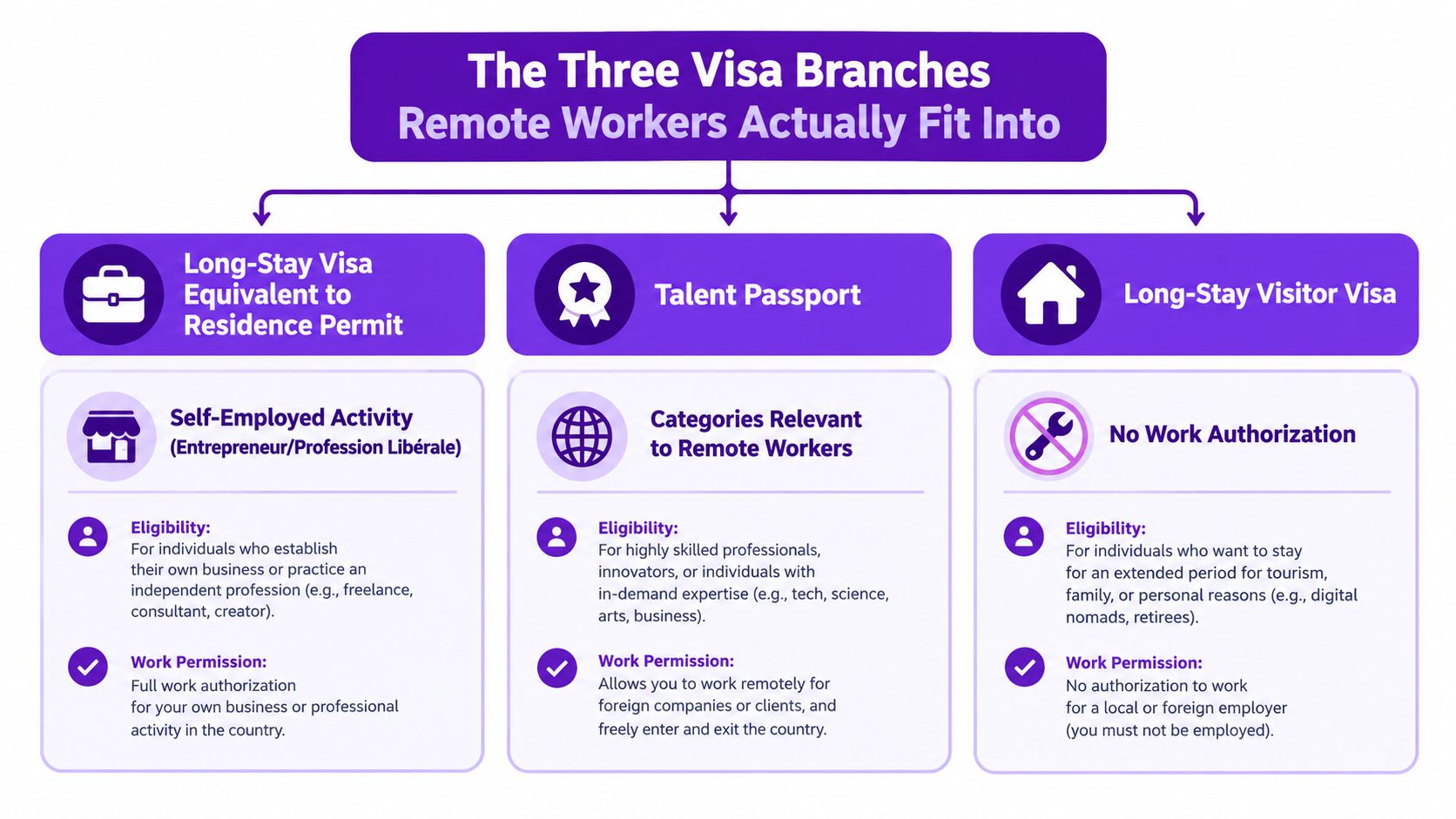
France has no visa category built around working online. Choose the route by your work structure: independent professional, business founder, or employee. Each branch calls for different evidence and carries distinct tax and compliance obligations, so get the category right before building your application.
If you're a freelancer or consultant
Start with the entrepreneur/profession libérale route if you plan to establish or carry out an independent economic activity in France. Show that the activity is viable. Being able to do your existing job from a French apartment is not enough. If you're joining an existing activity, demonstrate resources at least equivalent to France's statutory full-time minimum wage, as set out in France-Visas' guidance for independent and liberal activity.
Build a file around the work itself. Include relevant evidence such as a business plan, client agreements, recurring revenue, projected cash flow, qualifications, accommodation details, and health coverage. Overseas clients do not remove the need to explain what professional activity you will carry out from France.
If you're a founder
A Talent Passport may suit certain business founders or applicants whose projects qualify through recognition by a public entity. Owning an online business alone does not qualify you. Match your project and circumstances to a specific category, then document how you meet its conditions.
If you're an employee
Do not use a visitor visa as a substitute for work authorization. Applicants on that route commit not to perform professional activity in France. Keeping your employer and payroll abroad does not settle the question. The assessment can turn on the work you perform, the employer's presence, and whether your activity counts as professional work in France.
Before choosing a branch, write down who pays you, who your customers are, whether you will serve French clients, and whether your arrangement makes you an employee or self-employed. Those facts give you a better starting point than the label “remote worker.”
Eligibility, Duration, and Renewal Compared Side by Side
France has no single digital nomad visa, so compare the category that fits your work structure with its evidence and renewal rules. The table shows the main distinctions. For employees of companies based abroad, confirm the route with the consulate before applying.
| Route | Proof Required | Validity | Renewable | French-Market Activity |
|---|---|---|---|---|
| Entrepreneur/profession libérale | A viable independent activity, supporting business and financial evidence, and required administrative documents | Applicants staying 12 months or less may receive a long-stay visa equivalent to a residence permit, generally valid for 12 months; qualifying permits can be valid for 4 years | The entrepreneur/liberal-profession permit is renewable | The route covers establishing or participating in an economic activity in France; show how your activity meets the category |
| Qualifying Talent Passport | Evidence that you meet the requirements for a relevant category, such as a qualifying business-founder or recognized project route | Qualifying permits can be valid for 4 years | Renewable | Depends on the specific category and its conditions |
| Long-stay visitor | Sufficient resources and a commitment not to perform professional activity in France | The visa duration and residence steps depend on the application and intended stay | Renewal does not permit work; the work restriction remains central | No professional activity in France under the visitor commitment |
For stays of at least 12 months, applicants may instead receive a 3-month long-stay visa and apply for the appropriate multi-year residence permit in France. For stays of 12 months or less, the visa equivalent to a residence permit must be validated online after arrival within the required window. France's official public-service guidance on long-stay visas sets out these procedures.
How to choose
Freelancers should show that their business case is credible and their proposed work fits the independent-professional category. Founders need to match their project to a qualifying Talent Passport category; company ownership alone does not establish eligibility. Employees should get specific immigration advice before considering a visitor route, which requires a commitment not to work in France.
Check the category first, then compare its duration and renewal rules.
How to Apply Without Missing the Timing Traps
France's application process rewards careful sequencing. Approval is only one step. Depending on your category, arrival starts a separate validation deadline, and missing it can create avoidable residence problems.
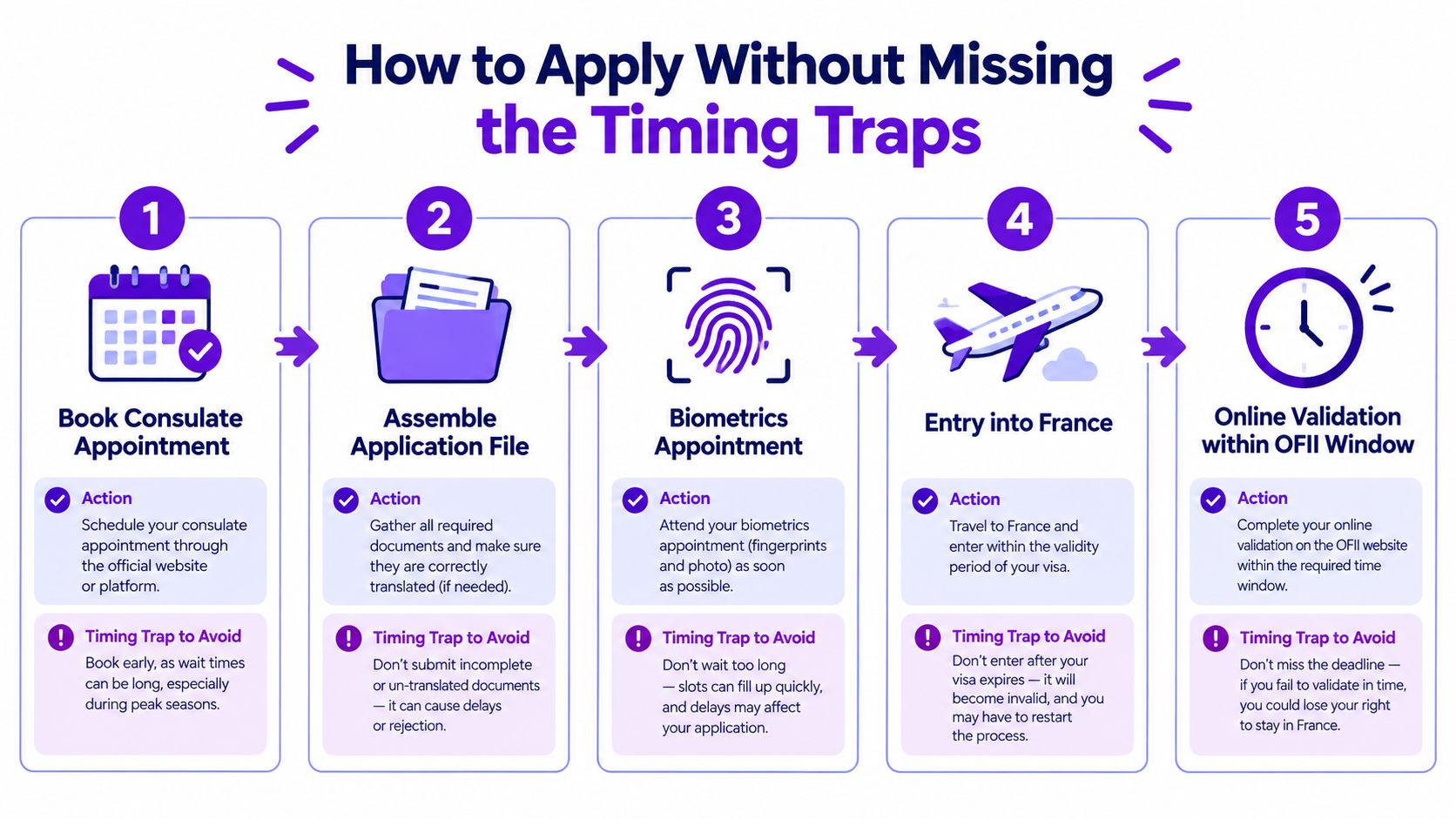
Choose the category before booking. Match the route to how you work: employee, freelancer, or founder. Freelancers should prepare evidence explaining their activity and its economic viability. Employees should confirm whether their employer must obtain work authorization. Founders should check that their project fits the specific qualifying category, rather than relying on company ownership alone.
Prepare a coherent file. Gather the documents required for your category, which may include professional records, proof of resources, accommodation details, and health coverage. Organize them to show how they support your application. An unexplained bundle makes it harder to assess your case.
Complete the consular process. Follow the appointment and identity-check instructions for the consulate handling your application. Confirm document requirements early, including whether records need translation or certification.
Check the visa terms before travel. Confirm the permitted entry period and the steps required after arrival. Your visa type determines whether you validate online or apply for a residence permit in France. Your planned stay determines which process applies, so confirm the requirement before you travel.
Meet the post-arrival deadline. For the entrepreneur/profession libérale long-stay visa equivalent to a residence permit, France-Visas requires validation within 15 days of arrival. Under the official long-stay framework, the general long-stay visa equivalent to a residence permit must be validated online within the first 3 months. Treat these as separate deadlines, not interchangeable rules. Keep your visa, validation confirmation, and permit application records together.
Build renewal timing into your plan, too. Start well before your current work authorization approaches expiry, and gather supporting documents in advance. HeyAtty's renewal planning tips can help you organize that preparation.
Put every deadline in your calendar as soon as you receive your visa. The application is a sequence, and each step has its own timing.
Tax and Social Security Exposure Most Guides Overlook
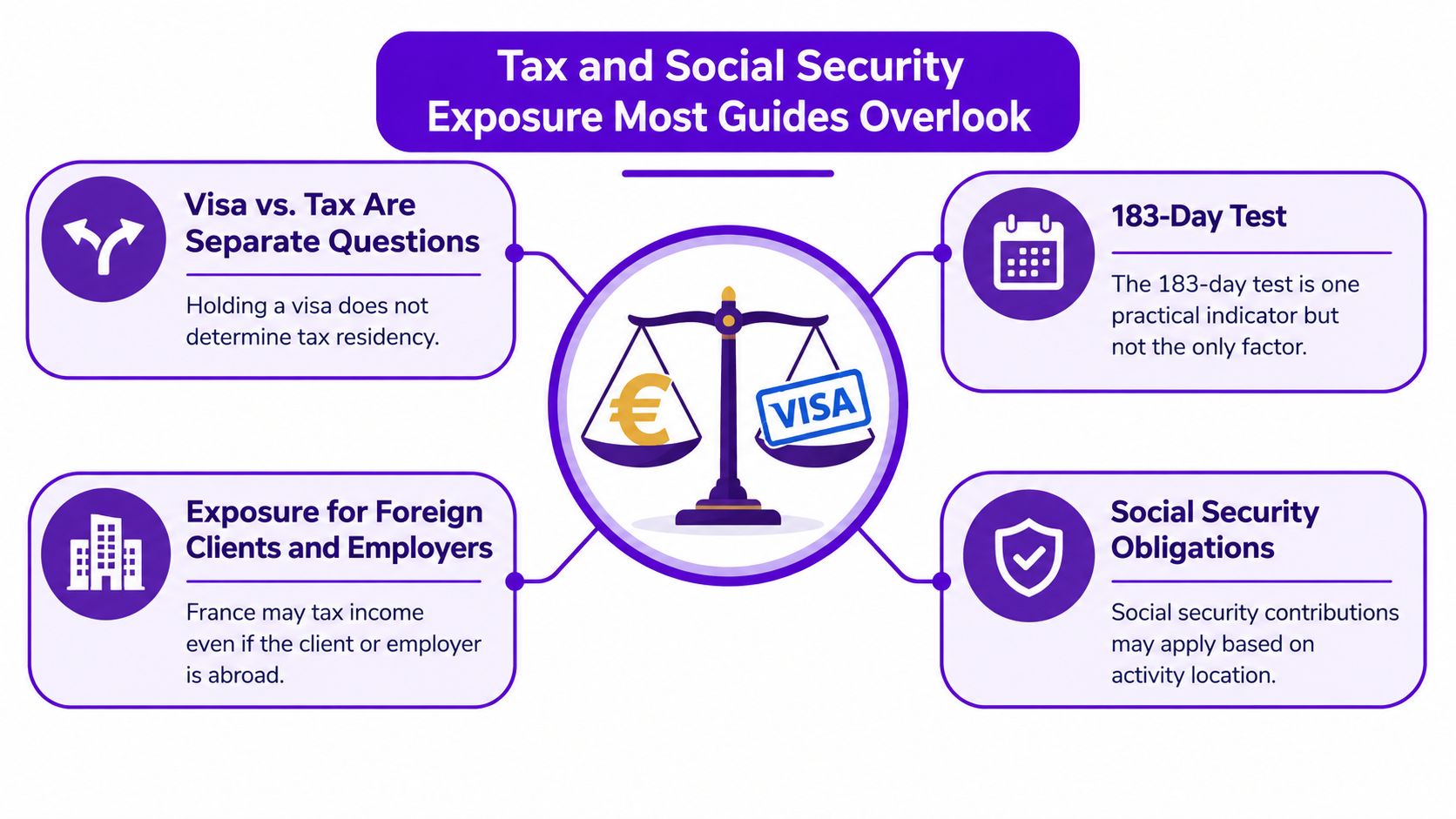
A visa decision does not decide your tax residence. You can have foreign clients or a foreign employer and still face French tax questions because you're physically carrying out work from France. The French tax authority says residents are generally taxed on French- and foreign-source income, subject to applicable tax treaties (French tax guidance for residents).
Don't treat 183 days as a safe harbor
The 183-day test matters in some treaty analyses, but it's not a universal exemption from French tax. For private-sector salary, many treaties may exempt income when the person's assignments in France stay within that limit, the employer isn't established in France, and the remuneration isn't charged to a French permanent establishment. The conditions work together. Passing one test alone doesn't settle the result.
Tax residence can also depend on factors such as your main home and centre of economic interests. Track your physical presence by calendar year, identify the entity paying you, and note whether you work for French customers. Self-employed income follows different treaty rules from employee salary, so don't use an employee's treaty analysis as a template for freelance income.
Ask about payroll and social security too
Immigration permission, income tax, payroll withholding, and social security are separate questions. A foreign employer may need advice on its obligations when an employee works from France, while a freelancer should ask whether their activity requires French registration or contributions. A visitor visa's work restriction doesn't resolve those tax and social-security issues; it makes choosing a permitted immigration route even more important.
US workers should also distinguish their French obligations from their US filing questions. For general context on how filing status and forms differ, consult tax form guidance from Allied Tax Advisors, then ask a cross-border tax professional to assess the France-specific position. If you're investing while abroad, also review this practical guide to investing while living abroad.
Practical rule: Get immigration and tax advice before you move, not after a consulate has approved your visa. The permission to reside and the consequences of working there aren't the same legal question.
France vs Portugal Spain and Germany for Remote Workers
France can be the right base if you have a route that matches your work and you're prepared for its immigration and tax rules. It can be the wrong choice if you need a simple, clearly defined remote-work permit and don't fit an existing category.
| Destination | Visa clarity for remote workers | What to check before choosing |
|---|---|---|
| France | No dedicated general-purpose digital nomad visa; applicants use existing categories | Work structure, French-market connection, activity permission, tax, and social security |
| Portugal | Has a named remote-work visa route | Current eligibility, documentation, and tax treatment for your circumstances |
| Spain | Has a named remote-work visa route | Current requirements, employer or business evidence, and tax treatment |
| Germany | The route depends on the intended activity and residence purpose | Whether your case fits a self-employment, employment, or other permit category |
The country comparison is about fit, not a promise that one destination is easier for everyone. Portugal and Spain have specific remote-work categories, while France makes applicants map their circumstances onto existing immigration routes. Germany also requires a category-specific assessment, so check which German permit matches the work you plan to do before comparing it with France.
Tax treatment and cost of living need their own comparison. Don't assume that a country's remote-work visa tells you how it will tax your income, or that a visa-friendly destination will be cheaper once housing, healthcare, and transport are included. The answer depends on your city, household, income source, and length of stay.
Before choosing a base, ask yourself three questions: Can I obtain a visa that permits my actual work? Can my employer or business meet the compliance obligations? Does the destination still make sense after tax and living costs? If you're comparing France with another Mediterranean option, this guide to the digital nomad visa in Greece can help frame the alternative.
A Realistic Relocation Scenario From Lisbon to Paris
Consider a US freelancer living in Lisbon who wants to move to Paris and keep serving clients abroad. The decisive fact isn't that the clients are American. It's that the freelancer plans to carry out an independent economic activity while based in France, so the entrepreneur/profession libérale route deserves a close look.
Before approaching the consulate, this applicant should build a file that makes the business legible: client agreements, recurring revenue records, a business plan, projected cash flow, and professional qualifications. They should also arrange suitable accommodation and health coverage, and ask a cross-border adviser how moving their work location affects tax and social-security obligations.
The move changes more than the address on an invoice. The freelancer may need to understand French administrative registration, the practicalities of banking, and whether their current business structure fits the French route. They should not assume that a short initial stay or foreign client list resolves the tax question.
Budgeting should also go beyond rent. Compare everyday costs for the places you're considering, including the recurring expenses that affect your work and household. A cost-of-living comparison by country can help organize that research, but the visa decision still needs to be based on the person's activity and documents.
Action Checklist and Common Questions
Before applying, confirm your route and prepare the file around it.
- Confirm the activity: Employee, freelancer, or founder. Don't apply under a category that doesn't match your work.
- Build your evidence: Include the required business, financial, professional, accommodation, and health-coverage documents.
- Track the deadlines: Record the relevant post-arrival validation or residence-permit steps as soon as your visa is issued.
- Get tax advice: Review residence, treaty, payroll, and social-security questions before departure.
Can I switch from a short-stay Schengen visit to a long-stay route after arrival? Don't plan your move around an assumed in-country switch. Confirm the application process with the relevant French authority before travelling.
Can my family come with me? Family residence options depend on your status and circumstances. Check the rules for your specific category before making commitments.
What if my work changes after I arrive? A new employer, business model, or client base may affect both your immigration category and tax position. Get advice before changing the arrangement.
What does the move cost? There isn't one reliable total for every applicant. Build a budget around your route, document preparation, housing, insurance, taxes, and professional advice.
Mazurly brings together practical tools and guides for visa research, cost-of-living comparisons, travel logistics, and remote-work planning. Use Mazurly to organize your France move, compare destinations, and prepare for the challenges of working across borders.