Skiplagging Explained: What It Is, How It Works, and the Risks You Should Know
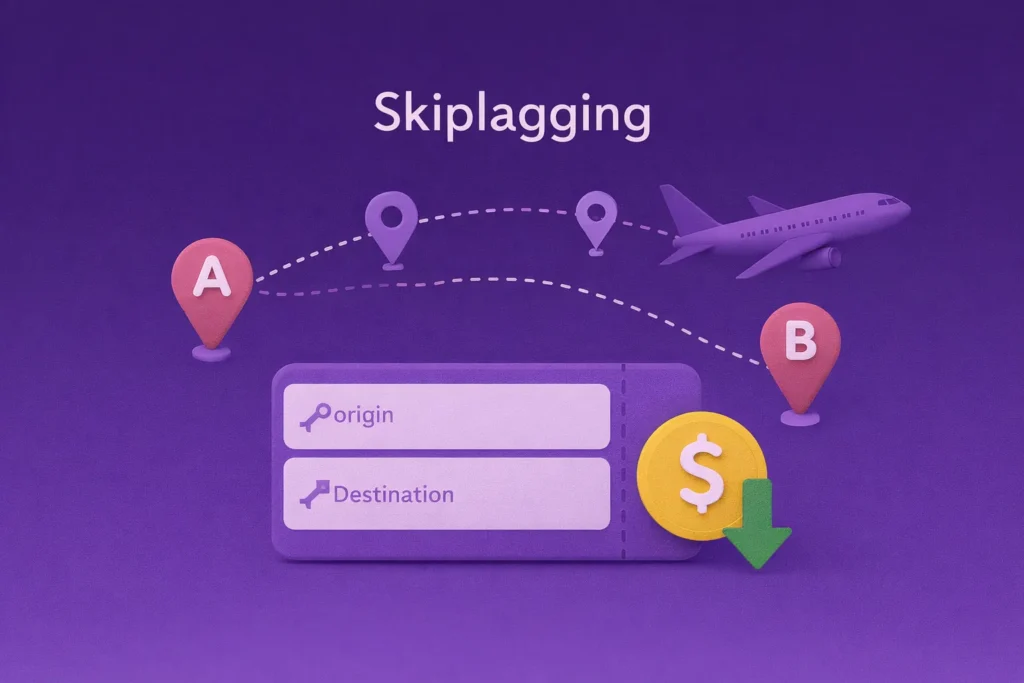
Table of content
Heard you can save hundreds on flights by ditching your connection? That’s skiplagging, and it’s gotten travelers banned from airlines. In August 2023, American Airlines refused to let a teenager board after discovering his skiplagging ticket. The practice can slash airfare costs, but airlines treat it as a serious contract violation. This guide explains what skiplagging is, how it works, whether it’s legal, and if the savings justify the risks.
How Does Skiplagging Work?
Skiplagging is booking a cheaper connecting flight and exiting at the layover city instead of continuing to the ticketed final destination. The practice goes by several names including hidden city ticketing, point beyond ticketing, and throwaway ticketing (though technically different). Airlines sometimes price flights with connections lower than direct routes to the same layover city, creating an opportunity to save money by abandoning the final leg.
A typical example: A flight from New York to Orlando might cost $350 direct. But a New York to Miami flight with a layover in Orlando could cost $220. You’d book the cheaper NYC-Orlando-Miami ticket, get off in Orlando, and never board the Orlando-Miami segment.
Hub-and-spoke airline economics is the reason for this peculiarity in pricing. To load aircraft on less lucrative routes, major airlines subsidize connecting flights via their hubs. Airlines set their prices not only on distance but also on route demand and competitive marketplaces. Prices remain high since Orlando is a popular vacation spot with plenty of direct service. Even while Miami routes cover more miles, there may be less competition, which would result in a lower connecting ticket.
Skiplagged.com, founded by Aktarer Zaman in 2013, popularized the technique by building a search engine that specifically highlights these pricing gaps. Traditional booking sites like Expedia and Kayak don’t surface hidden city opportunities because airlines prohibit it in their contracts with travel agencies. The site’s name became so associated with the practice that “skiplagging” itself derives from the Skiplagged brand.
Pro tip: Contact support team online before flight or ask at check-in if the airline will cancel your connecting segment voluntarily. In my experience Air Arabia let me cancel my second leg with no refund, eliminating the policy violation entirely.
Is Skiplagging Illegal?
Skiplagging isn’t illegal under U.S. federal law. No criminal statute prohibits buying a plane ticket and choosing not to complete your journey. The Department of Transportation, which regulates airline consumer practices, has no rules against the practice. However, skiplagging violates airline Contracts of Carriage, the terms and conditions you agree to when purchasing a ticket. Every major U.S. airline includes language prohibiting hidden city ticketing. This makes it a breach of contract, not a criminal act.
The distinction matters for consequences. Airlines can’t have you arrested for skiplagging, but they can pursue civil remedies. They have the right to cancel your ticket, deny you access to future flights, take away your loyalty club privileges, or charge you the difference in fee between what you paid and what a ticket to your actual destination would have cost.
American Airlines’ Contract of Carriage states that tickets must be used in sequence from origin to destination. United’s contract says tickets have no value if not used exactly as issued. Delta includes similar provisions. These terms give airlines legal grounds to penalize passengers who skiplag, even though the practice itself isn’t against the law.
International cases complicate the picture slightly. In 2019, Lufthansa sued a passenger in German court for skiplagging from Frankfurt to Oslo with a connection in Stockholm. The passenger flew Frankfurt-Stockholm and skipped the Stockholm-Oslo leg. Lufthansa demanded €2,112 for the fare difference. A Frankfurt court initially dismissed the case, though airlines continue to pursue such actions.
The key takeaway: You won’t face criminal charges, but airlines have contractual tools to impose financial and access penalties.
Can Airlines Ban or Punish You for Skiplagging?
Airlines actively enforce their anti-skiplagging policies, and documented cases show they follow through with punishments ranging from account suspension to legal action.
In August 2023, American Airlines refused to let a 17-year-old board his flight from Gainesville, Florida, after gate agents discovered his ticket was booked to New York with a connection in Charlotte, where he actually intended to get off. The airline canceled his ticket, banned him from flying American for three years, and required his father to purchase a new direct ticket at full price on the spot. The case gained national attention when NPR reported it, highlighting how airlines actively screen for the practice at departure gates.
The Lufthansa lawsuit from 2019 represents airlines’ willingness to pursue financial damages. Though the initial case was dismissed, Lufthansa argued it lost revenue when the passenger paid a lower fare than a direct ticket would have cost. Airlines view this as theft of services, even if courts don’t always agree.
United Airlines filed the most prominent case in 2014, suing both Skiplagged.com and a passenger who used the service. United sought to shut down the website and recover damages. The passenger portion was quickly dropped, but the lawsuit against Skiplagged dragged on before being dismissed. Orbitz joined as a co-plaintiff. After years of litigation, the case ultimately favored Skiplagged, establishing that the website’s operation isn’t illegal, though airlines continue to oppose the practice and pursue legal action against it.
Airlines employ several detection methods. Gate agents can see your full itinerary and may question passengers with carry-on bags on connecting flights. Automated systems flag passengers who repeatedly miss the same flight segments, indicating a pattern. Frequent flyer accounts make tracking easier since your booking history and travel patterns are linked to your profile.
Enforcement consequences include immediate account suspension. Airlines can close your frequent flyer account without refund or appeal, forfeiting any accumulated miles or elite status. They can also bill your credit card for the difference between what you paid and what a direct ticket to your actual destination would have cost. Some passengers report being added to internal watchlists that flag them for additional screening on future bookings.
The risk isn’t theoretical. Airlines have automated systems scanning for skiplagging patterns, and they’re willing to enforce penalties that can exceed any savings you achieved.
What Are the Major Risks of Skiplagging?
Five significant risks make skiplagging more complicated than simply getting off at a layover, and any one of them can turn your cost savings into a travel disaster.
Checked baggage creates an immediate problem. Your luggage gets checked through to the final ticketed destination automatically. If you book New York to Miami via Atlanta but plan to stay in Atlanta, your bag continues to Miami without you. Airlines don’t allow you to retrieve bags at connection cities unless you’re an arriving passenger. You’d need to file a claim in Miami and arrange shipping back to Atlanta, paying fees and waiting days. This forces you to travel with carry-on only, limiting trip length and what you can bring.
NOTE: If you attempt skiplagging despite the risks, you can request short-checking your baggage by asking gate agents in excuse of having a need of very important item from it or you can try asking them to tag luggage only to your layover destination instead of the final ticketed city. Though airlines rarely accommodate this on legacy carriers since it signals your intent to abandon the second flight. Without short-checking, your bag automatically is planned to go to the final destination and since you will not board after layover it will stay in lost baggage until you claim it, which actually can take months.
Involuntary itinerary changes expose your plan. Weather delays, mechanical issues, or operational needs cause airlines to reroute passengers constantly. If your Orlando-Denver-Seattle ticket gets changed to Orlando-Phoenix-Seattle due to a Denver snowstorm, you’ve lost your connection through Denver entirely. The airline rebooks you automatically, and refusing the change while demanding Denver routing reveals you never intended to go to Seattle. You can’t request specific routings without raising red flags about your true destination.
Round-trip tickets become worthless after one missed segment. Airlines automatically cancel all remaining flights on your itinerary if you no-show any portion. Book a round-trip from Boston to San Francisco via Las Vegas, exit in Vegas on the outbound, and your entire return trip gets canceled. You’d need to buy a new one-way ticket home at last-minute prices, eliminating any savings. This restriction means skiplagging only works on one-way tickets, limiting flexibility for trips with fixed return dates.
Loyalty program penalties include complete account forfeiture. Airlines can and do remove all accumulated miles from frequent flyer accounts when they detect skiplagging. You might have 100,000 miles saved for a free vacation, and one detected skip could zero your balance. Elite status gets revoked too, meaning you lose priority boarding, free checked bags, and upgrade eligibility. For frequent travelers, this penalty often exceeds years of accumulated value, making a single $150 savings catastrophic for your long-term travel costs.
Financial liability extends beyond the initial booking. Airline contracts allow them to charge your card for the fare difference retroactively. If you paid $220 for NYC-Miami via Orlando but a direct NYC-Orlando ticket costs $350, the airline can bill you $130 plus fees. Some passengers report receiving invoices weeks or months after travel. You might save money upfront but face unexpected charges later, with limited recourse since you violated the contract terms.
| Risk Factor | Likelihood | Severity | Mitigation |
|---|---|---|---|
| Baggage issues | Certain (if checked) | High | Carry-on only |
| Itinerary changes | Medium (5-15% of flights) | High | Flexible plans |
| Return cancellation | Certain (if round-trip) | Critical | One-way only |
| Loyalty penalties | Medium (if detected) | Very High | Use non-loyalty account |
| Retroactive charges | Low-Medium | Medium | Disposable payment method |
The combination of these risks means skiplagging requires perfect execution and acceptance that even one unexpected variable can cost more than you saved.
Which Airlines Actively Enforce Anti-Skiplagging Policies?
All major U.S. airlines prohibit skiplagging in their Contracts of Carriage, but enforcement intensity varies by carrier based on their pricing models and detection capabilities.
American Airlines demonstrates the most aggressive enforcement. The 2023 incident with the teenager wasn’t isolated the airline has refused boarding to multiple passengers caught with hidden city tickets at gates. American’s gate agents receive training to spot skiplagging patterns, particularly passengers with carry-on bags on connecting flights to less desirable destinations. The airline also actively pursues retroactive fare charges and frequent flyer account suspensions for repeat offenders.
United Airlines led the legal charge against the practice with its 2014 lawsuit against Skiplagged.com. While the case was eventually dismissed, United’s willingness to pursue legal action signals serious opposition. The airline’s Contract of Carriage includes explicit language that tickets “have no value” if not used in the exact sequence issued, giving United contractual grounds to deny boarding or cancel tickets.
Lufthansa stands out internationally for actually suing an individual passenger in 2019. The €2,112 lawsuit over a Frankfurt-Oslo ticket demonstrates that foreign carriers may pursue financial damages more aggressively than U.S. airlines, where such individual lawsuits remain rare. European airlines operate under different consumer protection frameworks, potentially making skiplagging riskier on international routes.
Delta Air Lines prohibits the practice but enforcement appears less public. The airline’s Contract of Carriage contains standard anti-skiplagging language, and Delta can impose the same penalties as competitors. However, fewer documented cases of gate-level enforcement or public banning incidents have emerged compared to American and United.
Southwest Airlines presents a unique case. The carrier’s point-to-point pricing model means it doesn’t use traditional hub-and-spoke economics. Southwest prices based on the specific city pair you’re flying, making hidden city opportunities rare. When they exist, Southwest’s more straightforward pricing means savings are typically smaller, reducing the incentive to skiplag.
Airlines employ sophisticated detection systems. Gate scanning tracks when passengers board planes, creating no-show patterns. Frequent flyer accounts link all bookings, making repeat behavior obvious. Some airlines flag one-way tickets with carry-on-only bookings to common skiplagging routes for manual review. The more you skiplag, especially through your frequent flyer account, the higher your detection risk becomes.
When Might Skiplagging Make Sense?
Skiplagging carries real risks, but specific scenarios exist where the practice becomes more defensible if you understand and accept potential consequences.
- Your traveler profile determines whether skiplagging could work. You need to be an infrequent flyer with no loyalty program status worth protecting. Losing 5,000 miles matters less than forfeiting 150,000 miles and elite status. You should have no plans to fly the same airline regularly, since account bans can last years. Business travelers should avoid skiplagging entirely since corporate accounts and expense reporting create paper trails that make detection easier and penalties more professionally embarrassing.
- The booking must meet strict requirements. Use one-way tickets exclusively since round-trips cancel entirely when you miss a leg. Travel with carry-on baggage only, accepting the limitations on trip length and packing. The savings threshold should be significant $150 or more justifies the time investment and risk more than saving $40. Make sure your connection city is your actual final destination, not a stopover where you’d need to continue elsewhere later.
- Your schedule needs flexibility. If you get rerouted due to weather or operational issues, you have to accept whatever city the airline sends you to or reveal your true intentions by refusing the change. Don’t skiplag for time-sensitive events like weddings, business meetings, or cruise departures where missing your target city creates serious consequences.
- Risk tolerance matters more than money. Can you afford to buy a last-minute replacement ticket if something goes wrong? Are you comfortable potentially being banned from an airline? Would losing frequent flyer miles or facing retroactive charges cause financial stress? If any answer is no, the practice isn’t worth the savings.
- Certain situations make skiplagging particularly unwise. Never attempt it with children, traveling families need checked bags and schedule reliability. International flights carry higher risks since foreign airlines may pursue legal action more aggressively than U.S. carriers. Avoid it entirely during peak travel periods (Thanksgiving, Christmas) when irregular operations are more likely and airlines have less patience for passengers gaming the system.
A realistic calculation: If you save $200 on a skiplag but risk losing $800 in frequent flyer miles and potentially get billed $150 in fare difference, you’re gambling $950 to save $200. The math only works if your probability of detection is extremely low and you have nothing valuable to lose in your airline account.
Legitimate Alternatives to Skiplagging
Six strategies let you find cheaper flights without violating airline contracts, and combining several often saves as much as skiplagging without the risks.
- Book separate positioning flights on budget carriers. Instead of searching for a connection through your destination, fly there directly using a low-cost airline and book it separately from your main ticket. If you want to reach Denver but find cheap flights from Las Vegas to your final destination, book a separate Southwest or Spirit ticket to get yourself to Las Vegas first. You control both bookings, can check bags normally, and face no policy violations. The catch is that you have no airline protection if your first flight is delayed. Some travel insurance policies may cover missed connections on separate tickets due to covered delays, but only if missed-connection or travel-delay coverage is included and the connection time is reasonable.
- Leverage points and miles strategically. Airline and credit card rewards often deliver better value than cash prices, especially for expensive routes. A ticket that costs $450 in cash might only require 25,000 miles plus $30 in fees. Chase Ultimate Rewards, American Express Membership Rewards, and Capital One miles all transfer to airline partners, letting you book award tickets that bypass hub pricing inefficiencies. Going.com (formerly Scott’s Cheap Flights) and AwardWallet can help you identify when award availability offers better deals than cash fares.
- Monitor error fares and flash sales. Airlines occasionally publish tickets at dramatically wrong prices due to currency conversion errors, technical glitches, or accidental fare filings. Error fares have offered $200 business class tickets to Asia or $130 roundtrips to Europe. FareDrops, Secret Flying, and The Flight Deal aggregate these opportunities in real-time. Airlines usually honor error fares booked before correction, though it’s not guaranteed. Flash sales from carriers trying to fill planes during slow periods can offer 40-60% discounts on normal fares.
- Mix budget carriers for point-to-point routing. Traditional airlines price connecting flights through hubs, but budget carriers use direct routing between cities. Combine Frontier from Denver to Orlando with Spirit from Orlando to Fort Lauderdale, and you might beat the legacy carrier price for Denver to Fort Lauderdale through their hubs. This requires separate bookings and self-transfer risk, but it’s completely legitimate and often cheaper than hub connections. Europe’s Ryanair, EasyJet, and Wizz Air make this approach even more effective internationally.
- Book during optimal purchase windows. Domestic flights typically reach their cheapest prices 21-60 days before departure, while international tickets bottom out 60-120 days in advance. Google Flights’ price tracking and calendar view show exactly when fares drop for your dates. Hopper’s app uses historical data to recommend whether to book now or wait. Buying too early or too late costs money the “Goldilocks zone” exists for every route, and hitting it saves 20-40% compared to last-minute bookings.
- Use flexible date searches religiously. Flying Tuesday instead of Friday can save $200 on the same route. Google Flights’ calendar grid shows prices across a two-month window, revealing when shifting your dates by a day or two cuts costs dramatically. Going.com sends alerts when prices drop for your saved routes. Setting alerts for multiple nearby airports (searching both NYC-area and Boston when you can drive to either) multiplies your chances of catching deals.
These methods combined often save 30-50% off standard fares legally. A passenger using credit card points for positioning flights, booking during the optimal window, and tracking error fares can achieve similar savings to skiplagging without risking account bans or contractual violations. The time investment is higher, but the legal and financial risk is zero.
Conclusion
Skiplagging offers real savings, but airlines treat it as a serious contract violation with consequences ranging from account bans to retroactive charges. The practice works only in narrow scenarios: one-way tickets, carry-on baggage, infrequent travelers with no loyalty status, and willingness to accept disruption risks.
Before attempting it, calculate the true value at stake. If you’ve accumulated miles, hold elite status, or fly the same airline regularly, a single detected skiplagging incident can destroy more value than you’ll save. The teenager who got banned from American Airlines for three years likely gave up more in future travel options than his family saved on that one ticket.
Legitimate alternatives like separate positioning flights, strategic points usage, and flexible date searches deliver comparable savings without policy violations. Try those methods first. If you still choose to skiplag, do it knowing airlines are actively watching, detection systems are improving, and the consequences are real. Make an informed choice based on what you personally can afford to lose.