Digital Nomad Visa Greece: 2026 Rules
Índice
- Sumário
- The Reality of Moving to Greece as a Remote Worker
- The move has three separate phases
- Eligibility Criteria and Financial Thresholds
- Income requirements by household
- Navigating the Application and Approval Process
- Build the file before booking the move
- Apply through the route that matches your situation
- Plan around uncertainty
- Tax Residency Traps and the 183-Day Rule
- Article 5C isn't an automatic visa benefit
- Local Registration and Securing Long-Term Housing
- Housing is a compliance issue
- Complete the local setup deliberately
- Evaluating the Greek Nomad Lifestyle and Infrastructure
- Choose the base around your work
The most popular advice about the digital nomad visa Greece is also the least useful: meet the income threshold, submit your documents, and book a flight. Approval is only the entry point. The harder decisions concern how you'll register locally, where you'll live beyond the first lease, and whether your physical presence turns a convenient immigration route into a Greek tax-residence obligation.
Greece created a dedicated framework through Law 4825/2021, which entered into force on 4 September 2021. The law recognizes remote workers serving employers or clients outside Greece, but it doesn't turn every long stay into a tax-free lifestyle. A successful move requires separate immigration, housing, registration, and tax decisions.
Sumário
- The Reality of Moving to Greece as a Remote Worker
- Eligibility Criteria and Financial Thresholds
- Navigating the Application and Approval Process
- Tax Residency Traps and the 183-Day Rule
- Local Registration and Securing Long-Term Housing
- Evaluating the Greek Nomad Lifestyle and Infrastructure
The Reality of Moving to Greece as a Remote Worker
The balcony, the sea view, and the flexible schedule are real possibilities. So are delayed appointments, inconsistent document requests, landlords who prefer seasonal bookings, and the uncomfortable question of where your tax residence really sits. A visa gives you permission to follow a defined remote-work arrangement in Greece. It doesn't automatically prove that your broader life is compliant there.
The legal framework is structured rather than informal. Greece moved from having no dedicated route to recognizing digital nomads as third-country nationals who work remotely for foreign employers or clients. Historical reporting indicates that applications rose from approximately 10 in 2021 to about 595 in 2022, an increase of roughly 5,850%, according to reported application figures for Greece's digital nomad programme. The same account reported approximately 1,200 applications in 2023 e 1,340 permits issued since launch, but the definitions aren't perfectly comparable across years.

Those figures show growing interest, not a dependable approval-rate benchmark. Greece doesn't publish a consistently defined official series that clearly separates applications, approvals, issued visas, residence permits, and renewals. That distinction matters because a high application count doesn't tell you how efficiently a consulate processes files or how many applicants complete the residence-permit stage.
The move has three separate phases
First comes immigration permission. You show that your work and income fit the scheme and that you won't enter the Greek labour market. Next comes settlement, which includes accommodation, local administration, insurance, and practical arrangements for working reliably. The third phase is tax positioning, where day counts, family circumstances, permanent housing, and your centre of vital interests can matter independently of the visa.
A general digital nomad guide can help clarify the broader lifestyle model, but Greece requires country-specific planning. Don't confuse inspiration with compliance. The person who succeeds here isn't necessarily the applicant with the most attractive destination board. It's the applicant who keeps a clean evidence trail and decides in advance how long they intend to stay.
Regra prática: Treat the visa as permission to enter a process, not as proof that every consequence of living in Greece has already been resolved.
Eligibility Criteria and Financial Thresholds
Greek consulates usually do not reject this visa because applicants misunderstand the headline income figure. They reject or delay it because the work arrangement and the money trail do not line up cleanly. Eligibility starts with a simple rule. Your employer or clients must be outside Greece, and you must not provide work to a Greece-registered employer or client while relying on this route.
That point is narrower than many applicants expect. Working remotely from Athens for a foreign company fits the scheme. So does freelance or self-employed work for foreign clients. Using the visa while taking on Greek customers, signing with a Greek employer, or building a local client book on the side does not fit the rule, even if most of your income still comes from abroad.
Income is the next filter, and weak files often show themselves here. The threshold for the main applicant is €3,500 net per month. In practice, officers want to see money that is identifiable after tax and deductions, not just a contract with an impressive gross figure. The framework and household uplifts are summarized in Greece's digital nomad visa tax alert.
Income requirements by household
| Applicant Profile | Multiplier | Required Net Monthly Income |
|---|---|---|
| Main applicant | Base amount | €3,500 |
| Applicant with spouse or cohabiting partner | +20% | €4,200 |
| Applicant with spouse or cohabiting partner and one dependent child | +20%, then +15% for the child | €4,725 |
Those family adjustments matter because applicants often substitute a rough living-cost estimate for the legal threshold. Consulates do not assess the file that way. They calculate from the base amount, then apply the partner and child increases.
The supporting evidence has to tell one story. For employees, that usually means the employment contract, recent payroll records, and confirmation that the employer is established outside Greece. For freelancers, I advise building a chain that starts with service agreements and runs through invoices, payment receipts, and bank statements. Self-employed applicants need to show foreign business activity clearly, without creating the impression that the business is Greek-based or serving the Greek market.
One caution deserves more attention than it usually gets. Meeting the visa income threshold does not settle your tax position. A person can qualify for the visa and still trigger Greek tax residency later, which is why clean records and a realistic stay plan matter from day one.
Before you collect documents, check four points carefully:
- Client and employer location: every relevant paying entity should be outside Greece.
- Income consistency: if earnings fluctuate, explain the pattern and match it to contracts and account activity.
- Family calculation: apply the spouse or partner and child adjustments before filing, not after.
- Local-work boundary: do not assume occasional Greek assignments are harmless.
If you are comparing countries side by side, the Malta digital nomad visa is a useful contrast. Use it to compare work restrictions, tax exposure, document practice, and renewal terms, not just headline income figures.
Navigating the Application and Approval Process
Applications for Greece usually succeed or fail on file quality, not intent. The people who run into delays are often the ones who had enough income and a real remote role, but submitted a file that looked inconsistent, incomplete, or poorly translated.
Start with the authority handling the case. Greek consulates do not always work the same way on appointments, formatting, translations, or follow-up requests. I tell clients to confirm the checklist with the specific post first, then build the file around that version rather than relying on a generic summary.
Build the file before booking the move
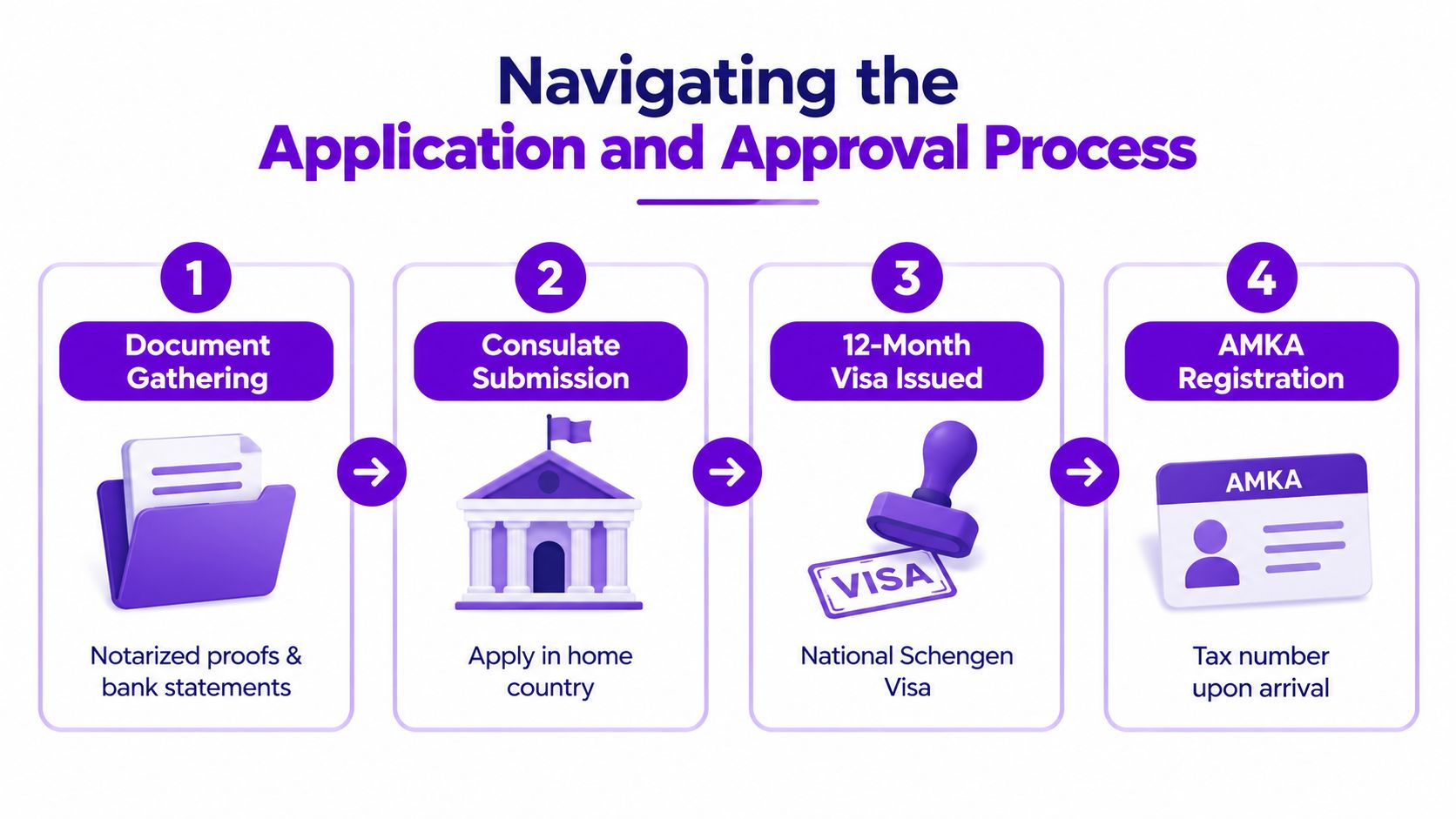
Put the paperwork in a sequence an officer can verify quickly. Begin with identity documents and the forms required by the relevant consular authority. Add proof of remote work, proof of net income, the declaration that you will not work for Greek employers or clients, health coverage, accommodation evidence if requested, a criminal-record certificate, and any medical documents required for the route.
Foreign-issued documents may need apostille or other authentication, plus certified translation if the authority asks for it. That point trips up applicants more often than income does. A document accepted by one consulate may draw questions at another, especially if names, dates, employer details, or address formats do not match across the set. Keep the original, the authenticated version, the translation, and a clear scan together so you can answer follow-up requests without rebuilding the pack.
Apply through the route that matches your situation
For many remote workers, applying through a Greek consulate in the country where they lawfully live is the cleaner route. It gives you an answer before the move and reduces the risk of signing a lease or shifting your work calendar around a status you do not yet hold. People already in Greece may have an in-country residence permit route, but that is not something to assume from blog summaries or old forum posts. Check the current process with the responsible authority before treating it as your plan.
The first permission can cover a limited initial period, and anyone intending to stay longer should plan the residence-permit stage from the start. That timing matters. If your housing, school schedule, or client workload is hard to change, a slow handoff between visa and permit can create pressure fast.
Plan around uncertainty
One of the least discussed problems is the lack of reliable official public data on approval rates, processing times by consulate, or the share of visa holders who later convert to residence status. Recent reporting points to this gap in official Greek digital nomad visa data. That makes consular confirmation more useful than broad approval-rate claims.
Use a travel visa requirements comparison tool to organize options, then verify the final checklist directly with the Greek authority handling your case. Keep work arrangements flexible, avoid non-refundable commitments before approval, and save proof of every submission, payment, appointment, and follow-up.
Tax Residency Traps and the 183-Day Rule
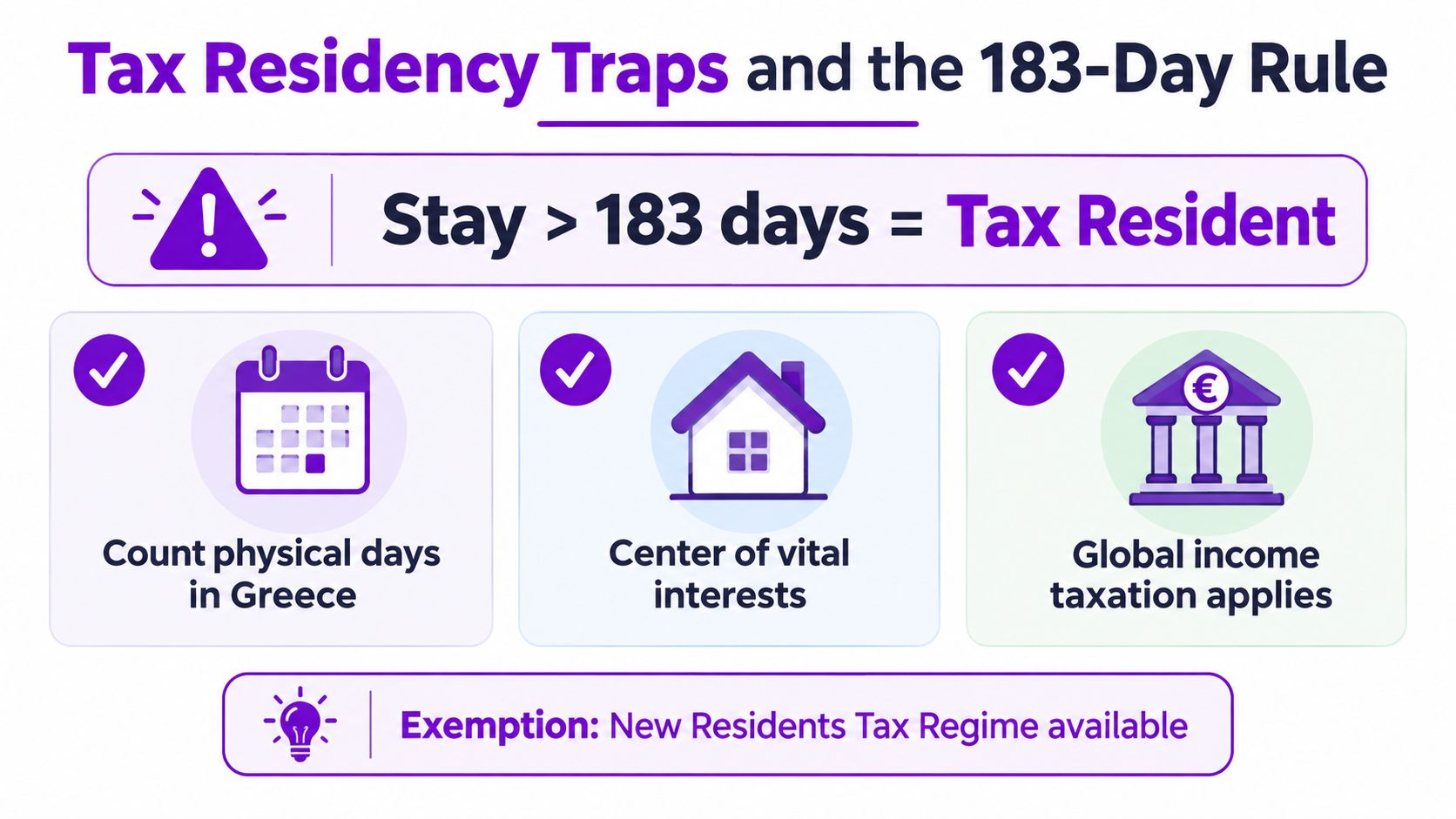
The tax mistake I see most often is simple. People treat the digital nomad visa as if it answers the tax question. It does not. Immigration status and tax residence are separate, and Greece can look at your physical presence and personal ties even if your clients, employer, and bank account sit elsewhere.
The headline rule is more than 183 days in Greece, but that is only the start. Greece can also examine whether the country has become your permanent home or your centre of vital interests, as outlined in guidance on Greece's digital nomad visa and tax residence. Once you cross into Greek tax residence, worldwide-income reporting can come into play. A foreign contract does not automatically keep you outside that system.
I tell clients to model the move before they book it. Use three scenarios and test each one carefully.
- A stay below 183 days: Track presence, then look at the harder facts, your home, family base, assets, and personal ties. If too many of those point to Greece, the day count alone may not protect you.
- A stay exceeding 183 days: Assume Greek tax residence may apply and plan for reporting obligations from the outset. Do not build your budget on the idea that foreign income stays invisible because the work is performed online.
- A family relocation: Review the full picture together. Housing, dependants, financial accounts, where the family lives, and how the work is structured can all shift the analysis.
Day counting needs discipline. Keep a calendar of arrivals, departures, and overnight stays in Greece. Match it against passport stamps, boarding passes, accommodation records, and work schedules. Memory is weak evidence when a tax position later needs support.
Income tax is only part of the exposure. Remote employment can raise payroll and social security questions. Employer risk matters too, especially if someone's work in Greece starts to look more permanent or commercially significant. Freelancers face a different problem. They need to check how foreign income is reported and whether their current business structure still makes sense once Greece enters the picture.
Article 5C isn't an automatic visa benefit
Greece's Article 5C regime may provide a 50% income-tax reduction for qualifying individuals who transfer their tax residence and meet separate legal conditions. That benefit is not attached to the digital nomad visa itself. The visa can put you in Greece. It does not grant a tax reduction by default.
The practical order matters. First determine whether you will become tax resident. Then test whether Article 5C fits your facts, timing, family situation, and work structure. There is also very little official public data on digital nomad visa approvals, so it is risky to assume a smooth timeline and layer tax planning on top of that assumption. Get cross-border advice before relying on a projected benefit.
The €3,500 income threshold answers an immigration question. It doesn't answer what you'll owe, where you'll report it, or whether your employer has created an additional compliance issue.
Local Registration and Securing Long-Term Housing
Arrival day often feels like the finish line because the visa is in your passport. In practice, it's when the practical work becomes visible. A remote worker needs an address that supports administration, internet that supports employment, and enough documentation to prove where the household is based.
Applicants seeking a longer stay generally need to transition from the initial national visa to a residence permit under the applicable immigration process. That can require proof of accommodation and local administrative steps. The exact sequence depends on the authority and current procedure, so confirm it locally rather than relying on a landlord's informal assurance.
Housing is a compliance issue
Short-term tourist accommodation may be comfortable but unsuitable for registration. A seasonal island rental can also create a timing problem: the owner may want the property back during the period when you need a stable address, or the lease may not provide the documentation an authority requests.
A practical search starts outside the most tourism-dependent areas. Athens and Thessaloniki offer broader year-round rental markets, while Chania and other popular locations can work well when you verify the lease terms, connectivity, and local administrative access before paying a deposit. The right home is not the one with the best view. It's the one where the owner will provide a properly documented tenancy and where you can maintain a consistent base.
Ask in writing whether the landlord will provide the documents needed for registration. Confirm the lease duration, permitted use, utility arrangements, and whether the address can support official correspondence. Don't build a long-term immigration plan on a verbal promise that the paperwork will be sorted later.
Complete the local setup deliberately
After arrival, applicants may need to deal with local registration, tax administration, and residence-permit appointments. The AFM, Greece's tax identification number, becomes an important practical identifier for financial and administrative matters. The precise registration sequence can vary, so use a local adviser or the responsible authority when the process is unclear.
Utilities deserve the same attention as immigration documents. Ask for a written internet speed commitment where possible, test mobile coverage at the property, and identify a backup workspace before signing. A reliable base protects client calls, payroll duties, and document appointments when a local provider or landlord isn't responsive.
The strongest approach is boring and repeatable: secure the address, preserve the lease and receipts, register with the appropriate authorities, and keep every confirmation in one digital folder. That discipline is more valuable than trying to improvise after the initial visa period is nearly over.
Evaluating the Greek Nomad Lifestyle and Infrastructure
Greece can be an excellent base for remote work, but lifestyle appeal shouldn't make the decision for you. The practical question is whether your chosen location supports your work pattern, tax plan, housing needs, and tolerance for administrative friction at the same time.
Mainland cities generally offer more resilient access to services, professional advisers, transport links, and workspaces. Islands can provide a calmer routine and a strong sense of place, but connectivity, medical access, rental availability, and seasonal business hours need closer checking. A property that works during a quiet month may be less suitable when demand rises or the owner changes the rental arrangement.

Choose the base around your work
Athens offers the widest range of urban services and professional communities. Thessaloniki can suit people who want a city environment with a different pace. Chania and other established hubs attract international residents, but popular areas can make long-term housing more difficult to secure.
Test the address before committing. Ask the provider about typical reliability, check whether the router sits inside the property, and confirm that mobile data works well enough for a hotspot. A coworking space can provide a useful backup, but it shouldn't be your only contingency if client confidentiality or late calls matter.
Healthcare planning also belongs in the relocation budget. The visa framework requires applicants to demonstrate appropriate support and documentation, while longer stays call for a clear understanding of how private coverage, local services, and existing home-country insurance interact. Don't assume that an attractive monthly budget automatically includes every service you may need.
For a wider comparison beyond Greece, resources that help you explore top-rated nomad locations can sharpen the destination decision. Compare infrastructure and compliance, not just scenery. The most attractive location on a short visit may be the least practical place for a year-round address.
A cost-of-living plan should include rent, deposits, utilities, transport, insurance, coworking, professional advice, and travel between countries. Mazurly's digital nomad lifestyle resources can sit alongside your own tax advice, consular confirmations, and housing research as you build that plan.
The Greek route makes sense for remote workers who value the country enough to manage the paperwork. It works less well for someone hoping to use a visa as a substitute for tax planning, local registration, or a stable address.
Mazurly brings visa research, cost-of-living planning, travel logistics, and remote-work tools into one platform, which can help you organize a Greece relocation before committing to dates or housing. Visit Mazurly to compare requirements, structure your budget, and prepare a more practical remote-work move.