How to Build a Personal Brand Online in 2026
Table of contents
- Why a Personal Brand Still Wins Clients
- How to Build Your Brand in Six Moves
- Name the buyer and the paid problem
- Write one positioning line
- Lock three to five pillars
- Turn one engagement into proof
- Run a four-post week
- Log the conversations, not the applause
- Test Consistency for 26 Weeks
- Read the bands before you change the plan
- Run one optimization loop
- Four traps that fake a test
- Tips for Staying Credible With AI
- What the model may touch
- Own the Audience When Platforms Shift
- Move one proof asset without copying it
- A light exit routine
- Ship the First Proof Asset This Month
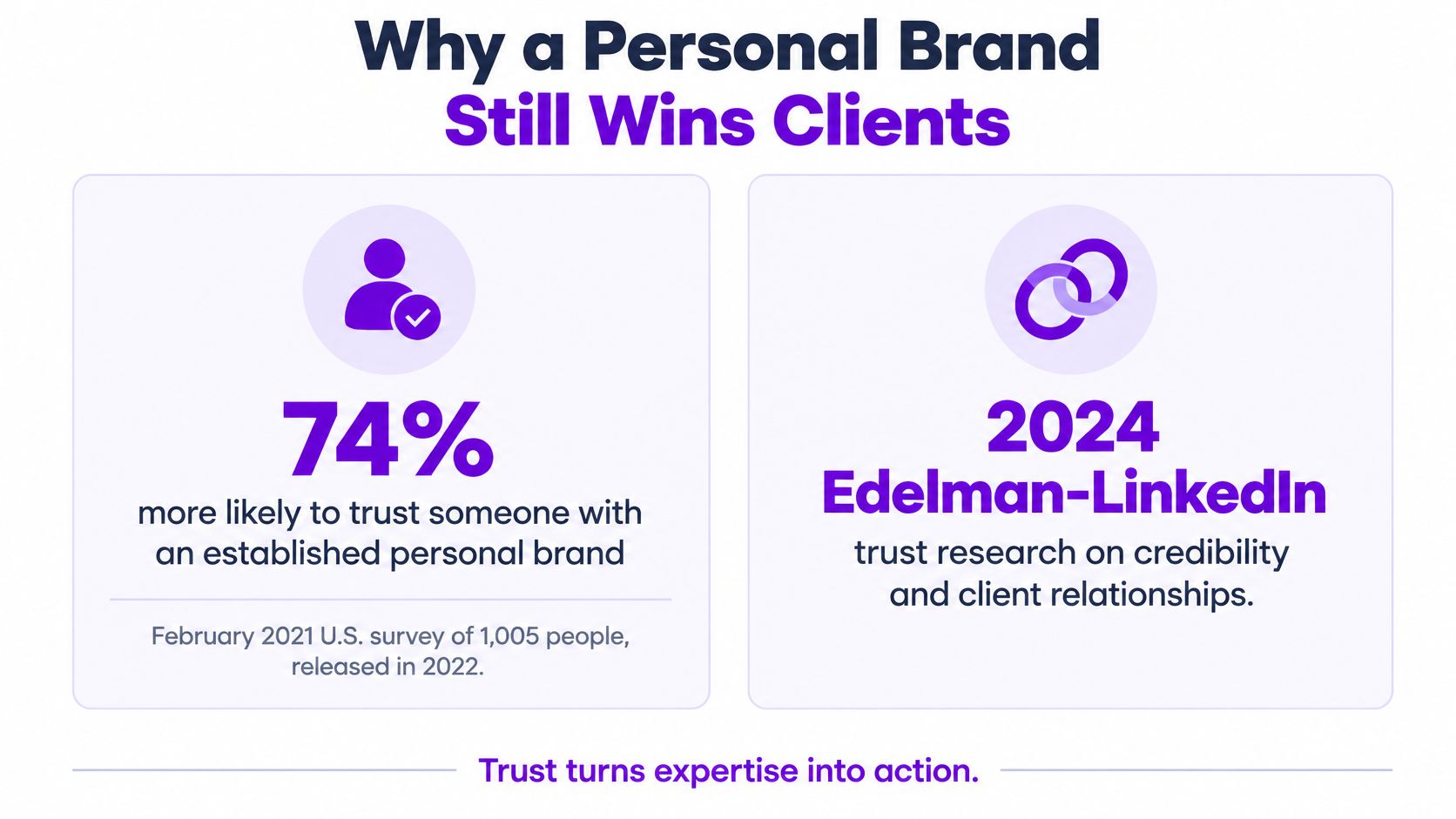
A U.S. national survey of 1,005 people, conducted in February 2021 and released in 2022, found that 74% of Americans were more likely to trust someone with an established personal brand, according to this compilation of personal branding statistics. The same compilation reports that 73% of B2B decision-makers consider thought leadership a more trustworthy basis for assessing a company's capabilities than its marketing materials, citing the 2024 Edelman-LinkedIn B2B Thought Leadership Impact Report.
That is the useful frame for how to build a personal brand online. Buyers aren't scoring your logo. They're looking for a person they can check before a call. For a freelancer, consultant, or founder who sells without a local office, a named operator lowers uncertainty faster than an anonymous company page, and the reputation can travel when you change country.
The brand that does that job is a portable evidence system: original proof, a disclosed line on AI, and an audience you can still reach if one network goes quiet. It isn't a follower target, a mark, or a motivational feed.
Why a Personal Brand Still Wins Clients
Those trust findings only matter if a stranger can verify you in a few minutes. Remote buyers rarely get a handshake first. They get a profile, a site, and a handful of posts. If those surfaces disagree, they wait or they hire someone clearer.
Four signals do the checking for them.
A clear professional position: One sentence that names who you help and the paid problem you take on. "I help distributed teams" is a category. "I help solo consultants invoice clients in two countries without chasing payment for a month" is a position.
Evidence of expertise: A workflow, a constraint, and a decision rule from work you did. A certificate list doesn't replace that.
A recognizable point of view: The same stance across posts, so a reader can predict how you'd handle their case. Switching opinions every week looks like marketing copy.
Visible proof: Case notes, client outcomes, a short publication, or a public explanation of the work. Proof is specific enough that a peer could argue with it.
Practical rule: If a buyer can't name your offer after reading your last five posts, the brand isn't winning the client. The feed is.
A content system for personal brands from SleekPost is worth using here because it treats publishing as a repeatable set of assets, not a mood. Pair that with a written offer. A business plan for freelancers keeps the commercial promise in one place so the posts don't invent a new service each week.
The sequence from here is simple, and you don't need to master it before you start. Pick one buyer and one paid problem. Lock a proof cadence. Write rules for AI. Move interested people onto a list you own.
Before the next section, write the single offer this brand should make easier to buy. One sentence. If you can't say it without a slide, you don't have a brand problem yet. You have an offer problem.
How to Build Your Brand in Six Moves
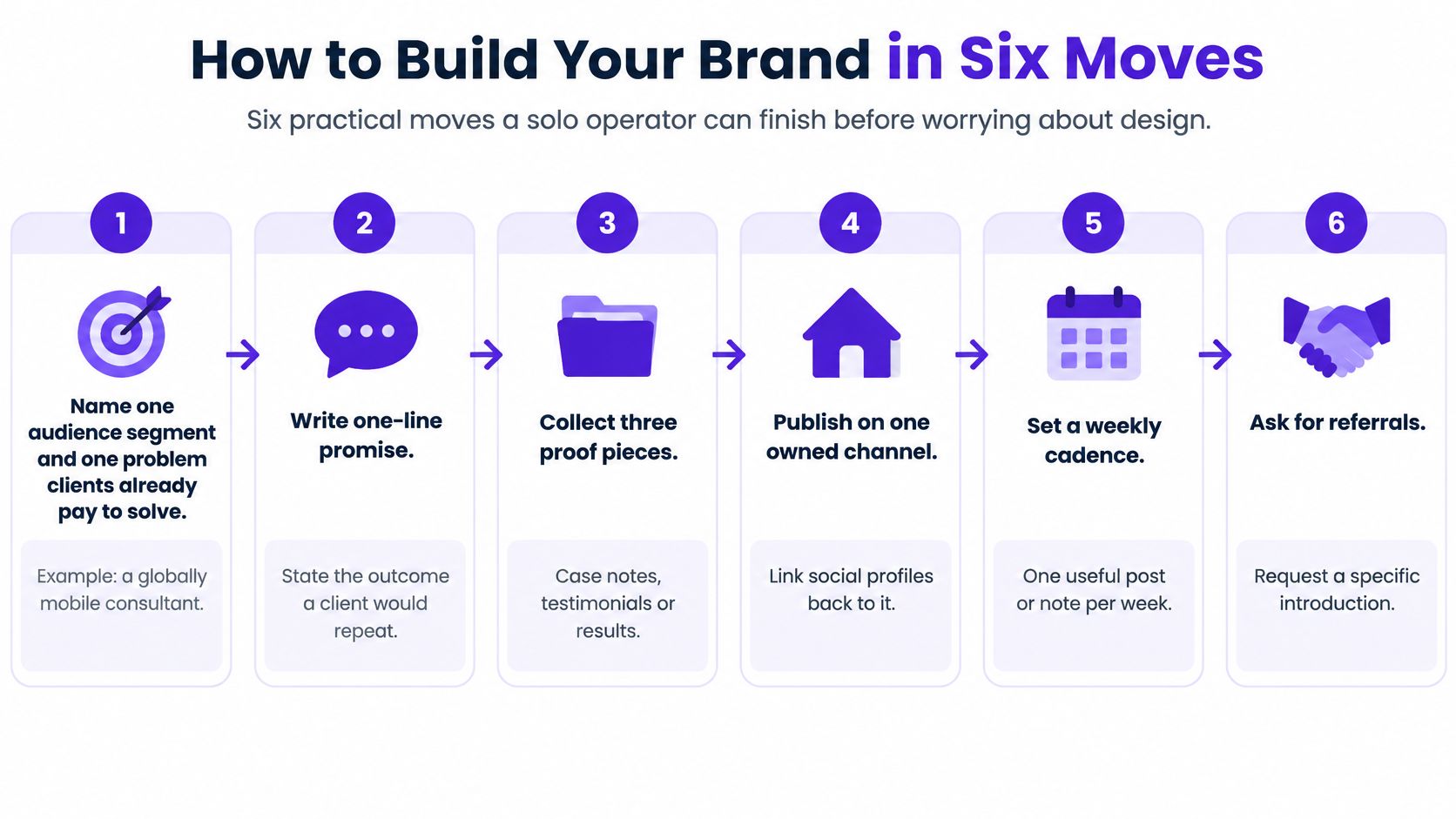
Finish these six moves before you worry about colors, templates, or a new headshot shoot. Design can wait. A buyer can already tell whether you know the work.
Name the buyer and the paid problem
Pick one audience segment and one problem clients already pay to solve. A useful cut for this kind of work is a globally mobile consultant handling cross-border payments and delivery. "Entrepreneurs" is not a segment. "Consultants billing clients in a second country while they change cities" is.
Why one problem: every later post has to point at a purchase. If you also teach visas, morning routines, and hiring, the reader can't tell what to buy.
Write one positioning line
Use this order and stop: audience, painful problem, distinctive method, measurable outcome.
Say a consultant writes: "I help location-independent consultants who wait weeks on cross-border invoices set a two-rail payment routine that shortens the cycle they can see." That line is a promise a client could repeat. It isn't a slogan.
When the outcome is a price, tie it to how you charge. A practical walk-through of how to price freelance services keeps the number in the line honest, instead of a round figure you hope sounds premium.
Lock three to five pillars
Refuse topics outside them. Strong pillars for this reader are international operations, founder productivity, and location-based business decisions. A fourth can be proof from client work. A fifth is usually too many for one person.
Pillars are a filter, not a content calendar theme of the month. If a post doesn't sit on a pillar, it doesn't ship.
Turn one engagement into proof
Take one real job, yours or a client's, and write five lines: the workflow, the constraint, a before-and-after number, the decision rule, and one failure.
An independent analysis of 134,522 LinkedIn posts found that posts using firsthand experience received 41% higher performance, while concrete specifics such as numbers, names, and places produced a 19% lift, as reported in Ligo Social's LinkedIn research. An Edelman-LinkedIn study in that same research found that more than half of decision-makers spend at least an hour weekly consuming thought leadership, but only 15% rate most of it as very good or excellent. Volume won't separate you. A dated constraint and a number will.
Photos still matter once the proof exists. A clear face helps a buyer match the writing to a person. Personal branding photos from AiHeadshots are a practical way to get a consistent set without booking a studio in every city you pass through. The photo supports the proof. It doesn't replace it.
Run a four-post week
One authoritative insight, one worked example, one correction, and one question. Each post points at an owned asset, such as an email list or a downloadable workflow. Likes are not the log.
| Post job | What it proves | Example | Owned next step |
|---|---|---|---|
| Authoritative insight | Judgment on a real constraint | How a consultant prices a cross-border retainer | Email signup or workflow |
| Worked example | A before-and-after with numbers | Invoice cycle cut from 21 days to 6 | Short case note |
| Contrarian correction | Where common advice fails | Why daily posting broke a one-person firm | Positioning page |
| Audience question | The buyer's actual decision | Which payment rail works across two countries | Reply saved as the next post |
Log the conversations, not the applause
Track qualified profile visits, email sign-ups, replies, referrals, and sales conversations. A post that draws cheers from people who will never buy is a distraction. A quiet post that produces two replies from the right consultants is the one you repeat.
Rewrite the sample line for your own offer and keep it where you draft:
"I help globally mobile consultants who lose weeks to cross-border payments install a two-country invoicing routine that cuts a 21-day cycle to 6, using the rails and the follow-up rules I publish in public."
If your version needs a paragraph, cut the method or the outcome until it fits one breath.
Test Consistency for 26 Weeks
Treat consistency as a 26-week test, not a reason to publish thin posts. The rule is at least one quality post a week, the same pillars, and a log. Raise frequency only after that process still holds quality.
Record, by format: impressions, meaningful comments, saves, shares, profile visits, subscribers, and qualified inquiries. "Meaningful" means a comment from someone who could hire you or refer you, not a one-word cheer.
Buffer's analysis reported that creators posting in at least 20 of 26 weeks generated approximately 450% more engagement per post than creators posting in four weeks or fewer. Creators posting in five to 19 weeks generated approximately 340% more engagement per post than sporadic creators. These are observational benchmarks, not guaranteed effects. Committed creators may also have stronger expertise, distribution, or production systems. Don't read the gap as "post more and the algorithm pays you."
| Cadence | Weeks active out of 26 | Engagement versus sporadic posters | What to do |
|---|---|---|---|
| Committed | 20 to 26 | About 450 percent more per post | Hold quality before adding frequency |
| Partial | 5 to 19 | About 340 percent more per post | Fix production before posting more |
| Sporadic | 4 or fewer | Baseline | Do not judge topics from this sample |
Read the bands before you change the plan
If you're in the sporadic band, you don't have a topic problem you can see yet. Four posts can't tell you whether international operations outperforms productivity. Get to a steady week first.
If you're partial, the miss is usually production: no notes from client work, no fixed drafting slot, or a pillar you don't know. Adding a second weekly post copies the gap.
If you're committed and quality is slipping, stop adding slots. The benchmark rewards weeks with a real post, not weeks with filler.
Run one optimization loop
Publish a hypothesis-led post. Example hypothesis: "A numbered payment-rail comparison will draw more qualified profile visits than a general note on founder focus." Wait a set window you choose in advance, such as seven days, and don't edit the post mid-window just to chase a spike.
Sort responses by audience quality. A save from a peer in your segment outranks a share from a random account. Keep the topic and format that produced inquiries. Repurpose that winner into an email, a case study, a short video, or a checklist. One asset, four doors, same proof.
A popular post that never creates a sales conversation is a topic to rewrite, not a topic to celebrate.
Four traps that fake a test
Changing your position every week resets the experiment. Chasing vanity engagement trains you to write for people who won't pay. Never asking for email permission leaves you renting the only place the post lives. Stating claims with no evidence teaches buyers to treat you like the thought leadership they already rate as weak.
For a mobile audience, tag each post by market, profession, and operational context. A note about invoicing from Portugal for a U.S. client is not the same post as a note about hiring a virtual assistant. Tags show whether freelancers, founders, or distributed teams are the ones replying, and whether a topic attracts attention but never a conversation you can bill.
At week 26, make one decision per pillar: keep, cut, or rewrite. Keep the pillar that produced inquiries. Cut the one that only produced likes. Rewrite the one that drew the right people but never asked them to take a next step.
Tips for Staying Credible With AI
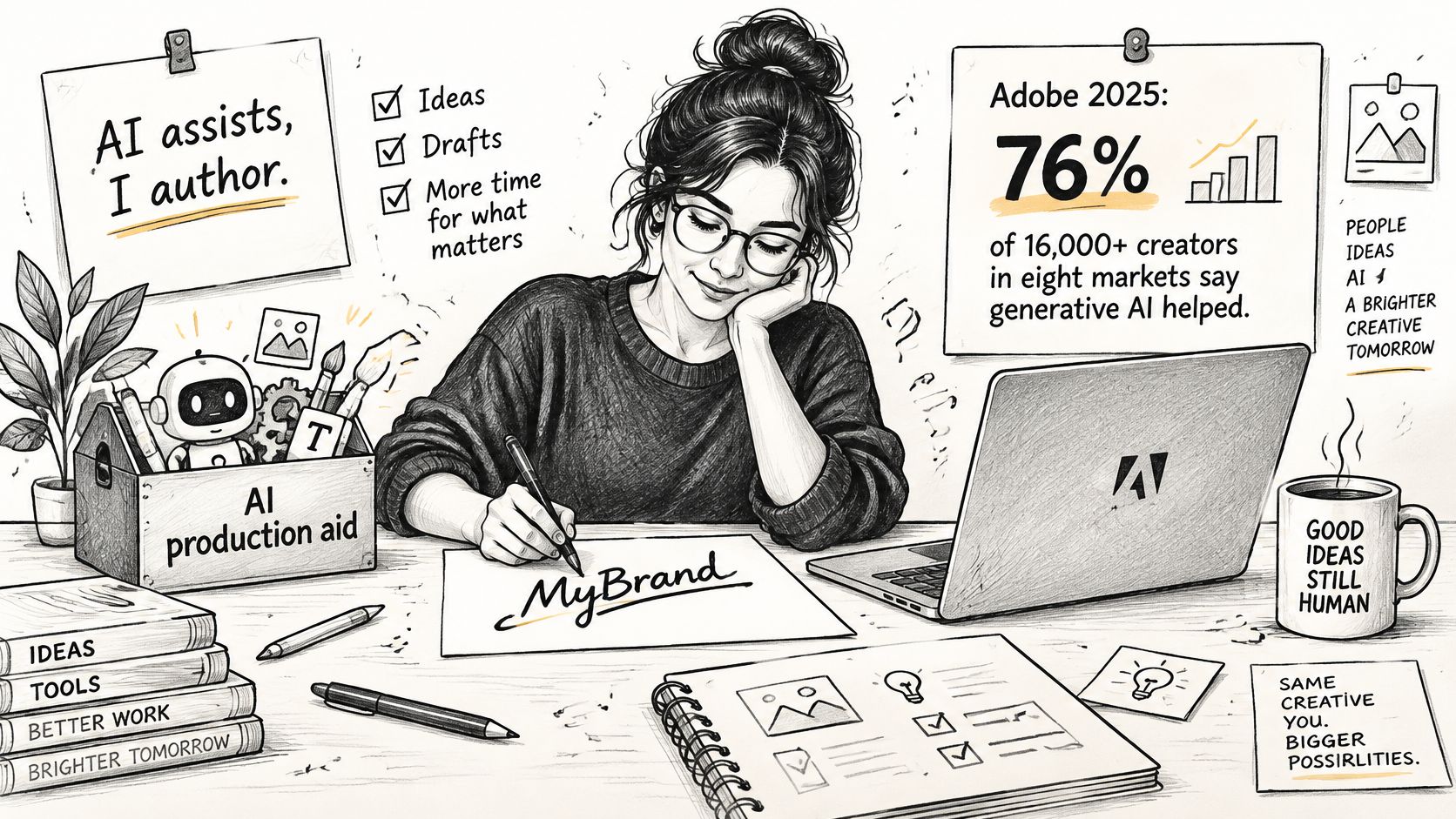
AI can speed production and still make the brand easier to ignore. Adobe's 2025 global survey of more than 16,000 creators across eight markets found that 76% said generative AI helped grow their business or personal brand, while 69% were concerned about their content being used to train AI without permission. Speed helps with packaging. Judgment is what makes the package worth opening.
The practical gap is narrow. A buyer does not need to know which tool touched the draft. They need to see that the conclusion came from your work, your standards, and your lived constraints.
The desk in the image below is the right mental model: the model sits beside the work, and the notes, the numbers, and the point of view stay on your side of the table.
What the model may touch
Allow outlines, transcripts, headline variants, and cleanup. These are assembly tasks, similar to laying out the shelf before stocking it. The product still needs to come from somewhere real.
Keep the opinion, the client numbers, and the failure in your own words. Label synthetic images. Label any passage that is substantially model-written, even if you edited the adjectives. Disclosure works like a receipt: it tells the reader which part of the work came from where.
Read every draft aloud. Cut lines that could belong to any consultant in the niche. If the sentence would still be true with your name removed, it is not proof.
Do not upload private client files, contracts, or unpublished numbers into a public model. A faster draft is not worth a confidentiality breach. A buyer who later recognizes their numbers in a generic post will not trust the rest of the brand.
| Task | Who does it | Disclosure or control |
|---|---|---|
| Outlines, transcripts, and headline variants | AI allowed | Mark any passage that is substantially model-written |
| Opinion, client numbers, and the failure | Human only | Keep firsthand proof in the published piece |
| Synthetic images | AI allowed | Label them as synthetic |
| Statistics and identifiable client stories | Human source note | Get permission when the client can be identified |
| Private client files, contracts, and unpublished numbers | Do not upload to a public model | Leave them out of the tool |
Keep a source note for every statistic and for every story taken from client work. If the client can be identified, get permission before you publish the detail. "A founder in Europe" is still identifiable if the invoice amount and the city are both in the post.
Once a month, mark every post that has no personal evidence. Rewrite it with a constraint, a number, or a mistake, or delete it. Polished paragraphs with no scar tissue are the ones a model can imitate next week. A post with a failed assumption, a fixed process, or a clear trade-off gives the reader something a generic model cannot supply on demand.
Use AI for the mechanical layer. Keep the evidence layer under your control. That split is what turns content into a portable proof system you can carry across platforms, email, and search.
A short walk-through of where human judgment still has to sit in the draft is worth watching before you set next week's rules.
More automation can raise volume while making you easier to skip. Original judgment is the asset buyers are paying for. If the model wrote the stance, you have a publishing habit rather than a brand.
Own the Audience When Platforms Shift
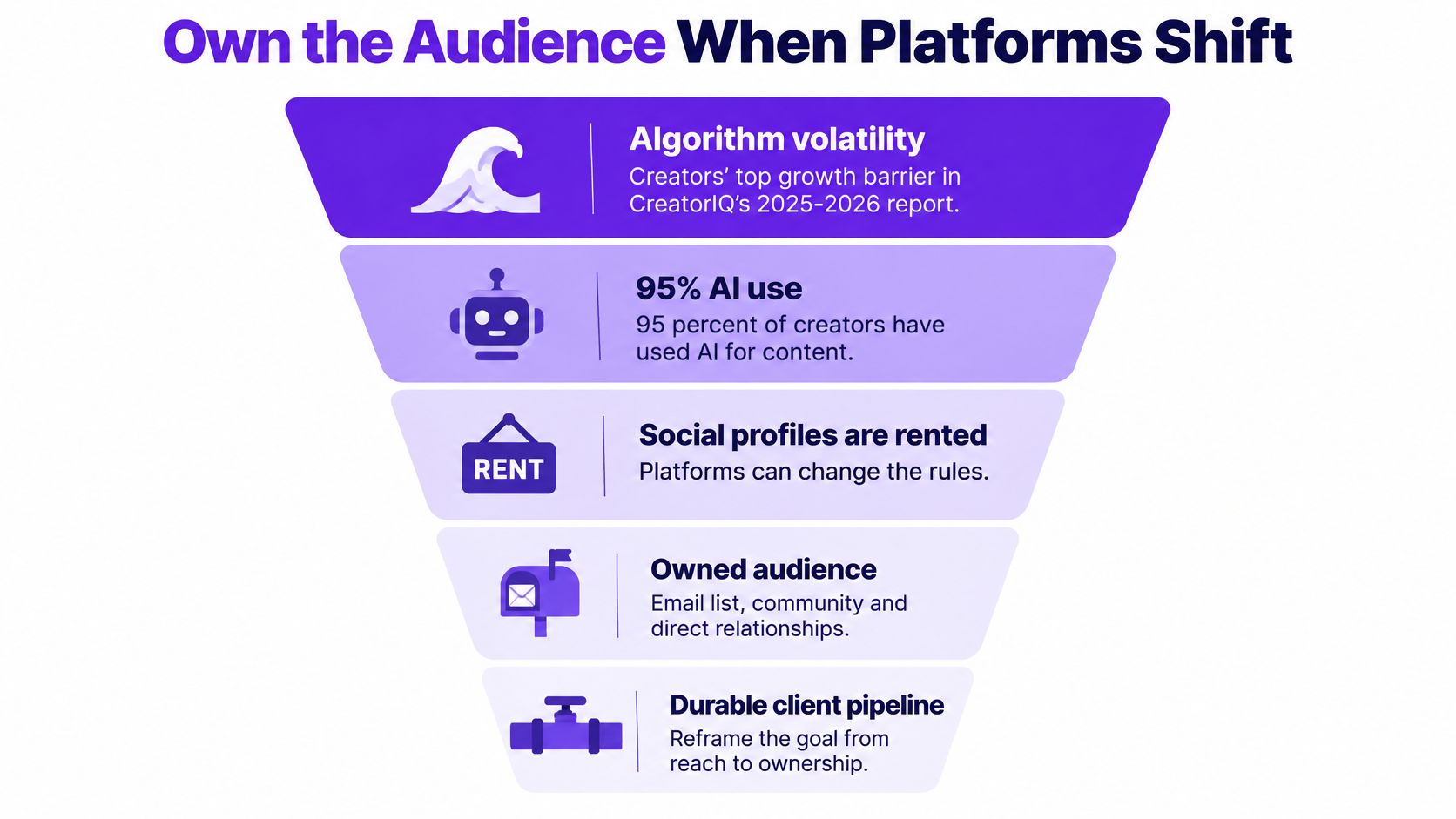
CreatorIQ's 2025–2026 industry report identifies platform algorithm volatility as creators' number-one barrier to growth, and reports that 95% of creators have used AI for content creation. Faster posting doesn't fix a channel you don't control. It can make you more dependent on it.
Social profiles are for discovery. The brand is resilient only if a qualified person can still be reached when reach drops, a rule changes, or an account is limited.
| Channel | Role | What you keep | Resilience metric |
|---|---|---|---|
| Social profile | Discovery | Little beyond the profile itself | Visits that become subscribers |
| Email list | Direct contact | Permission to write again | Sign-ups and reply rate |
| Searchable website | Durable proof | The URL and returning readers | Returning visitors and inquiries |
| Community or CRM | Known buyers and peers | Names and history | Referrals and repeat work |
Follower count isn't on that list on purpose. It doesn't survive a rule change, and it doesn't tell you whether anyone would answer an email.
Move one proof asset without copying it
Take the worked example, the invoice-cycle note, and give each version a different job.
The short post names the constraint and the result, then asks for the email. The email shows the decision rule and one failure, which is too long for the feed and more useful to someone already interested. The site page holds the full case so a buyer who searches your name six months later still finds it. Same facts, three jobs. Paste-and-repost is how you train people to mute you.
Email marketing best practices matter here because the list is the asset you still have on a quiet week. A signup with no next letter is just another rented promise.
A light exit routine
Export contacts on a set day, such as the first Monday of the month. Keep a backup way to write to current clients that doesn't depend on the social inbox, whether that's email or the thread you already use for delivery. Once a quarter, try to create one inquiry without a new social post: a letter to the list, a page update, or a direct note to past clients.
If the only way a new client can find you is a feed you don't control, you don't have a brand yet. You have a lease.
This matters more when the work is location-independent. Payments, time zones, and clients already sit in different countries. A dead platform can hit marketing and cash flow in the same week, because the profile was also how new invoices started.
Name the single channel you would still have if your main profile went quiet tomorrow. If the answer is "none," that channel is the build for this month, ahead of another posting streak.
Ship the First Proof Asset This Month
Don't try to stand up a full content engine in 30 days. Ship one asset a stranger could forward.
Week one: write the positioning line and choose the pillars. If the line doesn't name a paid problem, stop and fix that before you draft anything else.
Week two: document one client or personal workflow. Include the constraint, one number, and one mistake. Leave out private files. FoPost's guide to shipping in public is a useful check so the story teaches the work without turning a client's details into content.
Week three: publish that proof across the four-post roster and ask interested readers to join an email list. One asset, four jobs, one next step.
Week four: record inquiries and replies, label any AI help you used, and export the new subscribers. If a post has no personal evidence, it doesn't count toward the month.
The standard is one useful asset, not an overnight reputation. Our Build section covers marketing, growth, and monetization if you want the operating side of a location-independent business next to the brand work. We also publish free resources on travel hacks, entrepreneur insights, and remote work strategies, and our community is a place to compare notes with other remote founders, find a mentor, and test whether the positioning line is clear to peers. None of that is a blueprint for overnight success. The point is working smarter over a longer stretch than one viral week.
If the month produces no qualified reply, rewrite the problem you're solving before you publish more. Another month of posts on the wrong problem just makes the miss louder.
Mazurly helps globally mobile founders, freelancers, and consultants turn scattered growth and cross-border admin into workflows they can run. If you're building a personal brand that has to travel with the work, start with the practical guides on marketing, money, and remote operations at Mazurly. Sign up for the free entrepreneur and remote-work notes, or bring your positioning line into the community and see whether another operator can repeat the offer back to you.