
How to Monetize a Blog: Revenue Models That Actually Pay
Table of contents
- Compare the Main Blog Revenue Models at a Glance
- Read the comparison without mistaking revenue for profit
- Match the model to the reader's next action
- Choose a Model That Fits Your Traffic and Stage
- Compare the money left after delivery
- Check whether the model travels with you
- How to Set Up Your First Revenue Path in Six Steps
- Build the decision page
- Connect the follow-up to the original problem
- Measure Revenue and Protect It When Search Drops
- Measure reader value alongside ad performance
- Plan for losing a discovery channel
- Price Your First Sponsorship or Service
- Make the offer specific enough to evaluate
- Sell a defined result rather than unlimited availability
- Pick Your First Monetization Step This Month
- Set the review date before publication
Affiliate links generated about $113 billion in U.S. e-commerce sales during 2024, equivalent to 9.4% of total U.S. e-commerce sales, according to industry research summarized by Ahrefs. That reframes how to monetize a blog: you don't necessarily need your own product. You need to help the right reader make a useful purchasing decision.
But commercial value isn't the same as take-home income. A blog can generate sales for merchants while earning modest commissions, or sell an expensive service that leaves little after delivery costs. For a location-independent operator, the better question is which model produces a worthwhile contribution margin and remains workable when traffic, payment access, or your country of residence changes?
Compare the Main Blog Revenue Models at a Glance
Blog revenue models compared
Outrank's guide to turn blog traffic into revenue reports a 2025 survey comparison of $33.80 per 1,000 pageviews for ad-led blogs against $283.64 for blogs selling their own digital products, the figures used below.
| Model | What it needs | Revenue signal | Main risk |
|---|---|---|---|
| Display advertising | Steady monthly pageviews and fast, clean pages | $33.80 per 1,000 pageviews for ad-led blogs in the cited survey | Search losses can reduce income |
| Affiliate marketing | Buyer-intent articles and tracked links | Qualified purchases generate commissions under merchant terms | Commission terms change; disclosure is required |
| Sponsored content | A defined audience and a media kit | Negotiated payment for agreed deliverables | Irregular deals and weak brand fit |
| Own digital products | Trust, an email list, and fulfillment | $283.64 per 1,000 pageviews in the cited survey | Refunds, taxes, and support time |
| Services and consulting | Demonstrable expertise and paying clients | Agreed project fees, hourly charges, or retainers | Delivery consumes your capacity |
| Memberships and subscriptions | Recurring value and reliable delivery | Subscription payments less cancellations and servicing costs | Churn and ongoing obligations |
The nonnumeric cells describe how payment happens, not published earnings benchmarks. Missing earnings figures don't mean those models produce no revenue.
Read the comparison without mistaking revenue for profit
The digital-product result is roughly eight times the ad-led result in that comparison. It isn't an average for all bloggers, and it doesn't establish that switching models would give your blog the same outcome. The comparison doesn't isolate audience intent, product quality, acquisition costs, or the work required to support buyers.
The same Outrank account reports a median of 12 months to a first dollar and 36 months to full-time income. Treat those as reasons to budget for a slow start, not deadlines your blog should meet. Keep hosting, software, and production commitments affordable while you test demand; use an online business startup-cost checklist before taking on recurring expenses.
Match the model to the reader's next action
In a survey of 9,500 creators, only 2% identified a blog or website as their largest audience channel, while 25% identified it as their largest revenue source, according to Blogging Wizard. That doesn't prove websites outperform social platforms for everyone. It does suggest that audience size and commercial usefulness are different measures.
A practical mix can pair a traffic-based model, such as advertising, with a trust-based model, such as a product, and a time-based model, such as consulting. Don't launch every option simultaneously. Note which two rows fit the audience you already have, including what readers ask, what they buy, and whether they want advice or implementation.
Choose a Model That Fits Your Traffic and Stage
How much traffic and how many plausible buyers do you have today? Those aren't interchangeable. A reader asking for help with an invoicing workflow may be closer to purchasing than someone browsing a destination roundup.
Services and consulting can be sold with little or no blog traffic, whereas premium advertising networks require substantially larger audiences. That makes a narrowly scoped service worth evaluating early, provided you can demonstrate competence and deliver without exhausting your publishing time.
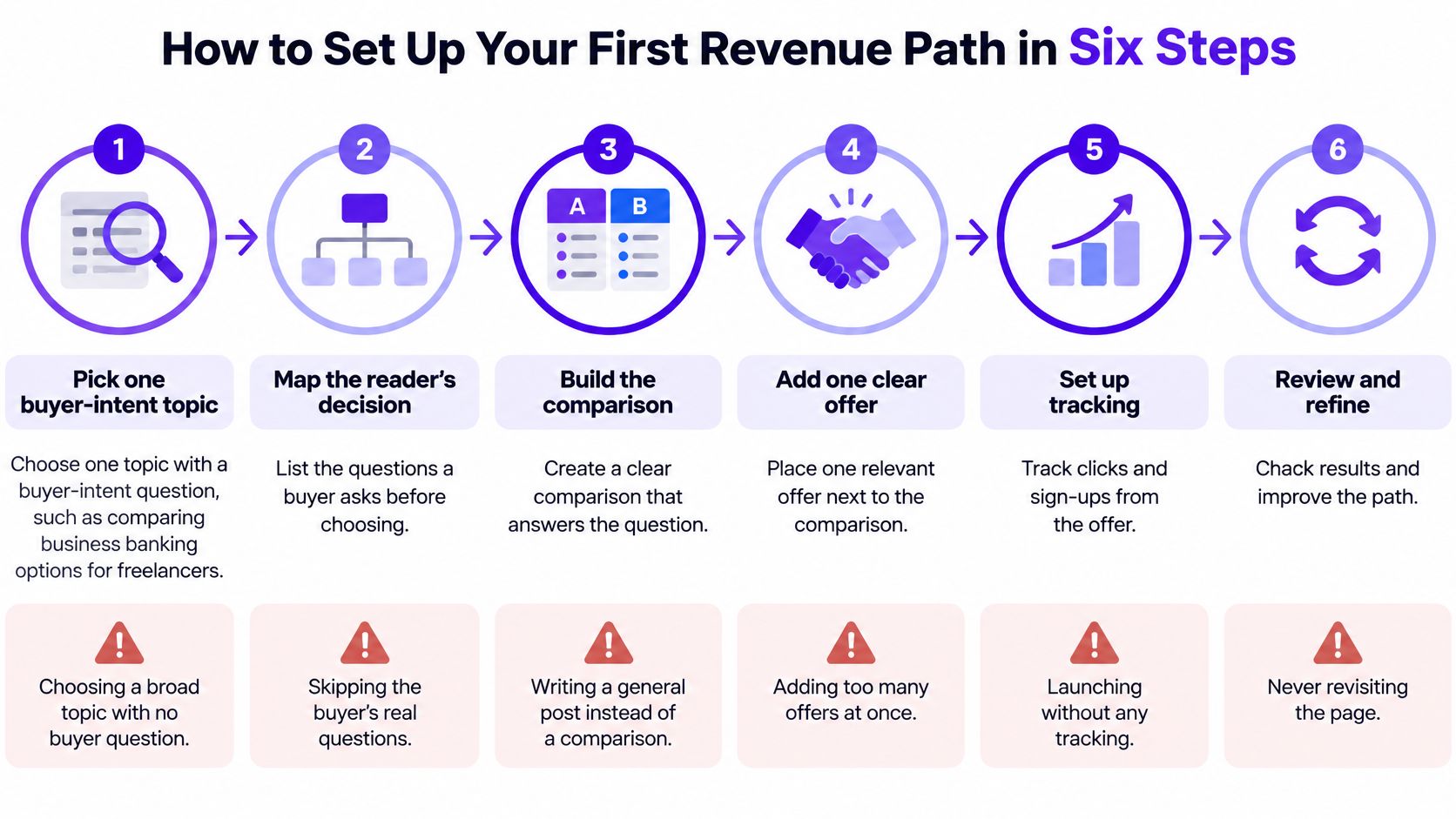
Use this buyer-intent workflow to connect your audience question to an offer.
Compare the money left after delivery
Contribution margin is revenue minus the costs directly associated with acquiring and fulfilling that revenue. It isn't final profit: general overhead and your own income-tax obligations still need separate treatment.
Say you plan to serve a small batch of consulting clients at a fixed project fee. Compare that scenario with earning advertising revenue from thousands of pageviews, using your actual fees and traffic estimates rather than a borrowed income promise.
| Calculation | Consulting scenario | Advertising scenario |
|---|---|---|
| Gross revenue | Paying clients × agreed project fee | Monetized pageviews × page RPM ÷ 1,000 |
| Acquisition costs | Outreach, sales calls, paid promotion | Content production and promotion attributable to traffic |
| Fulfillment costs | Contractors, project tools, delivery expenses | Ad-related technical work and direct operating costs |
| Transaction and compliance costs | Processing, refunds, applicable administration | Payout deductions and applicable administration |
| Capacity check | Remaining margin ÷ delivery and sales hours | Remaining margin ÷ publishing and maintenance hours |
Don't hide your labor because you aren't paying yourself yet. Track it separately so a service with positive cash contribution doesn't become a poorly paid job.
For affiliate offers, use Affiliate Landscape's top affiliate picks for blog monetization as a shortlist, then inspect the merchant's actual eligibility, attribution, reversal, and payout terms. A generous advertised commission is irrelevant if your readers can't buy the product.
The accompanying video offers another format for considering monetization options.
Check whether the model travels with you
Before selling internationally, check VAT or sales-tax exposure where customers live, supported currencies, contractor income classification, and payout availability in your country. Don't assume the same rules apply to consulting, downloadable products, and subscriptions. Confirm the relevant treatment with the tax authority or a qualified cross-border adviser before opening checkout.
Multi-currency pricing also needs a policy: decide who bears conversion costs and which currency governs refunds. Otherwise, apparently profitable orders can leave you absorbing charges you never included in the price.
Answer these questions with yes or no:
Is there a buyer-intent question in your niche? Yes points toward affiliate comparisons or a focused product; no suggests clarifying the problem before adding offers.
Can you serve a small client batch this quarter? Yes makes services testable; no favors models without individual delivery commitments.
Can you meet the applicable customer-country tax rules? Yes keeps direct sales under consideration; no means resolving compliance before launch.
Do readers already ask for help by email? Yes provides a starting point for a service or product; no calls for more demand discovery.
These answers narrow the options. They don't establish profitability until you complete the cost calculation.
How to Set Up Your First Revenue Path in Six Steps
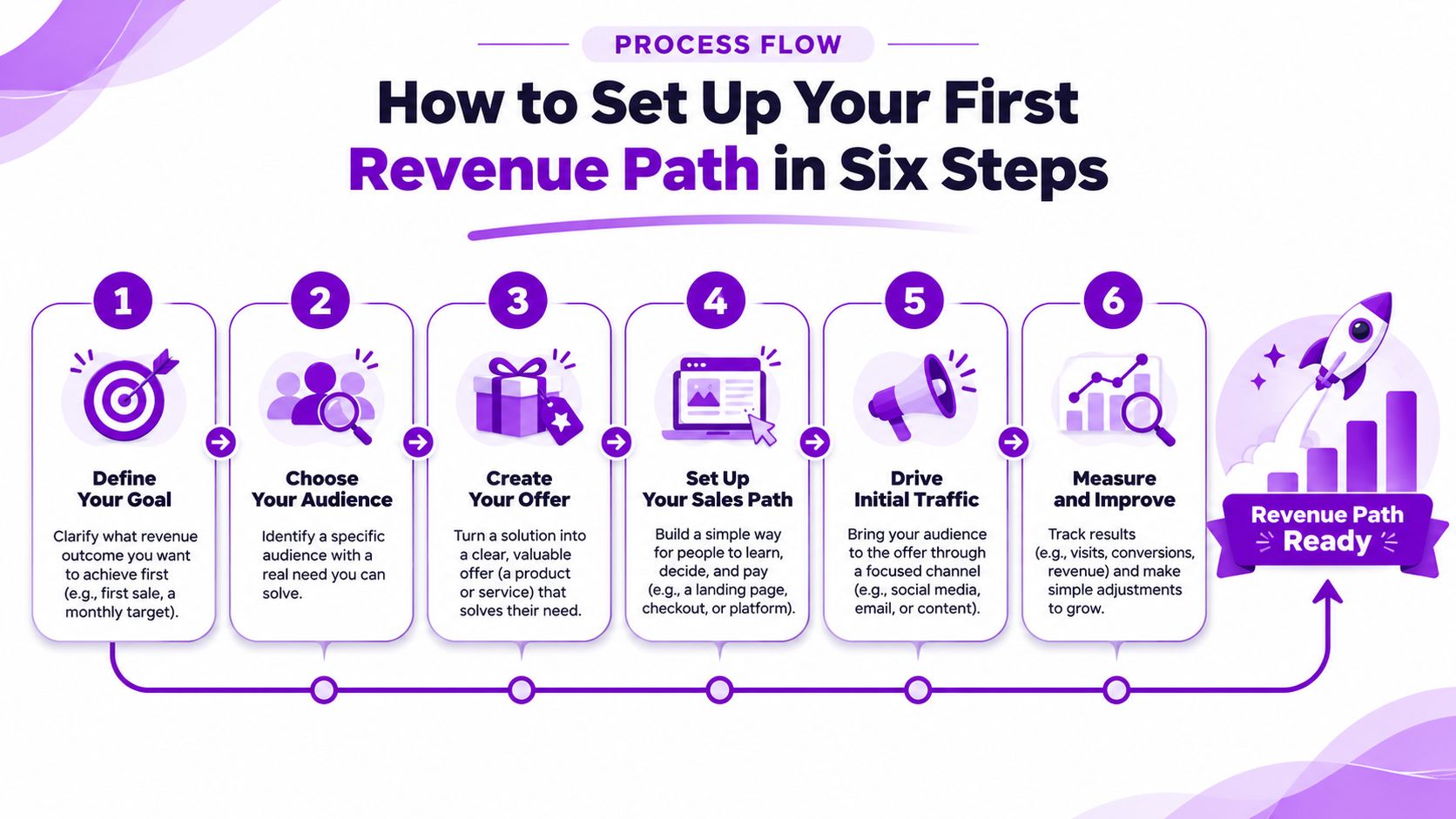
Build a single measurable path from a reader's question to an appropriate offer. Buying more software won't fix a page that attracts the wrong audience or a lead magnet that solves an unrelated problem.
The workflow below keeps content, email capture, and purchase tracking connected.
Build the decision page
Pick a topic with a buyer-intent question. Comparing business banking options for freelancers gives you a concrete decision to address: eligibility, supported countries, currencies, and operational fit. Avoid choosing a broad topic merely because you can write extensively about it; identify what the reader needs to decide before you draft.
Write around the decision and put your verdict near the top. State who each option suits, explain your evaluation criteria, and distinguish documented features from your judgment. The common slip is burying the answer beneath background material, forcing a ready buyer to search for the recommendation.
Place a useful email opt-in on the first screen. Offer a decision aid, such as a banking comparison worksheet or an invoicing setup checklist, with clear consent language and an accessible unsubscribe option. Don't conceal the form at the bottom or block the article with an intrusive popup; readers should understand both the benefit and what they'll receive afterward.
Add a relevant offer where the reader is deciding. Place affiliate or product links beside the comparison, verdict, or implementation instructions, and make the commercial relationship visible before readers act. Avoid introduction-only links and commission-led rankings; explain unsuitable use cases as clearly as suitable ones.
Connect the follow-up to the original problem
Segment subscribers and create a short welcome sequence. Tag subscribers by the problem attached to their signup, then deliver the promised resource, explain a useful next step, address an objection, and present the relevant offer. Don't send a cross-border finance subscriber an unrelated productivity pitch because both belong to a remote-work audience.
Tag acquisition links and review purchases by source. Use consistent UTM campaign names on email and external promotional links, record offer clicks and signups as events, and keep a consistent attribution window. Don't add UTMs to internal navigation, which can confuse attribution, or interpret an email open as evidence that someone wants to buy.
Omnisend's 2025 dataset, covering more than 20 billion emails from over 27,000 brands, found automated emails generated $3.41 per send versus $0.155 for campaign emails, with conversion rates of 1.49% versus 0.08%, according to its email marketing benchmarks. Those are brand-email results, not expected earnings for a beginner's blog. The practical lesson is to test relevant, behavior-triggered follow-up rather than assume broadcast newsletters are sufficient.
Practical rule: Your welcome sequence should continue the decision that brought the reader to the page, not introduce a different business.
Use this measurement model for your direct-product funnel:
Article visitors × opt-in rate × sequence purchase rate × average order value
Track each component separately. For affiliate revenue, substitute attributable commission per converted subscriber rather than the merchant's full order value.
Apple Mail Privacy Protection makes open rate directional, so prioritize clicks, purchases, and replies that reveal a specific need. Suppress inactive subscribers according to a documented policy and use email marketing best practices to maintain a consent-based list.
A practical first-week target is one published decision page, one functioning opt-in, one tested sequence, and recorded offer clicks. Send a test signup through the entire flow yourself, including the download and checkout destination. A working path matters more than a larger collection of disconnected pages.
Measure Revenue and Protect It When Search Drops
Monthly advertising revenue = monetized monthly pageviews × page RPM ÷ 1,000. RPM means revenue per thousand views in this calculation. Keep page RPM separate from session RPM, because a session can contain multiple pageviews.
The Adstimate advertising optimization guide gives these directional examples at 100,000 monthly pageviews, using RPMs of $3.50, $11.50, and $35 to estimate monthly revenue of about $350, $1,150, and $3,500, respectively.
Ad revenue at 100,000 monthly pageviews
| Site type | RPM | Monthly revenue |
|---|---|---|
| Generalist site | $3.50 | About $350 |
| Technology site | $11.50 | About $1,150 |
| High-value specialist site | $35 | About $3,500 |
These are publisher benchmarks, not guaranteed rates. Equal pageview totals can produce very different revenue, so evaluate niche, audience geography, and monetization quality rather than buying traffic to reach an arbitrary volume.
Measure reader value alongside ad performance
Create a dashboard that separates gross revenue, contribution margin, and audience behavior. Blog Health App's GA4 setup guide for bloggers can help with the analytics implementation; reconcile tracked events against payment records before treating them as financial totals.
Use a small set of clearly defined measures:
Revenue per thousand sessions: Compare page templates and acquisition channels using the same denominator.
Revenue per email subscriber: Divide attributable email revenue by your defined subscriber cohort during the reporting period.
Returning-reader revenue: Separate purchases associated with repeat visits from first-visit purchases.
Revenue by device: Check whether mobile readers encounter a broken form, difficult checkout, or disruptive ad layout.
Contribution by offer: Deduct refunds, transaction charges, and direct delivery costs rather than ranking offers by sales alone.
For advertising tests, change one layout variable, such as position, while monitoring viewability, fill rate, scroll depth, and engagement. More visible ads aren't automatically a better outcome if readers stop reaching your comparison, signup form, or checkout.
Avoid excessive ad density, intrusive mobile interstitials, invalid traffic, and thin pages created only to generate impressions. Improve technical SEO and Core Web Vitals without treating an ad-revenue increase as permission to make the page harder to use.
Plan for losing a discovery channel
Google referral traffic fell a median 10% year over year across Digital Content Next members during May–June 2025, with non-news publishers declining 14%, according to Digiday's account of the publisher findings. That describes participating publishers, not every blog. It still identifies a risk worth planning for: you can't control whether a search engine continues sending readers.
Separate your revenue by how buyers arrive, not just what you sell. Display ads and affiliate posts reached primarily through search are discovery-dependent. Consulting, templates, communities, and subscriptions bought through an established email relationship belong to an owned-audience strategy.
A product isn't automatically resilient merely because you own it. If every sale requires a new search visitor, the acquisition risk remains.
An owned audience gives you a way to contact willing readers again. It doesn't guarantee that they'll purchase.
Stress-test the business by removing search-driven revenue from your forecast. Ask whether repeat buyers, direct visits, referrals, and permission-based email can still cover direct costs and essential overhead.
Then evaluate each channel using the same operational checklist:
| Dimension | What to check |
|---|---|
| Portability | Can you deliver and administer it from your likely destinations? |
| Payment friction | Can customers pay and can you receive funds without costly workarounds? |
| Tax complexity | Can you reliably handle the applicable obligations? |
| Platform dependence | Could a merchant, network, marketplace, or search provider interrupt revenue? |
Cross-border freelancers factor transfer fees, currency conversion, withholding taxes, and platform fees into the calculation before accepting a rate. Apply the same discipline to blog offers.
Mark each dimension acceptable, unresolved, or blocking. Address blocking issues first, then reduce dependence on the channel whose interruption would remove the most contribution margin. Diversification should protect the business you have, not create extra administration without meaningful income.
Price Your First Sponsorship or Service
Price the commitment before you pitch it. A sponsorship fee must cover production and negotiated rights; a service price must cover delivery, communication, and the risk of unclear scope. Neither should begin with what another blogger claims to charge.
Make the offer specific enough to evaluate
Build a one-page media kit around audience relevance. Include current monthly pageviews, email subscribers, top countries, the audience niche, and the period each measure covers. Describe available placements without promising sales you can't substantiate; the slip is quoting a rate without showing who reads the blog.
Pitch a brand whose product fits an existing reader decision. Propose a placement on a relevant page or in a matching email segment, and explain why that audience would care. Specify deliverables, publication timing, revision limits, disclosure, reporting, and any usage or exclusivity rights; don't accept unrelated offers that make future recommendations harder to trust.
Sell a defined result rather than unlimited availability
Package a fixed-fee service with boundaries. An analytics tracking audit, for example, can include an event inventory, a findings document, and an agreed handoff, while excluding implementation unless separately purchased. Use a freelance service-pricing guide to work through scope and costs; avoid selling open-ended access under a project label.
Launch a membership only when you can name the recurring value. A maintained template library or scheduled community discussion needs an owner, a delivery process, and a clear cancellation policy. Don't open a paid tier merely because subscriptions sound predictable; subscribers need a reason to stay after consuming the initial material.
For uncertain service work, use a paid scoping phase or hourly diagnosis before committing to a fixed project price. Where client actions materially determine the result, separate delivery fees from any performance bonus tied to agreed measurement rules.
Pricing safeguard: Put revision limits, exclusions, payment timing, and acceptance criteria in writing before production starts.
Keep a recurring stream alongside irregular sponsorship income, but distinguish signed commitments from hoped-for renewals. A booked project can support planning; an unanswered pitch can't.
Pick Your First Monetization Step This Month
Choose a primary model and a secondary model using your buyer signals, capacity, and margin calculation. Then commit to one launch action this month. Don't spread a limited budget across an ad setup, a course, a membership, and a consulting offer before any has demonstrated demand.
For a content-led start, publish a buyer-intent page with an early verdict, attach a decision-specific lead magnet, and connect the follow-up to a relevant offer. If readers already request implementation help, make that offer a clearly scoped service rather than spending the month building an unrequested product.
Set the review date before publication
Schedule a review 30 days after launch as an operating checkpoint, not an income promise. Record these measures using consistent definitions:
Page visitors: Are people reaching the decision page from the channels you intended?
Opt-in rate: Does the resource give those readers a convincing reason to subscribe?
Revenue per subscriber: Does the follow-up produce attributable revenue after allowing for refunds?
Low opt-ins call for checking the lead magnet, form placement, and audience match. Strong offer clicks with weak purchases call for inspecting eligibility, checkout friction, and the offer itself before producing more traffic. With a small sample, treat the result as a reason to investigate, not proof that a model has failed.
Keep the successful parts intact and change one weak point at a time. Your next investment should answer an observed problem, not satisfy an urge to make the business look more established.
The first monetized page matters more than the perfect revenue mix.
Mazurly offers practical guides and tools for building revenue and managing the cross-border operations that affect what you keep. Visit Mazurly for business-growth and operational resources, and sign up by email to receive free travel hacks, entrepreneur insights, and remote work strategies.