How to Start Online Business with No Money in 2026
Table of contents
- Which Low-Cost Business Model Fits Your Skills
- Choose the shortest route from skill to payment
- Test Demand and Run the 90-Day Gates
- Run a short paid-demand test
- Extend the test into an operating cycle
- What Your First $1,000 Actually Has to Cover
- Allocate receipts before buying tools
- How to Land Your First Paying Clients Safely
- Make outreach specific and payment terms explicit
- Confirm Your First Offer and Launch This Week
- Turn the offer into a purchasing decision
The most popular advice about starting an online business with no money is to open a free store, post on social media, and wait for customers. That gets the order wrong. A free storefront doesn't solve the harder problem: getting paid before expenses, delivery work, and everyday bills exhaust your available cash.
If you're figuring out how to start an online business with no money, treat it as a cash-flow problem, not a promise that everything will be free. Start with an outcome you can sell using skills and equipment you already have. Then build the smallest operation that lets you deliver it, collect payment, and keep enough cash to continue.
Which Low-Cost Business Model Fits Your Skills
Low cash isn't the same as zero cost. You'll spend time learning, finding buyers, and delivering work even when your software bill is empty. The right starting model is the one you can sell before committing to expenses you can't reverse.
The U.S. Census Bureau's Nonemployer Statistics track businesses with no paid employees, which makes solo operation a recognized business structure rather than an informal stage before hiring. That says nothing about your odds of success. It does remove the assumption that a legitimate business needs a team.
Low-cost online business models compared
| Model | Cash needed to start | Time to first payment | Skill it relies on | Main risk |
|---|---|---|---|---|
| Freelance service, such as writing, design, or virtual assistance | Near zero with existing equipment | Fastest when you can approach existing contacts | A skill you already have | Income concentrated among a few clients |
| Consulting or coaching call packages | Near zero | After buyers trust your expertise | Domain expertise and credibility | Slow trust-building |
| Done-for-you research or lead generation | Near zero using manual methods | After agreeing on a useful deliverable | Research and prospecting | Client acquisition effort |
| Downloadable templates made with free tools | Near zero to low | Slower without an audience | Design and niche knowledge | Discovery, refunds, and copying |
| Print-on-demand or dropshipping store | Low to moderate | After product and channel testing | Marketing and product selection | Acquisition costs and thin margins |
Read the table as a filter, not a menu. The two columns that matter most with an empty bank account are cash needed and time to first payment. A model that costs nothing to open but pays in six weeks still strains a zero-balance launch.
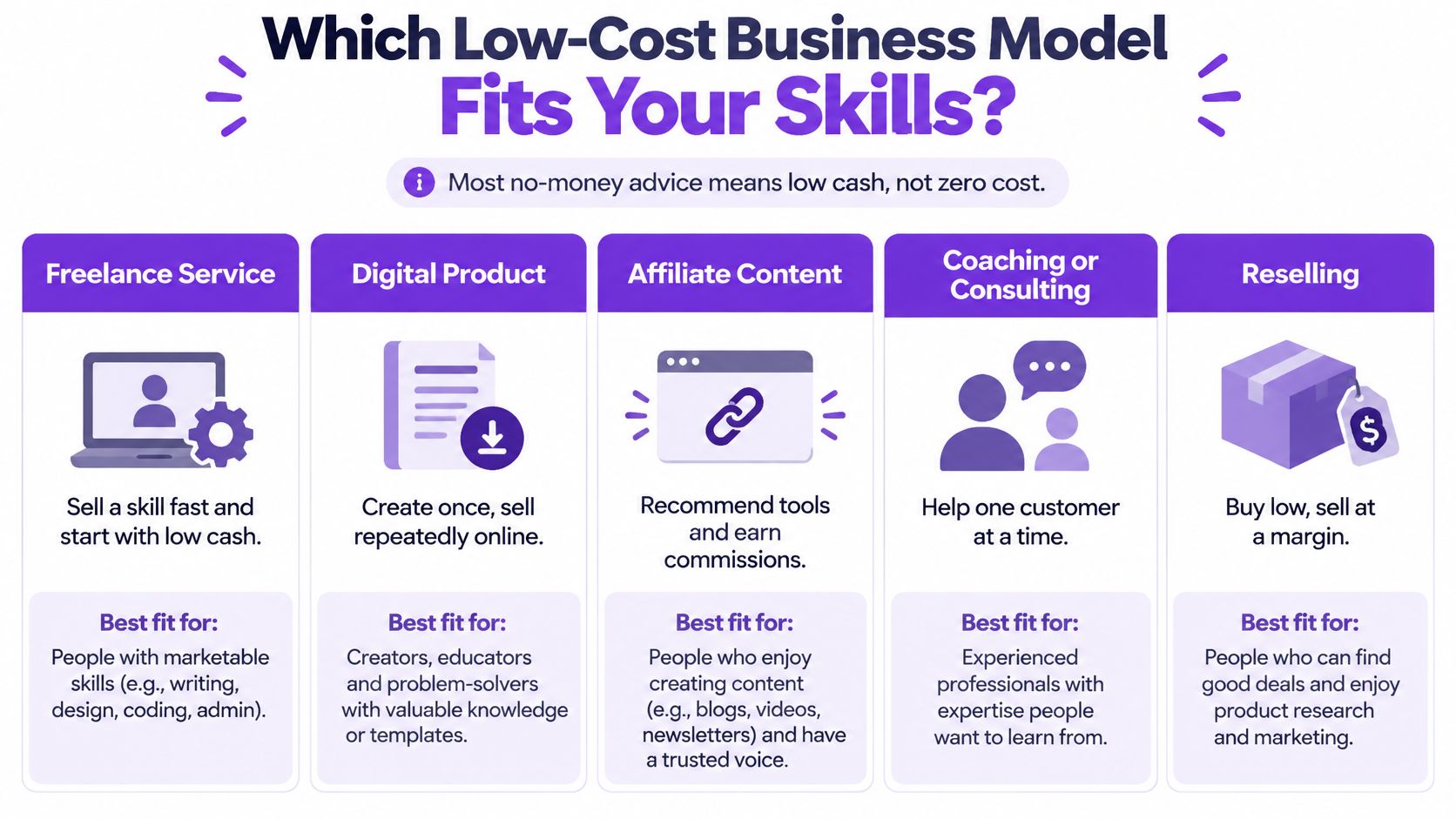
Choose the shortest route from skill to payment
Services usually offer the cleanest cash sequence: agree on work, collect an initial payment, deliver with tools you already own. A store introduces supplier payments, returns, fulfillment issues, and customer-acquisition work. Skipping inventory doesn't remove those obligations. Selling through a marketplace or storefront platform adds a different one: account holds, payout delays, and rule changes can freeze revenue you were counting on. I favor models where you invoice the client directly, because you control the gap between work done and cash received.
Say a former bookkeeper offers monthly reconciliations to small shops. The buyer understands the task, and the founder can prove competence with a sample workflow. A language teacher could sell a fixed-price onboarding lesson to newly arrived expats, focused on practical conversations rather than an open-ended course. Both offers can be fulfilled this week, with no tool purchase in between.
Find Startup Idea's quick demand tests for solo founders can help turn a broad ability into a testable offer. If your ambition is software, scan complaints in niche forums and product reviews for problem prompts, and look through lists of micro-SaaS ideas to see which problems repeat. Then check whether you can deliver the result manually before building anything.
Selection rule: Choose work you can already perform competently, for buyers you can reach directly.
Before committing, ask: can you name prospective buyers who could realistically purchase this outcome soon? If you can name only a demographic, you haven't narrowed the offer enough. Ask a second question too: who holds the money between delivery and payout? The shorter that answer, the safer your first months will be.
Test Demand and Run the 90-Day Gates
Your immediate target is a go or no-go decision, not a finished product. You need to learn whether a reachable customer has an urgent problem and will pay you to solve it.
The U.S. Small Business Administration's planning guidance recommends examining customers and competitors before committing resources, and identifies expenses such as marketing, communications, licenses, and professional services. Convert that planning work into direct conversations rather than a long document built on assumptions.
Use this sequence to keep your first experiment focused.
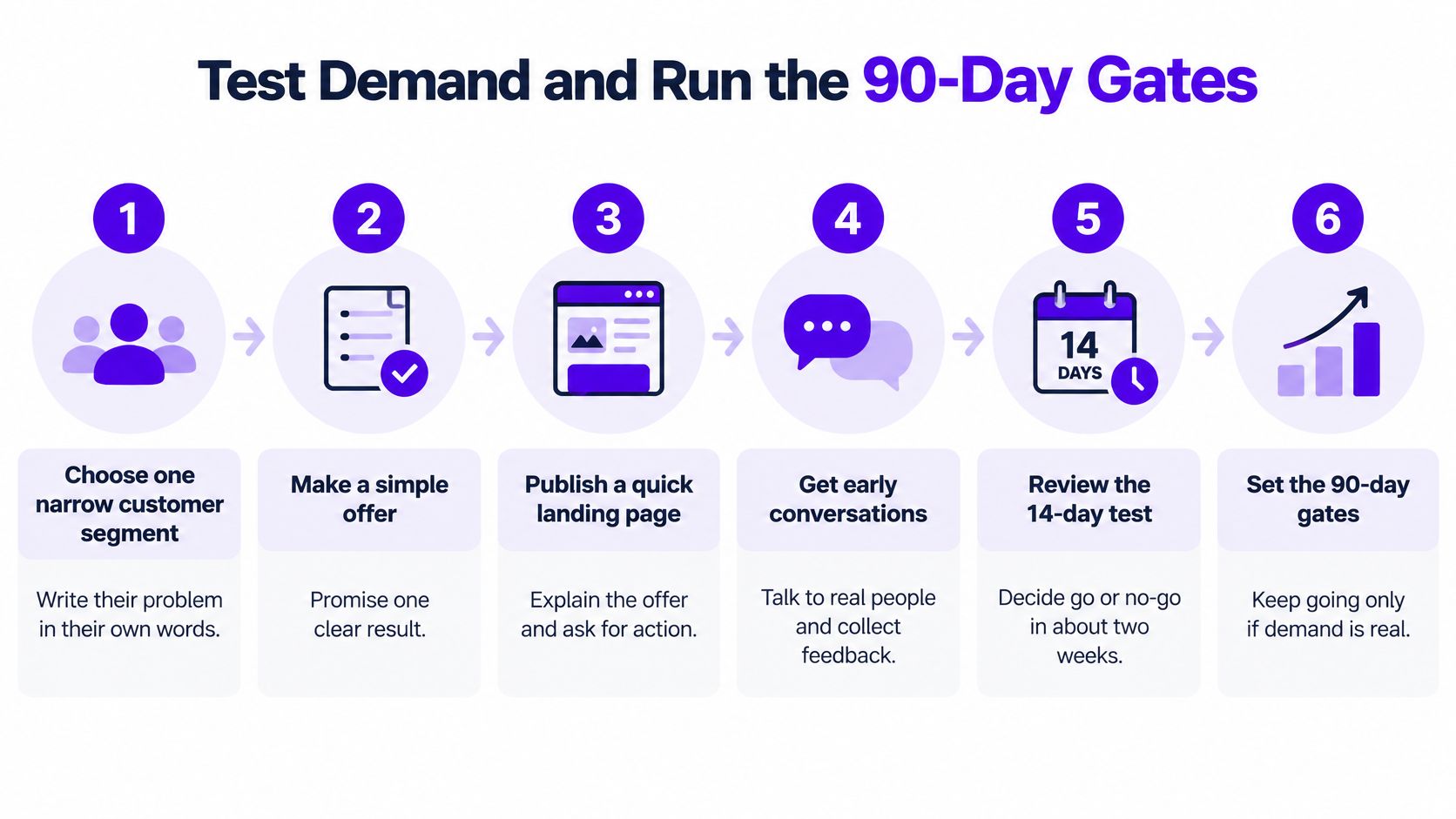
Run a short paid-demand test
Choose a narrow segment. Write down the buyer's role, situation, and problem. Remote consultants struggling to reconcile international client payments are more actionable than people who want financial help.
Interview potential buyers. Ask how they handle the problem now, what makes the current approach frustrating, and when they last paid for help. Ask about actual behavior, not whether they like your idea.
Publish a specific offer. Use a permitted community thread, niche group, or relevant direct message. Name the deliverable, exclusions, completion deadline, and next action.
Request a paid pilot. Offer a bounded piece of work rather than an entire transformation. Explain what the buyer receives and when payment becomes due.
Deliver manually. Use documents, spreadsheets, calls, and checklists. Record preparation, delivery, revisions, and support time, not just the hours spent producing the final file.
Make the decision. Continue when unrelated prospects describe the same painful problem and someone pays. If interest doesn't become payment, change the segment, promise, or route to buyers.
A useful interview question is: “What happened the last time this caused a problem?” It draws out consequences, workarounds, and purchasing context. “Would you use this?” invites encouragement that may never become a sale.
Likes, free sign-ups, and traffic measure attention. A paid pilot tests whether the outcome matters enough to buy.
Keep a simple spreadsheet with lead source, response rate, calls booked, proposals sent, paid conversions, delivery hours, refund requests, and gross margin. Add a short note explaining why each lost prospect declined. A pricing objection and a lack of urgency require different fixes.
Extend the test into an operating cycle
Early revenue isn't proof of durability. The U.S. Bureau of Labor Statistics reports that 34.7% of business establishments born in 2013 were still operating in 2023. Use milestones to decide whether to continue, rather than treating the first sale as permission to spend.
The schedule below is a recommended operating plan, not a forecast of how quickly your business will grow.
90-day launch phases and go or no-go gates
| Days | Focus | Go or no-go gate |
|---|---|---|
| 1 to 14 | Customer interviews and a paid pilot | At least three unrelated prospects share the problem and one pays |
| 15 to 30 | Manual delivery and collecting testimonials | Delivery time falls with each cycle and buyers stay |
| 31 to 60 | One repeatable acquisition channel | Clients arrive without paid advertising |
| 61 to 90 | Retention, referrals, and documented process | Repeat or referral buyers exist and contribution margin exceeds 50% for digital or consulting work |
Treat the margin threshold as a planning target, not an industry average. Calculate contribution margin after variable delivery costs, and examine your own hours separately. A project can look attractive on cash costs while paying poorly for your time.
If you miss a gate, change a specific variable and rerun that phase. Don't rewrite the offer, switch audiences, and change channels simultaneously, because you won't know which change helped.
Use the accompanying video as an additional walkthrough while keeping your own interview notes and payment evidence central to the decision.
At the end of the initial test, you should hold either a paid pilot with documented delivery work or a concrete reason to change direction. Both are more useful than a polished website nobody has purchased from.
What Your First $1,000 Actually Has to Cover
A launch that costs nothing to start can still fail on cash flow. The main constraint on a first $1,000 is timing: clients pay late, processors hold funds, and obligations come due before revenue clears. Separate what you owe from what you can improve, and treat the rest as a buffer rather than spending money.
Startup expenses and the free or low-cost option for each
| Expense | Free or low-cost option | When to pay |
|---|---|---|
| Website | Free builder page or link-in-bio profile | Once an offer converts repeatedly |
| Domain name | Free subdomain first | Once a paid order covers the annual cost |
| Invoicing | Free invoice generator or spreadsheet template | When manual invoice work becomes a bottleneck |
| Scheduling and calls | Free booking page and video-call tier | When necessary calls exceed free limits |
| Payment processing | Eligible per-transaction plan without a monthly fee | On sales under the provider's terms, with a refund reserve |
| Taxes | Reserve a share of payments in a separate account | Set aside on receipt according to local obligations |
| Advertising | Direct outreach, communities, and referrals | After you can demonstrate unpaid acquisition |
| Personal pay | Planned withdrawals from available revenue | After obligations, delivery costs, and a buffer |
Thin startup savings and unpredictable income are separate problems. Keeping setup inexpensive won't help if a delayed payment leaves you unable to finish the work.
Allocate receipts before buying tools
For your earliest receipts, reserve the appropriate tax share first. Then protect the cash needed to fulfill the order, including any licensed assets or subcontracted work already promised. Buy a tool only when it removes a measured bottleneck, and keep an emergency buffer before taking personal pay.
A $1,000 payment is rarely $1,000 in your account. Processor fees, currency-conversion spreads, international bank charges, refunds, and free-tier limits all take a cut or impose a delay. Compare the amount the client sends with the amount you'll receive, and check when it becomes withdrawable before you commit it to anything.
Say a copywriter receives a pilot payment. Reserving tax, postponing the domain purchase, and holding the balance until a second client pays keeps one late invoice from stalling delivery. There is no universal reserve percentage. The right figure follows your local obligations, refund exposure, and delivery commitments.
GetBill's practical billing steps for freelance consultants can help you establish an invoicing routine that shortens the gap between work done and cash received. A startup-cost checklist for online businesses surfaces the expenses you would otherwise discover after quoting a price.
Cash discipline: Don't add a recurring expense until paid work can support it without consuming protected reserves.
Before accepting payment, check your country's registration, tax ID, invoicing, and banking requirements. Keep tax reserves separately where practical so an available account balance doesn't become accidental permission to spend.
How to Land Your First Paying Clients Safely
A free platform isn't a risk-free sales channel. Marketplaces and social feeds can help buyers discover you, but account restrictions, changing reach, and payment holds can interrupt your operation.
The 2025 EPOP findings brief distinguishes freelance participation from digital-platform work in the U.S. entrepreneurial population. That distinction matters: building an independent service business isn't the same as building a marketplace profile.
Keep the relationship professional from the first conversation, even when the work begins through an informal introduction.
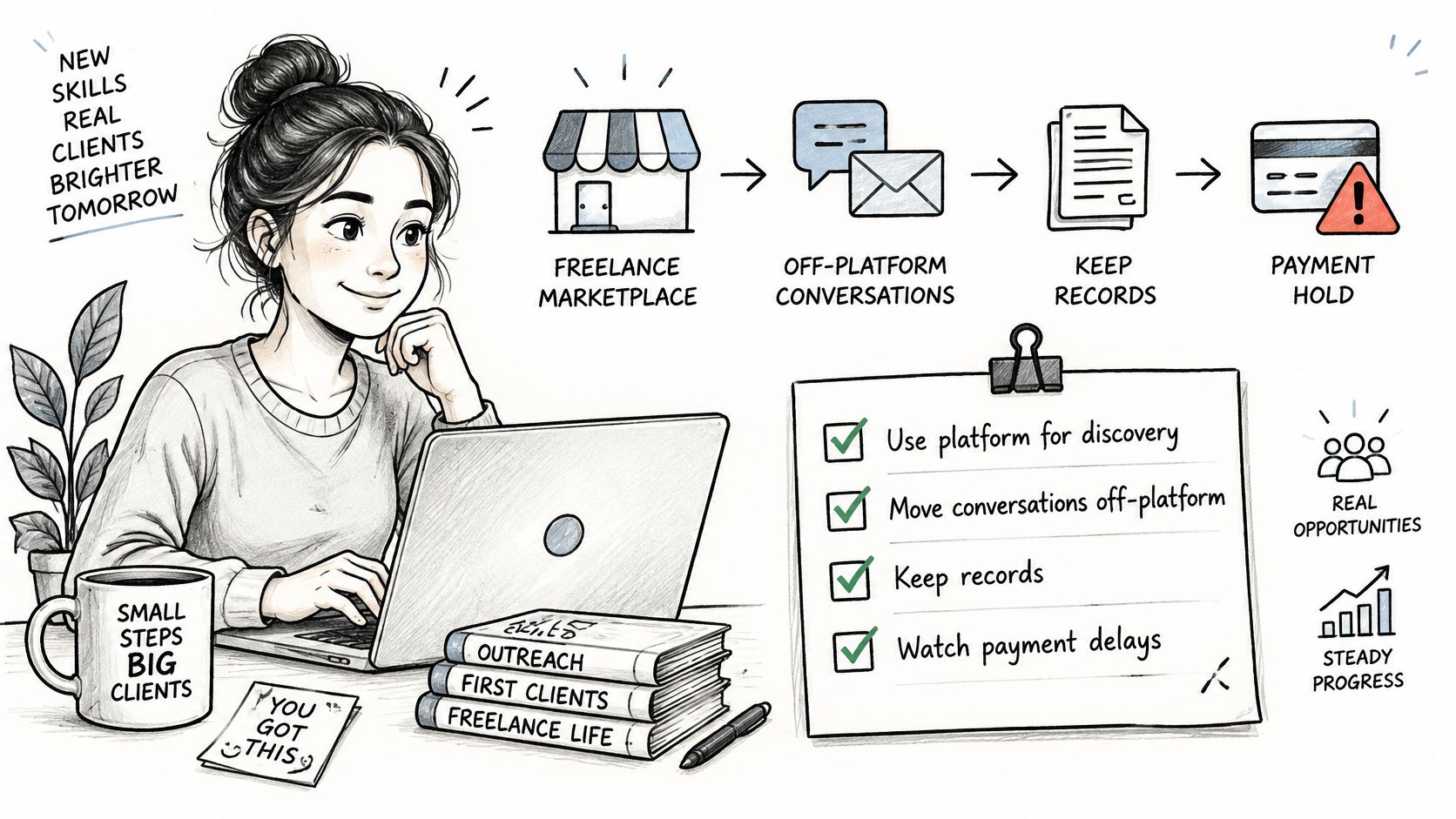
Make outreach specific and payment terms explicit
Lead with a relevant problem. Mention something specific about the prospect's operation, explain the outcome you offer, and ask whether it's a current priority. Don't send an unsolicited attachment or a long biography.
Use platforms within their rules. Treat communities and marketplaces as discovery channels. Request a direct email or booking relationship only where permitted, with consent.
Put scope in writing. Define deliverables, exclusions, client responsibilities, revision limits, approval procedures, and payment dates. Separate additional work from corrections to the agreed deliverable.
Collect against milestones. Request an initial payment or funded milestone before substantial work. Make later deliverables conditional on the agreed payment schedule.
Check cross-border practicality. Confirm supported countries, invoice currency, settlement currency, conversion charges, and withdrawal access before quoting.
Maintain alternatives. Keep a backup acquisition channel and an approved alternative payment route. Complete verification before an urgent invoice depends on either.
Preserve your records. Export permitted contacts, invoices, contracts, and delivery evidence regularly. Store them securely, with access limited to people who need it.
Say a copywriter wins initial projects through a marketplace. Rather than immediately trying to move those customers elsewhere, they complete the work under the platform's terms and ask permission to retain relevant contact details. Separately acquired clients can then receive direct contracts with staged billing.
A second project from the same buyer is a useful point to discuss a more predictable arrangement. Check non-circumvention restrictions first, including any required waiting period or conversion charge. Direct work isn't worth a platform violation.
Use a client onboarding checklist to standardize approvals, access, billing details, and communication expectations. The objective isn't paperwork for its own sake. It's avoiding a situation where you've finished the work but can't establish what was agreed or who should approve payment.
Confirm Your First Offer and Launch This Week
Your next decision is the offer, not the logo. Choose something narrow enough that a buyer can understand it without a presentation and you can deliver it without purchasing a new operating system of tools.
A useful offer names the customer, outcome, price, and deadline. For a bookkeeper, that might be a clearly scoped reconciliation package for shop owners with overdue records. For a teacher, it might be a practical arrival lesson that helps newcomers handle everyday local conversations.
Turn the offer into a purchasing decision
Write the offer in a sentence. State exactly what's included and attach your proposed price and completion deadline. Avoid broad promises such as improving someone's entire business.
Check the wording with prospects. Ask them to explain what they think they'd receive. If their interpretation differs from yours, clarify the promise before publishing it.
Prepare invoicing and payment. Set up a free invoice template or spreadsheet, confirm the client can use your payment route, and inspect the fees and withdrawal requirements.
Send focused outreach this week. Contact people who match your segment rather than broadcasting to everyone you know. Keep a record of replies and the reasons prospects give for declining.
Schedule interviews and a decision date. Put the demand test on your calendar and write down what would justify continuing before enthusiasm changes your standards.
Each action resolves a different uncertainty. The offer establishes what you're selling. Prospect feedback checks comprehension, while payment setup confirms that an interested buyer can complete the transaction.
If you're testing a downloadable product rather than a service, Genesize explains how to launch a storefront without building a website. Use that route to present an existing deliverable, not as an excuse to spend weeks producing a catalog before speaking with buyers.
Keep the launch small enough to manage alongside your current responsibilities. Don't promise instant responses across time zones or unlimited revisions to make the offer feel generous. Promise a bounded result you can deliver reliably.
A no-money launch limits tools and spending, not the quality of the test. Send the offer, hear the objections, and ask for a paid pilot. That purchasing decision is the start.
We offer a Free Invoice Generator and practical resources for running a location-independent business. Visit Mazurly to prepare your first invoice and organize the operating details behind your pilot. Pricing is coming soon, and everything on Mazurly is free in the meantime.