
Flight Cancellation Refund: Your Rights and How to Claim
Table of contents
- Refund Rules by Region at a Glance
- Establish coverage before quoting a rule
- Three Separate Rights When a Flight Is Cancelled
- Choose the outcome you actually need
- Which Costs Come Back and Which Do Not
- Separate ticket refunds from expense reimbursement
- How to Request a Flight Cancellation Refund and Follow Through
- Build the claim before opening a dispute
- Track the payment, not just the approval
- A Worked Example Through an Online Agency
- The moment the claim becomes a payment problem
- Edge Cases Where Refund Rights Get Murky
- Check substance before accepting the label
Your airline has cancelled the flight, the app has offered a replacement, and your agency's booking page still says confirmed. Meanwhile, the company card has already been charged, and you're trying to decide whether to salvage the trip or stay put. Getting a flight cancellation refund means resolving both questions: what you're entitled to, and who must return the money.
Don't start by accepting whatever button appears first. Save the original booking, check the replacement itinerary, and identify the seller on your payment statement. For a mobile freelancer or founder, the hardest part often isn't proving that the airline cancelled. It's tracing the payment through an airline, an agency, and a card account that may have changed since booking.
Refund Rules by Region at a Glance
An airline cancels your flight, but the fare passed through an online agency before reaching the airline. The applicable rules determine whether a refund is owed. The payment chain determines who must send it back and how quickly you can resolve a delay.
| Region | Refund trigger | Refund scope | Payment deadline | Compensation |
|---|---|---|---|---|
| United States | Airline cancellation or significant change, with the alternative declined | Refund of the affected ticket, including applicable taxes and charges, accounting for transportation used | Credit-card and other-payment deadlines differ; identify the payment method | Assess separately from repayment of the ticket |
| European Union | Cancellation on a covered flight, with reimbursement selected | Ticket reimbursement under the regulation's conditions | Within seven days | Separate eligibility test, including notice and extraordinary circumstances |
| United Kingdom | A covered cancellation where the passenger declines rerouting | Refund of the unused ticket portions, subject to the applicable rules | Refunds are generally due within seven days | Compensation may apply under UK passenger-rights rules, with eligibility depending on notice and the cause of cancellation |
| Canada | Cancellation where the airline must provide a refund under Canadian passenger-rights rules | Refund for unused transportation, subject to the applicable rules | The airline must provide the refund within the applicable regulatory period | Compensation may apply depending on the airline's control over the cancellation and its cause |
In the United States, the Department of Transportation's refund guidance explains that an eligible refund goes back to the original form of payment. If an agency charged your card, that distinction matters: identify whether the airline or agency must process the return, then track the refund through the same payment route.
For covered EU cancellations, the European Commission's passenger-rights guidance confirms reimbursement within seven days and distinguishes it from compensation. Compensation is generally unavailable when the airline gives more than fourteen days' notice or qualifying extraordinary circumstances caused the cancellation. The notice exception does not remove the ticket-refund choice.
Establish coverage before quoting a rule
Start with the departure airport, destination, and operating carrier, meaning the airline conducting the flight. Keep the ticket-issuing country in your records, but don't rely on it alone to determine which rules apply.
For connecting travel, check the whole booking. A cancelled segment can affect whether the remaining itinerary still serves its purpose, and the party handling the refund may differ from the airline that operated the flight.
Practical rule: Match the refund rule to the itinerary, then trace the payment back through the airline, agency, or card issuer.
Three Separate Rights When a Flight Is Cancelled
Think of a cancelled flight as a broken travel arrangement with three separate doors. The refund door returns the money for qualifying transportation. The rerouting door gets you to your destination. The compensation door concerns an additional payment for disruption, where the applicable rules provide one.
The distinctions are simple, but airline interfaces don't always make them obvious.
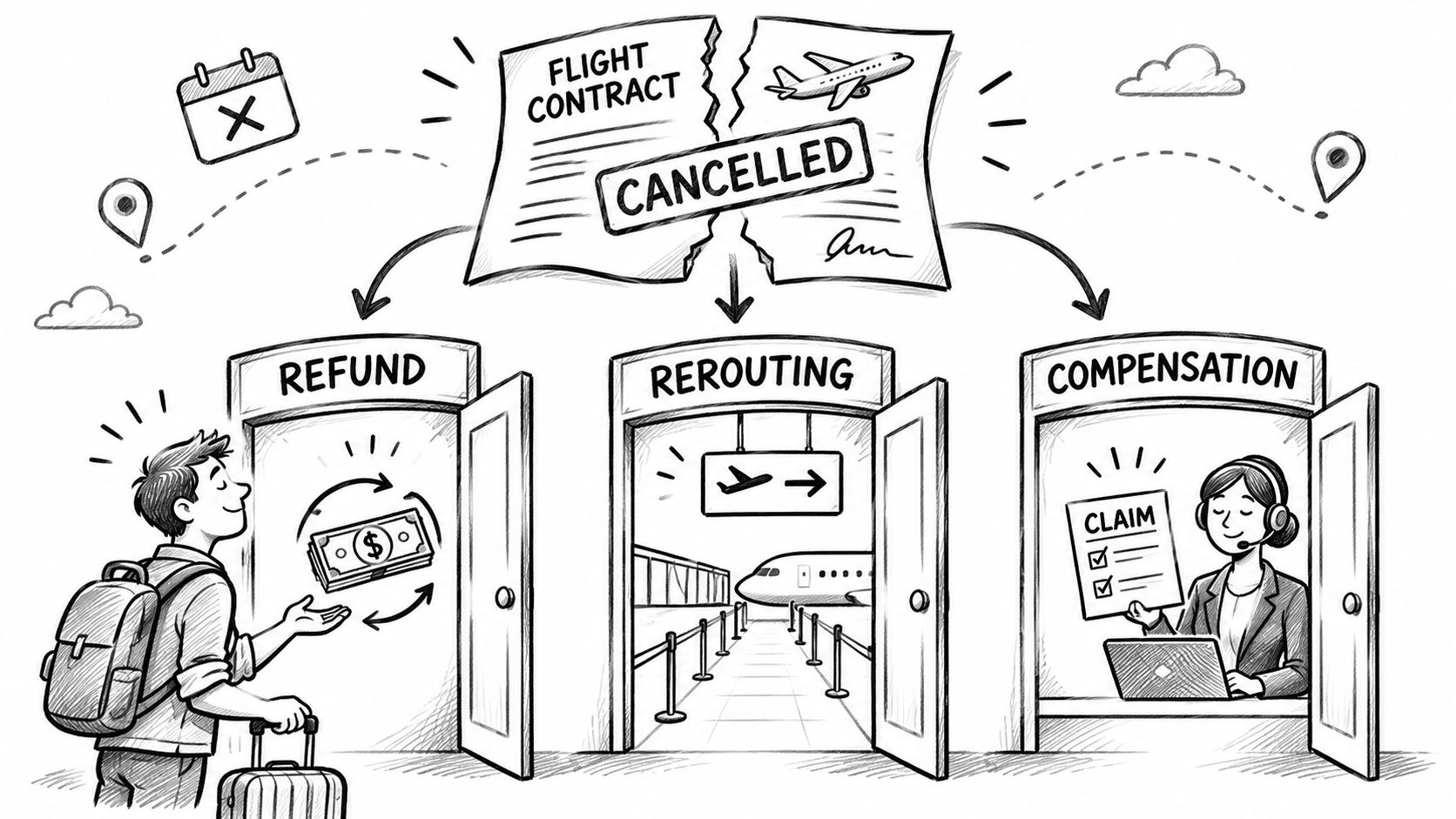
Under EU Regulation on air passenger rights, the cancellation remedy can involve reimbursement, a return flight to the first point of departure where relevant, or rerouting to the final destination under comparable conditions. Reimbursement can also cover portions already flown when the journey no longer serves the passenger's original travel plan.
Choose the outcome you actually need
If you still need to reach a client meeting, rerouting may be more valuable than recovering the fare and buying an expensive replacement yourself. If the meeting has been abandoned, accepting transportation you won't use creates an avoidable dispute.
Keep these choices distinct:
Reimbursement: Record that you're selecting repayment for the affected journey.
Rerouting: Save the replacement route and the conditions you accepted.
Compensation: Present this as a separate question, not another name for your ticket refund.
Voucher: Check the restrictions before agreeing. A discretionary credit offer doesn't replace the statutory choice.
Say a consultant requests rerouting because an event is still going ahead. Later, the organizer cancels the event, and the consultant asks for a refund instead. That later request isn't necessarily equivalent to declining the airline's original replacement: the carrier may already have arranged the remedy the traveler selected.
The sequence matters. Save the offered options, your written election, and any later change of circumstances. Don't rely on a phone conversation to establish which remedy you chose.
Which Costs Come Back and Which Do Not
A cancelled flight can leave several charges behind, but they do not all follow the same payment route. The ticket refund covers qualifying unused air transportation and applicable ticket charges. A hotel, transfer, or missed-work loss sits outside that claim and depends on its own contract or insurance.
For a qualifying cancellation or significant schedule change, the DOT refund guidance explains which ticket amounts must be refunded and the applicable deadlines. Check the ticket total against the original receipt, including government taxes, mandatory fees, and airline-imposed charges, and account for any transportation already used.
Refundable and non-refundable costs after an airline cancellation
| Cost item | Refundable after cancellation? | Where to claim |
|---|---|---|
| Base fare | Yes, for qualifying unused transportation | Airline or responsible booking channel |
| Government taxes and airport fees | Include applicable amounts in the ticket-refund calculation | Airline or responsible booking channel |
| Checked bag fee for the cancelled flight | Request a refund for the unused paid service | Airline or seller that collected it |
| Seat selection fee for the cancelled flight | Request a refund for the unused paid service | Airline or seller that collected it |
| Paid Wi-Fi not delivered | A qualifying undelivered service can be refundable | Airline |
| Hotel booked separately | Not automatically part of the airline ticket refund | Hotel, booking provider, or insurer |
| Pre-booked ground transfer | Not automatically part of the airline ticket refund | Transfer provider or insurer |
| Meals and hotel while stranded under EU rules | Assess separately under assistance rights | Operating airline, with receipts |
Separate ticket refunds from expense reimbursement
Keep the claims separate. List transportation, unused airline extras, and out-of-pocket assistance expenses as distinct subtotals so the recipient can assess each charge under the right rules. A separately booked apartment or taxi does not become an airline ticket cost just because the flight was cancelled.
The payment trail matters. Check each receipt and card statement to see whether the airline or an agency collected the money. Request repayment for an unused airline service from the party that charged for it, or ask the airline or booking channel to identify who is handling that payment. A booking website may have arranged the ticket without collecting its fare.
For EU assistance expenses, keep receipts and note what help the carrier offered. Explain why each expense was necessary while you waited for transportation. A hotel's own cancellation exception should be pursued with the hotel or booking provider, not added to the airline's ticket-refund total.
Build a separate calculation for each claim. Reconcile the airline's proposed total against the ticket receipt and any separate receipts for extras.
Check whether a fee was charged and whether the service was delivered. A seat listed on an itinerary does not prove you paid a separate selection fee; a charge on its own receipt can be missed if you submit only the ticket invoice.
How to Request a Flight Cancellation Refund and Follow Through
Refund eligibility isn't the same as cash received. The DOT's refund guidance confirms that a qualifying cancellation or significant change can require a refund even for a non-refundable ticket when the passenger declines the alternatives. The harder work is tracing the money: which entity charged the card, which one authorizes repayment, and which one settles the credit.
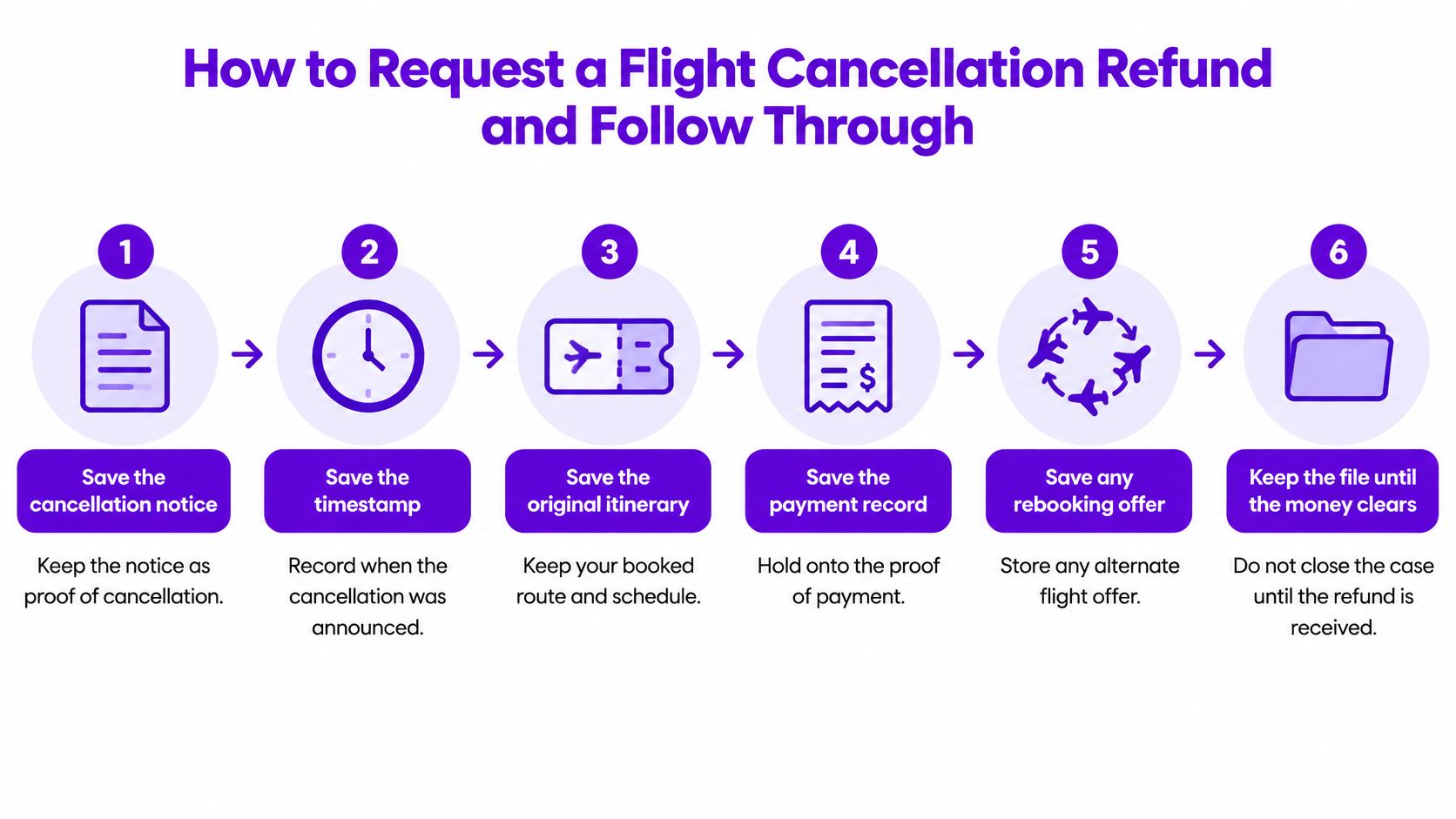
Keep the evidence together from the first notification through the cleared payment.
Build the claim before opening a dispute
Save the original evidence. Download the itinerary, ticket receipt, cancellation notice, and replacement offer. Capture timestamps and flight numbers before an app overwrites the original booking. Keep email files as well as screenshots where possible.
Identify the merchant of record. Compare the card-statement descriptor with the receipt. An online agency may have arranged the booking while the airline charged the card directly, or the agency may have collected the payment itself. Ask who charged the ticket and who processes repayment rather than assuming the website you used holds the money.
Record your remedy in writing. State whether you're declining the replacement and selecting reimbursement. If an interface labels the action as a voluntary cancellation, stop before submitting. The screens used to change or cancel a flight can blur the line between a voluntary change and an involuntary refund claim, and the wrong selection is hard to undo.
Send an itemized request. Include the passenger name, booking reference, ticket identifier, cancelled service, payment method, and requested amount. Attach the cancellation notice and receipt. Request repayment to the original form of payment rather than supplying bank details in reply to an unsolicited message.
A useful request can be short:
Suggested wording: The airline cancelled the flight identified in the attached itinerary. I decline the offered replacement and select reimbursement. Please confirm the amount, the entity processing it, and the original payment method receiving the credit.
Track the payment, not just the approval
Calendar the applicable deadline. Record the rule, relevant dates, and payment method in your claim file. Keep the seller's acknowledgment separate from its refund-processing confirmation. Neither message proves the money has reached your account.
Follow up with a precise question. Ask whether the refund sits with airline authorization, agency processing, or card settlement. Request a transaction reference if the seller says the credit was issued. A repeated statement that the refund is approved doesn't locate the stall.
Escalate to the right recipient. Use the airline's or agency's formal complaint channel for the unresolved issue. Depending on jurisdiction, an aviation regulator or EU national enforcement body may accept the complaint. Ask your card issuer about its dispute process and filing window separately, because a regulatory complaint does not automatically preserve card-dispute rights.
Close only after reconciliation. Compare the cleared credit against your itemized request. If the seller refunds only part, identify exactly which line remains unpaid. Tell the issuer if a merchant refund arrives during an open dispute so you don't collect twice.
This video walks through the refund process end to end.
For business-card purchases, involve whoever controls the statement early. The traveler may receive the airline's emails while a finance administrator sees the credit land. Keep the claim open until both records agree.
A Worked Example Through an Online Agency
Consider a hypothetical consultant, Priya, who books a return trip through an online agency using her company card. Her confirmation separates the fare, taxes, seat selection, and checked baggage. Before departure, the airline cancels the outbound service and offers a replacement that no longer works for her client commitment.
Priya declines the replacement in writing and asks for reimbursement. The airline directs her to the agency; the agency tells her it needs the airline's approval. Neither response tells her who charged the card or where her repayment currently sits.
The moment the claim becomes a payment problem
Priya checks the statement and finds the agency's name beside the ticket charge. She sends the agency the receipt, cancellation notice, and written rejection of the replacement, copying the airline's customer-relations channel. Her request asks the agency to confirm its role as merchant and identify any authorization still outstanding.
That changes the conversation. Instead of asking whether cancelled tickets are refundable, she asks the agency to identify the missing processing step.
| Claim stage | What Priya needs |
|---|---|
| Cancellation recorded | Original itinerary and airline notice |
| Agency responsibility clarified | Receipt and statement descriptor |
| Refund reportedly submitted | Written amount and transaction reference |
| Credit received | Statement reconciliation against each charged item |
The agency eventually confirms that it has submitted a refund. Priya doesn't close the file immediately. She checks the company statement and compares the credit against all qualifying unused items, not just the base fare.
If the credit excludes an ancillary service, she sends the relevant receipt as a specific outstanding item. If the company replaced its card, she asks the issuer to trace the incoming credit rather than demanding that the agency send money to an unrelated account.
The lesson isn't to copy everyone into every message. It's to give each recipient the evidence relevant to its responsibility. Next time, Priya keeps the original confirmation and payment receipt together from the moment she books, rather than reconstructing the chain after cancellation.
Edge Cases Where Refund Rights Get Murky
A changed flight number sits in a grey zone. It is not automatically harmless, but it is not always a straightforward cash-refund trigger either. A Federal Register enforcement notice published in December 2025 shows the DOT has used temporary enforcement pauses for certain renumbered flights where the passenger is rebooked without a significant itinerary change or delay. Positions like that carry expiry dates and narrow conditions, so confirm whether any current version still applies before relying on it.
Check substance before accepting the label
Compare the records in this order:
Original booking: Preserve the ticket and original flight number.
Operating carrier: Check who operates the replacement.
Schedule: Compare departure and arrival details against the applicable significant-change test.
Airports: Look for a different origin or destination.
Your election: Accept or reject in writing only after saving both itineraries.
A replacement described as operationally identical can still disrupt visa timing, a separate onward booking, or accommodation. Those consequences matter to your decision, but they do not automatically make every resulting loss recoverable.
The harder trap is the payment chain after a third-party sale. The airline owes the refund, but the agency that took your money controls when it moves, and the card issuer controls where it lands. A refund may reach a replaced card account, or its converted value may differ from the original statement debit. Ask for the refund currency and transaction reference, then let the issuer trace the payment before concluding that the seller underpaid.
For a complicated rejection, LegesGPT's AI legal help can help organize the chronology and draft questions, but verify its legal conclusions against the applicable rules. When costs fall outside the ticket refund, Mazurly's guide to travel insurance for expats helps you weigh a separate insurance route against your actual policy terms.
Mazurly offers practical guidance on cross-border payments, insurance, and travel logistics for people running a business from anywhere. Visit Mazurly to turn your next disrupted trip into a clearer workflow, with the booking evidence, payment trail, and follow-up responsibilities organized before you travel.