
How to Budget with Irregular Income: A Step-by-Step System
Table of contents
Three invoices went out on the first of the month. One client paid in four days, the second promised Friday and meant three weeks later, and the third went quiet after a polite reminder. Rent, health insurance and the software subscription arrived on schedule anyway, as they always do.
That gap between money you've earned and money you can spend is the whole problem. Not volatility in the abstract, not the average of last year's deposits, but the specific, recurring mismatch between when cash lands and when it leaves. A budget built for a salary assumes both happen on a schedule. Yours doesn't.
Most advice on how to budget with irregular income stops at "spend less in slow months." That's a symptom treatment. The fix is structural: pick a floor you can defend, route every payment through the same set of accounts in the same order, and stop letting a good month reset your standard of living.
The rule that changes everything: budget from your lowest reliable month, not your average month. Every number below is built on that floor.
The Four-Layer Budget at a Glance
Say a freelance designer's deposits over the past year ranged from $900 in a dead January to $8,400 in a launch month. For two years she budgeted off the $4,000 midpoint, and for two years she spent February and March on a credit card. The average was accurate and useless at the same time.
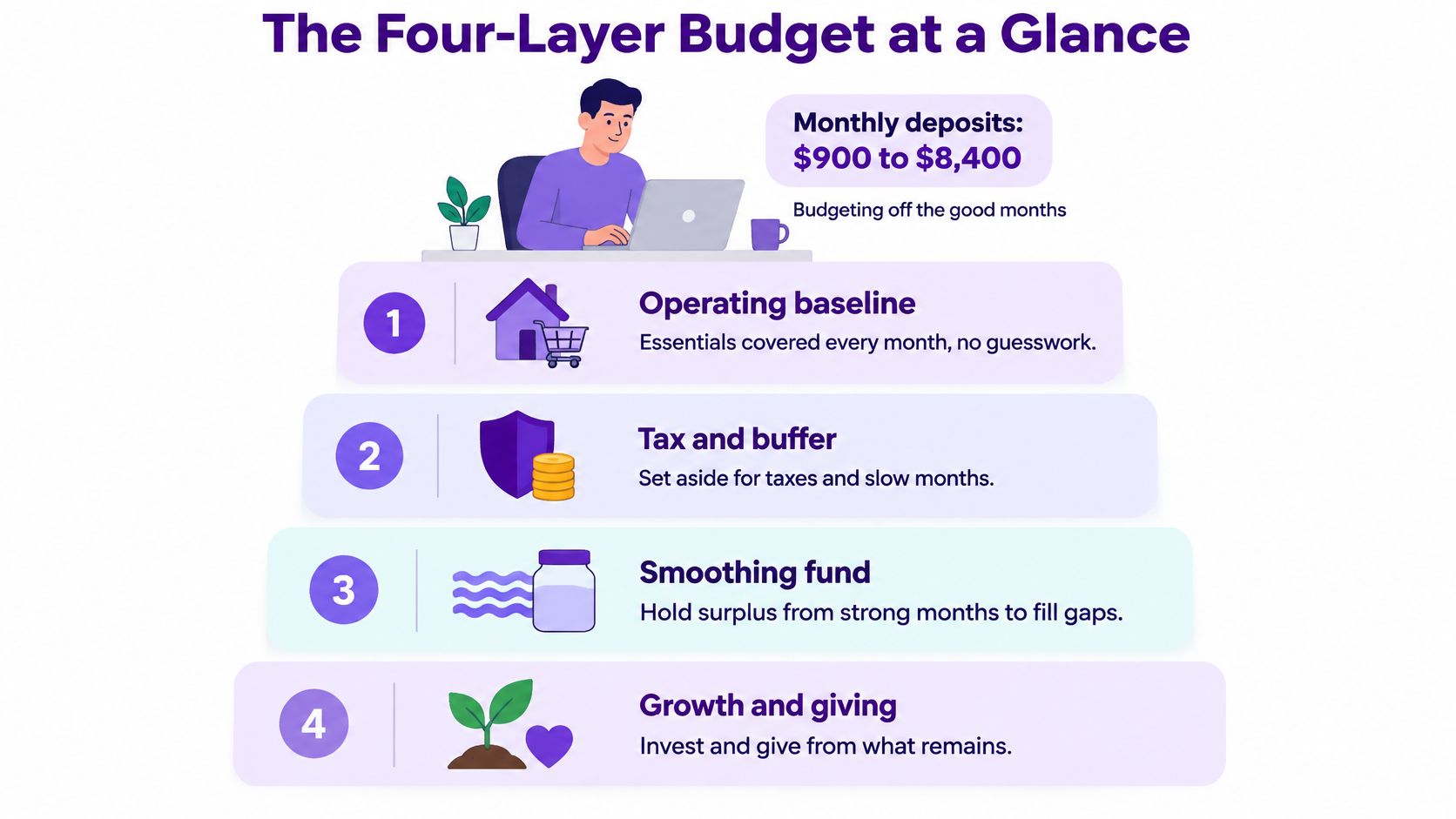
The system that replaces the average has four layers, funded in strict order. Money flows down them, and no lower layer gets a cent until the one above it is full.
| Layer | What it covers | Where the money comes from |
|---|---|---|
| 1. Operating baseline | Essential personal and business costs every month | Your lowest reliable monthly income |
| 2. Set-asides | Taxes and irregular bills such as insurance and equipment | A fixed share of each payment received |
| 3. Buffer | Gaps when deposits fall below the baseline | Income above the baseline in strong months |
| 4. Flexible spending | Dining, travel, hobbies and gifts | Only what remains after layers 1 to 3 are full |
The ordering is the mechanism. A fixed-salary budget works because the constraint is external: the employer decides what you get. When you decide, the constraint has to be internal and it has to be boring. The baseline is what you pay yourself no matter what the bank shows. Set-asides come off every payment before you see it. The buffer is what makes a slow quarter survivable. Flexible spending is the only layer allowed to move, and it moves down, never up on the strength of one invoice.
This works whether you're a solo freelancer, a contractor with one dominant client, or a founder drawing a salary from a company account. If you also run the business side, the build a business financial plan guide from Zaro covers how owner draws and reserves sit inside a company budget.
The first action costs an evening: open twelve months of bank deposits, write them in a column, and circle the lowest month you'd call repeatable rather than catastrophic. Every number that follows depends on that circle.
How to Calculate Your Monthly Baseline
Take a concrete gap. Essentials run $2,900 a month: rent, food, utilities, health insurance, minimum debt payments, transport and the two software tools the work depends on. The lowest reliable month last year brought in $2,400. That's a $500 hole, and no average, no good quarter and no optimistic forecast fills it. Averages hide exactly this.
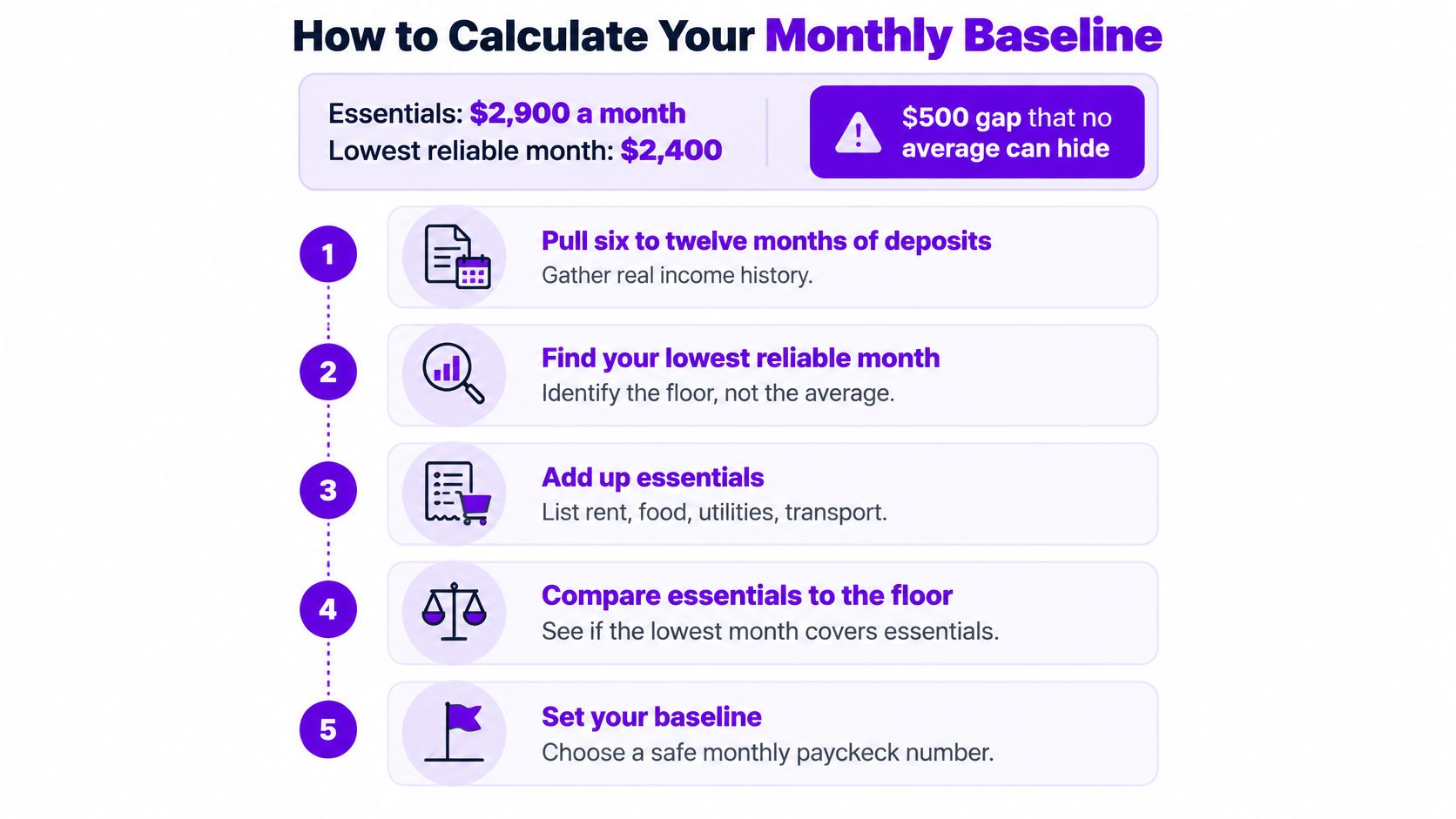
Work through it in this order.
Pull six to twelve months of deposits and expenses. Separate business and personal accounts so you're not counting a transfer as income.
List essentials, not habits. Housing, food, utilities, health insurance, minimum debt payments, transport, and the software you need to earn at all. Everything else waits.
Add the business floor. Banking and transfer fees, equipment payments, and quarterly tax obligations spread evenly across the year.
Divide every annual bill by 12. Insurance paid once a year is a monthly cost. Treating it as an annual event is how it becomes a crisis.
Compare essentials with your lowest reliable month. Not the average, not last quarter.
Set the baseline at or below that month. If essentials exceed the floor, cut costs or secure recurring revenue before building anything else.
Write it down and recalculate quarterly, or whenever a client, price or major cost changes.
The case for a conservative floor is empirical, not temperamental. Federal Reserve research cited in an OECD review of earnings volatility found that approximately 26% of U.S. families typically experience year-to-year income volatility, with about 9% seeing a positive shock, 7% a small negative shock and another 7% a large negative shock. Shocks are a standing condition, not an exception. Separating what's fixed from what flexes makes step 6 far easier, and this fixed vs variable expenses explained guide from Toya AI is a quick way to sort the list.
If you've never written the revenue side down, a business plan for freelancers gives you a place to record the baseline, the client mix and the assumptions behind both, which is what makes the quarterly review fast instead of painful.
How to Smooth Irregular Pay Into a Steady Paycheck
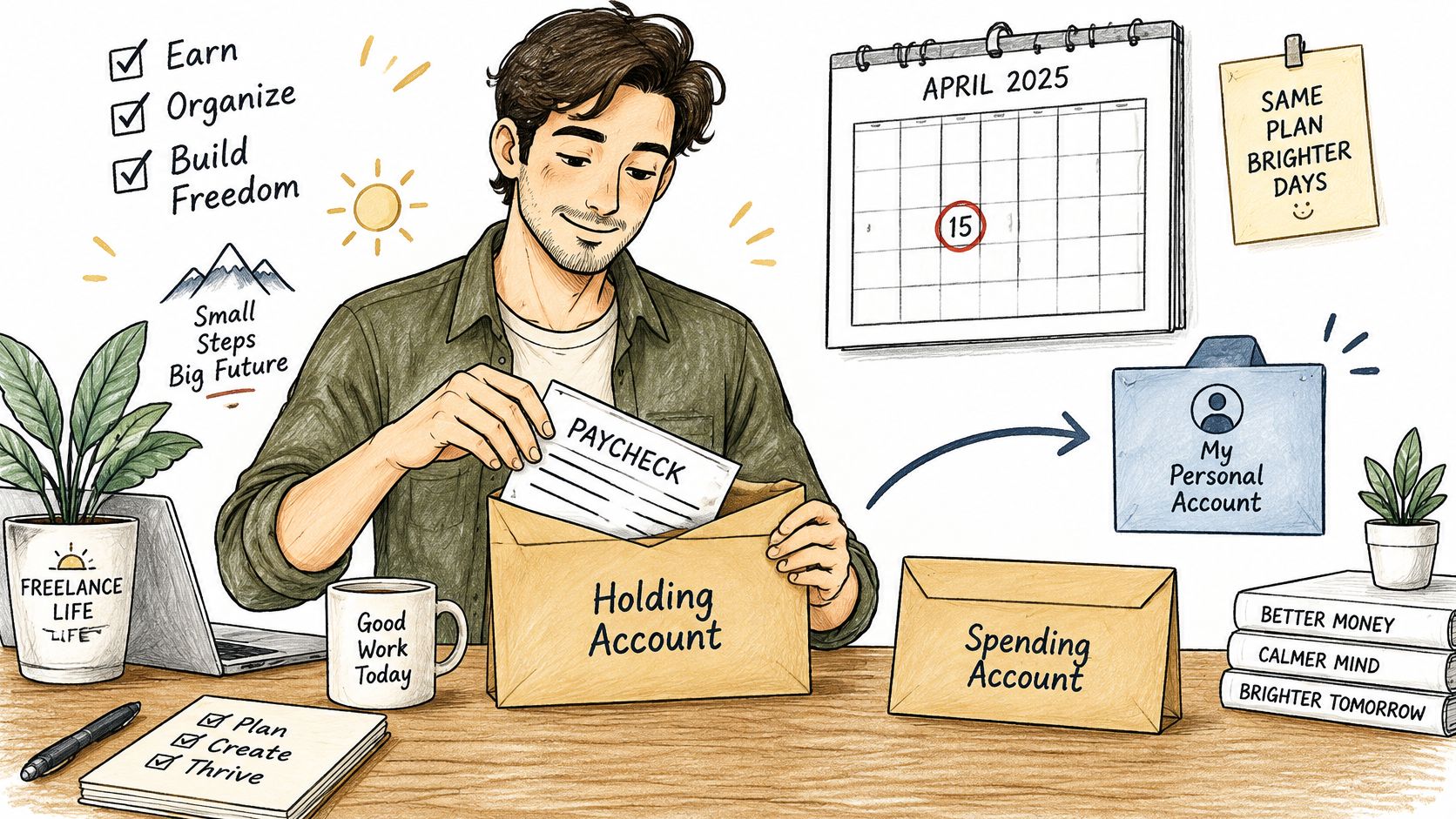
The mechanical part is one rule: no client payment ever lands in the account you spend from. Every deposit goes into a holding account. On a fixed date each month, the baseline moves from holding to your personal account, and that transfer is your paycheck. It doesn't care what the month looked like.
Run the arithmetic on two months with a $3,000 baseline.
A $6,000 month arrives. The tax account takes its share first, the paycheck takes $3,000, and the remaining $1,200 goes to the buffer. Now a $1,500 month. The paycheck still lands at $3,000, and the missing $1,500 comes out of the buffer. Your rent, your groceries and your insurance never notice the difference. That stability is the entire payoff, and it's worth more than a slightly higher average.
The failure mode is predictable: a strong quarter arrives, the buffer gets comfortable, and the paycheck rises to meet the new normal. Then the quarter ends.
The raise rule: a strong month is never a reason to raise your own pay. Raise the paycheck only after the buffer has held at the same level for six straight months.
Dry spells longer than the buffer need a sequence, not a scramble. Cut layer 4 spending first, all of it, the week the deposits drop. Then reduce set-asides (never the tax share) and pause discretionary projects. Reduce the baseline last, write down the date you'll review the decision, and treat that note as binding. Lowering your paycheck is a legitimate move; doing it without telling anyone and never restoring it is how people end up permanently under-saving.
Anything sitting in the holding account above the baseline belongs to the buffer until the buffer targets are set. Not to a holiday, not to a new laptop.
How to Plan for Irregular Expenses
Irregular bills aren't surprises. They're scheduled events you haven't scheduled. The fix is a sinking fund per expense: take the annual cost, divide by 12, transfer that amount monthly into a named account, and pay the bill from the fund when it lands. Never from the buffer.
| Expense | How often it hits | Example monthly set-aside |
|---|---|---|
| Quarterly tax payments | Four times a year | 25-30% of each month's net profit, adjusted quarterly |
| Annual insurance premium | Once a year | On a $1,200 premium, $100 a month |
| Equipment replacement | Every 2-3 years | A $2,400 laptop on a 24-month cycle is $100 a month |
| Software renewals | Annually or mixed | Total the annual plans and divide by 12; $840 a year is $70 a month |
| Vehicle or home repairs | Unpredictable | Average the last three years of repair bills and divide by 36 |
| Training and certifications | Once or twice a year | A $600 course twice a year is $100 a month |
| Visa, residency or registration fees | Every 1-3 years | Fee divided by months until renewal |
Quarterly tax is the biggest line for most independent workers and the one most often estimated with hope. Estimate from last year's actual profit, then adjust each quarter as the figure firms up. Keep the tax money in the currency the liability will be paid in, separate from everything else, and don't touch it for a cash-flow gap.
When a bill lands larger than its fund, borrow the difference from the buffer and rebuild it over the next three months. Cutting essentials to cover a one-off bill trades a small problem for a large one. Diarise the rebuild as three equal transfers so it happens.
Review the whole table each January, and again whenever a contract, insurance policy or equipment need changes. Ten minutes twice a year keeps the set-asides honest.
How Big Your Savings Buffer Should Be
The case for building a buffer before anything else is stark. In the Federal Reserve's 2024 survey of U.S. households, 55% of adults had savings covering three months of expenses, while 30% could not cover three months by any means and another 15% could only do it by borrowing or selling assets. The split tracks cash flow closely: 85% of adults who always had money left at month-end had three months saved, against 13% of those who never did. Leftover cash, not income level, is what predicts the reserve.
So the reserve gets built in tiers, and you don't skip ahead.
| Tier | What it covers | Target size |
|---|---|---|
| Tier 1: operating floor | Essential personal and business costs | One month of essentials |
| Tier 2: tax and invoice gaps | Next tax payment and known late invoices | Next tax bill plus expected receivables delayed 30 days |
| Tier 3: health and insurance | Medical costs and insurance deductibles | Highest deductible plus one month of essentials |
| Tier 4: full emergency reserve | Extended slow periods, lost clients or income gaps | Three months of essentials |
| Tier 5: runway and growth | Long-term savings and investment after resilience is secured | Set only after Tier 4 is complete |
Tier 1 protects the baseline itself, which is why it comes first even when it feels small. Tier 2 exists because tax deadlines and late invoices are certainties, not risks. Tier 3 stops a dental bill from becoming credit card debt.
Distinguish predictable downtime from genuine catastrophe. A seasonal dip you can date on a calendar belongs in a sinking fund, funded monthly. Losing your largest client is what Tier 4 is for.
Completion test: the buffer is finished when a full slow quarter passes without borrowing.
Once Tier 4 is full, send surplus to high-interest debt, then to retirement contributions, and only then start Tier 5. If you're modelling the personal side against the business, this startup costs for an online business breakdown helps separate one-off setup costs from recurring ones so the tiers aren't inflated by expenses that never recur.
Fixing Slow Months, Late Payments and Currency Gaps
The mistake that does the most damage is budgeting against invoices that are booked but not cleared. Issued isn't paid. A rolling 90-day forecast, updated weekly, fixes it: list every confirmed receivable by expected collection date, count only cleared cash as spendable, and flag anything more than seven days overdue. The formal budgeting research on income unpredictability is blunt on this point, finding that written or recorded budgeting substantially weakens the link between volatile income and poor financial well-being, while budgeting done only in your head does not.
A cleared invoice is income. A booked one is a forecast.
Cross-border work adds a second layer. Transfer fees, currency conversion, withholding taxes and platform fees get deducted before you decide what a rate is worth, never after. A rate that looks strong in USD can lose a meaningful slice by the time it reaches a EUR account. Hold the buffer in the currency you spend, and batch conversions on a schedule rather than converting every payment as it arrives.
| Symptom | Likely cause | Fix |
|---|---|---|
| Rent due before a client pays | Payment timing gap | Keep one month of essentials in the spending account as a clearing buffer |
| Invoice more than seven days overdue | Client payment delay | Chase it, update the 90-day forecast, draw the gap from the buffer |
| Conversion losses eat income | Currency and transfer fees not priced in | Deduct fees from each payment before setting the baseline, and batch transfers |
| Buffer shrinks every slow month | Flexible spending not cut in lean months | Cut layer 4 spending the week deposits drop, not the month after |
When revenue dips, the instinct is to sell harder and accept whatever comes. System beats panic here; if that pattern is familiar, replace panic-driven selling with systems from Jan Kutschera walks through building predictable revenue rather than reacting to each slow month.
The operational discipline is unglamorous: invoices out on fixed dates, numbered consistently, with payment terms printed on them. invoicing for consultants pays for itself here, because predictable billing is the cheapest late-payment prevention available.
Set Your First Baseline This Week
Six actions, all doable before the next payment lands.
Write the baseline down. On paper, with the lowest reliable month it was checked against beside it.
Open the accounts. A holding account, plus a sinking-fund account if your bank makes that easy.
Fix two dates. One for paying yourself from holding, one for moving set-asides into their funds.
Build the 90-day forecast. Every outstanding invoice, its expected payment date, and a flag on anything already past seven days.
Diarise the quarterly review. A reminder to recheck the baseline after any change in clients, prices or costs.
Standardise invoicing. Same dates, same numbering, same terms. Mazurly's Free Invoice Generator handles the formatting in a couple of minutes.
The test that the system works isn't a spreadsheet. It's that your paycheck stays flat through a strong month and a slow one, and you stop checking the balance before buying groceries.
Mazurly is built for people whose income arrives in irregular amounts from more than one country, and the platform's guides and free tools exist to make that admin less fragile. Beyond this budgeting system, you can use it to work through invoicing, multi-currency payment workflows, pricing and the cost-of-living decisions that change what your baseline needs to be. Start with the free tools and the operational guides at Mazurly, and set your baseline before the next invoice goes out.